How to identify haddock
Melanogrammus aeglefinus · Gadidae
The characters that identify haddock, ranked by how far each one can be trusted on its own.
Safety: barotrauma and pressure injury — can cause injury needing treatment. One more point applies here.
How this was identified, and who took it
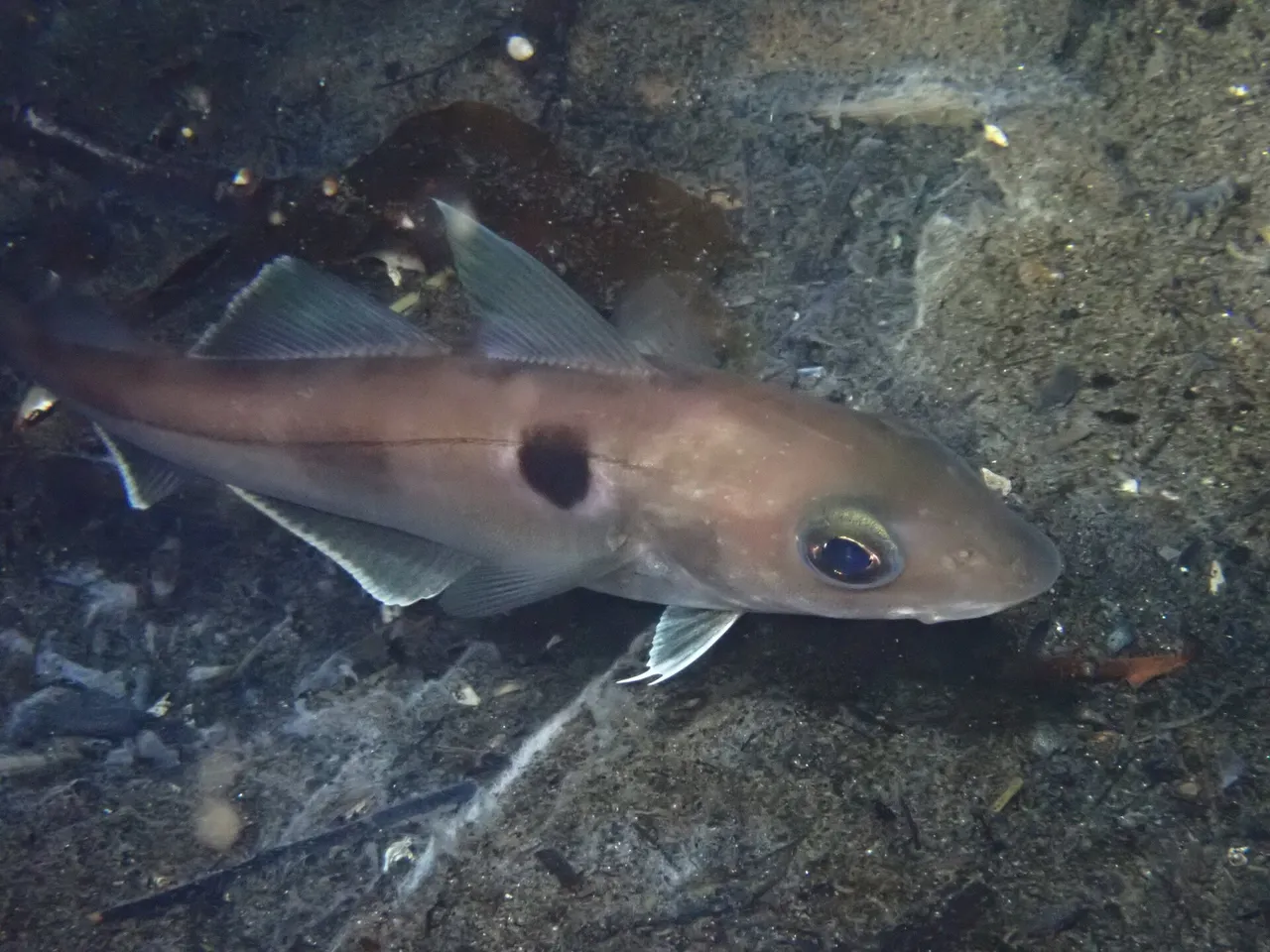
Identified by: In situ over soft bottom. The dark thumbprint blotch above the pectoral fin — the character that settles haddock against cod in one look — is unmistakable, along with the dark lateral line, three dorsal fins and the small chin barbel.Vsevolod Rudyi — CC BY 4.0, via Wikimedia Commons — source, licenceLook at this first
The lateral line. On a haddock it is a black stripe running the length of the flank, and on the cod it is caught beside it is pale. Nothing else about the two fish separates them as quickly or as reliably, and the character holds on a dead fish, in poor light, at any size.
Diagnostic — settles it on its own
Each of these settles the identification on its own. If one is clear, you have your answer.
A black lateral line
Dark, unbroken, and obvious against the silver-grey flank. Cod's runs pale. This is the fastest separation between the two commonest northern gadoids and it does not fade in a dead fish.
A dark blotch above the pectoral fin
A smudged oval mark on the shoulder, above and behind the pectoral. Fishermen have called it St Peter's thumbprint for centuries. It is present in nearly every haddock and absent in cod, and it is worth checking when the lateral line is obscured by handling damage.
Supporting — use with other characters
Real characters that are not conclusive by themselves. Use two or three together.
A tall, pointed first dorsal fin
The leading dorsal rises to a distinct point, higher and sharper than a cod's rounded one. Useful on a fish in a box where the flank is not visible.
A small mouth under a pointed snout
The mouth is set low and is noticeably smaller than a cod's of the same length, which is a consequence of feeding on small invertebrates picked off the bottom rather than on fish. A chin barbel is present but small.
Suggestive only — varies with condition
Hints only. These vary with condition, season, water and how long the fish has been out of it, and a fish that contradicts them is still the same species.
A slimmer body with a purple sheen above
Haddock are less deep-bodied than cod and carry a purplish cast over the back in fresh fish. Both impressions are reliable in a side-by-side comparison and unreliable on their own.
What it gets confused with
- Atlantic cod, constantly, because they are caught together. Lateral line and shoulder blotch settle it.
- Whiting, which is slimmer again, lacks the shoulder mark and has a much smaller barbel or none.
Side by side: Haddock vs Atlantic cod.
Where this stops working
The shoulder blotch varies in intensity and can be faint in small fish or scuffed away by handling, which is why the lateral line leads. Neither character depends on colour, so both survive time on ice — but a badly damaged flank removes both at once, and at that point the first dorsal shape and the mouth size are what is left.
The full record
This page covers identification only. The Haddock record covers behaviour, lifecycle, distribution, handling and the sources behind all of it.
Reviewed 2026-08-13.
More about this fish
Telling it apart is one question. Here are the others.
Similar and related fish
How it is caught
Where you will find it
Why the 3 connections on this page are here, and the sources
Similar and related fish
Backed by research — 1 connection
Supported by peer-reviewed research or fisheries science. The sources are listed and can be checked.
Atlantic cod
An identification and feeding comparison naming both binomials.
- FishBase: a global information system on fishes — Froese, R. and D. Pauly, eds. — FishBase Consortium (Scientific institute)Relied on for: That Melanogrammus aeglefinus and Gadus morhua are both Gadidae of the North Atlantic continental shelf with overlapping distributions.States this directlyPassage read and verified
- The Fishes of the British Isles and North-West Europe — Macmillan, 1969 (Reference work)Relied on for: The morphological separation of haddock from cod by lateral line colour and the shoulder blotch, and their differing feeding habits.States this directlyCitation checked — the work exists and is described correctly
How it is caught
What experienced anglers do — 1 connection
Widely and independently recommended by experienced anglers and specialist sources. This is real angling knowledge, not proof: controlled evidence for it is limited, and FishingHQ records it as convention rather than as a demonstrated effect.
Ledgering
A practitioner claim following from the species' verified feeding morphology.
- Sea Angler — Bauer Media (Specialist angling publication)Relied on for: Practitioner treatment of bait size and presentation for haddock in relation to cod on the same ground.Citation checked — the work exists and is described correctly
- General angling website restatements of established technique — Various (Credible secondary source)Relied on for: Widely restated practitioner guidance that haddock take small baits fished hard on the bottom.Citation checked — the work exists and is described correctly
Where you will find it
Backed by research — 1 connection
Supported by peer-reviewed research or fisheries science. The sources are listed and can be checked.
Shetland
A distribution association between an animal and a kind of water, rather than a claim about any named mark.
- The Fishes of the British Isles and North-West Europe — Macmillan, 1969 (Reference work)Relied on for: Distribution, habitat association, depth and ground preference of fishes in British and north-west European waters.States this directlyCitation checked — the work exists and is described correctly
- FishBase: a global information system on fishes — Froese, R. and D. Pauly, eds. — FishBase Consortium (Scientific institute)Relied on for: Distribution, habitat association and depth range recorded for the species.Background and mechanism onlyPassage read and verified
Safety
Barotrauma and pressure injury is set out at the top of this page, where it cannot be missed.
Boat safety — Can cause injury needing treatment
This is offshore and inshore boat fishing in cold northern water, where immersion is rapidly incapacitating and conditions change quickly.
What reduces it: Wear a lifejacket. Check the forecast for the whole window. File a plan ashore and carry a means of calling for help.