Whiting
Fish · Last reviewed 2026-08-10
A small, abundant, silver gadoid of European coasts, a mainstay of winter shore fishing and distinguished by a dark spot at the pectoral fin base.
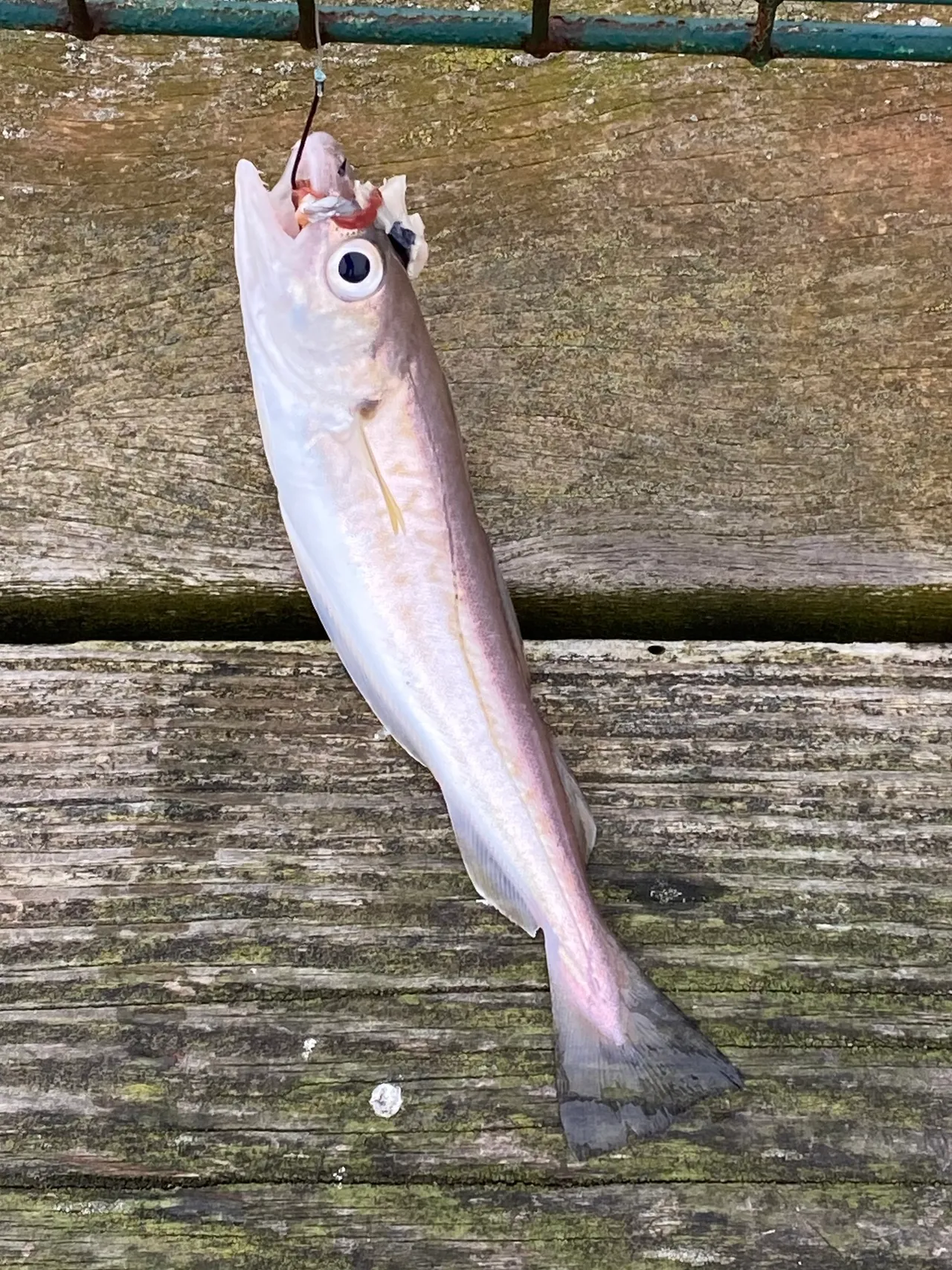
How this was identified, and who took it
Identified by: Identified on three characters, all legible: the chin carries no barbel, which separates it from cod, haddock and pouting of similar size; the upper jaw projects beyond the lower; and there is a distinct dark blotch at the base of the pectoral fin. The three-dorsal, two-anal gadoid profile and the slender pointed-snouted body are complete in frame. Research-grade iNaturalist observation from England with agreeing identifications and none disagreeing.rmjb — CC BY, via iNaturalist — source, licenceCatching Whiting
Everything here on fishing for it. Each entry opens the page behind it.
- When
- Jun–Mar — months recorded at the places that document it, not a season for the whole range.
- Where
- 142 places FishingHQ documents — strongest claim anywhere: regular local target · From the shore, From a boat, From a kayak
Whiting is the fish that keeps European winter shore fishing going. It is a small, slender, silver gadoid that moves inshore in enormous numbers as water cools, feeding voraciously on anything it can catch, and it is often the only species reliably available from a beach in the coldest months.
It is separated from the other small gadoids by a dark spot at the base of each pectoral fin, no chin barbel in adults, and a projecting upper jaw. Pouting, its usual companion, is deeper-bodied, barbelled and coppery.
Its appetite is its defining characteristic. Whiting will take baits larger than seems reasonable and are frequently caught deeply hooked, which is a genuine handling concern for the many that are undersized.
How it is caught
Gear for this fish
Where Whiting is documented
Places where public sources describe this species as fished, with how it is fished and how strongly the evidence supports it. This is not a range map and it is not a recommendation — it is what has been written down about a fishery rather than a record of any individual catch, and being listed is never permission to fish.
The north-east England coast
21 documented places
Holy Island and the Lindisfarne causeway
Island
Seasonal
From the shore
Around Nov, Dec, Jan, Feb
Pier
Seasonal
From the shore
Around Nov, Dec, Jan, Feb
Beach
Seasonal
From the shore
Around Nov, Dec, Jan, Feb
Bay
Regular local target
From the shore
Around Nov, Dec, Jan, Feb
Blyth South Harbour breakwater
Breakwater
Regular local target
From the shore
Around Nov, Dec, Jan, Feb
Island
Seasonal
From the shore
Around Nov, Dec, Jan, Feb
South Shields and the Tyne piers
Pier
Regular local target
From the shore
Around Nov, Dec, Jan, Feb
Rock mark
Seasonal
From the shore
Around Nov, Dec, Jan, Feb
Pier
Regular local target
From the shore
Around Nov, Dec, Jan, Feb
The Norfolk and Suffolk sandbank coast
13 documented places
Sandbank
Seasonal
From the shore
Around Nov, Dec, Jan, Feb
Beach section
Seasonal
From the shore
Around Nov, Dec, Jan, Feb
Beach section
Seasonal
From the shore
Around Nov, Dec, Jan, Feb
Pier
Seasonal
From the shore
Around Nov, Dec, Jan, Feb
Pier
Seasonal
From the shore
Around Nov, Dec, Jan, Feb
Beach
Regular local target
From the shore
Around Nov, Dec, Jan, Feb
Pier
Seasonal
From the shore
Around Nov, Dec, Jan, Feb
Beach
Seasonal
From the shore
Around Nov, Dec, Jan, Feb
Beach
Seasonal
From the shore
Around Nov, Dec, Jan, Feb
The Cornish and Devon coasts
10 documented places
Estuary mark
Seasonal
From a kayak
Around Nov, Dec, Jan, Feb
Harbour wall
Repeatedly reported
From a kayak
Headland
Repeatedly reported
From a kayak
Estuary
Repeatedly reported
From the shore
Pier
Regular local target
From the shore
Headland
Seasonal
From the shore
Around Nov, Dec, Jan, Feb
Surf beach
Seasonal
From the shore
Around Nov, Dec, Jan, Feb
Headland
Repeatedly reported
From a kayak
Pier
Recorded here
From the shore
The Severn Estuary
7 documented places
Cove
Repeatedly reported
From the shore
Beach section
Seasonal
From the shore
Around Nov, Dec, Jan, Feb
Estuary mark
Seasonal
From the shore
Around Nov, Dec, Jan, Feb
Island
Seasonal
From the shore
Around Nov, Dec, Jan, Feb
Headland
Regular local target
From the shore
Beach
Seasonal
From the shore
Around Nov, Dec, Jan, Feb
Headland
Seasonal
From the shore
Around Nov, Dec, Jan, Feb
The Thames Estuary
5 documented places
Pier
Seasonal
From the shore
Around Nov, Dec, Jan, Feb
Beach
Regular local target
From the shore
Around Nov, Dec, Jan, Feb
Beach
Seasonal
From the shore
Around Oct, Nov, Dec, Jan, Feb, Mar
Beach
Seasonal
From the shore
Around Oct, Nov, Dec, Jan, Feb, Mar
Estuary mark
Seasonal
From the shore
Around Oct, Nov, Dec, Jan, Feb, Mar
Dublin Bay and the Wicklow coast
4 documented places
The Great South Wall, Dublin Bay
Breakwater
Regular local target
From the shore
Around Nov, Dec, Jan, Feb, Mar
Pier
Regular local target
From the shore
Greystones North Beach and Pier
Pier
Regular local target
From the shore
Around Nov, Dec, Jan, Feb, Mar
Surf beach
Regular local target
From the shore
Around Nov, Dec, Jan, Feb, Mar
The Channel shingle coasts
3 documented places
Ramsgate harbour
Harbour wall
Seasonal
From the shore
Around Nov, Dec, Jan, Feb
Beach
Regular local target
From the shore
Around Nov, Dec, Jan, Feb
Pier
Repeatedly reported
From the shore
Around Nov, Dec, Jan, Feb
Cork Harbour and the east Cork coast
3 documented places
Estuary
Recorded here
From a boat
Around Jul
Observed July 2026
Harbour wall
Regular local target
From the shore
Around Nov, Dec, Jan, Feb, Mar
Beach section
Recorded here
From the shore
Also documented on 28 more coasts
Fewer places each, or less strongly supported. Each one names its own marks.
The Donegal coast and its sea loughs (3) · The Solway Firth (3) · The Waterford coast (3) · The Wexford coast (2) · The Moray Firth (1) · The Kerry coast (1) · The Clare coast and the Shannon estuary (1) · Morecambe Bay and the north-west England coast (10) · The Yorkshire coast (6) · The Wash and the Lincolnshire coast (6) · Scottish sea lochs (4) · The Causeway and Antrim coast (4) · The outer Ards coast (3) · Chesil Beach (3) · Pembrokeshire and the south-west Wales coast (3) · Anglesey (3) · The Welsh coast and Anglesey (2) · Belfast Lough and the north Down shore (2) · The Mourne coast and Carlingford Lough (2) · Weymouth Bay (2) · The Gower and Carmarthen Bay (2) · East Lothian and the Firth of Forth coast (2) · The East Antrim coast (1) · The Firth of Clyde (1) · Cardigan Bay and the sarnau (1) · The Purbeck coast and Poole Bay (1) · Orkney (3) · The Fife, Angus and Mearns coast (1)
What these strengths mean
- Seasonal
- Well supported, and concentrated in part of the year rather than spread through it.
- Recorded here
- At least one credible public account of this species being caught here. That is all it means.
- Regular local target
- Fishing sources describe this as a normal local target here, not merely as caught.
- Repeatedly reported
- Several independent public accounts. Enough to say it happens more than once; not enough to call it a fishery.
When to fish for whiting
Where the places here state a season for whiting, it clusters in Nov–Feb. This is a count of how many documented places name each month — evidence about when people fish for it, not a prediction of what any particular day will produce.
| Jan | Feb | Mar | Apr | May | Jun | Jul | Aug | Sep | Oct | Nov | Dec |
|---|---|---|---|---|---|---|---|---|---|---|---|
| January: 108 places name this month — most places. | February: 105 places name this month — most places. | March: 27 places name this month — few places. | April: no place here names this month — no place names it. | May: no place here names this month — no place names it. | June: 3 places name this month — few places. | July: 3 places name this month — few places. | August: 3 places name this month — few places. | September: 3 places name this month — few places. | October: 22 places name this month — few places. | November: 108 places name this month — most places. | December: 108 places name this month — most places. |
111 of the 141 places that record catches of whiting state which months. The other 30 name no season, so they are counted in neither direction: the shape above is what the dated records say, not the whole picture. The dated records span 32 separate areas.
Identification
- Scientific name
- Merlangius merlangus
- Family
- Gadidae
- Water
- Saltwater
- Conservation status
- Least Concern
- Regions
- Britain & Ireland, Western Europe, Northern Europe, Mediterranean
- A distinct dark spot at the base of each pectoral fin.
- No chin barbel in adults, and an upper jaw that projects beyond the lower.
- Slender silver body with a sandy or bluish back and three dorsal fins.
- Silvery flanks without the coppery bronze and vertical bars of a pouting.
Size
- Typical
- 200–500 g (7 oz–1.1 lb)
- Large
- 0.8–1.5 kg (1.8–3.3 lb)
Exceptional: FishBase records a maximum of 91.5 cm and 3.1 kg
Lifecycle and reproduction
Fast-growing and short-lived, maturing within two years. Abundance fluctuates considerably between years, and the species is a major prey item for larger gadoids and for marine mammals.
Spawns in spring in coastal waters, broadcasting pelagic eggs over an extended period. Juveniles are pelagic and shelter among jellyfish before settling.
Feeding and senses
An indiscriminate predator taking small fish, crustaceans, worms and squid. It feeds aggressively and takes large baits relative to its size, which is why deep hooking is common.
Hunts by sight and by lateral-line detection in the water column and near the bottom, feeding actively in low light and after dark.
Through the year
Moves inshore in autumn and winter in large numbers and retreats to deeper water in summer, making it the defining winter species of many European beaches.
Distribution
Northeast Atlantic: southeastern Barents Sea and Iceland to Portugal, also in the Black Sea, Aegean Sea, Adriatic Sea and adjacent areas. Rare in the northwestern Mediterranean
This is a biological range — where the species occurs, not a prediction that you will catch one. To browse the fishing geography FishingHQ holds, start at fishing places.
Why anglers care
A mainstay of winter shore and small-boat fishing across northern Europe, taken on multi-hook rigs baited with worm, squid and fish strip. Its significance is availability: whiting keep beaches fishable in the months when little else is present, and they are an important introduction to sea angling for many people. Small fish predominate and careful unhooking matters.
Handling and returning
Deep hooking is common because the fish takes baits aggressively. Use appropriately sized hooks, unhook with a disgorger, and return undersized fish quickly. Fish from deeper water may show barotrauma. Handle with wet hands and avoid dropping fish onto shingle.
Going further
- Whiting vs Pouting — how to tell them apart.
Where to go next
Similar and related fish
Where it lives
Where you will find it
- Chesil BeachA numerous cold-season gadoid over the clean ground offshore of the beach and what a winter night session most often produces.
- Morecambe Bay and the north-west England coastFrom the more open shores, promenades and pier marks of the coast either side of the bay through autumn and winter.
- Portland Bill and the Portland RaceA cold-season gadoid over the deeper clean ground beyond the race.
- Scottish sea lochsA deep-basin species here, occupying the water behind the sill that the shallow entrance partially isolates from the open sea.
- The Channel shingle coastsPresent in numbers over the ground beyond the step through the colder months, and a mainstay of winter shore sessions on this coast.
- The Firth of ClydeAs with cod, present at a small fraction of the abundance that supported the firth's historic sea angling fishery.
- The Norfolk and Suffolk sandbank coastThe realistic expectation of most winter beach sessions here, arriving inshore on the same cooling pattern as cod and in far greater numbers.
- The Severn EstuaryMoves into the outer estuary through the colder months and is a mainstay of winter shore fishing there.
2 more
- The Thames Estuary Fishing regions
- The Yorkshire coast Fishing regions
Sources and evidence
- FishBase: a global information system on fishes — Froese, R. and D. Pauly, eds. — FishBase Consortium (Scientific institute)Relied on for: Family, maximum size, depth and environment, distribution and the IUCN assessment for Merlangius merlangus.States this directlyPassage read and verified
- The IUCN Red List of Threatened Species — International Union for Conservation of Nature (Conservation authority)Relied on for: The Least Concern assessment for Merlangius merlangus, assessed 18 October 2013.States this directlyCitation checked — the work exists and is described correctly
Why the 17 connections on this page are here, and the sources
Similar and related fish
Backed by research — 1 connection
Supported by peer-reviewed research or fisheries science. The sources are listed and can be checked.
Pouting
An identification comparison naming both binomials: Merlangius merlangus and Trisopterus luscus.
- FishBase: a global information system on fishes — Froese, R. and D. Pauly, eds. — FishBase Consortium (Scientific institute)Relied on for: Morphological and distributional data for Merlangius merlangus and for Trisopterus luscus.States this directlyPassage read and verified
- The IUCN Red List of Threatened Species — International Union for Conservation of Nature (Conservation authority)Relied on for: Separate assessments treating Merlangius merlangus and Trisopterus luscus as distinct species.States this directlyCitation checked — the work exists and is described correctly
How it is caught
What experienced anglers do — 2 connections
Widely and independently recommended by experienced anglers and specialist sources. This is real angling knowledge, not proof: controlled evidence for it is limited, and FishingHQ records it as convention rather than as a demonstrated effect.
Ledgering
A practitioner claim about how Merlangius merlangus is commonly fished, following from where and how it feeds.
- General angling website restatements of established technique — Various (Credible secondary source)Relied on for: Widely restated practitioner accounts of fishing for whiting.Citation checked — the work exists and is described correctly
- Sea Angler — Bauer Media (Specialist angling publication)Relied on for: Practitioner treatment of the methods used for whiting and comparable species.Citation checked — the work exists and is described correctly
Surfcasting
A practitioner claim about how Merlangius merlangus is commonly fished, following from where and how it feeds.
- General angling website restatements of established technique — Various (Credible secondary source)Relied on for: Widely restated practitioner accounts of fishing for whiting.Citation checked — the work exists and is described correctly
- Sea Angler — Bauer Media (Specialist angling publication)Relied on for: Practitioner treatment of the methods used for whiting and comparable species.Citation checked — the work exists and is described correctly
Gear for this fish
What experienced anglers do — 2 connections
Widely and independently recommended by experienced anglers and specialist sources. This is real angling knowledge, not proof: controlled evidence for it is limited, and FishingHQ records it as convention rather than as a demonstrated effect.
Lugworm
A practitioner claim about tackle commonly used for Merlangius merlangus.
- General angling website restatements of established technique — Various (Credible secondary source)Relied on for: Widely restated practitioner accounts of this presentation for whiting.Citation checked — the work exists and is described correctly
- Angling Times — Bauer Media (Specialist angling publication)Relied on for: Practitioner treatment of comparable presentations for the species group.Citation checked — the work exists and is described correctly
Paternoster rig
Which species a terminal arrangement is directed at is established practitioner knowledge, converging across independent angling traditions and literatures, and is labelled as consensus rather than as tested result.
- Sea Angler — Bauer Media (Specialist angling publication)Relied on for: Contemporary UK sea angling practice as reported by practitioners, including rig construction and the species each is directed at.States this directlyCitation checked — the work exists and is described correctly
- General angling website restatements of established technique — Various (Credible secondary source)Relied on for: Widely restated descriptions of established terminal-rig convention, recorded as practitioner consensus rather than as scholarship.Background and mechanism onlyCitation checked — the work exists and is described correctly
Where it lives
Backed by research — 2 connections
Supported by peer-reviewed research or fisheries science. The sources are listed and can be checked.
Inshore ground
A habitat association for Merlangius merlangus taken from the environment and distribution data on its FishBase summary.
- FishBase: a global information system on fishes — Froese, R. and D. Pauly, eds. — FishBase Consortium (Scientific institute)Relied on for: The environment, depth range and habitat description recorded for Merlangius merlangus.States this directlyPassage read and verified
Surf beaches
A habitat association for Merlangius merlangus taken from the environment and distribution data on its FishBase summary.
- FishBase: a global information system on fishes — Froese, R. and D. Pauly, eds. — FishBase Consortium (Scientific institute)Relied on for: The environment, depth range and habitat description recorded for Merlangius merlangus.States this directlyPassage read and verified
Where you will find it
Backed by research — 10 connections
Supported by peer-reviewed research or fisheries science. The sources are listed and can be checked.
Chesil Beach
A distribution association between an animal and a kind of water, rather than a claim about any named mark.
- The Fishes of the British Isles and North-West Europe — Macmillan, 1969 (Reference work)Relied on for: Distribution, habitat association, depth and ground preference of fishes in British and north-west European waters.States this directlyCitation checked — the work exists and is described correctly
- FishBase: a global information system on fishes — Froese, R. and D. Pauly, eds. — FishBase Consortium (Scientific institute)Relied on for: Distribution, habitat association and depth range recorded for the species.Background and mechanism onlyPassage read and verified
Morecambe Bay and the north-west England coast
A claim that a place contains the ground, water and seasonal conditions the species is associated with. It is a distributional statement about the world, it rests on the regional reference literature, and it deliberately asserts nothing about access, permission or catch.
- The Fishes of the British Isles and North-West Europe — Macmillan, 1969 (Reference work)Relied on for: Distribution and habitat association of the marine, estuarine and freshwater fishes of the British Isles, including which coasts and ground types a species occupies.States this directlyCitation checked — the work exists and is described correctly
- FishBase: a global information system on fishes — Froese, R. and D. Pauly, eds. — FishBase Consortium (Scientific institute)Relied on for: Recorded distribution, depth range and habitat association for the species named.States this directlyPassage read and verified
Portland Bill and the Portland Race
A distribution association between an animal and a kind of water, rather than a claim about any named mark.
- The Fishes of the British Isles and North-West Europe — Macmillan, 1969 (Reference work)Relied on for: Distribution, habitat association, depth and ground preference of fishes in British and north-west European waters.States this directlyCitation checked — the work exists and is described correctly
- FishBase: a global information system on fishes — Froese, R. and D. Pauly, eds. — FishBase Consortium (Scientific institute)Relied on for: Distribution, habitat association and depth range recorded for the species.Background and mechanism onlyPassage read and verified
Scottish sea lochs
A claim that a place contains the ground and conditions the species is associated with. It is a distributional statement about the world, it rests on the regional reference literature, and it deliberately asserts nothing about access, permission or catch.
- The Fishes of the British Isles and North-West Europe — Macmillan, 1969 (Reference work)Relied on for: Distribution and habitat association of the marine and estuarine fishes of the British Isles, including which coasts and ground types a species occupies.States this directlyCitation checked — the work exists and is described correctly
- FishBase: a global information system on fishes — Froese, R. and D. Pauly, eds. — FishBase Consortium (Scientific institute)Relied on for: Recorded distribution, depth range and habitat association for the species named.States this directlyPassage read and verified
The Channel shingle coasts
Occurrence of the species in this system or along this coast: a statement about the animal's distribution, not a venue recommendation.
- The Fishes of the British Isles and North-West Europe — Macmillan, 1969 (Reference work)Relied on for: Distribution and habitat association of fishes in British and north-west European waters.States this directlyCitation checked — the work exists and is described correctly
- FishBase: a global information system on fishes — Froese, R. and D. Pauly, eds. — FishBase Consortium (Scientific institute)Relied on for: Distribution, depth range and habitat association recorded for the species.States this directlyPassage read and verified
The Firth of Clyde
A claim that a place contains the ground, water and seasonal conditions the species is associated with. It is a distributional statement about the world, it rests on the regional reference literature, and it deliberately asserts nothing about access, permission or catch.
- The Fishes of the British Isles and North-West Europe — Macmillan, 1969 (Reference work)Relied on for: Distribution and habitat association of the marine, estuarine and freshwater fishes of the British Isles, including which coasts and ground types a species occupies.States this directlyCitation checked — the work exists and is described correctly
- FishBase: a global information system on fishes — Froese, R. and D. Pauly, eds. — FishBase Consortium (Scientific institute)Relied on for: Recorded distribution, depth range and habitat association for the species named.States this directlyPassage read and verified
The Norfolk and Suffolk sandbank coast
A claim that a place contains the ground and conditions the species is associated with. It is a distributional statement about the world, it rests on the regional reference literature, and it deliberately asserts nothing about access, permission or catch.
- The Fishes of the British Isles and North-West Europe — Macmillan, 1969 (Reference work)Relied on for: Distribution and habitat association of the marine and estuarine fishes of the British Isles, including which coasts and ground types a species occupies.States this directlyCitation checked — the work exists and is described correctly
- FishBase: a global information system on fishes — Froese, R. and D. Pauly, eds. — FishBase Consortium (Scientific institute)Relied on for: Recorded distribution, depth range and habitat association for the species named.States this directlyPassage read and verified
The Severn Estuary
A distribution association between an animal and a kind of water, rather than a claim about any named mark.
- The Fishes of the British Isles and North-West Europe — Macmillan, 1969 (Reference work)Relied on for: Distribution, habitat association, depth and ground preference of fishes in British and north-west European waters.States this directlyCitation checked — the work exists and is described correctly
- FishBase: a global information system on fishes — Froese, R. and D. Pauly, eds. — FishBase Consortium (Scientific institute)Relied on for: Distribution, habitat association and depth range recorded for the species.Background and mechanism onlyPassage read and verified
The Thames Estuary
A claim that a place contains the ground, water and seasonal conditions the species is associated with. It is a distributional statement about the world, it rests on the regional reference literature, and it deliberately asserts nothing about access, permission or catch.
- The Fishes of the British Isles and North-West Europe — Macmillan, 1969 (Reference work)Relied on for: Distribution and habitat association of the marine, estuarine and freshwater fishes of the British Isles, including which coasts, estuaries and ground types a species occupies.States this directlyCitation checked — the work exists and is described correctly
- FishBase: a global information system on fishes — Froese, R. and D. Pauly, eds. — FishBase Consortium (Scientific institute)Relied on for: Recorded distribution, depth range and habitat association for the species named.States this directlyPassage read and verified
The Yorkshire coast
A claim that a place contains the ground, water and seasonal conditions the species is associated with. It is a distributional statement about the world, it rests on the regional reference literature, and it deliberately asserts nothing about access, permission or catch.
- The Fishes of the British Isles and North-West Europe — Macmillan, 1969 (Reference work)Relied on for: Distribution and habitat association of the marine, estuarine and freshwater fishes of the British Isles, including which coasts and ground types a species occupies.States this directlyCitation checked — the work exists and is described correctly
- FishBase: a global information system on fishes — Froese, R. and D. Pauly, eds. — FishBase Consortium (Scientific institute)Relied on for: Recorded distribution, depth range and habitat association for the species named.States this directlyPassage read and verified
How FishingHQ labels evidence is explained in the evidence policy.