What does haddock eat?
What is established about how haddock feeds, kept separate from what anglers infer from it.
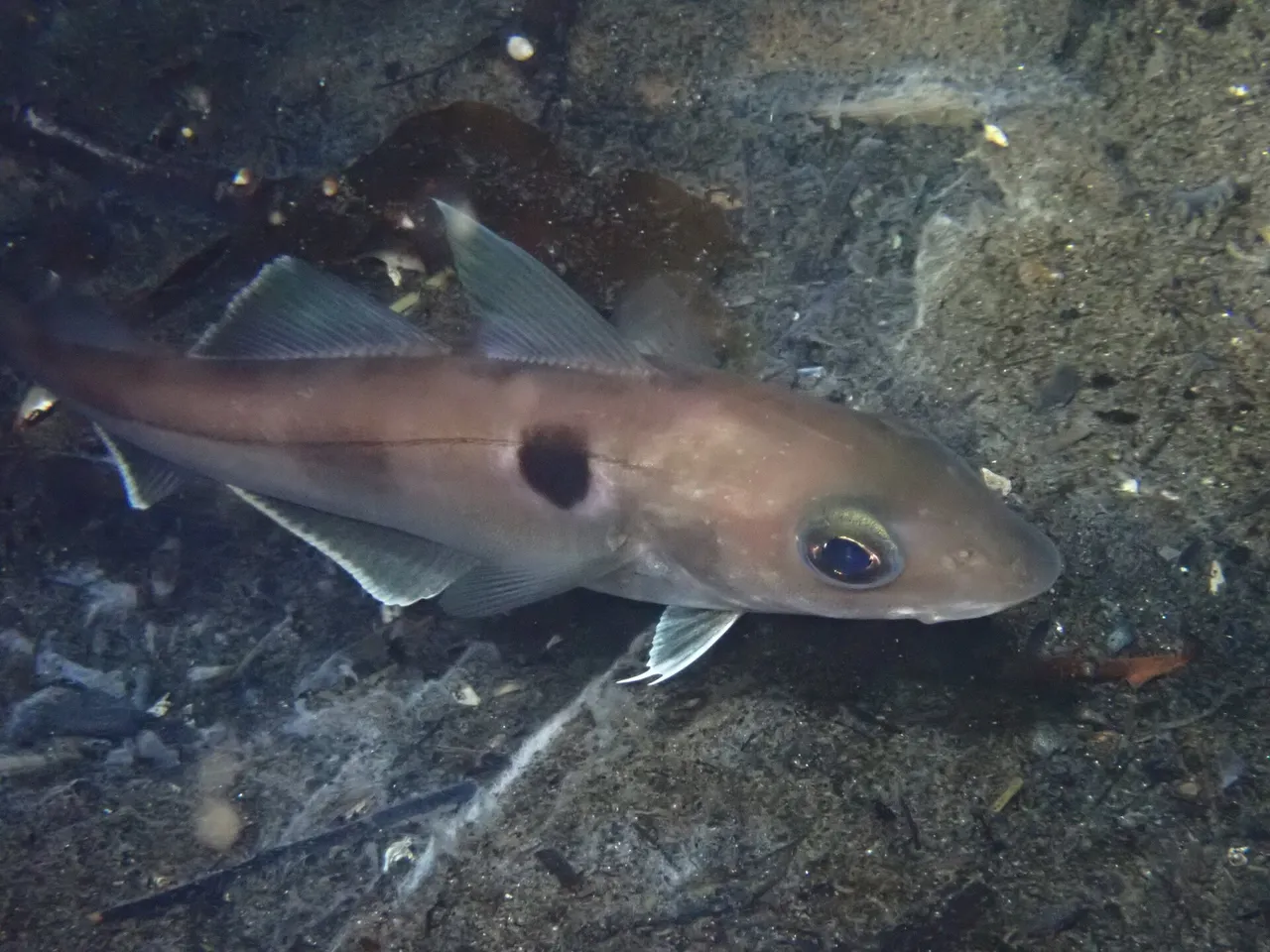
How this was identified, and who took it
Identified by: In situ over soft bottom. The dark thumbprint blotch above the pectoral fin — the character that settles haddock against cod in one look — is unmistakable, along with the dark lateral line, three dorsal fins and the small chin barbel.Vsevolod Rudyi — CC BY 4.0, via Wikimedia Commons — source, licenceWhat is known about how it feeds
Haddock and cod are caught on the same ground and are not doing the same job.
The haddock's mouth is small and inferior — set below a projecting snout — and the fish picks prey from and just above the seabed rather than seizing it. That single anatomical difference separates the two species' diets more completely than any behavioural preference would: a haddock cannot take what a cod takes, and does not try.
Both verified relationships are benthic and both are recorded at group level: polychaete worms and molluscs. Brittlestars, small crustaceans and fish eggs make up much of the rest, and fish appear in the diet far less than they do for cod of the same size.
The sensory arrangement suits the method. In the low light of deep shelf water the lateral line and taste contribute substantially alongside sight, and the fish works close to the sediment where all three are usable.
There is no strong ontogenetic shift towards piscivory. A large haddock eats larger benthic invertebrates rather than a different class of food, which is why the species stays comparatively low in the food web despite reaching a respectable size.
Spawning aggregations and the associated pre-spawning feeding are the main seasonal features, and the fish disperses over soft and mixed ground afterwards.
The food
Prey with a verified dietary link to this fish. Each entry carries its own evidence, and each is written at the precision the source actually used: a named species where the source named one, a group or food category where it said “polychaetes”, “crustaceans” or “detritus” and meant it. That is why this list is shorter than the animal’s real diet rather than longer.
- Polychaete worms as prey — a group rather than a species: the evidence names the group
Haddock are benthic feeders working soft ground for worms and other buried invertebrates, which is a fundamentally different feeding strategy from the cod they are usually caught alongside.
- Bivalve and gastropod molluscs as prey — a group rather than a species: the evidence names the group
Small molluscs are a regular component of the diet, taken from soft sediment along with worms and small crustaceans.
Food with no page of its own here yet
These are real components of the diet, listed as plain text because FishingHQ has no page for them yet. Inventing pages to make the list look fuller would be the fabrication this whole approach exists to prevent.
- brittlestars and other echinoderms
- small crustaceans
- fish eggs, including herring spawn
- sandeels
What anglers do with this
Everything below is interpretation, not finding. It is what experienced anglers conclude from the biology above, and the reasoning is usually sound and almost never tested. It is separated from the biology deliberately.
The small mouth is the fact that converts, and it converts into a presentation argument rather than an attraction one: haddock take small offerings presented properly on the bottom, and a conspicuous but badly presented one is ignored. That contrast with cod, on the same ground and at the same time, is the observation the northern European boat fishery is built on.
The herring-spawn association is worth recording: haddock aggregate on spawning grounds to feed on the eggs, a genuinely documented behaviour that anglers use to explain seasonal concentrations.
Neither point is a tested comparison. Both are practitioner reasoning from the anatomy and the recorded diet.
What this does not establish
Both relationships are group-level and neither establishes proportion. Diet varies with ground type and depth, and the account describes the north-east Atlantic. Nothing here supports a claim about the fish component of the diet, which is real but small and is not represented by a verified relationship.
Where this connects
These are the baits, lures, methods and explainers FishingHQ already joins to this fish — which is why the list is sometimes short. They are not chosen for this page, and a link here means an evidenced relationship exists, not that it follows from the diet.
Methods used for it
This page covers feeding. The Haddock record covers identification, lifecycle, seasonal behaviour, handling and the sources behind all of it.
Reviewed 2026-08-12.