Ballan wrasse
Fish · Last reviewed 2026-08-10
A long-lived rocky-ground resident that begins life female and may change sex — and the species that turned rock marks into a lure fishery.
Safety: cliffs and rock platforms — can cause serious injury or death. 5 more points apply here.
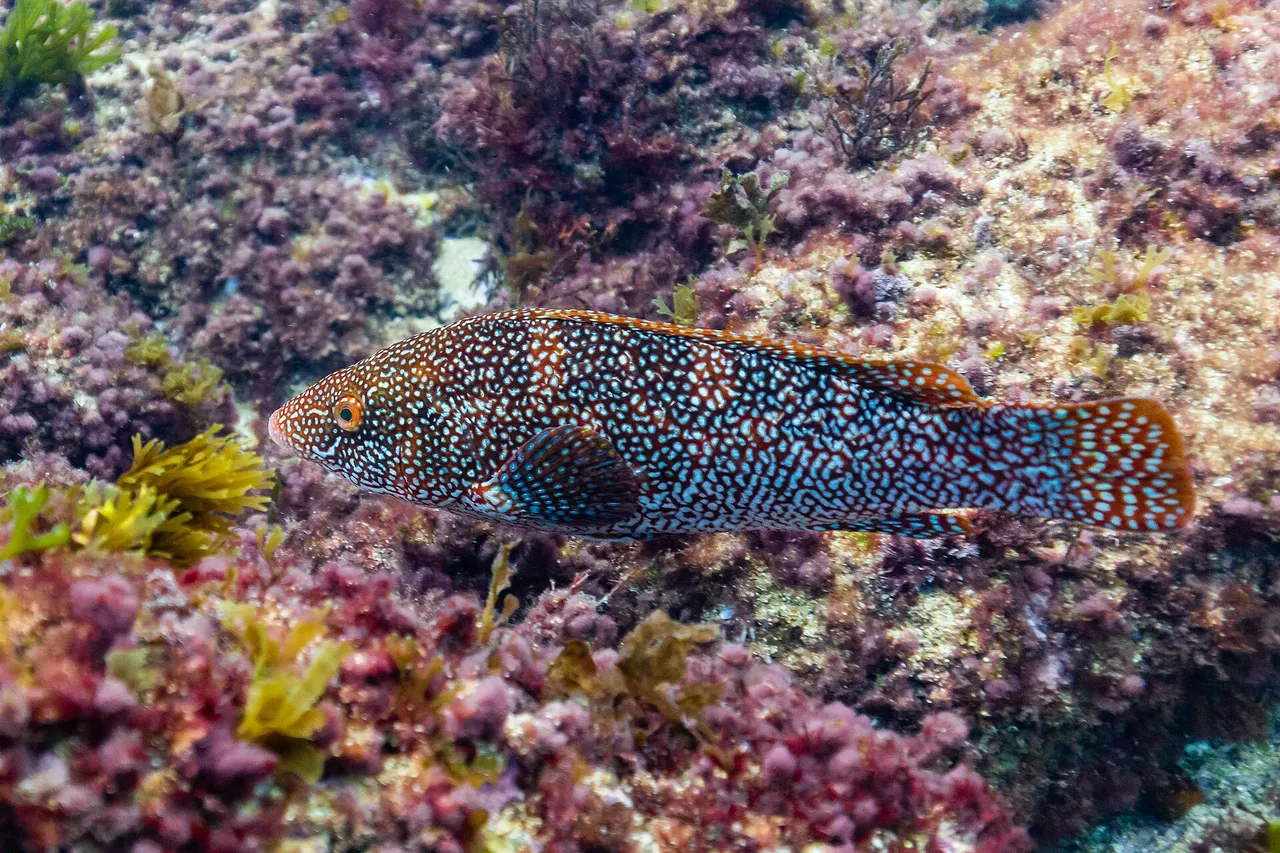
,_isla_de_Mouro,_Santander,_Espa%C3%B1a,_2019-08-15,_DD_55.jpg)
Catching Ballan wrasse
Everything here on fishing for it. Each entry opens the page behind it.
- Ground
- When
- Mar and May–Oct — months recorded at the places that document it, not a season for the whole range.
- Where
- 165 places FishingHQ documents — strongest claim anywhere: characteristic of this water · From the shore, From a kayak, Spearfishing
Ballan wrasse are the largest European wrasse and the characteristic fish of rocky, kelpy inshore ground. They are deep-bodied, thick-lipped, powerfully built for their size, and equipped with crushing pharyngeal teeth for dealing with crabs and molluscs.
Two facts about them reframe how they should be fished for. The first is age: FishBase records a maximum of 34 years, which for a fish of under 5 kg is extraordinary, and it means the wrasse on a given piece of reef may have been there for decades. The second follows from it — all ballan wrasse are born female and change sex between four and fourteen years old, so the large fish on a mark are disproportionately the males, and removing them has a structural effect on the local population that removing an equivalent weight of mackerel does not.
The modern wrasse fishery is almost entirely catch-and-release lure fishing, and those two facts are why that matters more here than for most species.
Straight answers
For somebody who is already standing on the mark. Everything below this expands on it.
- Where is the fish?
- In the rough. Kelp, boulder fields, gullies between rock ledges, undercut faces, the broken ground at the foot of a cliff — usually in two to thirty metres and often much closer in than that.
- What is the one thing that matters?
- Getting a hook into the ground without losing it, and getting the fish out before it goes back in. Everything about the tackle is heavier than the fish needs because of the reef, not because of the wrasse.
- What do they eat?
- Crabs, shellfish and other hard-shelled things, crushed with teeth in the throat rather than bitten in the jaws. That is why crab is the classic bait and why a crab-shaped soft plastic works.
- When are they there?
- Spring through autumn inshore, with high summer usually the most reliable. They drop into slightly deeper water in winter and become much less active in cold conditions, and they feed by day and not at night.
- Do I keep them?
- Almost nobody does, and the reason is the fish rather than a rule: born female, sex-changing between four and fourteen, up to thirty-four years old, low resilience, and living on one patch of reef for its whole life.
- So the population is safe?
- Unknown, and that is a government body's own word. Wild wrasse are also caught alive and commercially for salmon farms — 78.6 tonnes in Scotland in 2022 — and the Scottish Animal Welfare Commission states the effect on natural populations has not been established.
Where you are fishing from
The same fish, and genuinely different fishing. Open the one you are standing on.
Rock marks
Depth close in, and the edge fish hunt along
Rock marks and gullies — the fishery, almost all of it
- Upper water
- Mid water
- On or near the bottom
Methods: Light rock fishing, Float fishing, Ledgering
How this mark actually fishes
Why fish are here
A rock mark with deep water, kelp and broken ground at the foot of it is a wrasse's entire world: food, cover, a home patch and somewhere to bolt to. The fish are frequently within a rod length, which is why this is a shore fishery that does not reward distance and does reward looking before casting.
How to fish it
Fish the gullies, the undercut faces, the boulder fields and the kelp edges — close in, and often straight down. Work along the ledge rather than casting out from it. Because the fight is a race between you and the ground, everything happens fast: hit the pull, lift hard, keep the fish's head up and out of the weed, and land it at the waterline rather than lifting it up a face.
What to look at on arrival
- Kelp visible at low water, which shows you where the ground is before the tide covers it.
- Gullies running back into the rock, which concentrate both food and fish.
- Whether you can reach the water to land a fish. A mark you can catch on and cannot land on is a mark that hurts fish.
What goes wrong here
- Casting as far as possible. The fish are usually within fifteen metres and frequently at your feet.
- Striking at the knocks instead of waiting for the pull.
- Playing the fish gently, which gives it exactly the time it needs to get back into the kelp.
Wrasse ground and dangerous ground are the same ground: weed-covered rock at the water's edge, swell that reaches further than it looks, and often a scramble down. Wet kelp is as slippery as ice, and the best wrasse marks have the least margin for error.
Official guidance — why, and the sources (2)
Stated by a fisheries authority, scientific institute or recognised angling body. Authoritative, but summarising rather than demonstrating.
How rock marks marks fish for this species, from the evidence named here.
- FishBase: a global information system on fishes — Froese, R. and D. Pauly, eds. — FishBase Consortium (Scientific institute)Relied on for: Reef-associated ground from 1 to 50 m, usually 2 to 30 m.States this directlyPassage read and verified
- Pollack (Pollachius pollachius) — MarLIN species record — The Marine Life Information Network, Marine Biological Association of the United Kingdom (Scientific institute)Relied on for: Wrasse working rock, kelp and crevices at close quarters.States this directlyCitation checked — the work exists and is described correctly
Reef and rough ground
Broken ground, weed and the fish that live in it
Reef and broken ground — the same fish, further out
- Mid water
- On or near the bottom
Methods: Light rock fishing, Ledgering, Kayak fishing
How this mark actually fishes
Why fish are here
The ground continues under the water and so do the wrasse. Inshore reef, boulder ground and kelp forest out to twenty or thirty metres hold the same territorial fish on the same principle, generally with larger average size the further from the accessible marks you get.
How to fish it
From a boat or a kayak, fish vertically or on a short cast down the side of the structure, because the fish is on the ground rather than in the water above it. Use a rig you can lose cheaply and expect to lose it. Keep the boat off the ground rather than over it where the swell allows.
What to look at on arrival
- The transition from clean ground to broken, which is where the fish start.
- Depth. Wrasse are recorded from one to fifty metres and usually two to thirty, so a lot of promising deep ground holds none.
What goes wrong here
- Fishing over sand between reefs and concluding the ground is empty.
- Using tackle light enough to be enjoyable and too light to get a fish off the bottom.
Official guidance — why, and the sources (1)
Stated by a fisheries authority, scientific institute or recognised angling body. Authoritative, but summarising rather than demonstrating.
How reef and rough ground marks fish for this species, from the evidence named here.
- FishBase: a global information system on fishes — Froese, R. and D. Pauly, eds. — FishBase Consortium (Scientific institute)Relied on for: Depth range of 1 to 50 m, usually 2 to 30 m, on reef-associated ground.States this directlyPassage read and verified
Harbour
Enclosed water, walls and moored structure
Harbour walls and structure — where a lot of people meet their first one
- Upper water
- Mid water
Methods: Light rock fishing, Float fishing
How this mark actually fishes
Why fish are here
A harbour wall is an artificial reef: vertical rock or concrete, weed growth, crevices, and crabs and shellfish living on it. Wrasse colonise them readily, and a wall with kelp on its outer face frequently holds fish within a metre of it.
How to fish it
Straight down the face, with a small soft plastic or a piece of crab, working the wall rather than casting away from it. Harbour wrasse are usually smaller than open-coast fish and are correspondingly forgiving, which is exactly why it is a good place to learn the bite.
What to look at on arrival
- Weed and mussel growth on the wall, which is both the food and the cover.
- The corners and the steps, where the structure changes.
What goes wrong here
- Fishing the open water inside the harbour rather than the wall itself.
- Lifting a fish vertically up a high wall, which is the most damaging thing done to wrasse anywhere.
Landing a fish from height is the problem on a wall. A drop net, or moving to steps, is the difference between returning a fish and dropping one.
What experienced anglers do — why, and the sources
Widely and independently recommended by experienced anglers and specialist sources. This is real angling knowledge, not proof: controlled evidence for it is limited, and FishingHQ records it as convention rather than as a demonstrated effect.
How harbour marks fish for this species, from the evidence named here.
Kayak
Mobility, silence, and very little room
Kayak — reaching ground a boat will not go and a bank will not reach
- Mid water
- On or near the bottom
Methods: Kayak fishing, Light rock fishing
How this mark actually fishes
Why fish are here
The best wrasse ground is shallow, rocky and close to the shore, which is precisely the water a boat with a keel avoids and a shore angler cannot cast to. A kayak sits in exactly that gap, and it also lets an angler move along a reef quickly and fish it in sections.
How to fish it
Drift or paddle slowly along the reef edge and fish short and vertical, because the fish is under you rather than away from you. Keep the rig simple: a jig head or a weedless soft plastic, a short leader, and no more terminal tackle than you can afford to lose repeatedly.
What to look at on arrival
- The kelp line seen through the water, which on a calm clear day is visible from a kayak in a way it never is from a bank.
- Swell running onto the ground you are fishing, which is a different proposition at sea level.
What goes wrong here
- Anchoring over rough ground in swell.
- Fishing so light that a hooked fish reaches the kelp before you can lift it, which on a kayak means losing both fish and tackle.
Rock and kelp in shallow water is exactly where swell stands up and breaks. A kayak on wrasse ground is close to the one hazard it cannot paddle away from quickly.
What experienced anglers do — why, and the sources
Widely and independently recommended by experienced anglers and specialist sources. This is real angling knowledge, not proof: controlled evidence for it is limited, and FishingHQ records it as convention rather than as a demonstrated effect.
How kayak marks fish for this species, from the evidence named here.
Why they are in the rough ground and will not leave it
Each of these is a piece of biology or hydrography, what it looks like from where you are standing, and what you can try as a result.
It lives in the structure rather than near it
- What you may see
- Kelp visible at low water, boulder fields between ledges, gullies with weed growing up the sides, and the colour change where clean ground gives way to broken. On a clear day you can frequently see the fish.
- What to try
- Fish INTO the ground rather than past it, with tackle rigged to come back through weed, and be prepared to lose end tackle. Choose marks where you can reach the fish at the waterline rather than lift it up a face.
- Where this breaks down
- There is a limit. Ground so severe that every cast is lost is ground to leave alone — partly because it is unfishable and partly because lead and line left on a reef stay there.
Why this happens
A ballan wrasse works rock, kelp and crevices at close quarters, feeding on crustaceans and molluscs it crushes with pharyngeal teeth in the throat. It is not hanging off a reef waiting for something to swim past; it is in among the ground, moving over and through it, inspecting. That has a direct and awkward consequence for an angler: the fish is where the tackle gets lost. Every technique in wrasse fishing is a response to that single fact — weedless rigging, heavy braid, rotten-bottom leads, short fights and a rod that lifts rather than plays.
Official guidance — why, and the sources (1)
Stated by a fisheries authority, scientific institute or recognised angling body. Authoritative, but summarising rather than demonstrating.
The mechanism above, and what it rests on.
- FishBase: a global information system on fishes — Froese, R. and D. Pauly, eds. — FishBase Consortium (Scientific institute)Relied on for: Reef-associated ground from 1 to 50 m and usually 2 to 30 m; feeding on crustaceans and molluscs crushed with pharyngeal teeth.States this directlyPassage read and verified
The same fish are on the same ground for years, and both halves of that matter
- What you may see
- Consistency. Return to a productive gully and the fishing is recognisably the same; return to one that has been hammered and it is recognisably thinner.
- What to try
- Learn a small number of marks properly rather than searching new ones constantly, and spread your fishing across them rather than working one gully every trip.
Why this happens
Wrasse are inshore residents from spring through autumn, move only into slightly deeper water for the winter, and do not migrate in any substantial sense. They are strongly territorial about a home patch. The angling consequence is a gift: a gully that produced last August will produce this August, and a mark you learn stays learned in a way a tide-dependent bass mark never does. The conservation consequence is the same fact read the other way: the fish you take off a mark are not replaced from somewhere else in a season, so a heavily-fished gully does not recover quickly.
Official guidance — why, and the sources (1)
Stated by a fisheries authority, scientific institute or recognised angling body. Authoritative, but summarising rather than demonstrating.
The mechanism above, and what it rests on.
- Pollack (Pollachius pollachius) — MarLIN species record — The Marine Life Information Network, Marine Biological Association of the United Kingdom (Scientific institute)Relied on for: Wrasse as inshore residents moving to slightly deeper water in winter, not migrating substantially, and being strongly territorial about a home patch.States this directlyCitation checked — the work exists and is described correctly
Every one is born female, and the big ones are the breeding males
- What you may see
- Size. On a mark where you catch a lot of half-pound to pound fish and occasionally something over three pounds, you have caught a great many females and one much older male.
- What to try
- Return the large ones specifically, and handle them best of all. Returning a big wrasse is worth disproportionately more here than in a fishery where size is only age.
- Where this breaks down
- The sex-change window is wide — four to fourteen years — so size is a rough guide to sex rather than a reliable one, and this profile does not claim you can tell by looking.
Why this happens
Ballan wrasse are protogynous hermaphrodites: all are born female and some change sex to male between four and fourteen years of age. Males then build and guard nests of algae in rock crevices. Put that together with the age structure — FishBase records a maximum of 34 years and rates resilience as LOW, with a population doubling time of four and a half to fourteen years — and the implication is unusually direct. The largest fish on a mark are the males; there are not many of them; they are decades old; they guard the nests; and the population replaces them slowly. Removing the big ones does not thin a population evenly, it removes its breeding males.
Backed by research — why, and the sources (1)
Supported by peer-reviewed research or fisheries science. The sources are listed and can be checked.
The mechanism above, and what it rests on.
- FishBase: a global information system on fishes — Froese, R. and D. Pauly, eds. — FishBase Consortium (Scientific institute)Relied on for: Protogynous hermaphroditism with sex change between four and fourteen years; maximum reported age 34 years; LOW resilience with a population doubling time of 4.5 to 14 years.States this directlyPassage read and verified
It crushes its food in its throat, which changes what a bite feels like
- What you may see
- Rattling, plucking knocks on the rod tip that go on and on without developing, then a single decisive downward pull.
- What to try
- Do not strike at the knocks. Hold the rod, keep in contact, and hit it when the tip goes over and stays over — then lift hard immediately, because the fish's first move is back into the ground.
Why this happens
Wrasse feed on crabs, molluscs and other hard-shelled prey, and they do not bite through them. Prey is taken in the jaws and crushed by pharyngeal teeth in the throat. From the rod that produces a bite unlike almost anything else: a series of sharp knocks and plucks as the fish works the bait, then — when it turns and moves off with it — a solid, heavy pull. Striking at the knocks pulls the bait out of a fish that has not committed. Waiting for the weight is the whole difference between a session of bites and a session of fish.
Official guidance — why, and the sources (1)
Stated by a fisheries authority, scientific institute or recognised angling body. Authoritative, but summarising rather than demonstrating.
The mechanism above, and what it rests on.
- FishBase: a global information system on fishes — Froese, R. and D. Pauly, eds. — FishBase Consortium (Scientific institute)Relied on for: Feeding on crustaceans and molluscs crushed with pharyngeal teeth in the throat rather than bitten in the jaws.States this directlyPassage read and verified
It comes out and looks at things, which is most of the appeal
- What you may see
- The fish itself, following the lure up through the water or out of the kelp. In clear shallow water this is routine rather than exceptional.
- What to try
- When a fish follows and turns away, change something small — the speed, the pause, the size — rather than moving on. A dead stop as the fish closes converts a good proportion of follows.
- Where this breaks down
- This is a clear-water phenomenon. In coloured or rough conditions you will never see any of it, and the fishing becomes bait-and-feel rather than sight.
Why this happens
Wrasse are visual feeders in the clear water they favour and they are visibly curious: they will approach a lure, follow it, inspect it and turn away, sometimes repeatedly, before committing. Very few fish behave that way, and on a bright day in clear water it turns a session into something closer to hunting than to fishing — you can watch the whole encounter. It also means a refusal is not a rejection: a fish that has looked and turned away will usually look again if something changes.
Official guidance — why, and the sources (1)
Stated by a fisheries authority, scientific institute or recognised angling body. Authoritative, but summarising rather than demonstrating.
The mechanism above, and what it rests on.
- Pollack (Pollachius pollachius) — MarLIN species record — The Marine Life Information Network, Marine Biological Association of the United Kingdom (Scientific institute)Relied on for: Vision dominating in clear water, and wrasse approaching and inspecting a lure repeatedly before taking it.States this directlyCitation checked — the work exists and is described correctly
They are day fish and they mean it
- What you may see
- The clock. Sport falls away sharply as the light goes, rather than picking up.
- What to try
- Fish daylight, and fish the brightest, clearest conditions rather than avoiding them. This is one of very few British shore fisheries where a flat calm sunny day is an advantage.
Why this happens
Wrasse feed by day and are effectively inactive at night, sheltering in crevices. This is the reverse of a great deal of British shore fishing, where the received wisdom is that darkness improves everything, and it is one of the reasons wrasse fishing found an audience: it is a species you can fish for on a summer afternoon with somebody who does not want to be on a rock ledge at two in the morning.
Official guidance — why, and the sources (1)
Stated by a fisheries authority, scientific institute or recognised angling body. Authoritative, but summarising rather than demonstrating.
The mechanism above, and what it rests on.
- Pollack (Pollachius pollachius) — MarLIN species record — The Marine Life Information Network, Marine Biological Association of the United Kingdom (Scientific institute)Relied on for: Wrasse feeding by day and being effectively inactive at night, sheltering in crevices.States this directlyCitation checked — the work exists and is described correctly
The fish you are putting back is also caught alive by the tonne
- What you may see
- Creels and traps in wrasse ground on the west coast, and salmon pens. The two are connected and the connection is not obvious from either end.
- What to try
- Know it before forming a view. It does not make releasing your fish pointless and it does not make the commercial fishery indefensible — it means the honest position for an angler is that nobody currently knows what the total removal is doing.
- Where this breaks down
- The figures are Scottish. Whether an equivalent fishery is managed, unmanaged or absent in England and Wales was not established here, and the report notes supply coming from further south.
Why this happens
Wild wrasse are caught commercially and alive for the salmon-farming industry, where they are put into pens as cleaner fish to eat sea lice off the salmon. The scale is not small: in 2022 approximately 78.6 tonnes were landed in Scotland under 63 letters of derogation, of which 80.6 per cent were ballan wrasse, with 25.8 per cent of the catch returned as under- or oversized. The fishery is concentrated on the Scottish west coast, the Hebrides and Orkney, with further supply from Northern Ireland and elsewhere. It is managed rather than unregulated: statutory minimum and maximum landing sizes, recently moved from 12–24 cm to 14–24 cm, live traps with slow retrieval to avoid swimbladder damage, an annual derogation with limits on trap numbers, catch reporting, and voluntary welfare standards on top. AND THE SCOTTISH ANIMAL WELFARE COMMISSION STATES THAT THE EFFECT OF REMOVING THAT SIZE CLASS ON THE NATURAL POPULATIONS IS CURRENTLY UNKNOWN, with the potential for negative impact.
Official guidance — why, and the sources (1)
Stated by a fisheries authority, scientific institute or recognised angling body. Authoritative, but summarising rather than demonstrating.
The mechanism above, and what it rests on.
- Welfare of cleaner fish used in the Scottish salmon industry — outcomes of evidence gathering — The Scottish Animal Welfare Commission, for the Scottish Government, 2024 (Government fisheries body)Relied on for: 78.6 tonnes landed in Scotland in 2022 under 63 derogations, 80.6 per cent ballan wrasse, 25.8 per cent returned as under- or oversized; landing sizes moved from 12–24 cm to 14–24 cm; live traps with slow retrieval; annual derogation and catch reporting; and the statement that the population effect is currently unknown.States this directlyPassage read and verified
Finding them
What to look for, what it means, and how much it is worth. None of these guarantees a fish — the third column says how far each one is worth trusting.
6 things to look for
Kelp showing at low water along the foot of a mark
Usually worth acting onThe ground is there and so, in the season, are the fish. Kelp is the single most reliable visual indicator of wrasse ground on the British shore.
What to do: Note it at low water and fish it when the tide covers it. A kelp line you have seen dry is a map you keep.
Official guidance — why, and the sources (1)
Stated by a fisheries authority, scientific institute or recognised angling body. Authoritative, but summarising rather than demonstrating.
What this sign rests on.
- Pollack (Pollachius pollachius) — MarLIN species record — The Marine Life Information Network, Marine Biological Association of the United Kingdom (Scientific institute)Relied on for: Wrasse working rock, kelp and crevices at close quarters.States this directlyCitation checked — the work exists and is described correctly
A series of sharp knocks that never develops
Usually worth acting onA fish working the bait with its jaws before crushing it. It is the fish, and it has not committed yet.
What to do: Do not strike. Stay in contact and wait for the tip to go over and stay over.
Official guidance — why, and the sources (1)
Stated by a fisheries authority, scientific institute or recognised angling body. Authoritative, but summarising rather than demonstrating.
What this sign rests on.
- FishBase: a global information system on fishes — Froese, R. and D. Pauly, eds. — FishBase Consortium (Scientific institute)Relied on for: Prey crushed by pharyngeal teeth in the throat rather than bitten in the jaws.States this directlyPassage read and verified
A fish following the lure and turning away
Often worth acting onCuriosity rather than refusal. Wrasse inspect things repeatedly before deciding, and a turned-away fish is usually still interested.
What to do: Change one thing — a pause, a speed, a smaller profile — and present again to the same fish rather than moving on.
Official guidance — why, and the sources (1)
Stated by a fisheries authority, scientific institute or recognised angling body. Authoritative, but summarising rather than demonstrating.
What this sign rests on.
- Pollack (Pollachius pollachius) — MarLIN species record — The Marine Life Information Network, Marine Biological Association of the United Kingdom (Scientific institute)Relied on for: Wrasse approaching and inspecting a lure repeatedly before taking it.States this directlyCitation checked — the work exists and is described correctly
Clear water and bright sun on a calm summer day
Often worth acting onGood conditions, which is the opposite of most British shore fishing. Wrasse are visual, diurnal and inshore in summer.
What to do: Go. Fish close, fish light-tackle lures, and expect to see the fish.
Official guidance — why, and the sources (1)
Stated by a fisheries authority, scientific institute or recognised angling body. Authoritative, but summarising rather than demonstrating.
What this sign rests on.
- Pollack (Pollachius pollachius) — MarLIN species record — The Marine Life Information Network, Marine Biological Association of the United Kingdom (Scientific institute)Relied on for: Vision dominating in clear water; wrasse feeding by day and inactive at night.States this directlyCitation checked — the work exists and is described correctly
Crabs visible in the rock pools and on the ledges
Often worth acting onThe main food is present and locally abundant, which is a reasonable proxy for the wrasse being there too.
What to do: Fish crab, or a crab-shaped soft plastic, and fish it right into the ground where the crabs are.
Official guidance — why, and the sources (1)
Stated by a fisheries authority, scientific institute or recognised angling body. Authoritative, but summarising rather than demonstrating.
What this sign rests on.
- FishBase: a global information system on fishes — Froese, R. and D. Pauly, eds. — FishBase Consortium (Scientific institute)Relied on for: Feeding on crustaceans and molluscs.States this directlyPassage read and verified
Sport falling away sharply as the light goes
Usually worth acting onExactly what should happen. Wrasse are day fish that shelter in crevices at night, and this is not a sign that the mark has stopped producing.
What to do: Go home, and come back tomorrow in the middle of the day rather than staying into the dark as you would for bass or cod.
Official guidance — why, and the sources (1)
Stated by a fisheries authority, scientific institute or recognised angling body. Authoritative, but summarising rather than demonstrating.
What this sign rests on.
- Pollack (Pollachius pollachius) — MarLIN species record — The Marine Life Information Network, Marine Biological Association of the United Kingdom (Scientific institute)Relied on for: Wrasse effectively inactive at night, sheltering in crevices.States this directlyCitation checked — the work exists and is described correctly
How to fish for them
Weedless soft plastics
When: Whenever the ground is fishable and the light is good — which for this species means most of a summer day.
- Rock marks
- Reef and rough ground
- Harbour
- Kayak
- Mid water
- On or near the bottom
Why it works, how to do it, and what it will not do
Why it works
It is the technique that turned wrasse from bycatch into a discipline in about fifteen years, and the reason is entirely mechanical: a hook point buried in a soft plastic body comes back through kelp and over boulders that would take any other rig on the first cast. That single fact opened up ground nobody could fish, and the ground it opened up is where the wrasse live.
How to fish it
Rig a creature or crab-profile soft plastic weedless on a wide-gape hook, weighted with a bullet or a jig head heavy enough to reach the bottom in the current and no heavier. Cast into the rough, let it down, and work it in short hops along the bottom with pauses. When the pull comes, lift hard and keep lifting.
Tackle
A rod with a soft enough tip to feel the plucks and enough backbone to turn a fish out of kelp, braid straight through or to a heavy fluorocarbon leader, and hooks strong enough not to open under a hard early lift.
What it will not do
- It is a clear-water, daylight method. In coloured water or poor light it loses most of its advantage over bait.
- The weedless hook point that gets you through the ground also costs hookups, and missed takes are normal rather than a fault.
- It still gets snagged. Weedless reduces losses; it does not remove them.
What experienced anglers do — why, and the sources
Widely and independently recommended by experienced anglers and specialist sources. This is real angling knowledge, not proof: controlled evidence for it is limited, and FishingHQ records it as convention rather than as a demonstrated effect.
What this account of the method rests on.
Crab on a simple bottom rig
When: In any conditions, and particularly when the water is coloured or the light is poor and lures stop working.
- Rock marks
- Reef and rough ground
- Harbour
- On or near the bottom
Why it works, how to do it, and what it will not do
Why it works
Crab is what wrasse eat. A hardback or peeler crab presented on the bottom in broken ground is not an imitation of the food, it is the food, and it will out-fish a lure on a rough day with a big sea running when nothing can be seen.
How to fish it
The simplest rig that will hold: a short trace, a single strong hook, and a lead on a rotten-bottom link so that a snagged weight breaks away and the rest of the rig comes back. Fish it hard into the ground, hold the rod, and wait for the pull rather than striking at the knocks.
Tackle
A rod that can lift, line strong enough to straighten a hook out of the ground, and a lead attached so that it — and only it — is lost. Leaving lead and line on a reef every cast is not an acceptable cost of the method.
What it will not do
- Deep hooking is a real risk when a fish is given time with a bait, which is the trade against not striking at the knocks.
- It is a static method, so it searches ground far more slowly than a lure does.
- Crab is seasonal, and collecting it has its own rules and its own conservation questions.
Official guidance — why, and the sources (1)
Stated by a fisheries authority, scientific institute or recognised angling body. Authoritative, but summarising rather than demonstrating.
What this account of the method rests on.
- FishBase: a global information system on fishes — Froese, R. and D. Pauly, eds. — FishBase Consortium (Scientific institute)Relied on for: Feeding on crustaceans and molluscs crushed with pharyngeal teeth.States this directlyPassage read and verified
Float-fished bait over rough ground
When: Over ground too severe to leger, and where the fish are up in the kelp rather than under it.
- Rock marks
- Harbour
- Upper water
- Mid water
Why it works, how to do it, and what it will not do
Why it works
A float suspends the bait above the worst of the ground, which turns unfishable rock into fishable rock. It also gives a visible indication and lets the bait be searched along a gully with the tide instead of sitting in one place.
How to fish it
Set the depth so the bait fishes just above the kelp, and adjust constantly as the tide changes it. Let the float travel along the gully or the ledge face rather than anchoring it. Strike on a positive submersion rather than on a bob.
Tackle
A sliding float set-up on a rod long enough to control line over rock, with a hook and trace strong enough to lift a fish clear of weed immediately.
What it will not do
- It fishes above the ground, so it misses fish that are hard down in it.
- Wind and surface drift move a float where they want, which on an exposed ledge is often not where the fish are.
What experienced anglers do — why, and the sources
Widely and independently recommended by experienced anglers and specialist sources. This is real angling knowledge, not proof: controlled evidence for it is limited, and FishingHQ records it as convention rather than as a demonstrated effect.
What this account of the method rests on.
Lures
Chosen by weight, sink rate, depth and retrieve, because those are what decide whether a lure is in front of a fish. There is no best one, and no best colour.
Creature and crab-profile soft plastics
A soft body with legs, claws or appendages, rigged weedless on a wide-gape hook so the point sits in the plastic.
- Weight
- 5–20 g of bullet weight or jig head, sized to reach bottom and no more
- Depth it fishes
- On or just above the bottom, in the ground itself
- Sink rate
- Set by the weight; the aim is to reach the ground and stay in contact with it
- Retrieve
- Short hops along the bottom with definite pauses. Most takes come during or immediately after the pause, and the pause is also what a following fish is waiting for.
When it works, and when it does not
In clear water and daylight, over ground no other rig survives. It is the technique the whole modern wrasse fishery is built on, and it works because a buried hook point comes back through kelp that would take an exposed one on the first cast.
Limitation: The buried point costs hookups and missed takes are routine. It also loses most of its edge in coloured water or low light, where bait does better.
- Rock marks
- Reef and rough ground
- Harbour
- Kayak
What experienced anglers do — why, and the sources
Widely and independently recommended by experienced anglers and specialist sources. This is real angling knowledge, not proof: controlled evidence for it is limited, and FishingHQ records it as convention rather than as a demonstrated effect.
What this lure guidance rests on.
Small paddle-tail on a weedless weighted hook
A fish-profile soft plastic with a thumping tail, rigged with the point buried.
- Weight
- 7–20 g weighted hooks
- Depth it fishes
- Mid-water down to the bottom over the ground
- Sink rate
- Falls tail-first on a weighted hook, which is part of what draws a following fish
- Retrieve
- Slow and steady with pauses, or hopped along the bottom like a creature bait.
When it works, and when it does not
Where wrasse are taking small fish as well as crustaceans, and in slightly coloured water where a tail's displacement gives the fish something to find rather than only something to look at.
Limitation: Wrasse are primarily crustacean feeders and a fish profile is a less direct imitation than a crab one, so it is a searching lure rather than a first choice.
- Rock marks
- Reef and rough ground
- Kayak
What experienced anglers do — why, and the sources
Widely and independently recommended by experienced anglers and specialist sources. This is real angling knowledge, not proof: controlled evidence for it is limited, and FishingHQ records it as convention rather than as a demonstrated effect.
What this lure guidance rests on.
Baits
Hardback and peeler crab
Why it works, and how to present it
It is the principal food. Wrasse crush crustaceans with pharyngeal teeth and work rock and crevices at close quarters looking for exactly this, so a crab presented into the ground is not standing in for anything.
Presentation: Whole small hardbacks or half a peeler on a single strong hook, fished hard on the bottom in the rough on a rotten-bottom lead. Hold the rod and wait for the pull.
Limitation: It gives the fish time, which is how a bait ends up deep. Collecting crab has its own local rules and its own effect on a shore's invertebrate life.
- Rock marks
- Reef and rough ground
- Harbour
Official guidance — why, and the sources (1)
Stated by a fisheries authority, scientific institute or recognised angling body. Authoritative, but summarising rather than demonstrating.
What this bait guidance rests on.
- FishBase: a global information system on fishes — Froese, R. and D. Pauly, eds. — FishBase Consortium (Scientific institute)Relied on for: Feeding on crustaceans and molluscs crushed with pharyngeal teeth in the throat.States this directlyPassage read and verified
Ragworm
Why it works, and how to present it
Readily taken, easy to buy and easy to present, which makes it the bait most people catch their first wrasse on even though crab is the more specific choice.
Presentation: A single worm on a strong hook, fished on the bottom or under a float over rough ground.
Limitation: It catches everything else on the mark too, and small fish will strip it repeatedly before a wrasse finds it.
- Rock marks
- Harbour
What experienced anglers do — why, and the sources
Widely and independently recommended by experienced anglers and specialist sources. This is real angling knowledge, not proof: controlled evidence for it is limited, and FishingHQ records it as convention rather than as a demonstrated effect.
What this bait guidance rests on.
Limpet and shellfish
Why it works, and how to present it
Molluscs are part of the natural diet and limpets are on the rock you are standing on, which makes this the bait of last resort that frequently is not one.
Presentation: Several limpet bodies bound onto a single hook, fished on the bottom close in. It is soft and needs re-baiting often.
Limitation: It comes off the hook easily and casts badly. Stripping limpets off a shore also removes a slow-growing grazer from the rock, which is worth thinking about before doing it at scale.
- Rock marks
Official guidance — why, and the sources (1)
Stated by a fisheries authority, scientific institute or recognised angling body. Authoritative, but summarising rather than demonstrating.
What this bait guidance rests on.
- FishBase: a global information system on fishes — Froese, R. and D. Pauly, eds. — FishBase Consortium (Scientific institute)Relied on for: Feeding on crustaceans and molluscs.States this directlyPassage read and verified
Conditions
What each of these changes, why that matters to the fish, and what it is worth trying. None of it is a rule — fishing does not have any.
5 conditions, and what each one changes
Water clarity
How far a wrasse can see, which decides whether this is a lure fishery or a bait fishery today.
Why it matters, and what to try
Wrasse are visual feeders in the clear water they favour and much of the appeal — the follow, the inspection, the visible take — depends on being able to see into the water. In colour the whole sight-fishing element disappears and a crab on the bottom becomes the better proposition.
What to try: In clear water fish lures and expect to see fish. In colour switch to bait and fish it hard into the ground, and stop expecting the same day.
Official guidance — why, and the sources (1)
Stated by a fisheries authority, scientific institute or recognised angling body. Authoritative, but summarising rather than demonstrating.
What this rests on.
- Pollack (Pollachius pollachius) — MarLIN species record — The Marine Life Information Network, Marine Biological Association of the United Kingdom (Scientific institute)Relied on for: Vision dominating in the clear water wrasse favour.States this directlyCitation checked — the work exists and is described correctly
Light
Whether the fish are feeding at all.
Why it matters, and what to try
Wrasse feed by day and are effectively inactive at night, sheltering in crevices. This inverts the usual British shore-fishing assumption that darkness is better, and it means a session has a hard end rather than a promising one.
What to try: Fish the middle of the day rather than the ends of it, and treat the fishing dying at dusk as normal rather than as a problem to solve.
Official guidance — why, and the sources (1)
Stated by a fisheries authority, scientific institute or recognised angling body. Authoritative, but summarising rather than demonstrating.
What this rests on.
- Pollack (Pollachius pollachius) — MarLIN species record — The Marine Life Information Network, Marine Biological Association of the United Kingdom (Scientific institute)Relied on for: Feeding by day and effectively inactive at night.States this directlyCitation checked — the work exists and is described correctly
Swell and sea state
Whether the ground is fishable and whether the mark is safe to stand on, which for this fishery are frequently the same question.
Why it matters, and what to try
Wrasse ground is shallow rock at the water's edge, which is precisely where swell stands up and breaks. A modest ground swell that is invisible offshore arrives at a wrasse ledge as a wave that reaches further up than the previous twenty did.
What to try: Check the swell forecast as well as the wind, and watch a mark for several minutes before committing to a position on it. Choose marks with a route off them.
What experienced anglers do — why, and the sources
Widely and independently recommended by experienced anglers and specialist sources. This is real angling knowledge, not proof: controlled evidence for it is limited, and FishingHQ records it as convention rather than as a demonstrated effect.
What this rests on.
Water temperature
Whether the fish are inshore and active, or in slightly deeper water and torpid.
Why it matters, and what to try
Wrasse are inshore residents from spring through autumn and drop into deeper water in winter, becoming much less active in cold conditions. It is not a migration and the fish have not gone anywhere far — they are simply not catchable from the ledge you caught them off in August.
What to try: Treat this as a spring-to-autumn fishery. In cold water, expect much less and fish deeper ground rather than the shallow gullies.
Official guidance — why, and the sources (1)
Stated by a fisheries authority, scientific institute or recognised angling body. Authoritative, but summarising rather than demonstrating.
What this rests on.
- Pollack (Pollachius pollachius) — MarLIN species record — The Marine Life Information Network, Marine Biological Association of the United Kingdom (Scientific institute)Relied on for: Inshore residency from spring through autumn, movement to slightly deeper water in winter, and much reduced activity in cold conditions.States this directlyCitation checked — the work exists and is described correctly
Stage of tide
How much water is over the ground, which decides both which gullies are fishable and which ledges are standable.
Why it matters, and what to try
Much of the best wrasse ground is only covered for part of the tide, and a gully with two metres in it fishes completely differently from the same gully with six. The tide also decides the safety of the position, which on this ground is not a separate consideration.
What to try: Learn each mark's tide: which state covers the ground you want and which state cuts off the platform you are standing on. Scout at low water.
What experienced anglers do — why, and the sources
Widely and independently recommended by experienced anglers and specialist sources. This is real angling knowledge, not proof: controlled evidence for it is limited, and FishingHQ records it as convention rather than as a demonstrated effect.
What this rests on.
Tackle
Each of these says why it is the size it is. Where a heavier outfit is suggested it is almost always about casting range or holding bottom, not about the strength needed to land the fish.
3 outfits, and why each is the size it is
Rock-mark lure outfit
- Rock marks
- Reef and rough ground
- Harbour
- Kayak
- Rod
- Around seven to nine feet, with a tip soft enough to register plucks and a butt that can lift a fish out of kelp
- Reel
- A small fixed spool with a drag that can be locked up, because this is not a fishery where you give line
- Line
- Braid, straight through or to a leader, for direct contact and immediate lifting power
- Leader
- Heavy fluorocarbon or mono, short, and treated as consumable against rock abrasion
- Terminal
- Weedless wide-gape hooks strong enough not to open under a hard early lift, with a bullet weight or a weighted hook
Heavier than the fish requires, and the reason is the ground rather than the fish. A one-pound wrasse on tackle that lets it run is a one-pound wrasse in the kelp with your lure, and the fight is a race you have to win in the first two seconds.
What experienced anglers do — why, and the sources
Widely and independently recommended by experienced anglers and specialist sources. This is real angling knowledge, not proof: controlled evidence for it is limited, and FishingHQ records it as convention rather than as a demonstrated effect.
What this tackle guidance rests on.
Bait outfit for rough ground
- Rock marks
- Reef and rough ground
- Harbour
- Rod
- A rod with the backbone to lift a fish clear of the ground immediately
- Reel
- A reel with a strong drag and enough line capacity to survive repeated break-offs
- Line
- Strong enough to straighten a hook out of a snag rather than to break at the knot
- Leader
- A short heavy trace, replaced often, because rock abrasion is constant
- Terminal
- A single strong hook and a lead on a rotten-bottom link, so that a snag costs a weight rather than the whole rig
The rotten-bottom link is the part that matters and the part most often left off. Losing a lead every few casts is the price of fishing this ground; losing a lead, a trace and a baited hook every few casts leaves terminal tackle all over a reef that fish live on permanently.
What experienced anglers do — why, and the sources
Widely and independently recommended by experienced anglers and specialist sources. This is real angling knowledge, not proof: controlled evidence for it is limited, and FishingHQ records it as convention rather than as a demonstrated effect.
What this tackle guidance rests on.
Landing and release kit
- Rock marks
- Reef and rough ground
- Harbour
- Kayak
- Rod
- Not applicable — this is what decides whether the fish goes back in good order
- Reel
- Not applicable
- Line
- Line heavy enough to land the fish quickly, which is the same thing as fishing it responsibly here
- Leader
- Short, heavy, and replaced whenever rock has been rubbing on it
- Terminal
- A long-handled net or a drop net for anywhere with height, forceps or a disgorger, and wet hands
Wrasse are hardy fish that are damaged mainly by one specific thing: being lifted up a rock face or a harbour wall on the line. A net turns the most harmful moment of the encounter into a non-event, and given that this is a fishery where essentially everything goes back, it is the single most useful item in the bag.
Official guidance — why, and the sources (1)
Stated by a fisheries authority, scientific institute or recognised angling body. Authoritative, but summarising rather than demonstrating.
What this tackle guidance rests on.
- Pollack (Pollachius pollachius) — MarLIN species record — The Marine Life Information Network, Marine Biological Association of the United Kingdom (Scientific institute)Relied on for: Wrasse being hardy but suffering from being lifted up rock faces; use a long-handled net or unhook at the waterline, keep the fish wet, and return it where it came from.States this directlyCitation checked — the work exists and is described correctly
Things that actually help
9 things that actually help
Wait for the pull, not the knocks
A wrasse takes prey in its jaws and crushes it in its throat, so the knocking is the fish working the bait and has nothing to do with the hook being anywhere useful. Striking at knocks is the commonest reason for a session of bites and no fish.
Official guidance — why, and the sources (1)
Stated by a fisheries authority, scientific institute or recognised angling body. Authoritative, but summarising rather than demonstrating.
What this rests on.
- FishBase: a global information system on fishes — Froese, R. and D. Pauly, eds. — FishBase Consortium (Scientific institute)Relied on for: Prey crushed by pharyngeal teeth in the throat rather than bitten in the jaws.States this directlyPassage read and verified
Win the first two seconds or lose the fish
A hooked wrasse's first move is straight back into the ground it came out of, and once it is in the kelp it usually stays there. This is why the tackle is heavier than the fish justifies and why the drag is set tight.
What experienced anglers do — why, and the sources
Widely and independently recommended by experienced anglers and specialist sources. This is real angling knowledge, not proof: controlled evidence for it is limited, and FishingHQ records it as convention rather than as a demonstrated effect.
What this rests on.
Carry a drop net or a long-handled net for anywhere with height
Lifting a wrasse vertically up a rock face or a harbour wall on the line is the single most damaging thing routinely done to this species, and it happens in a fishery where essentially every fish is meant to go back.
Official guidance — why, and the sources (1)
Stated by a fisheries authority, scientific institute or recognised angling body. Authoritative, but summarising rather than demonstrating.
What this rests on.
- Pollack (Pollachius pollachius) — MarLIN species record — The Marine Life Information Network, Marine Biological Association of the United Kingdom (Scientific institute)Relied on for: Wrasse suffering from being lifted up rock faces; use a long-handled net or unhook at the waterline.States this directlyCitation checked — the work exists and is described correctly
Return the biggest fish most carefully of all
The largest wrasse on a mark are the oldest fish and are likely to be the nest-guarding males, in a species born female that changes sex between four and fourteen years old and can live to thirty-four. A big wrasse is not just a bigger fish, it is a different and much scarcer thing.
Backed by research — why, and the sources (1)
Supported by peer-reviewed research or fisheries science. The sources are listed and can be checked.
What this rests on.
- FishBase: a global information system on fishes — Froese, R. and D. Pauly, eds. — FishBase Consortium (Scientific institute)Relied on for: Protogynous hermaphroditism with sex change at 4–14 years, males guarding nests, and a maximum reported age of 34 years.States this directlyPassage read and verified
Use a rotten-bottom link on every bait rig
This fishery loses terminal tackle by design, and the difference between losing a lead and losing a whole baited rig is the difference between a bit of lead on a reef and a hook, a trace and a lead on a reef that fish live on for decades.
What experienced anglers do — why, and the sources
Widely and independently recommended by experienced anglers and specialist sources. This is real angling knowledge, not proof: controlled evidence for it is limited, and FishingHQ records it as convention rather than as a demonstrated effect.
What this rests on.
Spread your fishing across several marks
Wrasse are territorial residents that do not migrate, so the fish you take off a gully are not replaced from elsewhere within a season. A mark fished every week by the same person thins in a way a tide-swept bass mark never does.
Official guidance — why, and the sources (1)
Stated by a fisheries authority, scientific institute or recognised angling body. Authoritative, but summarising rather than demonstrating.
What this rests on.
- Pollack (Pollachius pollachius) — MarLIN species record — The Marine Life Information Network, Marine Biological Association of the United Kingdom (Scientific institute)Relied on for: Wrasse not migrating substantially, being strongly territorial about a home patch, and local depletion being possible.States this directlyCitation checked — the work exists and is described correctly
Fish the middle of a bright calm day
Wrasse are diurnal and visual and are inactive at night, which inverts almost every other piece of British shore-fishing advice. This is one of very few marks where turning up at eleven in the morning in flat calm sunshine is the right decision.
Official guidance — why, and the sources (1)
Stated by a fisheries authority, scientific institute or recognised angling body. Authoritative, but summarising rather than demonstrating.
What this rests on.
- Pollack (Pollachius pollachius) — MarLIN species record — The Marine Life Information Network, Marine Biological Association of the United Kingdom (Scientific institute)Relied on for: Feeding by day, inactive at night, and vision dominating in clear water.States this directlyCitation checked — the work exists and is described correctly
Change one thing when a fish follows and turns away
Wrasse inspect repeatedly before committing, so a refusal is information rather than a verdict. A dead stop, a smaller profile or a slower drop converts a good share of follows, and moving on wastes a fish that is still interested.
Official guidance — why, and the sources (1)
Stated by a fisheries authority, scientific institute or recognised angling body. Authoritative, but summarising rather than demonstrating.
What this rests on.
- Pollack (Pollachius pollachius) — MarLIN species record — The Marine Life Information Network, Marine Biological Association of the United Kingdom (Scientific institute)Relied on for: Wrasse approaching and inspecting a lure repeatedly before taking it.States this directlyCitation checked — the work exists and is described correctly
Know that the same fish is caught commercially, alive, for salmon farms
78.6 tonnes were landed in Scotland in 2022 under 63 derogations, four-fifths of it ballan. The fishery has landing sizes and reporting, and the Scottish Government's own commission says the effect on wild populations is unknown. An angler's release ethic sits alongside that rather than instead of it, and the honest position is that nobody currently knows the total.
Official guidance — why, and the sources (1)
Stated by a fisheries authority, scientific institute or recognised angling body. Authoritative, but summarising rather than demonstrating.
What this rests on.
- Welfare of cleaner fish used in the Scottish salmon industry — outcomes of evidence gathering — The Scottish Animal Welfare Commission, for the Scottish Government, 2024 (Government fisheries body)Relied on for: 78.6 tonnes landed in 2022 under 63 derogations, 80.6 per cent ballan, and the statement that the effect on natural populations is currently unknown.States this directlyPassage read and verified
What they are feeding on
What the evidence says they eat, and — separately — what that does or does not imply for what you tie on. Some of the most important prey has no angling consequence at all.
4 prey items, and what each implies
Crabs
The staple. Wrasse take crabs of a size that looks improbable and crush them in the throat, and shore crab is abundant on exactly the ground wrasse live on.
What that means for fishing: The reason crab is the classic bait and the reason a crab-profile soft plastic outfishes a fish-profile one on most marks.
Official guidance — why, and the sources (1)
Stated by a fisheries authority, scientific institute or recognised angling body. Authoritative, but summarising rather than demonstrating.
What this rests on.
- FishBase: a global information system on fishes — Froese, R. and D. Pauly, eds. — FishBase Consortium (Scientific institute)Relied on for: Feeding on crustaceans crushed with pharyngeal teeth.States this directlyPassage read and verified
Molluscs — mussels, limpets and winkles
Hard-shelled grazers living on the same rock, crushed in the same way. Wrasse are among the few inshore fish equipped to eat them.
What that means for fishing: Explains why limpet works as an improvised bait, and why a mark with heavy mussel and limpet growth is usually a mark with wrasse on it.
Official guidance — why, and the sources (1)
Stated by a fisheries authority, scientific institute or recognised angling body. Authoritative, but summarising rather than demonstrating.
What this rests on.
- FishBase: a global information system on fishes — Froese, R. and D. Pauly, eds. — FishBase Consortium (Scientific institute)Relied on for: Feeding on molluscs.States this directlyPassage read and verified
Small crustaceans in kelp — prawns, shrimps and amphipods
The invertebrate community living in and on kelp fronds and holdfasts, which is dense and constantly available on wrasse ground.
What that means for fishing: Part of why wrasse are IN the weed rather than beside it, and why a small creature bait worked slowly through kelp fringes is a convincing thing.
What experienced anglers do — why, and the sources
Widely and independently recommended by experienced anglers and specialist sources. This is real angling knowledge, not proof: controlled evidence for it is limited, and FishingHQ records it as convention rather than as a demonstrated effect.
What this rests on.
Sea lice, on farmed salmon
Not a natural prey item in any meaningful sense, and included here because it is the reason wild wrasse are caught commercially: they are put into salmon pens to eat the parasites off the fish.
What that means for fishing: None for the angler's tackle, and everything for the angler's understanding of the fishery. It is why 78.6 tonnes of wrasse were landed alive in Scotland in one recent year.
Official guidance — why, and the sources (1)
Stated by a fisheries authority, scientific institute or recognised angling body. Authoritative, but summarising rather than demonstrating.
What this rests on.
- Welfare of cleaner fish used in the Scottish salmon industry — outcomes of evidence gathering — The Scottish Animal Welfare Commission, for the Scottish Government, 2024 (Government fisheries body)Relied on for: Wild wrasse used as cleaner fish on salmon farms to control sea lice, with 78.6 tonnes landed in Scotland in 2022.States this directlyPassage read and verified
When, and where
Not one season. These are different coasts with genuinely different windows, and the boundaries move between years — they follow water temperature rather than the calendar.
| Where | JJan | FFeb | MMar | AApr | MMay | JJun | JJul | AAug | SSep | OOct | NNov | DDec |
|---|---|---|---|---|---|---|---|---|---|---|---|---|
| South and south-west England | Jan: not expected | Feb: not expected | Mar: not expected | Apr: present inshore | May: present inshore | Jun: present inshore | Jul: present inshore | Aug: present inshore | Sep: present inshore | Oct: present inshore | Nov: present inshore | Dec: not expected |
| Wales and the Irish Sea coasts | Jan: not expected | Feb: not expected | Mar: not expected | Apr: not expected | May: present inshore | Jun: present inshore | Jul: present inshore | Aug: present inshore | Sep: present inshore | Oct: present inshore | Nov: not expected | Dec: not expected |
| Scotland and the northern isles | Jan: not expected | Feb: not expected | Mar: not expected | Apr: not expected | May: not expected | Jun: present inshore | Jul: present inshore | Aug: present inshore | Sep: present inshore | Oct: not expected | Nov: not expected | Dec: not expected |
| The eastern Atlantic range as a whole | Jan: present inshore | Feb: present inshore | Mar: present inshore | Apr: present inshore | May: present inshore | Jun: present inshore | Jul: present inshore | Aug: present inshore | Sep: present inshore | Oct: present inshore | Nov: present inshore | Dec: present inshore |
What each of these 4 regions actually looks like
South and south-west England
The longest inshore season in Britain, on a coast with a great deal of the rock and kelp ground the species needs. Wrasse are inshore residents through this window rather than arriving and leaving.
Peak: High summer into early autumn is the most reliable of it, with the fish hard inshore and the water at its clearest.
Official guidance — why, and the sources (1)
Stated by a fisheries authority, scientific institute or recognised angling body. Authoritative, but summarising rather than demonstrating.
What this seasonal window rests on.
- Pollack (Pollachius pollachius) — MarLIN species record — The Marine Life Information Network, Marine Biological Association of the United Kingdom (Scientific institute)Relied on for: Inshore residency from spring through autumn.States this directlyCitation checked — the work exists and is described correctly
Wales and the Irish Sea coasts
A shorter window than the far south-west, on ground that is often more exposed. The species is present rather than seasonal; what changes is how far inshore and how active it is.
Peak: Midsummer, when the water has warmed and clarity is best on the rocky western coasts.
What experienced anglers do — why, and the sources
Widely and independently recommended by experienced anglers and specialist sources. This is real angling knowledge, not proof: controlled evidence for it is limited, and FishingHQ records it as convention rather than as a demonstrated effect.
What this seasonal window rests on.
Scotland and the northern isles
The shortest window and the coldest water, on a coast that is also where the commercial cleaner-fish fishery is concentrated — the west coast, the Inner and Outer Hebrides and Orkney.
Peak: A narrow midsummer window, on some of the best wrasse ground anywhere in Britain.
Official guidance — why, and the sources (1)
Stated by a fisheries authority, scientific institute or recognised angling body. Authoritative, but summarising rather than demonstrating.
What this seasonal window rests on.
- Welfare of cleaner fish used in the Scottish salmon industry — outcomes of evidence gathering — The Scottish Animal Welfare Commission, for the Scottish Government, 2024 (Government fisheries body)Relied on for: The cleaner-fish fishery concentrated on the west coast of Scotland, the Inner and Outer Hebrides and Orkney.States this directlyPassage read and verified
The eastern Atlantic range as a whole
The species runs from Norway to Morocco including Madeira, the Azores and the Canaries, and its assessed status is Least Concern on an assessment dating from August 2008. Seasons, rules and local management across that range are not established here.
Peak: There is no single peak across a range this long. What is summer in Orkney is not summer in Morocco.
Backed by research — why, and the sources (2)
Supported by peer-reviewed research or fisheries science. The sources are listed and can be checked.
What this seasonal window rests on.
- FishBase: a global information system on fishes — Froese, R. and D. Pauly, eds. — FishBase Consortium (Scientific institute)Relied on for: Eastern Atlantic distribution from Norway to Morocco including Madeira, the Azores and the Canaries.States this directlyPassage read and verified
- The IUCN Red List of Threatened Species — International Union for Conservation of Nature (Conservation authority)Relied on for: The global category of Least Concern, on an assessment dating from August 2008.States this directlyCitation checked — the work exists and is described correctly
Why people blank
8 common mistakes, and what to do instead
Striking at the first knock
The knocking is a wrasse manipulating the bait in its jaws before crushing it in its throat. There is nothing to hook yet, and pulling it away teaches the fish something.
Instead: Hold the rod, keep contact, and hit it only when the tip goes over and stays over.
Official guidance — why, and the sources (1)
Stated by a fisheries authority, scientific institute or recognised angling body. Authoritative, but summarising rather than demonstrating.
What this rests on.
- FishBase: a global information system on fishes — Froese, R. and D. Pauly, eds. — FishBase Consortium (Scientific institute)Relied on for: Prey crushed by pharyngeal teeth rather than bitten in the jaws.States this directlyPassage read and verified
Fishing too light because the fish are not big
The tackle is not sized to the wrasse, it is sized to the kelp. A pound-and-a-half fish that reaches cover on light gear is a lost fish and, usually, a lure left in a reef.
Instead: Fish braid, a locked drag and a rod that lifts, and accept that this is not a fishery for finesse tackle.
What experienced anglers do — why, and the sources
Widely and independently recommended by experienced anglers and specialist sources. This is real angling knowledge, not proof: controlled evidence for it is limited, and FishingHQ records it as convention rather than as a demonstrated effect.
What this rests on.
Lifting a fish up a rock face or a harbour wall on the line
It is the specific thing that damages wrasse. They are otherwise hardy fish, and this is the moment the encounter goes wrong — in a fishery where the whole point is that they go back.
Instead: Use a long-handled or drop net, or move to a position where the fish can be unhooked at the waterline.
Official guidance — why, and the sources (1)
Stated by a fisheries authority, scientific institute or recognised angling body. Authoritative, but summarising rather than demonstrating.
What this rests on.
- Pollack (Pollachius pollachius) — MarLIN species record — The Marine Life Information Network, Marine Biological Association of the United Kingdom (Scientific institute)Relied on for: Wrasse suffering from being lifted up rock faces; unhook at the waterline where possible.States this directlyCitation checked — the work exists and is described correctly
Fishing one favourite gully every trip
Wrasse are site-attached residents that do not migrate. The fish removed from a small piece of ground are not replaced from elsewhere in a season, so a mark fished relentlessly by the same handful of people gets measurably thinner.
Instead: Learn several marks and rotate them, and treat a productive gully as something to look after rather than to exhaust.
Official guidance — why, and the sources (1)
Stated by a fisheries authority, scientific institute or recognised angling body. Authoritative, but summarising rather than demonstrating.
What this rests on.
- Pollack (Pollachius pollachius) — MarLIN species record — The Marine Life Information Network, Marine Biological Association of the United Kingdom (Scientific institute)Relied on for: Territorial residency on a home patch and the possibility of local depletion.States this directlyCitation checked — the work exists and is described correctly
Leaving a whole rig on the reef every few casts
This ground takes tackle and always will. What is avoidable is losing the hook and trace with the lead, on ground where the same fish live for decades and where a baited hook on the bottom keeps working long after you have gone home.
Instead: Use a rotten-bottom link so a snag costs a weight, and use line strong enough to straighten a hook.
What experienced anglers do — why, and the sources
Widely and independently recommended by experienced anglers and specialist sources. This is real angling knowledge, not proof: controlled evidence for it is limited, and FishingHQ records it as convention rather than as a demonstrated effect.
What this rests on.
Staying into the dark expecting it to improve
Wrasse feed by day and shelter in crevices at night. The received wisdom that darkness improves shore fishing is true for a great many species and is simply wrong for this one.
Instead: Fish the daylight properly and go home. Come back at midday tomorrow.
Official guidance — why, and the sources (1)
Stated by a fisheries authority, scientific institute or recognised angling body. Authoritative, but summarising rather than demonstrating.
What this rests on.
- Pollack (Pollachius pollachius) — MarLIN species record — The Marine Life Information Network, Marine Biological Association of the United Kingdom (Scientific institute)Relied on for: Feeding by day and effectively inactive at night.States this directlyCitation checked — the work exists and is described correctly
Taking the biggest fish because there is no minimum size
There is no legal size limit in British sea angling for wrasse, and that is precisely why the decision falls to the angler. The largest fish are the oldest, are likely to be the nest-guarding males in a species born female, and come from a population with LOW resilience and a doubling time measured in years.
Instead: Return everything, and handle the large fish best of all. That is what the fishery does and the biology is the reason.
Backed by research — why, and the sources (1)
Supported by peer-reviewed research or fisheries science. The sources are listed and can be checked.
What this rests on.
- FishBase: a global information system on fishes — Froese, R. and D. Pauly, eds. — FishBase Consortium (Scientific institute)Relied on for: Protogynous hermaphroditism, males guarding nests, LOW resilience, a population doubling time of 4.5 to 14 years and a maximum age of 34 years.States this directlyPassage read and verified
Assuming the release ethic settles the conservation question
It does not, and an angler who believes it does has half the picture. The same species is taken alive and commercially for salmon farms at a scale of tens of tonnes a year in Scotland alone, and the Scottish Government's own commission states that the effect on wild populations is unknown.
Instead: Hold both facts. Release your fish, and understand that the total removal from a reef is not something anybody can currently quantify.
Official guidance — why, and the sources (1)
Stated by a fisheries authority, scientific institute or recognised angling body. Authoritative, but summarising rather than demonstrating.
What this rests on.
- Welfare of cleaner fish used in the Scottish salmon industry — outcomes of evidence gathering — The Scottish Animal Welfare Commission, for the Scottish Government, 2024 (Government fisheries body)Relied on for: 78.6 tonnes landed in Scotland in 2022, the management measures in place, and the stated uncertainty about the population effect.States this directlyPassage read and verified
How it is caught
- Drop shottingWeedless soft plastics worked over and into rough ground — a recent discipline that turned wrasse from an incidental capture into a targeted sport fishery.
- Float fishingCrab or worm suspended over rock and kelp, keeping the bait above the ground that would otherwise take the tackle.
- LedgeringA bait fished hard on rough ground with a rotten-bottom link, which is the traditional approach and still the way the largest fish are taken.
- Light rock fishingThe heavier end of the discipline — the branch imported as hard rock fishing — is aimed squarely at ballan wrasse over rough ground.
Gear for this fish
- Crab and shellfishCrab is the wrasse bait the sources name most, and where crab is not to hand they name what is: the Clare directory records specimen wrasse and triggerfish taken on local LIMPETS prised off the rock at the mark.
- Prawns and shrimpThe statutory guide gives crab, SHRIMP or worm for the wrasse of the Sheep's Head marks, and it is the only reading in this set where a shrimp bait is named for a rock species.
- RagwormWhere the wrasse are under the angler's feet rather than at range, worm on a single-hook paternoster is what the sources give — Carnsore Point specifically, where the directory says the best fish are directly below and lugworm on a single hook is the way to reach them.
- Soft plasticsWeedless creature and crab imitations on a light weighted hook are the whole of this fishery. Wrasse feed on crustaceans and molluscs prised off rock, so the lure must reach into broken ground and come back out of it, which rules out every exposed-hook lure family.
Where Ballan wrasse is documented
Places where public sources describe this species as fished, with how it is fished and how strongly the evidence supports it. This is not a range map and it is not a recommendation — it is what has been written down about a fishery rather than a record of any individual catch, and being listed is never permission to fish.
The Cornish and Devon coasts
34 documented places
Breakwater
Recorded here
From the shore
Breakwater
Recorded here
From the shore
Headland
Recorded here
From a kayak
Headland
Repeatedly reported
From the shore
Headland
Repeatedly reported
From the shore
Estuary mark
Repeatedly reported
From a kayak
Beach section
Repeatedly reported
From a kayak
Harbour wall
Repeatedly reported
From the shore
Harbour wall
Repeatedly reported
From the shore
The Isles of Scilly
4 documented places
Headland
Characteristic of this water
From the shore
Old Town Bay
Bay
Regular local target
From the shore
Harbour wall
Recorded here
From the shore
The Daymark, St Martin's
Headland
Regular local target
From the shore
The Causeway and Antrim coast
10 documented places
Headland
Regular local target
From the shore
Around May, Jun, Jul, Aug, Sept, Oct
Island
Seasonal
From the shore
Around May, Jun, Jul, Aug, Sept, Oct
Bay
Seasonal
From the shore
Around May, Jun, Jul, Aug, Sept, Oct
Headland
Seasonal
From the shore
Around May, Jun, Jul, Aug, Sept, Oct
Rock mark
Seasonal
From the shore · Spearfishing
Around May, Jun, Jul, Aug, Sept
Beach
Regular local target
From the shore
Rock mark
Regular local target
From the shore · Spearfishing
Harbour wall
Regular local target
From the shore · Spearfishing
Harbour wall
Regular local target
From the shore · Spearfishing
East Lothian and the Firth of Forth coast
9 documented places
Headland
Repeatedly reported
From a kayak
Around Jun
Observed June 2025
North Berwick and the Bass Rock
Island
Regular local target
From the shore
Around May, Jun, Jul, Aug, Sept, Oct
Headland
Regular local target
From the shore
Harbour wall
Regular local target
From the shore
Rock mark
Seasonal
From the shore
Around Jun, Jul, Aug, Sept
Harbour wall
Regular local target
From the shore
Pier
Seasonal
From the shore
Around Jun, Jul, Aug, Sept
Breakwater
Seasonal
From the shore
Around Jun, Jul, Aug, Sept
Breakwater
Regular local target
From the shore
Anglesey
8 documented places
Breakwater
Regular local target
From the shore
Around May, Jun, Jul, Aug, Sept, Oct
Rock mark
Seasonal
From the shore
Around May, Jun, Jul, Aug, Sept, Oct
Bay
Seasonal
From the shore
Around May, Jun, Jul, Aug, Sept, Oct
Bay
Seasonal
From the shore
Around May, Jun, Jul, Aug, Sept, Oct
Headland
Seasonal
From the shore
Around May, Jun, Jul, Aug, Sept, Oct
Headland
Regular local target
From the shore
Rock mark
Regular local target
From the shore
Pier
Regular local target
From the shore
The Purbeck coast and Poole Bay
5 documented places
Swanage Pier
Pier
Regular local target
From the shore
Around May, Jun, Jul, Aug, Sept, Oct
Pier
Regular local target
From the shore
Headland
Seasonal
From the shore
Around Jun, Jul, Aug, Sept
Ledge
Regular local target
From the shore
Headland
Regular local target
From the shore
The Firth of Clyde
5 documented places
Sea loch
Regular local target
From the shore
Beach
Regular local target
From the shore
Harbour wall
Regular local target
From the shore
Harbour wall
Regular local target
From the shore
Harbour wall
Regular local target
From the shore
Clew Bay and Achill
5 documented places
Bay
Regular local target
From the shore
Pier
Regular local target
From the shore
Pier
Regular local target
From the shore
Headland
Regular local target
From the shore
Around Jun, Jul, Aug, Sept
Harbour wall
Regular local target
From the shore
Also documented on 35 more coasts
Fewer places each, or less strongly supported. Each one names its own marks.
The Clare coast and the Shannon estuary (5) · West Cork (5) · The Donegal coast and its sea loughs (5) · Connemara and Galway Bay (5) · The Yorkshire coast (4) · Cardigan Bay and the sarnau (4) · Pembrokeshire and the south-west Wales coast (4) · Dublin Bay and the Wicklow coast (4) · Weymouth Bay (4) · The Kerry coast (4) · Scottish sea lochs (3) · Belfast Lough and the north Down shore (3) · The Wexford coast (3) · The Gower and Carmarthen Bay (3) · The Lecale coast and Dundrum Bay (2) · Brittany and the French Atlantic coast (2) · The Isle of Man (2) · The Waterford coast (2) · Strangford Lough and the Ards coast (1) · Skye and the Inner Hebrides (1) · The Moray Firth (1) · Portland Bill and the Portland Race (1) · Cork Harbour and the east Cork coast (1) · The Sligo and Leitrim coast (1) · The Louth and Meath coast (1) · The north-east England coast (4) · The East Antrim coast (2) · Chesil Beach (1) · The Welsh coast and Anglesey (1) · The outer Ards coast (1) · The Mourne coast and Carlingford Lough (1) · The Solway Firth (1) · The Solent and the Hampshire coast (1) · Morecambe Bay and the north-west England coast (1) · The Azores (1)
What these strengths mean
- Regular local target
- Fishing sources describe this as a normal local target here, not merely as caught.
- Recorded here
- At least one credible public account of this species being caught here. That is all it means.
- Seasonal
- Well supported, and concentrated in part of the year rather than spread through it.
- Repeatedly reported
- Several independent public accounts. Enough to say it happens more than once; not enough to call it a fishery.
- Occasional
- Caught here, and described as unusual rather than normal. Do not plan a session around it.
- Characteristic of this water
- This water is strongly identified with this species by the sources that cover it.
When to fish for ballan wrasse
Where the places here state a season for ballan wrasse, it clusters in May–Oct. This is a count of how many documented places name each month — evidence about when people fish for it, not a prediction of what any particular day will produce.
| Jan | Feb | Mar | Apr | May | Jun | Jul | Aug | Sep | Oct | Nov | Dec |
|---|---|---|---|---|---|---|---|---|---|---|---|
| January: no place here names this month — no place names it. | February: no place here names this month — no place names it. | March: 1 place names this month — few places. | April: no place here names this month — no place names it. | May: 32 places name this month — many places. | June: 44 places name this month — most places. | July: 44 places name this month — most places. | August: 44 places name this month — most places. | September: 44 places name this month — most places. | October: 30 places name this month — many places. | November: no place here names this month — no place names it. | December: no place here names this month — no place names it. |
45 of the 165 places that record catches of ballan wrasse state which months. The other 120 name no season, so they are counted in neither direction: the shape above is what the dated records say, not the whole picture. The dated records span 21 separate areas.
Identification
- Scientific name
- Labrus bergylta
- Family
- Labridae
- Water
- Saltwater
- Conservation status
- Least Concern
- Regions
- Britain & Ireland, Western Europe, Northern Europe, North Africa
- Deep, heavy body with thick, distinctly fleshy lips.
- A single long dorsal fin with a spiny forward section running most of the back.
- Colouring highly variable — green, brown, red or mottled — often with pale spots forming a net pattern over the flank.
- Large, clearly defined scales.
- Powerful pharyngeal teeth in the throat rather than obvious teeth in the jaws.
Size
- Typical
- 25–40 cm and 0.5–1.5 kg.
- Large
- Over 50 cm and 2.5 kg.
Exceptional: FishBase records a maximum of 65.9 cm and 4.4 kg. A fish of that size is likely to be decades old.
A deep-water fish caught in the shallows, and thick lips over strong teeth
Read this in full
Ballan wrasse are the fish that most often teaches British shore anglers about crushing dentition, and the fishery for them creates a hazard that has nothing to do with the fish.
THE MOUTH. Thick rubbery lips over powerful jaws with strong conical teeth at the front and pharyngeal grinding plates behind, all of it built for removing and crushing shellfish from rock. It does not cut; it crushes and grips. Fingers stay out.
THE SPINES. A long spiny dorsal running most of the back, stiff and sharp, met by any hand gripping across the fish. Handle from behind with the fin folded flat, or support the fish from underneath.
THE FISH IS FRAGILE IN ONE SPECIFIC WAY. Ballan wrasse are territorial, site-attached and slow-growing, they live in specific rock ground, and they are frequently caught from marks where returning them means dropping them from height. A wrasse dropped ten metres onto water is injured. Lower it, or use a drop net, or choose a different mark. Several dedicated wrasse fisheries have adopted exactly that as a norm.
THEY ARE ALSO LONG-LIVED AND SEX-CHANGING — individuals mature as females and some later become males — which means removing large fish removes the males from a local population. It is a good argument for a release-only approach and it is the reason the specialist fishery treats it that way.
AND THE GROUND IS THE DANGER. This is rock fishing on broken ground, often close to the water, often where swell arrives. The wrasse will not hurt you; the platform will.
What experienced anglers do — why, and the sources (2)
Widely and independently recommended by experienced anglers and specialist sources. This is real angling knowledge, not proof: controlled evidence for it is limited, and FishingHQ records it as convention rather than as a demonstrated effect.
- FishBase: a global information system on fishes — Froese, R. and D. Pauly, eds. — FishBase Consortium (Scientific institute)Relied on for: Dentition, fin and spine morphology, body form, air-breathing capability and distribution for the species, which are the anatomical facts the handling practice below follows from.States this directlyPassage read and verified
- General angling website restatements of established technique — Various (Credible secondary source)Relied on for: Widely restated angling practice for handling this species, recorded as practitioner consensus rather than as tested fact.Background and mechanism onlyCitation checked — the work exists and is described correctly
Territory, ground and why wrasse fishing is a release fishery
Read this in full
Ballan wrasse are the most site-attached fish an inshore shore angler regularly catches, and every sensible practice in the fishery follows from that.
THE GROUND IS THE FISH. Ballan wrasse live in rock, kelp and broken ground and they do not travel. An individual occupies a small area and stays in it, using crevices for shelter and returning to the same holes. That means a gully, a cleft or a kelp-fringed ledge holds a specific and finite population, and it is not restocked from elsewhere on any short timescale.
WHICH IS WHY A MARK CAN BE FISHED OUT AND STAY THAT WAY. Removing the wrasse from a piece of ground removes them from that ground, not from a pool of fish that will move in. Specialist wrasse anglers rotate marks and return fish for that reason, and the practice is a response to the biology rather than a fashion.
THE SEX-CHANGE MAKES IT SHARPER. Ballan wrasse mature as females and some later become male. The large fish on a piece of ground are therefore disproportionately the males, and removing the biggest fish removes the breeding males from a localised population that cannot easily replace them.
AND THEY ARE SLOW-GROWING AND LONG-LIVED. A large ballan is old — considerably older than its size suggests to anyone used to bass or pollack.
WHAT THEY EAT DECIDES THE TACKLE. Crab and shellfish, taken by picking and crushing with strong teeth and pharyngeal plates. That is why crab is the bait, why bites are a series of knocks rather than a run, and why the fish must be turned away from the rock immediately — a hooked wrasse dives for its hole and reaching it ends the fight.
ARE THEY GOOD TO EAT. They are edible and are eaten in parts of their range, and in Britain and Ireland they are very largely not. Given the site attachment, the slow growth, the sex change and the fact that a productive gully holds a handful of fish, the case for returning them is strong and it is the settled practice among people who fish for them deliberately.
AND THE GROUND IS THE HAZARD. See the handling section on this page: the wrasse will not hurt you and the platform can.
What experienced anglers do — why, and the sources (2)
Widely and independently recommended by experienced anglers and specialist sources. This is real angling knowledge, not proof: controlled evidence for it is limited, and FishingHQ records it as convention rather than as a demonstrated effect.
- Sea Angler — Bauer Media (Specialist angling publication)Relied on for: Shore and boat practice in north-west European sea angling for the ground, method or species described, presented across multiple independent contributors.States this directlyCitation checked — the work exists and is described correctly
- FishBase: a global information system on fishes — Froese, R. and D. Pauly, eds. — FishBase Consortium (Scientific institute)Relied on for: Diet, dentition, reproductive strategy, longevity and habitat association for the species described.States this directlyPassage read and verified
A fish that does not migrate, and why that makes the season a conservation question
Read this in full
Ballan wrasse have the simplest seasonal pattern of any British sea fish and the most consequential one, and the consequence follows from what they do not do.
THE PATTERN. Wrasse are inshore rock-ground residents through the warmer months, present and active on the same reefs and gullies, feeding on crustaceans and molluscs prised off hard surfaces. As water cools they move into slightly deeper water and become markedly less active — a cold-water wrasse is a torpid animal, and the shore fishery effectively closes for the winter without the fish having gone anywhere in particular.
WHAT MAKES THIS DIFFERENT FROM EVERY OTHER SPECIES ON THE SAME MARK is that there is no migration underneath it. A bass moves along a coast. A cod moves inshore and offshore across tens of miles. A mackerel shoal is somewhere else entirely by November. A ballan wrasse is on the same patch of rock it was on last year and the year before, for its whole long life, and wrasse are long-lived — individuals reach well over two decades.
SO A MARK HAS ITS OWN POPULATION, and that population is not refilled from anywhere. Fish removed from a gully are not replaced by fish moving in from along the coast, because no such movement happens; replacement depends on recruitment, which is slow. Local depletion of a wrasse mark is therefore both possible and effectively permanent on any timescale an angler experiences, and it has been documented where commercial demand for wrasse as cleaner fish in salmon aquaculture has concentrated effort on specific ground.
THE SEX CHANGE COMPOUNDS IT. Ballan wrasse are protogynous: fish mature as females and some later become males, so the largest fish on a mark are disproportionately the breeding males. A fishery that keeps the big ones removes exactly those.
WHICH IS WHY THE SEASONAL ANSWER FOR THIS SPECIES IS REALLY A BEHAVIOURAL ONE. The fish are available through the warm months on ground that cannot restock itself, and the specialist fishery has very largely gone catch-and-release on its own account for that reason rather than because anybody required it.
Backed by research — why, and the sources (4)
Supported by peer-reviewed research or fisheries science. The sources are listed and can be checked.
- The IUCN Red List of Threatened Species — International Union for Conservation of Nature (Conservation authority)Relied on for: Assessment, population trend and the life-history traits that determine sensitivity to seasonal exploitation.States this directlyCitation checked — the work exists and is described correctly
- FishBase: a global information system on fishes — Froese, R. and D. Pauly, eds. — FishBase Consortium (Scientific institute)Relied on for: Spawning season, migration and life-history data recorded for the species.States this directlyPassage read and verified
- The Fishes of the British Isles and North-West Europe — Macmillan, 1969 (Reference work)Relied on for: Seasonal distribution and inshore–offshore movement of fishes in British and north-west European waters.States this directlyCitation checked — the work exists and is described correctly
- Sea Angler — Bauer Media (Specialist angling publication)Relied on for: Established seasonal practice in the British and Irish shore and boat fisheries.Background and mechanism onlyCitation checked — the work exists and is described correctly
Every wrasse starts female, and what that does to a rock mark
Read this in full
Ballan wrasse reproduction contains a fact that reorganises how a fishery for them should be thought about, and it is not intuitive.
ALL BALLAN WRASSE ARE BORN FEMALE. Individuals mature as females and some later change sex to male, somewhere between roughly four and fourteen years of age — protogynous hermaphroditism, the same pattern seen in many groupers and in black sea bass. The change is size- and age-related, and in many protogynous species it is socially mediated, triggered by the absence of a dominant male.
THE CONSEQUENCE IS ARITHMETIC. If fish become male as they get large, then the large fish in a population ARE the males. A fishery that keeps the biggest fish is therefore a fishery that removes the breeding males specifically, and it does so while leaving what looks like a healthy population of females behind. A mark can be full of wrasse and short of the sex that fertilises the eggs.
MALES DO REAL WORK, WHICH MAKES THEIR LOSS WORSE. Ballan wrasse males build and defend nests of algae wedged into rock crevices, and they guard them. Removing a nesting male costs the nest as well as the fish, in the same way it does for zander and lingcod.
AND THE SPECIES CANNOT REDISTRIBUTE ITSELF TO COMPENSATE. Ballan wrasse are site-attached and effectively non-migratory: the same fish are on the same ground year after year, for lives measured in decades. So a mark's sex structure is a local property that is not corrected by fish arriving from elsewhere, because no fish arrive from elsewhere. Sex change can compensate to a degree — the loss of males can prompt further females to switch — but that takes years, and it converts females into males rather than creating fish.
WHICH IS WHY THIS SPECIES' RECREATIONAL FISHERY HAS LARGELY GONE RELEASE-ONLY on its own account. It is not a rule imposed on anybody; it is the specialist fishery working out that a slow-growing, long-lived, site-attached, sex-changing fish on a finite piece of rock is not something a mark can supply indefinitely. Commercial demand for wrasse as cleaner fish in salmon aquaculture has made the same arithmetic considerably more urgent in some areas.
Backed by research — why, and the sources (4)
Supported by peer-reviewed research or fisheries science. The sources are listed and can be checked.
- FishBase: a global information system on fishes — Froese, R. and D. Pauly, eds. — FishBase Consortium (Scientific institute)Relied on for: Reproductive mode, spawning season, fecundity, parental care, sex-change pattern and larval development recorded for the species.States this directlyPassage read and verified
- The IUCN Red List of Threatened Species — International Union for Conservation of Nature (Conservation authority)Relied on for: Assessment, population trend, and the life-history traits — age at maturity, longevity, reproductive strategy — that determine sensitivity to exploitation.States this directlyCitation checked — the work exists and is described correctly
- Reef Fish Spawning Aggregations: Biology, Research and Management — Springer, Fish & Fisheries Series vol. 35, 2012 (Scientific literature)Relied on for: The biology of reef fish spawning aggregations, their predictability in time and space, and the disproportionate effect of fishing them on population reproductive output.States this directlyCitation checked — the work exists and is described correctly
- FishBase: a global information system on fishes — Froese, R. and D. Pauly, eds. — FishBase Consortium (Scientific institute)Relied on for: Spawning season, aggregation behaviour and reproductive mode recorded for the species.States this directlyPassage read and verified
Kelp, rock and a very small home range
Read this in full
Ballan wrasse habitat is narrow, shallow and — the key point — occupied by individual fish that essentially never leave it.
THE GROUND IS ROCKY AND REEF-ASSOCIATED, and shallow. The species occurs in the eastern Atlantic from Norway to Morocco including Madeira, the Azores and the Canaries, at depths from about one to fifty metres and usually between two and thirty. That is a shallow band by marine standards, and it coincides almost exactly with the depth at which large algae can grow.
WHICH IS WHY KELP IS THE DEFINING ASSOCIATION. Kelp forest is a three-dimensional habitat — holdfasts, stipes, canopy — providing structure, shelter and, crucially, an enormous surface area colonised by the molluscs, crustaceans and other invertebrates that wrasse eat. The fish's whole feeding apparatus is built for it: strong conical front teeth to prise and pick, and pharyngeal crushing plates behind to process shelled prey. A wrasse in kelp is in a food-covered climbing frame.
THE TERRAIN REQUIREMENT IS SPECIFIC BEYOND JUST BEING ROCKY. Ballan wrasse want broken ground with crevices — for shelter, for nest sites, and because that is where the prey lives. Flat rock pavement holds far fewer than boulder ground, gully systems and fissured reef do. They are absent from sand and mud entirely.
AND THE HOME RANGE IS VERY SMALL, WHICH IS THE POINT. Ballan wrasse are site-attached to a degree that is unusual for a fish of their size: individuals occupy a defined area of reef, shelter in specific crevices, and remain there across years, with only limited movement to slightly deeper water in winter. Combined with slow growth and a long life measured in decades, that means a piece of reef supports its own population, which is not restocked from along the coast.
WHICH TURNS A HABITAT DESCRIPTION INTO A CONSERVATION ONE. Local depletion of a wrasse mark is possible and persistent, and kelp loss — from warming, from urchin grazing where predators have been removed, from sedimentation — removes both the shelter and the food supply at once. The fish cannot relocate to compensate.
Backed by research — why, and the sources (2)
Supported by peer-reviewed research or fisheries science. The sources are listed and can be checked.
- The Fishes of the British Isles and North-West Europe — Macmillan, 1969 (Reference work)Relied on for: Habitat association, depth and ground type of fishes in British and north-west European waters.States this directlyCitation checked — the work exists and is described correctly
- FishBase: a global information system on fishes — Froese, R. and D. Pauly, eds. — FishBase Consortium (Scientific institute)Relied on for: Habitat association, depth range and substrate preference recorded for the species.States this directlyPassage read and verified
Decades to reach a size that fits in a bucket
Read this in full
Ballan wrasse are the outstanding example on British coasts of a fish whose size badly understates its age, and the mismatch is the reason the fishery is what it is.
GROWTH IS EXTREMELY SLOW AND LONGEVITY IS EXTREME. A ballan wrasse of the 'large' size on this page may be twenty years old or more, and fish approaching the recorded maximum are older still — this is a fish that can outlive the boat it is caught from. Growth slows dramatically after maturity, so the difference between a good fish and an exceptional one is measured in decades rather than in seasons.
WHICH TURNS EVERY SIZE QUESTION INTO A CONSERVATION QUESTION. A rock mark holding a population of large wrasse holds a population accumulated over thirty or forty years, in a fish with a very small home range that does not move to refill a gap. Remove the big fish and they are not replaced within a fishing lifetime. That is why the fishery is overwhelmingly catch-and-release and why the release ethic is stronger here than for almost any other British shore species.
THE SEX-CHANGE STRUCTURE COMPOUNDS IT. Ballan wrasse begin life as females and the larger, older fish become male. So the biggest fish on a mark are the breeding males, and size-selective removal is male-selective removal — the same structure as the groupers, in a fish taken from the rocks with a float rod.
SIZE VARIES WITH GROUND RATHER THAN WITH LATITUDE. Wrasse on rich, kelp-heavy, structurally complex ground grow better than those on thin ground, and marks a few hundred metres apart can hold visibly different populations because the fish do not mix.
AND THE SHAPE MAKES THEM WEIGH MORE THAN THEY LOOK. A ballan is deep-bodied, thick-set and heavily scaled, so a fish of a given length outweighs a streamlined fish of the same length considerably. Anglers used to bass or pollack consistently underestimate wrasse weights, which is the opposite of the usual error and worth knowing for anybody deciding whether their fish is a specimen.
Backed by research — why, and the sources (2)
Supported by peer-reviewed research or fisheries science. The sources are listed and can be checked.
- The Fishes of the British Isles and North-West Europe — Macmillan, 1969 (Reference work)Relied on for: Size range, growth and age of fishes in British and north-west European waters.States this directlyCitation checked — the work exists and is described correctly
- FishBase: a global information system on fishes — Froese, R. and D. Pauly, eds. — FishBase Consortium (Scientific institute)Relied on for: Maximum recorded length and weight and reported longevity for the species.Background and mechanism onlyPassage read and verified
Fishing into ground that eats tackle, and the release that the whole method is built around
Read this in full
Wrasse fishing is defined by a single practical conflict: the fish live in ground that destroys terminal tackle, and they are a species that should almost always go back. Every element of the method answers one or both.
THE GROUND IS KELP, BOULDER AND GULLY, AND IT WILL TAKE YOUR RIG. Wrasse hold tight to structure and a hooked fish dives straight into it, so any method that cannot extract a fish immediately loses it. That produces short, powerful rods and heavy line — not because a wrasse is unusually strong, but because the fish must be lifted clear of the kelp in the first seconds.
WHICH IS WHY THE RIG IS DESIGNED TO BREAK IN THE RIGHT PLACE. A rotten-bottom or weak-link arrangement, where the lead is attached on lighter line than the main trace, means a snagged lead is lost and the rest of the rig comes back. That is a deliberate design decision and it is the standard solution to fishing hard ground responsibly — less lead on the seabed and less line left behind.
SOFT PLASTIC LURES ON WEEDLESS HOOKS HAVE CHANGED THE DISCIPLINE, and the reason is mechanical: a weedless soft crab or creature bait can be worked into ground that would take any exposed hook, it holds fish well, and there is no lead sitting on the bottom to snag. It has also made wrasse fishing a genuinely mobile lure discipline rather than a static bait one.
CRAB IS THE CLASSIC BAIT BECAUSE IT IS WHAT THE FISH EATS. Wrasse crush crabs, molluscs and barnacles with powerful pharyngeal teeth, and a hard-backed or peeler crab presented on the ground is exactly right. Small hardback crabs collected from the same shore are as good a bait as exists.
AND THE RELEASE IS THE POINT OF THE WHOLE DESIGN. The size section explains why: wrasse are extremely slow-growing, extremely long-lived, sex-changing and site-attached, so a mark's large fish are decades of accumulation and are not replaced. Wrasse are also taken from shallow water, which means they can usually be returned successfully — unlike deep-water species. Barbless or crushed hooks, quick unhooking and returning fish to the water they came from is the norm in this fishery, and it is a practitioner ethic rather than a rule. Where any rule exists, the competent authority sets it.
What experienced anglers do — why, and the sources (2)
Widely and independently recommended by experienced anglers and specialist sources. This is real angling knowledge, not proof: controlled evidence for it is limited, and FishingHQ records it as convention rather than as a demonstrated effect.
- Sea Angler — Bauer Media (Specialist angling publication)Relied on for: Established shore and boat angling practice, including tackle selection and the reasoning behind it.States this directlyCitation checked — the work exists and is described correctly
- General angling website restatements of established technique — Various (Credible secondary source)Relied on for: The widely restated sea angling practice for this species, recorded as a consensus position rather than as an original observation.States this directlyCitation checked — the work exists and is described correctly
Lifecycle and reproduction
Exceptionally long-lived for its size: FishBase records a maximum reported age of 34 years and rates the species' resilience as LOW, with a minimum population doubling time of 4.5 to 14 years. That combination — slow growth, late maturity, long life, low resilience — is the profile of a species that recovers slowly from over-removal.
All ballan wrasse are born female and change sex to male between four and fourteen years old, a pattern known as protogynous hermaphroditism. Males build and guard nests of algae in rock crevices. The practical consequence is that the largest fish on a mark are the males, and that a local population's sex structure can be altered by removing them.
Feeding and senses
Wrasse feed on crustaceans and molluscs, crushed with pharyngeal teeth in the throat rather than bitten in the jaws. They work rock, kelp and crevices at close quarters and are strongly territorial about a home patch of ground, which is why a productive gully stays productive and why a heavily-fished one does not recover quickly.
Vision dominates in the clear water they favour, and wrasse are visibly curious — they will approach and inspect a lure repeatedly before taking it, which is unusual and is a large part of the appeal of fishing for them. They feed by day and are effectively inactive at night, sheltering in crevices.
Through the year
Wrasse are inshore residents from spring through autumn and move to slightly deeper water in winter, becoming much less active in cold conditions. They do not migrate in any substantial sense — the same fish are on the same ground year after year, which is precisely why local depletion is possible.
Distribution
Eastern Atlantic from Norway to Morocco, including Madeira, the Azores and the Canaries, on rocky reef-associated ground from 1 to 50 m and usually 2 to 30 m. The global IUCN category is Least Concern, on an assessment dating from August 2008.
This is a biological range — where the species occurs, not a prediction that you will catch one. To browse the fishing geography FishingHQ holds, start at fishing places.
Why anglers care
The species that turned rock marks into a light lure fishery. Wrasse fishing is almost entirely catch-and-release, fished with weedless soft plastics and hard-ground tackle, and it has grown rapidly because it puts genuinely hard-fighting fish within reach from the shore.
Handling and returning
Wrasse are hardy but suffer from being lifted up rock faces. Use a long-handled net or unhook at the waterline where possible, keep the fish wet, and return it to the water it came from rather than dropping it from height. Given the age structure, returning large fish specifically is worth more here than in most fisheries.
Going further
- What does ballan wrasse eat? — feeding biology, kept separate from what anglers infer from it.
Safety
Cliffs and rock platforms — Can cause serious injury or death
Wrasse live on exactly the ground that is most dangerous to fish from — rock platforms, gullies and ledges with swell running. The fishing draws anglers onto low, wet rock at the water's edge.
What reduces it: Watch a mark for a full set cycle before committing, wear a buoyancy aid and studded boots, know the tide and your exit, and never fish a rock mark alone. Treat a forecast ground swell as a decision already made.
Precautions that always apply here
- Check the tide before you go and know your exit route. Being cut off is the commonest way a shore session becomes a rescue.
- Wear a buoyancy aid or lifejacket. Cold water incapacitates strong swimmers within a minute, long before swimming ability matters.
- Tell somebody where you are going and when you expect to be back.
- Carry a charged phone in a waterproof case, or another means of calling for help.
- Wet your hands before touching a fish. Dry hands strip the protective mucus layer that keeps infection out.
Where to go next
Similar and related fish
Where it lives
- Kelp forestBallan wrasse are the characteristic resident of temperate kelp and rough ground, strongly site-attached and often spending their whole adult life on a small area of reef.
- Seagrass bedsWorks the boundary between seagrass and rock, where the invertebrate community of the meadow meets the structure wrasse need.
Where you will find it
- AngleseyAbundant over the kelp and rough ground of the exposed coasts, and increasingly fished for deliberately on light tackle rather than treated as bycatch.
- Brittany and the French Atlantic coastOn the extensive intertidal and subtidal reef and boulder, which the extreme tidal range exposes and covers twice a day and which supplies the holes and hard-shelled food the species needs.
- Cardigan Bay and the sarnauOn the sarnau themselves and around the hard rock of the Llŷn end. The moraine reefs are the only hard substrate for a long way in an otherwise soft bay, which concentrates rough-ground species onto three narrow strips.
- Clew Bay and AchillPresent through the year over the boulder and weed of the island coast, and taken on light float tackle because the summer water off these headlands is clear enough to watch a fish take a bait.
- Connemara and Galway BayResident in the heavy weed and boulder of the exposed western headlands, where float fishing is preferred over legering because the ground otherwise takes the tackle.
- Dublin Bay and the Wicklow coastSpecimen fish are recorded from under the rock pinnacles at the head, taken at distance rather than close in, which is the reverse of the usual arrangement and is worth knowing.
- Galicia and the Iberian ria coastOccupies the rocky reef and kelp ground of the exposed coast, at the southern part of the species' Atlantic range.
- Pembrokeshire and the south-west Wales coastResident in the kelp forest and boulder ground along the whole coast and around the islands, and one of the species this coast is genuinely exceptional for.
20 more
- Portland Bill and the Portland Race Fishing regions
- Scottish sea lochs Fishing regions
- Skye and the Inner Hebrides Fishing regions
- Strangford Lough and the Ards coast Fishing regions
- The Atlantic coast of Ireland Fishing regions
- The Causeway and Antrim coast Fishing regions
- The Clare coast and the Shannon estuary Fishing regions
- The Cornish and Devon coasts Fishing regions
- The Donegal coast and its sea loughs Fishing regions
- The Firth of Clyde Fishing regions
- The Gower and Carmarthen Bay Fishing regions
- The Isle of Man Fishing regions
- The Isles of Scilly Fishing regions
- The Moray Firth Fishing regions
- The north-east England coast Fishing regions
- The outer Ards coast Fishing regions
- The Purbeck coast and Poole Bay Fishing regions
- The Waterford coast Fishing regions
- The Wexford coast Fishing regions
- The Yorkshire coast Fishing regions
Understanding this fish
- Bivalve and gastropod molluscs as preyBallan wrasse crush shelled molluscs with powerful pharyngeal teeth behind the mouth, which is the specialisation that lets them exploit rocky ground so completely.
- Decapod crustaceans as preyCrabs are a major part of the diet and are crushed rather than swallowed whole, which is why a wrasse's mouth does so much damage to a soft bait.
- How fish behave towards a diverWrasse are curious, approach a stationary diver, and are protogynous — so the largest fish on a piece of reef are the breeding males. That combination is why they are easy to spear and a poor choice to take.
Told apart from
- Cuckoo wrasseThe two large British wrasse. Ballan is deep-bodied, heavy and a shore species; cuckoo is slimmer, more pointed, deeper-water, and the males are blue.
- Corkwing wrasseThe smallest and the largest of the British wrasse a shore angler meets. Size settles it above 35 cm; below that, look for the comma behind the eye and the spot on the tail stock.
Sources and evidence
- FishBase: a global information system on fishes — Froese, R. and D. Pauly, eds. — FishBase Consortium (Scientific institute)Relied on for: Family (Labridae), maxima of 65.9 cm and 4.4 kg, maximum reported age 34 years, the LOW resilience rating with a 4.5–14 year doubling time, depth 1–50 m, the crustacean and mollusc diet, the statement that all are born female and change sex at 4–14 years, and Least Concern assessed 10 August 2008. Read during source review.States this directlyPassage read and verified
Why the 44 connections on this page are here, and the sources
Similar and related fish
Backed by research — 1 connection
Supported by peer-reviewed research or fisheries science. The sources are listed and can be checked.
Humphead wrasse
Cheilinus undulatus reaches 229 cm and 191 kg; Labrus bergylta reaches a fraction of that and is the largest wrasse a European shore angler will meet. The comparison is the useful one for a reader whose idea of a wrasse is a two-pound fish off a Cornish rock mark.
- FishBase: a global information system on fishes — Froese, R. and D. Pauly, eds. — FishBase Consortium (Scientific institute)Relied on for: The morphology, size, depth range and distribution that separate these two species from one another.States this directlyPassage read and verified
How it is caught
What experienced anglers do — 4 connections
Widely and independently recommended by experienced anglers and specialist sources. This is real angling knowledge, not proof: controlled evidence for it is limited, and FishingHQ records it as convention rather than as a demonstrated effect.
Drop shotting
An established way this species is taken recreationally in north-west European waters.
- Sea Angler — Bauer Media (Specialist angling publication)Relied on for: Shore and boat practice in north-west European sea angling for the species and method described, presented across multiple independent contributors.States this directlyCitation checked — the work exists and is described correctly
- General angling website restatements of established technique — Various (Credible secondary source)Relied on for: Widely restated practice connecting this species to this method, recorded as practitioner consensus rather than as tested fact.Background and mechanism onlyCitation checked — the work exists and is described correctly
Float fishing
An established way this species is taken recreationally in north-west European waters.
- Sea Angler — Bauer Media (Specialist angling publication)Relied on for: Shore and boat practice in north-west European sea angling for the species and method described, presented across multiple independent contributors.States this directlyCitation checked — the work exists and is described correctly
- General angling website restatements of established technique — Various (Credible secondary source)Relied on for: Widely restated practice connecting this species to this method, recorded as practitioner consensus rather than as tested fact.Background and mechanism onlyCitation checked — the work exists and is described correctly
Ledgering
An established way this species is taken recreationally in north-west European waters.
- Sea Angler — Bauer Media (Specialist angling publication)Relied on for: Shore and boat practice in north-west European sea angling for the species and method described, presented across multiple independent contributors.States this directlyCitation checked — the work exists and is described correctly
- General angling website restatements of established technique — Various (Credible secondary source)Relied on for: Widely restated practice connecting this species to this method, recorded as practitioner consensus rather than as tested fact.Background and mechanism onlyCitation checked — the work exists and is described correctly
Light rock fishing
What anglers actually use a method for, recorded as convention.
- Sea Angler — Bauer Media (Specialist angling publication)Relied on for: UK shore lure fishing practice: tackle scale, presentation and ground.States this directlyCitation checked — the work exists and is described correctly
- Angling Times — Bauer Media (Specialist angling publication)Relied on for: Contemporary UK angling practice and the adoption of imported techniques as reported in the angling press.States this directlyCitation checked — the work exists and is described correctly
Gear for this fish
What experienced anglers do — 4 connections
Widely and independently recommended by experienced anglers and specialist sources. This is real angling knowledge, not proof: controlled evidence for it is limited, and FishingHQ records it as convention rather than as a demonstrated effect.
Crab and shellfish
Named for wrasse by a statutory guide and a practitioner directory independently, the second recording an improvised shellfish bait taken at the mark.
- Inland Fisheries Ireland: South West Sea Angling Guide — the west and south Cork angling marks — Inland Fisheries Ireland, 2020 (Government fisheries body)Relied on for: The statutory body naming crab, shrimp or worm baits for wrasse at the Sheep's Head and Mizen marks.Passage read and verified
- Sea Angling in Ireland: the shore marks of Clare and the Shannon estuary — Sea Angling Ireland (Credible secondary source)Relied on for: A county directory recording specimen wrasse and triggerfish on many baits including local limpets at a named gully.Passage read and verified
Prawns and shrimp
Named by a statutory guide and a practitioner directory on two different Irish coasts, in both cases as one of a short list rather than as the bait.
- Inland Fisheries Ireland: South West Sea Angling Guide — the west and south Cork angling marks — Inland Fisheries Ireland, 2020 (Government fisheries body)Relied on for: The statutory body naming crab, shrimp or worm baits for float-fished wrasse at a named headland path.Passage read and verified
- Sea Angling in Ireland: the shore marks of Galway — Sea Angling Ireland (Credible secondary source)Relied on for: A county directory naming prawn and shellfish among the baits taking the ray and wrasse of the shallow Connemara bays.Passage read and verified
Ragworm
Two independent county pages naming worm for wrasse, each with the presentation attached — one close in on a paternoster, one on a float.
- Sea Angling in Ireland: the shore marks of Wexford — Sea Angling Ireland (Credible secondary source)Relied on for: A county directory naming lugworm on a single-hook paternoster fished close in for the wrasse of a named rough-ground point.Passage read and verified
- Sea Angling in Ireland: the shore marks of Donegal — Sea Angling Ireland (Credible secondary source)Relied on for: A county directory describing float-fished worm keeping an angler in wrasse all day at a named Donegal headland.Passage read and verified
Soft plastics
A practitioner claim about which lure family answers this species' feeding or holding behaviour.
- Sea Angler — Bauer Media (Specialist angling publication)Relied on for: Established shore and boat lure practice for the species in north-west European seas.States this directlyCitation checked — the work exists and is described correctly
- General angling website restatements of established technique — Various (Credible secondary source)Relied on for: Widely restated lure selection for this species, recorded as practitioner consensus rather than as tested fact.Background and mechanism onlyCitation checked — the work exists and is described correctly
Where it lives
Backed by research — 2 connections
Supported by peer-reviewed research or fisheries science. The sources are listed and can be checked.
Kelp forest
A habitat and site-fidelity claim held to a scientific standard, because the site-attachment is what makes the conservation argument on the species page work.
- The Fishes of the British Isles and North-West Europe — Macmillan, 1969 (Reference work)Relied on for: Habitat and site association of Labrus bergylta with rocky and weed-covered ground.States this directlyCitation checked — the work exists and is described correctly
- FishBase: a global information system on fishes — Froese, R. and D. Pauly, eds. — FishBase Consortium (Scientific institute)Relied on for: Recorded habitat, site fidelity and protogynous sex change for Labrus bergylta.States this directlyPassage read and verified
Seagrass beds
A habitat association resting on the regional identification and fisheries literature rather than on angling report.
- JNCC species and habitat conservation advice — Joint Nature Conservation Committee (Conservation authority)Relied on for: UK and European habitat classification and the conservation status of seagrass beds, including the species associated with them.States this directlyCitation checked — the work exists and is described correctly
- FAO Species Identification Guides for Fishery Purposes and the FAO Species Catalogues — Food and Agriculture Organization of the United Nations (Scientific institute)Relied on for: Habitat association and distribution of the species concerned.States this directlyCitation checked — the work exists and is described correctly
Where you will find it
Backed by research — 28 connections
Supported by peer-reviewed research or fisheries science. The sources are listed and can be checked.
Anglesey
A distributional claim about where a species occurs, which is a claim about the world and rests on the reference literature rather than on angling report.
- The Fishes of the British Isles and North-West Europe — Macmillan, 1969 (Reference work)Relied on for: Distribution, habitat association and biology of the fishes of the British Isles and north-west Europe.States this directlyCitation checked — the work exists and is described correctly
- Cefas science, advice and data on marine and freshwater environments — Centre for Environment, Fisheries and Aquaculture Science (Government fisheries body)Relied on for: UK marine fisheries science: distribution, survey data and the biological basis of management advice.States this directlyCitation checked — the work exists and is described correctly
Brittany and the French Atlantic coast
A claim that a place contains the ground, water and seasonal conditions the species is associated with. It is a distributional statement about the world, it rests on the regional reference literature, and it deliberately asserts nothing about access, permission or catch.
- FishBase: a global information system on fishes — Froese, R. and D. Pauly, eds. — FishBase Consortium (Scientific institute)Relied on for: Recorded distribution, depth range and habitat association for the species named.States this directlyPassage read and verified
- The Fishes of the British Isles and North-West Europe — Macmillan, 1969 (Reference work)Relied on for: Distribution and habitat association of the fishes of north-west Europe, including the continental coasts and seas named.States this directlyCitation checked — the work exists and is described correctly
Cardigan Bay and the sarnau
A claim that a place contains the ground, water and seasonal conditions the species is associated with. It is a distributional statement about the world, it rests on the regional reference literature, and it deliberately asserts nothing about access, permission or catch.
- The Fishes of the British Isles and North-West Europe — Macmillan, 1969 (Reference work)Relied on for: Distribution and habitat association of the marine, estuarine and freshwater fishes of the British Isles, including which coasts, estuaries and ground types a species occupies.States this directlyCitation checked — the work exists and is described correctly
- FishBase: a global information system on fishes — Froese, R. and D. Pauly, eds. — FishBase Consortium (Scientific institute)Relied on for: Recorded distribution, depth range and habitat association for the species named.States this directlyPassage read and verified
Clew Bay and Achill
A claim that a coast contains the ground and conditions the species is associated with. It is a distributional statement about the world, it rests on the regional reference literature, and it deliberately asserts nothing about access, permission or catch.
- The Fishes of the British Isles and North-West Europe — Macmillan, 1969 (Reference work)Relied on for: Distribution and habitat association of the marine and estuarine fishes of the British Isles and north-west Europe, including which coasts and ground types a species occupies.States this directlyCitation checked — the work exists and is described correctly
- FishBase: a global information system on fishes — Froese, R. and D. Pauly, eds. — FishBase Consortium (Scientific institute)Relied on for: Recorded distribution, depth range and habitat association for the species named.States this directlyPassage read and verified
Connemara and Galway Bay
A claim that a coast contains the ground and conditions the species is associated with. It is a distributional statement about the world, it rests on the regional reference literature, and it deliberately asserts nothing about access, permission or catch.
- The Fishes of the British Isles and North-West Europe — Macmillan, 1969 (Reference work)Relied on for: Distribution and habitat association of the marine and estuarine fishes of the British Isles and north-west Europe, including which coasts and ground types a species occupies.States this directlyCitation checked — the work exists and is described correctly
- FishBase: a global information system on fishes — Froese, R. and D. Pauly, eds. — FishBase Consortium (Scientific institute)Relied on for: Recorded distribution, depth range and habitat association for the species named.States this directlyPassage read and verified
Dublin Bay and the Wicklow coast
A claim that a coast contains the ground and conditions the species is associated with. It is a distributional statement about the world, it rests on the regional reference literature, and it deliberately asserts nothing about access, permission or catch.
- The Fishes of the British Isles and North-West Europe — Macmillan, 1969 (Reference work)Relied on for: Distribution and habitat association of the marine and estuarine fishes of the British Isles and north-west Europe, including which coasts and ground types a species occupies.States this directlyCitation checked — the work exists and is described correctly
- FishBase: a global information system on fishes — Froese, R. and D. Pauly, eds. — FishBase Consortium (Scientific institute)Relied on for: Recorded distribution, depth range and habitat association for the species named.States this directlyPassage read and verified
Galicia and the Iberian ria coast
Occurrence of the species in this system or along this coast: a statement about the animal's distribution, not a venue recommendation.
- The Fishes of the British Isles and North-West Europe — Macmillan, 1969 (Reference work)Relied on for: Distribution and habitat association of fishes in British and north-west European waters.States this directlyCitation checked — the work exists and is described correctly
- FishBase: a global information system on fishes — Froese, R. and D. Pauly, eds. — FishBase Consortium (Scientific institute)Relied on for: Distribution, depth range and habitat association recorded for the species.States this directlyPassage read and verified
Pembrokeshire and the south-west Wales coast
A claim that a place contains the ground, water and seasonal conditions the species is associated with. It is a distributional statement about the world, it rests on the regional reference literature, and it deliberately asserts nothing about access, permission or catch.
- The Fishes of the British Isles and North-West Europe — Macmillan, 1969 (Reference work)Relied on for: Distribution and habitat association of the marine, estuarine and freshwater fishes of the British Isles, including which coasts and ground types a species occupies.States this directlyCitation checked — the work exists and is described correctly
- FishBase: a global information system on fishes — Froese, R. and D. Pauly, eds. — FishBase Consortium (Scientific institute)Relied on for: Recorded distribution, depth range and habitat association for the species named.States this directlyPassage read and verified
Portland Bill and the Portland Race
A distribution association between an animal and a kind of water, rather than a claim about any named mark.
- The Fishes of the British Isles and North-West Europe — Macmillan, 1969 (Reference work)Relied on for: Distribution, habitat association, depth and ground preference of fishes in British and north-west European waters.States this directlyCitation checked — the work exists and is described correctly
- FishBase: a global information system on fishes — Froese, R. and D. Pauly, eds. — FishBase Consortium (Scientific institute)Relied on for: Distribution, habitat association and depth range recorded for the species.Background and mechanism onlyPassage read and verified
Scottish sea lochs
A claim that a place contains the ground and conditions the species is associated with. It is a distributional statement about the world, it rests on the regional reference literature, and it deliberately asserts nothing about access, permission or catch.
- The Fishes of the British Isles and North-West Europe — Macmillan, 1969 (Reference work)Relied on for: Distribution and habitat association of the marine and estuarine fishes of the British Isles, including which coasts and ground types a species occupies.States this directlyCitation checked — the work exists and is described correctly
- FishBase: a global information system on fishes — Froese, R. and D. Pauly, eds. — FishBase Consortium (Scientific institute)Relied on for: Recorded distribution, depth range and habitat association for the species named.States this directlyPassage read and verified
Skye and the Inner Hebrides
A distribution association between an animal and a kind of water, rather than a claim about any named mark.
- The Fishes of the British Isles and North-West Europe — Macmillan, 1969 (Reference work)Relied on for: Distribution, habitat association and ground type of fishes in British and north-west European waters.States this directlyCitation checked — the work exists and is described correctly
- FishBase: a global information system on fishes — Froese, R. and D. Pauly, eds. — FishBase Consortium (Scientific institute)Relied on for: Distribution, habitat association and depth range recorded for the species.Background and mechanism onlyPassage read and verified
Strangford Lough and the Ards coast
A claim that a place contains the ground, water and seasonal conditions the species is associated with. It is a distributional statement about the world, it rests on the regional reference literature, and it deliberately asserts nothing about access, permission or catch.
- The Fishes of the British Isles and North-West Europe — Macmillan, 1969 (Reference work)Relied on for: Distribution and habitat association of the marine, estuarine and freshwater fishes of the British Isles, including which coasts, estuaries and ground types a species occupies.States this directlyCitation checked — the work exists and is described correctly
- FishBase: a global information system on fishes — Froese, R. and D. Pauly, eds. — FishBase Consortium (Scientific institute)Relied on for: Recorded distribution, depth range and habitat association for the species named.States this directlyPassage read and verified
The Atlantic coast of Ireland
A claim that a place contains the ground and conditions the species is associated with. It is a distributional statement about the world, it rests on the regional reference literature, and it deliberately asserts nothing about access, permission or catch.
- The Fishes of the British Isles and North-West Europe — Macmillan, 1969 (Reference work)Relied on for: Distribution and habitat association of the marine and estuarine fishes of the British Isles, including which coasts and ground types a species occupies.States this directlyCitation checked — the work exists and is described correctly
- FishBase: a global information system on fishes — Froese, R. and D. Pauly, eds. — FishBase Consortium (Scientific institute)Relied on for: Recorded distribution, depth range and habitat association for the species named.States this directlyPassage read and verified
The Causeway and Antrim coast
A claim that a place contains the ground, water and seasonal conditions the species is associated with. It is a distributional statement about the world, it rests on the regional reference literature, and it deliberately asserts nothing about access, permission or catch.
- The Fishes of the British Isles and North-West Europe — Macmillan, 1969 (Reference work)Relied on for: Distribution and habitat association of the marine, estuarine and freshwater fishes of the British Isles, including which coasts, estuaries and ground types a species occupies.States this directlyCitation checked — the work exists and is described correctly
- FishBase: a global information system on fishes — Froese, R. and D. Pauly, eds. — FishBase Consortium (Scientific institute)Relied on for: Recorded distribution, depth range and habitat association for the species named.States this directlyPassage read and verified
The Clare coast and the Shannon estuary
A claim that a coast contains the ground and conditions the species is associated with. It is a distributional statement about the world, it rests on the regional reference literature, and it deliberately asserts nothing about access, permission or catch.
- The Fishes of the British Isles and North-West Europe — Macmillan, 1969 (Reference work)Relied on for: Distribution and habitat association of the marine and estuarine fishes of the British Isles and north-west Europe, including which coasts and ground types a species occupies.States this directlyCitation checked — the work exists and is described correctly
- FishBase: a global information system on fishes — Froese, R. and D. Pauly, eds. — FishBase Consortium (Scientific institute)Relied on for: Recorded distribution, depth range and habitat association for the species named.States this directlyPassage read and verified
The Cornish and Devon coasts
A distributional claim about where a species occurs, taken from reference works on the fishes of the region rather than from angling report. It states presence and habitat association and asserts nothing about a fishery.
- FishBase: a global information system on fishes — Froese, R. and D. Pauly, eds. — FishBase Consortium (Scientific institute)Relied on for: Distribution, habitat association, depth range and feeding behaviour recorded for the species concerned.States this directlyPassage read and verified
- The Fishes of the British Isles and North-West Europe — Macmillan, 1969 (Reference work)Relied on for: Distribution, habitat and biology of the fishes of the British Isles and north-west Europe.States this directlyCitation checked — the work exists and is described correctly
The Donegal coast and its sea loughs
A claim that a coast contains the ground and conditions the species is associated with. It is a distributional statement about the world, it rests on the regional reference literature, and it deliberately asserts nothing about access, permission or catch.
- The Fishes of the British Isles and North-West Europe — Macmillan, 1969 (Reference work)Relied on for: Distribution and habitat association of the marine and estuarine fishes of the British Isles and north-west Europe, including which coasts and ground types a species occupies.States this directlyCitation checked — the work exists and is described correctly
- FishBase: a global information system on fishes — Froese, R. and D. Pauly, eds. — FishBase Consortium (Scientific institute)Relied on for: Recorded distribution, depth range and habitat association for the species named.States this directlyPassage read and verified
The Firth of Clyde
A claim that a place contains the ground, water and seasonal conditions the species is associated with. It is a distributional statement about the world, it rests on the regional reference literature, and it deliberately asserts nothing about access, permission or catch.
- The Fishes of the British Isles and North-West Europe — Macmillan, 1969 (Reference work)Relied on for: Distribution and habitat association of the marine, estuarine and freshwater fishes of the British Isles, including which coasts and ground types a species occupies.States this directlyCitation checked — the work exists and is described correctly
- FishBase: a global information system on fishes — Froese, R. and D. Pauly, eds. — FishBase Consortium (Scientific institute)Relied on for: Recorded distribution, depth range and habitat association for the species named.States this directlyPassage read and verified
The Gower and Carmarthen Bay
A claim that a place contains the ground, water and seasonal conditions the species is associated with. It is a distributional statement about the world, it rests on the regional reference literature, and it deliberately asserts nothing about access, permission or catch.
- The Fishes of the British Isles and North-West Europe — Macmillan, 1969 (Reference work)Relied on for: Distribution and habitat association of the marine, estuarine and freshwater fishes of the British Isles, including which coasts, estuaries and ground types a species occupies.States this directlyCitation checked — the work exists and is described correctly
- FishBase: a global information system on fishes — Froese, R. and D. Pauly, eds. — FishBase Consortium (Scientific institute)Relied on for: Recorded distribution, depth range and habitat association for the species named.States this directlyPassage read and verified
The Isle of Man
A distributional claim about where a species occurs, which is a claim about the world and rests on the reference literature rather than on angling report.
- The Fishes of the British Isles and North-West Europe — Macmillan, 1969 (Reference work)Relied on for: Distribution, habitat association and biology of the fishes of the British Isles and north-west Europe.States this directlyCitation checked — the work exists and is described correctly
- Cefas science, advice and data on marine and freshwater environments — Centre for Environment, Fisheries and Aquaculture Science (Government fisheries body)Relied on for: UK marine fisheries science: distribution, survey data and the biological basis of management advice.States this directlyCitation checked — the work exists and is described correctly
The Isles of Scilly
A claim that a place contains the ground, water and seasonal conditions the species is associated with. It is a distributional statement about the world, it rests on the regional reference literature, and it deliberately asserts nothing about access, permission or catch.
- The Fishes of the British Isles and North-West Europe — Macmillan, 1969 (Reference work)Relied on for: Distribution and habitat association of the marine, estuarine and freshwater fishes of the British Isles, including which coasts, estuaries and ground types a species occupies.States this directlyCitation checked — the work exists and is described correctly
- FishBase: a global information system on fishes — Froese, R. and D. Pauly, eds. — FishBase Consortium (Scientific institute)Relied on for: Recorded distribution, depth range and habitat association for the species named.States this directlyPassage read and verified
The Moray Firth
A claim that a place contains the ground, water and seasonal conditions the species is associated with. It is a distributional statement about the world, it rests on the regional reference literature, and it deliberately asserts nothing about access, permission or catch.
- The Fishes of the British Isles and North-West Europe — Macmillan, 1969 (Reference work)Relied on for: Distribution and habitat association of the marine, estuarine and freshwater fishes of the British Isles, including which coasts, estuaries and ground types a species occupies.States this directlyCitation checked — the work exists and is described correctly
- FishBase: a global information system on fishes — Froese, R. and D. Pauly, eds. — FishBase Consortium (Scientific institute)Relied on for: Recorded distribution, depth range and habitat association for the species named.States this directlyPassage read and verified
The north-east England coast
A claim that a place contains the ground and conditions the species is associated with. It is a distributional statement about the world, it rests on the regional reference literature, and it deliberately asserts nothing about access, permission or catch.
- The Fishes of the British Isles and North-West Europe — Macmillan, 1969 (Reference work)Relied on for: Distribution and habitat association of the marine and estuarine fishes of the British Isles, including which coasts and ground types a species occupies.States this directlyCitation checked — the work exists and is described correctly
- FishBase: a global information system on fishes — Froese, R. and D. Pauly, eds. — FishBase Consortium (Scientific institute)Relied on for: Recorded distribution, depth range and habitat association for the species named.States this directlyPassage read and verified
The outer Ards coast
A claim that a coast or region contains the ground and conditions this species is associated with. It is a distributional statement about the world, it rests on the reference literature and on the institute that surveyed it, and it deliberately asserts nothing about access, permission or catch.
- The Fishes of the British Isles and North-West Europe — Macmillan, 1969 (Reference work)Relied on for: Distribution and habitat association of the marine fishes of the British Isles and north-west Europe, including which coasts and ground types a species occupies.States this directlyCitation checked — the work exists and is described correctly
- FishBase: a global information system on fishes — Froese, R. and D. Pauly, eds. — FishBase Consortium (Scientific institute)Relied on for: Recorded distribution, depth range and habitat association for the species named.States this directlyPassage read and verified
The Purbeck coast and Poole Bay
A claim that a coast or region contains the ground and conditions this species is associated with. It is a distributional statement about the world, it rests on the reference literature and on the institute that surveyed it, and it deliberately asserts nothing about access, permission or catch.
- The Fishes of the British Isles and North-West Europe — Macmillan, 1969 (Reference work)Relied on for: Distribution and habitat association of the marine fishes of the British Isles and north-west Europe, including which coasts and ground types a species occupies.States this directlyCitation checked — the work exists and is described correctly
- FishBase: a global information system on fishes — Froese, R. and D. Pauly, eds. — FishBase Consortium (Scientific institute)Relied on for: Recorded distribution, depth range and habitat association for the species named.States this directlyPassage read and verified
The Waterford coast
A claim that a coast contains the ground and conditions the species is associated with. It is a distributional statement about the world, it rests on the regional reference literature, and it deliberately asserts nothing about access, permission or catch.
- The Fishes of the British Isles and North-West Europe — Macmillan, 1969 (Reference work)Relied on for: Distribution and habitat association of the marine and estuarine fishes of the British Isles and north-west Europe, including which coasts and ground types a species occupies.States this directlyCitation checked — the work exists and is described correctly
- FishBase: a global information system on fishes — Froese, R. and D. Pauly, eds. — FishBase Consortium (Scientific institute)Relied on for: Recorded distribution, depth range and habitat association for the species named.States this directlyPassage read and verified
The Wexford coast
A claim that a coast contains the ground and conditions the species is associated with. It is a distributional statement about the world, it rests on the regional reference literature, and it deliberately asserts nothing about access, permission or catch.
- The Fishes of the British Isles and North-West Europe — Macmillan, 1969 (Reference work)Relied on for: Distribution and habitat association of the marine and estuarine fishes of the British Isles and north-west Europe, including which coasts and ground types a species occupies.States this directlyCitation checked — the work exists and is described correctly
- FishBase: a global information system on fishes — Froese, R. and D. Pauly, eds. — FishBase Consortium (Scientific institute)Relied on for: Recorded distribution, depth range and habitat association for the species named.States this directlyPassage read and verified
The Yorkshire coast
A claim that a place contains the ground, water and seasonal conditions the species is associated with. It is a distributional statement about the world, it rests on the regional reference literature, and it deliberately asserts nothing about access, permission or catch.
- The Fishes of the British Isles and North-West Europe — Macmillan, 1969 (Reference work)Relied on for: Distribution and habitat association of the marine, estuarine and freshwater fishes of the British Isles, including which coasts and ground types a species occupies.States this directlyCitation checked — the work exists and is described correctly
- FishBase: a global information system on fishes — Froese, R. and D. Pauly, eds. — FishBase Consortium (Scientific institute)Relied on for: Recorded distribution, depth range and habitat association for the species named.States this directlyPassage read and verified
Understanding this fish
Backed by research — 3 connections
Supported by peer-reviewed research or fisheries science. The sources are listed and can be checked.
Bivalve and gastropod molluscs as prey
Recorded diet evidence identifies bivalve and gastropod molluscs as a food item of this predator at group level rather than to species. The edge points at the taxon record for that reason, and encoding it as a species-level claim would assert something the source does not.
- FishBase: a global information system on fishes — Froese, R. and D. Pauly, eds. — FishBase Consortium (Scientific institute)Relied on for: Food items recorded for this predator, given as bivalve and gastropod molluscs.States this directlyPassage read and verified
- FAO Species Identification Guides for Fishery Purposes and the FAO Species Catalogues — Food and Agriculture Organization of the United Nations (Scientific institute)Relied on for: Species account describing this predator's diet, recorded at the level of bivalve and gastropod molluscs.Background and mechanism onlyCitation checked — the work exists and is described correctly
Decapod crustaceans as prey
Recorded diet evidence identifies decapod crustaceans as a food item of this predator at group level rather than to species. The edge points at the taxon record for that reason, and encoding it as a species-level claim would assert something the source does not.
- FishBase: a global information system on fishes — Froese, R. and D. Pauly, eds. — FishBase Consortium (Scientific institute)Relied on for: Food items recorded for this predator, given as decapod crustaceans.States this directlyPassage read and verified
- FAO Species Identification Guides for Fishery Purposes and the FAO Species Catalogues — Food and Agriculture Organization of the United Nations (Scientific institute)Relied on for: Species account describing this predator's diet, recorded at the level of decapod crustaceans.Background and mechanism onlyCitation checked — the work exists and is described correctly
How fish behave towards a diver
A behavioural and reproductive-biology claim with a direct conservation consequence, which is precisely why it is held to a scientific standard rather than left as practitioner lore.
- FishBase: a global information system on fishes — Froese, R. and D. Pauly, eds. — FishBase Consortium (Scientific institute)Relied on for: Protogynous hermaphroditism in Labrus bergylta, such that larger individuals are disproportionately male.States this directlyPassage read and verified
- Good Fish Guide — Marine Conservation Society (Conservation authority)Relied on for: That the size and sex structure of a local population is material to whether taking large individuals is sustainable.FishingHQ's interpretation of what it saysCitation checked — the work exists and is described correctly
Told apart from
What experienced anglers do — 2 connections
Widely and independently recommended by experienced anglers and specialist sources. This is real angling knowledge, not proof: controlled evidence for it is limited, and FishingHQ records it as convention rather than as a demonstrated effect.
Cuckoo wrasse
A comparison a reader with the animal or the decision in front of them actually needs, joining two records that resolve one another.
- The Fishes of the British Isles and North-West Europe — Macmillan, 1969 (Reference work)Relied on for: Distribution, habitat association, identification and biology of the fishes and inshore fauna of the British Isles and north-west Europe.States this directlyCitation checked — the work exists and is described correctly
- FAO Species Identification Guides for Fishery Purposes and the FAO Species Catalogues — Food and Agriculture Organization of the United Nations (Scientific institute)Relied on for: Diagnostic characters, family placement, habitat and depth range as set out in the FAO species identification sheets for the eastern Atlantic and Mediterranean.States this directlyCitation checked — the work exists and is described correctly
Corkwing wrasse
A comparison a reader with the animal or the decision in front of them actually needs, joining two records that resolve one another.
- The Fishes of the British Isles and North-West Europe — Macmillan, 1969 (Reference work)Relied on for: Distribution, habitat association, identification and biology of the fishes and inshore fauna of the British Isles and north-west Europe.States this directlyCitation checked — the work exists and is described correctly
- FAO Species Identification Guides for Fishery Purposes and the FAO Species Catalogues — Food and Agriculture Organization of the United Nations (Scientific institute)Relied on for: Diagnostic characters, family placement, habitat and depth range as set out in the FAO species identification sheets for the eastern Atlantic and Mediterranean.States this directlyCitation checked — the work exists and is described correctly
Backed by research — 1 connection
Supported by peer-reviewed research or fisheries science. The sources are listed and can be checked.
Cuckoo wrasse
Taxonomic and practical relatedness recorded because confusable species matter more to a reader than a shared family does, with the evidence naming the species the edge is about.
- The Fishes of the British Isles and North-West Europe — Macmillan, 1969 (Reference work)Relied on for: Identification characters, family placement and biology of Labrus bergylta and of the species it is confused with, as set out for the fauna of the British Isles and north-west Europe.States this directlyCitation checked — the work exists and is described correctly
- FAO Species Identification Guides for Fishery Purposes and the FAO Species Catalogues — Food and Agriculture Organization of the United Nations (Scientific institute)Relied on for: Diagnostic characters and family placement of Labrus bergylta as set out in the FAO species identification sheets for the region concerned.States this directlyCitation checked — the work exists and is described correctly
How FishingHQ labels evidence is explained in the evidence policy.