What does ballan wrasse eat?
What is established about how ballan wrasse feeds, kept separate from what anglers infer from it.
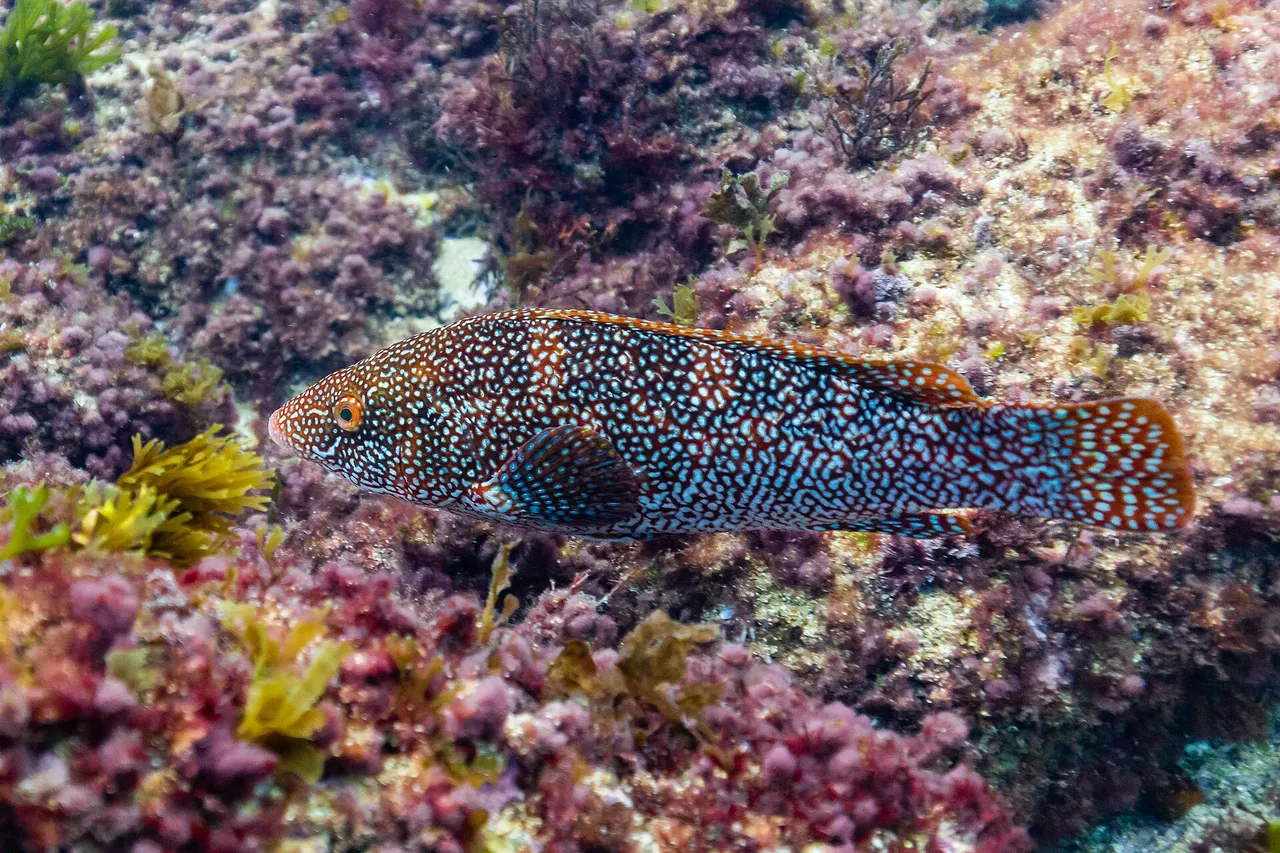
How this was identified, and who took it
Identified by: Complete fish including caudal fin, in habitat. Thick lips, heavy pale-centred scales, long spiny dorsal and rounded tail all legible.Diego Delso — CC BY-SA 4.0, via Wikimedia Commons — source, licenceWhat is known about how it feeds
A ballan wrasse eats things that are armoured, and it does so with a second set of jaws.
The teeth in the mouth grip and pull; the mill that actually breaks shells sits further back, in the throat, as a pharyngeal apparatus of crushing plates. A wrasse takes a mussel or a crab, carries it back, and reduces it. That arrangement is why the species can exploit rock, kelp and mussel beds so completely, and why the two verified prey relationships are molluscs and decapod crustaceans rather than fish.
The behaviour is as distinctive as the anatomy. Wrasse are strongly territorial over a home patch of ground, working the same crevices and kelp stipes day after day, which has a consequence that matters for the animal rather than for the angler: a productive gully stays productive because the same fish are there, and a heavily fished one does not repopulate quickly.
They are strictly diurnal. Feeding stops at dusk and the fish shelters in a crevice overnight, sometimes wedging itself in. There is no nocturnal component to the diet at all, which is unusual among the inshore species FishingHQ covers.
Wrasse are also protogynous — individuals may function first as females and later as males — so the largest fish on a mark are typically old, and removing them changes the local population structure rather than simply reducing its size.
The food
Prey with a verified dietary link to this fish. Each entry carries its own evidence, and each is written at the precision the source actually used: a named species where the source named one, a group or food category where it said “polychaetes”, “crustaceans” or “detritus” and meant it. That is why this list is shorter than the animal’s real diet rather than longer.
- Bivalve and gastropod molluscs as prey — a group rather than a species: the evidence names the group
Ballan wrasse crush shelled molluscs with powerful pharyngeal teeth behind the mouth, which is the specialisation that lets them exploit rocky ground so completely.
- Decapod crustaceans as prey — a group rather than a species: the evidence names the group
Crabs are a major part of the diet and are crushed rather than swallowed whole, which is why a wrasse's mouth does so much damage to a soft bait.
Food with no page of its own here yet
These are real components of the diet, listed as plain text because FishingHQ has no page for them yet. Inventing pages to make the list look fuller would be the fabrication this whole approach exists to prevent.
- barnacles
- sea urchins
- brittlestars
- small hermit crabs
- encrusting invertebrates scraped from kelp
What anglers do with this
Everything below is interpretation, not finding. It is what experienced anglers conclude from the biology above, and the reasoning is usually sound and almost never tested. It is separated from the biology deliberately.
The crushing dentition is the reasoning behind the standard approach of using hard-shelled natural baits, and it is convention with an obvious mechanical basis rather than a tested finding.
The territorial habit is used to argue for moving along a mark rather than fishing one spot out, and the same fact underlies the widespread practice of returning wrasse. That practice is worth more than a tactic here: the combination of site fidelity, slow growth, late maturity and sex change means a mark can be measurably depleted by a small number of anglers, and the sea angling bodies say so.
The curiosity anglers report — repeated inspection before taking — is a genuine and consistently reported behaviour, and it is anecdotal rather than studied.
What this does not establish
Both relationships are recorded at group level, because diet studies report crushed shell to family at best. Nothing here establishes proportions, and diet composition differs between rock, kelp and mixed ground and between the sizes and sexes of the fish. The description is of the north-east Atlantic population.
Where this connects
These are the baits, lures, methods and explainers FishingHQ already joins to this fish — which is why the list is sometimes short. They are not chosen for this page, and a link here means an evidenced relationship exists, not that it follows from the diet.
Baits recorded for this species
Lures recorded for this species
Methods used for it
Where it lives
The science behind the feeding
This page covers feeding. The Ballan wrasse record covers identification, lifecycle, seasonal behaviour, handling and the sources behind all of it.
Reviewed 2026-08-12.