Cuckoo wrasse
Fish · Last reviewed 2026-08-17
The most extravagantly two-coloured fish in British waters, and the reason is that every blue male on the reef began life as an orange female.
Safety: fish welfare — can cause injury needing treatment.
Catching Cuckoo wrasse
Everything here on fishing for it. Each entry opens the page behind it.
- When
- May–Oct — months recorded at the places that document it, not a season for the whole range.
- Where
- 6 places FishingHQ documents — strongest claim anywhere: regular local target · From a kayak, From the shore, From a boat, On a charter
A cuckoo wrasse looks like two different fish, and for most of the twentieth century plenty of people assumed it was.
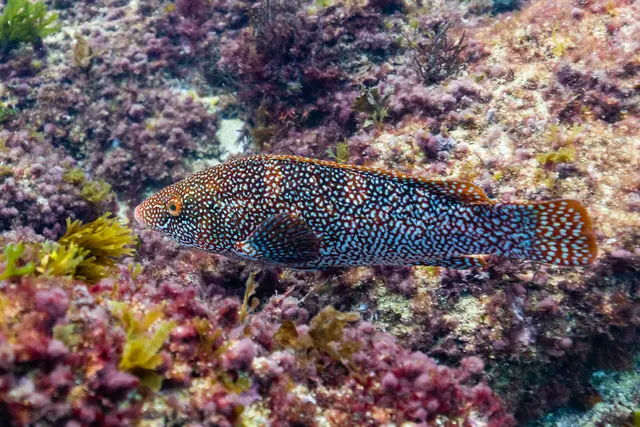
THE FEMALE IS ORANGE-PINK with three dark blotches and white patches across the back of the body. The MALE is electric blue and yellow-orange with irregular blue banding over the head, and looks like something that should be on a tropical reef rather than forty metres down off Pembrokeshire.
THEY ARE ONE SPECIES, AND EVERY MALE USED TO BE A FEMALE. The cuckoo wrasse is a protogynous hermaphrodite: fish mature as females, and some later change sex, changing colour completely as they do. Sex is not fixed at birth in this animal, and the ratio of males to females on a reef is a property of the population rather than of the eggs.
IT IS A DEEPER-WATER WRASSE THAN THE OTHERS. Ballan wrasse are a shore-caught fish; cuckoo wrasse are largely a boat capture over rough ground and reef in ten to a hundred metres, and most British anglers who catch one are fishing for something else at the time.
How it is caught
Gear for this fish
Where Cuckoo wrasse is documented
Places where public sources describe this species as fished, with how it is fished and how strongly the evidence supports it. This is not a range map and it is not a recommendation — it is what has been written down about a fishery rather than a record of any individual catch, and being listed is never permission to fish.
The East Antrim coast
1 documented place
Promenade
Seasonal
From the shore
Around May, Jun, Jul, Aug, Sept, Oct
The Solway Firth
1 documented place
Harbour wall
Repeatedly reported
From a kayak
Around Aug
Observed August 2022
What these strengths mean
- Recorded here
- At least one credible public account of this species being caught here. That is all it means.
- Seasonal
- Well supported, and concentrated in part of the year rather than spread through it.
- Regular local target
- Fishing sources describe this as a normal local target here, not merely as caught.
- Repeatedly reported
- Several independent public accounts. Enough to say it happens more than once; not enough to call it a fishery.
Identification
No photograph of Cuckoo wrasse has passed identity review yet, so none is shown. A photograph is published only once somebody has checked the animal in it against the diagnostic features described on this page.
- Scientific name
- Labrus mixtus
- Family
- Labridae
- Water
- Saltwater
- Conservation status
- Least Concern
- Regions
- Britain & Ireland, Western Europe, Northern Europe, Mediterranean, West Africa
- MALES ARE BLUE. Electric blue and orange-yellow, with irregular blue lines and banding over the head and along the back. Nothing else in British waters looks like it, and the colour is bright rather than subtle.
- FEMALES ARE ORANGE-PINK with three conspicuous dark blotches on the upper rear of the body, usually separated by white. Two fish this different are routinely reported as two species.
- SLIMMER AND MORE ELONGATE THAN A BALLAN WRASSE, with a more pointed head. A ballan is a deep-bodied, heavy fish; a cuckoo is a streamlined one.
- SINGLE LONG DORSAL FIN with a spiny front section running most of the length of the back, as in all wrasse.
- PROTRUDING FRONT TEETH, separate and conical, for picking invertebrates off hard surfaces rather than crushing them.
- A CUCKOO WRASSE FROM A BEACH IS ALMOST CERTAINLY NOT ONE. This is a rough-ground and reef fish of ten metres and deeper; shore captures happen where deep water comes close to rock and are the exception.
Size
- Typical
- 20–30 cm and a few hundred grams.
- Large
- Over 35 cm is a good one.
Exceptional: Around 40 cm is the widely reported maximum for the species. Males run larger than females, which follows directly from the sex change.
Every blue male was an orange female, and what that means for a reef
Sequential hermaphroditism sounds like a curiosity and is in fact the organising fact of this species.
CUCKOO WRASSE ARE PROTOGYNOUS: female first, male later. Fish mature as females at around two to three years. Later in life some of them change sex, and the change is total — gonad, behaviour, and the extraordinary shift from orange-pink with dark blotches to electric blue and yellow.
SO THE BIGGEST FISH ON THE REEF ARE MALES, NECESSARILY. Not because males grow faster, but because a male is by definition an older fish that has already spent years as a female. Size and sex are linked by the life history rather than by growth.
AND THE SEX RATIO IS A PROPERTY OF THE POPULATION, NOT THE EGGS. In a species with fixed sexes, removing the largest fish removes big individuals. In a protogynous one it removes MALES, and the population responds by changing sex earlier and at smaller size. That is a real effect, documented across many protogynous fishes, and it is the reason fisheries scientists treat sex-changing species as a distinct management problem.
WHY THE FISH BOTHERS. The usual explanation is that a large male can defend a nest and monopolise spawning in a way a small one cannot, while a small fish produces more offspring as a female than as an unsuccessful male. Whether an individual switches depends on the social situation on the reef as much as on its age.
THE ANGLING CONSEQUENCE IS SMALL AND WORTH STATING. A nesting male in early summer is guarding eggs and is easy to catch repeatedly from a tiny area. Taking several fish from one patch of reef in June is removing the guarded nests as well as the fish.
Backed by research — why, and the sources (3)
Supported by peer-reviewed research or fisheries science. The sources are listed and can be checked.
- The Fishes of the British Isles and North-West Europe — Macmillan, 1969 (Reference work)Relied on for: Distribution, habitat, identification characters and biology of the fishes of the British Isles and north-west Europe.States this directlyCitation checked — the work exists and is described correctly
- FAO Species Identification Guides for Fishery Purposes and the FAO Species Catalogues — Food and Agriculture Organization of the United Nations (Scientific institute)Relied on for: Diagnostic identification characters, family placement, depth range and distribution as set out in the FAO species identification sheets for the eastern Atlantic and Mediterranean.States this directlyCitation checked — the work exists and is described correctly
- Cefas science, advice and data on marine and freshwater environments — Centre for Environment, Fisheries and Aquaculture Science (Government fisheries body)Relied on for: UK marine fisheries science: survey data, distribution and the biological basis of management advice.States this directlyCitation checked — the work exists and is described correctly
Which British wrasse is which
Britain has five wrasse a shore or boat angler meets, and three of them account for nearly everything caught.
BALLAN WRASSE is the big one: deep-bodied, heavy, green to red-brown with pale-centred scales giving a spotted look, thick lips, and up to sixty centimetres. It is the shore lure fisher's catch and lives in kelp and gully ground within casting distance.
CUCKOO WRASSE is the colourful one, slimmer and more pointed, and lives deeper. A blue-and-orange fish is a male; an orange fish with three dark blotches at the back is a female of the same species.
CORKWING WRASSE is the small one — under twenty centimetres, deep-bodied, greenish-brown with a dark spot on the tail stock and a comma-shaped dark mark behind the eye. It is what a light-tackle angler catches from a harbour wall or rock mark most of the time.
GOLDSINNY is smaller still, slim and reddish-brown with a dark spot at the top of the tail base and another on the front of the dorsal fin. ROCK COOK is smaller again and rarely identified by anyone not looking for it.
THE SHORTCUT THAT ACTUALLY WORKS. Size first: over 35 cm on the shore is a ballan. Then colour: blue means cuckoo. Then the tail-stock mark: a dark spot on the caudal peduncle with a comma behind the eye is a corkwing; a dark spot at the TOP of the tail base with a spot on the dorsal is a goldsinny.
AND WHY THE RED-MULLET TRAP MATTERS. Nothing here is a red mullet, which is not a wrasse and not a mullet either. The name overlap is the reason the grey mullets briefly looked fully covered here — one of the three records it counted was a Mullidae.
What experienced anglers do — why, and the sources (4)
Widely and independently recommended by experienced anglers and specialist sources. This is real angling knowledge, not proof: controlled evidence for it is limited, and FishingHQ records it as convention rather than as a demonstrated effect.
- The Fishes of the British Isles and North-West Europe — Macmillan, 1969 (Reference work)Relied on for: Distribution, habitat, identification characters and biology of the fishes of the British Isles and north-west Europe.States this directlyCitation checked — the work exists and is described correctly
- FAO Species Identification Guides for Fishery Purposes and the FAO Species Catalogues — Food and Agriculture Organization of the United Nations (Scientific institute)Relied on for: Diagnostic identification characters, family placement, depth range and distribution as set out in the FAO species identification sheets for the eastern Atlantic and Mediterranean.States this directlyCitation checked — the work exists and is described correctly
- Sea Angler — Bauer Media (Specialist angling publication)Relied on for: Contemporary UK sea angling practice as reported by practitioners: ground, seasonal timing, bait and method convention.States this directlyCitation checked — the work exists and is described correctly
- General angling website restatements of established technique — Various (Credible secondary source)Relied on for: Widely restated descriptions of species behaviour and regional angling practice, recorded as consensus rather than as scholarship.Background and mechanism onlyCitation checked — the work exists and is described correctly
Lifecycle and reproduction
Cuckoo wrasse are protogynous hermaphrodites. Individuals mature as females at around two to three years; some subsequently change sex to male, a process that involves the reorganisation of the gonad and a complete change of colour and pattern. Because sex change occurs later in life, males are on average older and larger than females, and a reef's largest cuckoo wrasse are its males. The species is relatively long-lived for its size, with ages well into the teens reported. Eggs are shed into a nest and the larvae are planktonic before settling to hard ground.
Males build and defend a nest of algae and small stones in a crevice or depression on rough ground in spring and early summer, court females with an intensified display of the blue and yellow colouring, and guard the eggs after spawning. That is a substantial parental investment by fish standards, and it is why a male is territorial and easily caught from a small area — a fact worth knowing before removing several fish from one mark. Sex change means that removing the largest individuals removes the males, and a population's sex ratio responds to fishing pressure in a way it does not in a species with fixed sexes.
Feeding and senses
A picker rather than a crusher. Cuckoo wrasse take small crustaceans, molluscs, worms and brittle stars from rock, weed and reef surfaces, using protruding front teeth to pull prey off hard substrate and pharyngeal teeth behind to process it. They feed by day and by sight, working over structure. The practical consequence is that they are caught on small baits — worm, crab, mussel, prawn — fished close to rough ground, and that they will take a small lure or jig worked near the bottom over reef.
Vision dominates, which is unusual among the fish on FishingHQ and is bound up with the colour. A fish whose courtship display and whose feeding both depend on seeing detail on a rock face at depth is a visual animal; cuckoo wrasse are day-active and effectively inactive at night, when they wedge into crevices and rest.
Through the year
Resident on rough ground year-round rather than migratory, but far less active in cold water. The fishing is a spring-to-autumn business, and the nesting period in late spring and early summer concentrates males in small defended areas. In winter cuckoo wrasse move into deeper water and feed little.
Distribution
Eastern Atlantic from Norway south to Senegal, including the whole of the British Isles and Ireland, and into the western Mediterranean. Associated with rough ground, reef and rocky substrate, typically in ten to a hundred metres and occasionally deeper. Common around the west and south-west of Britain and Ireland, less so in the southern North Sea where suitable ground is scarcer.
This is a biological range — where the species occurs, not a prediction that you will catch one. To browse the fishing geography FishingHQ holds, start at fishing places.
Why anglers care
Largely a by-catch of boat fishing over reef and rough ground, and a fish most anglers are delighted to see for reasons that have nothing to do with its size. It is also increasingly a target for light-tackle and light rock fishing over deep rock marks, where a small soft plastic worked slowly along the bottom will take them. Its main significance is biological: it is the accessible British example of sequential hermaphroditism, a phenomenon that would otherwise have to be explained with a tropical fish nobody here will ever catch.
Handling and returning
Wrasse are delicate for their apparent toughness. They have large scales that are easily removed, a heavy mucus layer, and — because they are caught over rough ground — a high risk of abrasion during landing. Wet hands, support the body, unhook quickly with forceps and return the fish rather than leaving it in a bucket. Fish caught from any depth may show some barotrauma; a wrasse that will not swim down should be given time in the water rather than thrown. They are territorial nest-builders in early summer, and a mark that produces several males in an hour is a mark that has been emptied of them.
Safety
Fish welfare — Can cause injury needing treatment
Wrasse are territorial residents of a small patch of ground and are nest-guarders in early summer. A mark fished hard for them empties, and it does not refill quickly because the fish do not move far.
What reduces it: Return wrasse, move on after a few fish, and leave nesting males alone in late spring and early summer. Handle with wet hands and unhook with forceps rather than fingers.
Worse when:
- Late spring and early summer, when males are guarding nests
Where to go next
Where it lives
Understanding this fish
- Bivalve and gastropod molluscs as preyMolluscs picked from rock and reef surfaces are a staple of the diet, described in the reference works at group level.
- Decapod crustaceans as preySmall crabs and other decapods taken off hard substrate, described as a group rather than by species.
- Mini species and species huntingA cuckoo wrasse is one of the captures a species hunter most wants, and the branch of fishing that produces it is not organised around size.
Told apart from
 Ballan wrasseThe two large British wrasse. Ballan is deep-bodied, heavy and a shore species; cuckoo is slimmer, more pointed, deeper-water, and the males are blue.
- Corkwing wrasseBoth are wrasse a British angler meets and the confusion runs the other way: a female cuckoo wrasse is orange with dark blotches, a corkwing has a comma behind the eye and a spot on the tail stock.
Sources and evidence
- The Fishes of the British Isles and North-West Europe — Macmillan, 1969 (Reference work)Relied on for: Distribution, habitat, identification characters and biology of the fishes of the British Isles and north-west Europe.States this directlyCitation checked — the work exists and is described correctly
- FAO Species Identification Guides for Fishery Purposes and the FAO Species Catalogues — Food and Agriculture Organization of the United Nations (Scientific institute)Relied on for: Diagnostic identification characters, family placement, depth range and distribution as set out in the FAO species identification sheets for the eastern Atlantic and Mediterranean.States this directlyCitation checked — the work exists and is described correctly
- The IUCN Red List of Threatened Species — International Union for Conservation of Nature (Conservation authority)Relied on for: The global Red List category and the assessment behind it, assessed 30 April 2014. A statement about the species across its range and not about any managed stock.States this directlyCitation checked — the work exists and is described correctly
- Sea Angler — Bauer Media (Specialist angling publication)Relied on for: Contemporary UK sea angling practice as reported by practitioners: ground, seasonal timing, bait and method convention.States this directlyCitation checked — the work exists and is described correctly
Why the 10 connections on this page are here, and the sources
How it is caught
What experienced anglers do — 2 connections
Widely and independently recommended by experienced anglers and specialist sources. This is real angling knowledge, not proof: controlled evidence for it is limited, and FishingHQ records it as convention rather than as a demonstrated effect.
Drift fishing
A statement about how a species is fished, which is angling convention rather than biology and is labelled as such.
- Sea Angler — Bauer Media (Specialist angling publication)Relied on for: Contemporary UK sea angling and shore gathering practice as reported by practitioners: ground, seasonal timing, tackle, bait and method convention.States this directlyCitation checked — the work exists and is described correctly
- General angling website restatements of established technique — Various (Credible secondary source)Relied on for: Widely restated descriptions of technique, fish behaviour and regional practice, recorded as consensus rather than as scholarship.Background and mechanism onlyCitation checked — the work exists and is described correctly
Light rock fishing
A statement about how a species is fished, which is angling convention rather than biology and is labelled as such.
- Sea Angler — Bauer Media (Specialist angling publication)Relied on for: Contemporary UK sea angling and shore gathering practice as reported by practitioners: ground, seasonal timing, tackle, bait and method convention.States this directlyCitation checked — the work exists and is described correctly
- General angling website restatements of established technique — Various (Credible secondary source)Relied on for: Widely restated descriptions of technique, fish behaviour and regional practice, recorded as consensus rather than as scholarship.Background and mechanism onlyCitation checked — the work exists and is described correctly
Gear for this fish
What experienced anglers do — 1 connection
Widely and independently recommended by experienced anglers and specialist sources. This is real angling knowledge, not proof: controlled evidence for it is limited, and FishingHQ records it as convention rather than as a demonstrated effect.
Jigs and jig heads
What anglers actually use a lure for, recorded as convention.
- Sea Angler — Bauer Media (Specialist angling publication)Relied on for: UK shore lure fishing practice: tackle scale, presentation and ground.States this directlyCitation checked — the work exists and is described correctly
- Angling Times — Bauer Media (Specialist angling publication)Relied on for: Contemporary UK angling practice and the adoption of imported techniques as reported in the angling press.States this directlyCitation checked — the work exists and is described correctly
Where it lives
Backed by research — 2 connections
Supported by peer-reviewed research or fisheries science. The sources are listed and can be checked.
Inshore ground
A distributional claim about where a species is found, resting on the standard regional reference works rather than on angling report.
- The Fishes of the British Isles and North-West Europe — Macmillan, 1969 (Reference work)Relied on for: Distribution, habitat association, identification and biology of the fishes and inshore fauna of the British Isles and north-west Europe.States this directlyCitation checked — the work exists and is described correctly
- FAO Species Identification Guides for Fishery Purposes and the FAO Species Catalogues — Food and Agriculture Organization of the United Nations (Scientific institute)Relied on for: Diagnostic characters, family placement, habitat and depth range as set out in the FAO species identification sheets for the eastern Atlantic and Mediterranean.States this directlyCitation checked — the work exists and is described correctly
Rocky shores and reefs
A distributional claim about where a species is found, resting on the standard regional reference works rather than on angling report.
- The Fishes of the British Isles and North-West Europe — Macmillan, 1969 (Reference work)Relied on for: Distribution, habitat association, identification and biology of the fishes and inshore fauna of the British Isles and north-west Europe.States this directlyCitation checked — the work exists and is described correctly
- FAO Species Identification Guides for Fishery Purposes and the FAO Species Catalogues — Food and Agriculture Organization of the United Nations (Scientific institute)Relied on for: Diagnostic characters, family placement, habitat and depth range as set out in the FAO species identification sheets for the eastern Atlantic and Mediterranean.States this directlyCitation checked — the work exists and is described correctly
Understanding this fish
Backed by research — 2 connections
Supported by peer-reviewed research or fisheries science. The sources are listed and can be checked.
Bivalve and gastropod molluscs as prey
A diet claim recorded at group level, pointed at a modelled prey CATEGORY, because the reference works describe the diet as a group rather than by species. Naming a particular species FishingHQ happens to hold would invent a precision the evidence never had.
- The Fishes of the British Isles and North-West Europe — Macmillan, 1969 (Reference work)Relied on for: Distribution, habitat association, identification and biology of the fishes and inshore fauna of the British Isles and north-west Europe.States this directlyCitation checked — the work exists and is described correctly
- FAO Species Identification Guides for Fishery Purposes and the FAO Species Catalogues — Food and Agriculture Organization of the United Nations (Scientific institute)Relied on for: Diagnostic characters, family placement, habitat and depth range as set out in the FAO species identification sheets for the eastern Atlantic and Mediterranean.States this directlyCitation checked — the work exists and is described correctly
Decapod crustaceans as prey
A diet claim recorded at group level, pointed at a modelled prey CATEGORY, because the reference works describe the diet as a group rather than by species. Naming a particular species FishingHQ happens to hold would invent a precision the evidence never had.
- The Fishes of the British Isles and North-West Europe — Macmillan, 1969 (Reference work)Relied on for: Distribution, habitat association, identification and biology of the fishes and inshore fauna of the British Isles and north-west Europe.States this directlyCitation checked — the work exists and is described correctly
- FAO Species Identification Guides for Fishery Purposes and the FAO Species Catalogues — Food and Agriculture Organization of the United Nations (Scientific institute)Relied on for: Diagnostic characters, family placement, habitat and depth range as set out in the FAO species identification sheets for the eastern Atlantic and Mediterranean.States this directlyCitation checked — the work exists and is described correctly
What experienced anglers do — 1 connection
Widely and independently recommended by experienced anglers and specialist sources. This is real angling knowledge, not proof: controlled evidence for it is limited, and FishingHQ records it as convention rather than as a demonstrated effect.
Mini species and species hunting
An explainer that carries the mechanism the subject record depends on.
- Sea Angler — Bauer Media (Specialist angling publication)Relied on for: UK shore lure fishing practice: tackle scale, presentation and ground.States this directlyCitation checked — the work exists and is described correctly
- Angling Times — Bauer Media (Specialist angling publication)Relied on for: Contemporary UK angling practice and the adoption of imported techniques as reported in the angling press.States this directlyCitation checked — the work exists and is described correctly
Told apart from
What experienced anglers do — 2 connections
Widely and independently recommended by experienced anglers and specialist sources. This is real angling knowledge, not proof: controlled evidence for it is limited, and FishingHQ records it as convention rather than as a demonstrated effect.
Ballan wrasse
A comparison a reader with the animal or the decision in front of them actually needs, joining two records that resolve one another.
- The Fishes of the British Isles and North-West Europe — Macmillan, 1969 (Reference work)Relied on for: Distribution, habitat association, identification and biology of the fishes and inshore fauna of the British Isles and north-west Europe.States this directlyCitation checked — the work exists and is described correctly
- FAO Species Identification Guides for Fishery Purposes and the FAO Species Catalogues — Food and Agriculture Organization of the United Nations (Scientific institute)Relied on for: Diagnostic characters, family placement, habitat and depth range as set out in the FAO species identification sheets for the eastern Atlantic and Mediterranean.States this directlyCitation checked — the work exists and is described correctly
Corkwing wrasse
A comparison a reader with the animal or the decision in front of them actually needs, joining two records that resolve one another.
- The Fishes of the British Isles and North-West Europe — Macmillan, 1969 (Reference work)Relied on for: Distribution, habitat association, identification and biology of the fishes and inshore fauna of the British Isles and north-west Europe.States this directlyCitation checked — the work exists and is described correctly
- FAO Species Identification Guides for Fishery Purposes and the FAO Species Catalogues — Food and Agriculture Organization of the United Nations (Scientific institute)Relied on for: Diagnostic characters, family placement, habitat and depth range as set out in the FAO species identification sheets for the eastern Atlantic and Mediterranean.States this directlyCitation checked — the work exists and is described correctly
Backed by research — 2 connections
Supported by peer-reviewed research or fisheries science. The sources are listed and can be checked.
Ballan wrasse
Taxonomic and practical relatedness recorded because confusable species matter more to a reader than a shared family does, with the evidence naming the species the edge is about.
- The Fishes of the British Isles and North-West Europe — Macmillan, 1969 (Reference work)Relied on for: Identification characters, family placement and biology of Labrus bergylta and of the species it is confused with, as set out for the fauna of the British Isles and north-west Europe.States this directlyCitation checked — the work exists and is described correctly
- FAO Species Identification Guides for Fishery Purposes and the FAO Species Catalogues — Food and Agriculture Organization of the United Nations (Scientific institute)Relied on for: Diagnostic characters and family placement of Labrus bergylta as set out in the FAO species identification sheets for the region concerned.States this directlyCitation checked — the work exists and is described correctly
Corkwing wrasse
Taxonomic and practical relatedness recorded because confusable species matter more to a reader than a shared family does, with the evidence naming the species the edge is about.
- The Fishes of the British Isles and North-West Europe — Macmillan, 1969 (Reference work)Relied on for: Identification characters, family placement and biology of Labrus mixtus and of the species it is confused with, as set out for the fauna of the British Isles and north-west Europe.States this directlyCitation checked — the work exists and is described correctly
- FAO Species Identification Guides for Fishery Purposes and the FAO Species Catalogues — Food and Agriculture Organization of the United Nations (Scientific institute)Relied on for: Diagnostic characters and family placement of Labrus mixtus as set out in the FAO species identification sheets for the region concerned.States this directlyCitation checked — the work exists and is described correctly
How FishingHQ labels evidence is explained in the evidence policy.