Common sole
Fish · Last reviewed 2026-08-10
A nocturnal, sand-dwelling flatfish with a rounded head and a small twisted mouth, and one of the most valuable food fish in European waters.
Safety: tides and being cut off — can cause serious injury or death. 5 more points apply here.
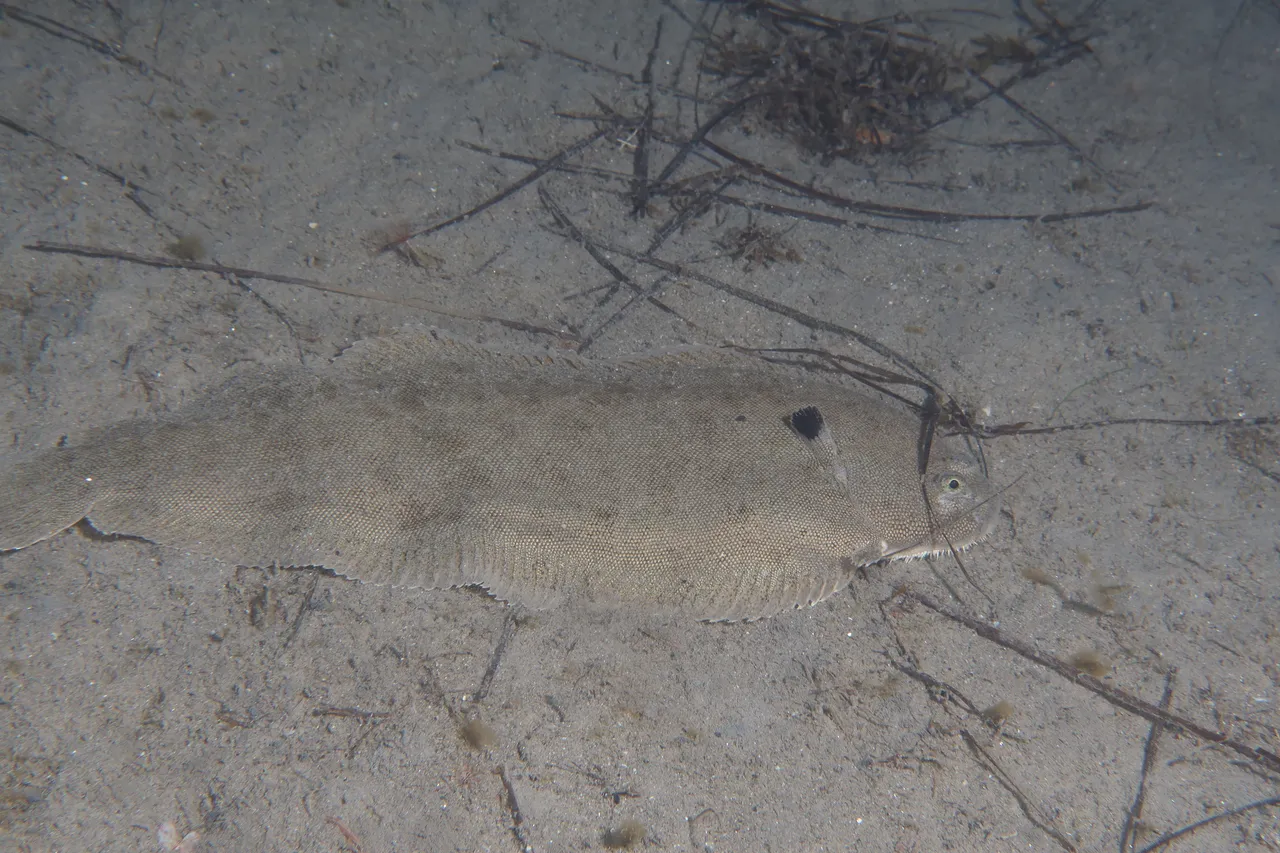
How this was identified, and who took it
Identified by: Small eyes set close together on the RIGHT side of a rounded head, on an elongate oval body with dorsal and anal fins running almost its full length, plus a distinct dark blotch on the pectoral fin. Critically the fin margins carry NO regularly darkened rays, which rules out the solenette pattern that caused a sibling candidate to be refused.Julien Renoult — CC BY, via iNaturalist — source, licenceCatching Common sole
Everything here on fishing for it. Each entry opens the page behind it.
- When
- May–Oct — months recorded at the places that document it, not a season for the whole range.
- Where
- 38 places FishingHQ documents — strongest claim anywhere: regular local target · From the shore
The common sole — sold as Dover sole, though its association with that port is commercial rather than biological — is the most valuable flatfish in European seas and one of the more distinctive.
It is shaped quite unlike a plaice or a flounder: an elongated oval with a rounded head, the eyes small and close together on the right side, and a small mouth twisted round onto the blind side. That mouth arrangement is the key to its feeding: soles are nocturnal bottom feeders that root worms and small crustaceans out of sand and mud, working with their heads down in the sediment, and the mouth has migrated to suit.
They are almost entirely nocturnal, which is the single most useful thing an angler can know about them. Sole fishing is night fishing over clean sand with small baits and small hooks, and daylight attempts over the same ground catch almost nothing. The bait of choice across their range is ragworm or lugworm, presented small and hard on the bottom.
Commercially they are heavily fished and stock status varies substantially between management areas, with several stocks having been depleted and subject to recovery measures.
How it is caught
Where Common sole is documented
Places where public sources describe this species as fished, with how it is fished and how strongly the evidence supports it. This is not a range map and it is not a recommendation — it is what has been written down about a fishery rather than a record of any individual catch, and being listed is never permission to fish.
The Thames Estuary
6 documented places
Pier
Recorded here
From the shore
Pier
Seasonal
From the shore
Around Jun, Jul, Aug, Sept
Beach
Regular local target
From the shore
Around May, Jun, Jul, Aug, Sept
Beach
Recorded here
From the shore
Beach
Recorded here
From the shore
Estuary mark
Recorded here
From the shore
The Channel shingle coasts
5 documented places
Shingle bank
Seasonal
From the shore
Around May, Jun, Jul, Aug, Sept
Pier
Seasonal
From the shore
Around May, Jun, Jul, Aug, Sept
Beach section
Regular local target
From the shore
Around May, Jun, Jul, Aug, Sept
Beach
Regular local target
From the shore
Around May, Jun, Jul, Aug, Sept
Pier
Recorded here
From the shore
The Severn Estuary
4 documented places
Estuary mark
Recorded here
From the shore
Rock mark
Seasonal
From the shore
Around Jun, Jul, Aug, Sept
Beach
Seasonal
From the shore
Around Jun, Jul, Aug, Sept
Estuary mark
Regular local target
From the shore
Chesil Beach
2 documented places
Beach section
Regular local target
From the shore
Around May, Jun, Jul, Aug, Sept, Oct
Beach section
Regular local target
From the shore
Around May, Jun, Jul, Aug, Sept, Oct
Also documented on 7 more coasts
Fewer places each, or less strongly supported. Each one names its own marks.
The Norfolk and Suffolk sandbank coast (7) · The Cornish and Devon coasts (5) · Weymouth Bay (1) · The north-east England coast (1) · Portugal (1) · The Welsh coast and Anglesey (1) · Morecambe Bay and the north-west England coast (1)
What these strengths mean
- Recorded here
- At least one credible public account of this species being caught here. That is all it means.
- Seasonal
- Well supported, and concentrated in part of the year rather than spread through it.
- Regular local target
- Fishing sources describe this as a normal local target here, not merely as caught.
When to fish for common sole
Where the places here state a season for common sole, it clusters in May–Sep. This is a count of how many documented places name each month — evidence about when people fish for it, not a prediction of what any particular day will produce.
| Jan | Feb | Mar | Apr | May | Jun | Jul | Aug | Sep | Oct | Nov | Dec |
|---|---|---|---|---|---|---|---|---|---|---|---|
| January: no place here names this month — no place names it. | February: no place here names this month — no place names it. | March: no place here names this month — no place names it. | April: no place here names this month — no place names it. | May: 10 places name this month — some places. | June: 17 places name this month — most places. | July: 17 places name this month — most places. | August: 17 places name this month — most places. | September: 17 places name this month — most places. | October: 3 places name this month — few places. | November: no place here names this month — no place names it. | December: no place here names this month — no place names it. |
17 of the 38 places that record catches of common sole state which months. The other 21 name no season, so they are counted in neither direction: the shape above is what the dated records say, not the whole picture. The dated records span 7 separate areas.
Identification
- Scientific name
- Solea solea
- Family
- Soleidae
- Water
- Saltwater, Brackish
- Conservation status
- Not assessed
- Regions
- Western Europe, Britain & Ireland, Northern Europe, Mediterranean, North Africa, West Africa
- Elongated oval body with a rounded head, the eyes small and close together on the RIGHT side.
- A small mouth twisted round onto the blind side, adapted to feeding head-down in sediment.
- Dorsal and anal fins running almost the whole length of the body and joining the tail fin, without a clear gap.
- Brown with darker irregular blotches on the eyed side; a distinct black spot at the tip of the pectoral fin on the eyed side.
- Separated from other soles and from dab and flounder by the joined fins, the twisted mouth and the pectoral spot.
Size
- Typical
- 200–400 g (7–14 oz)
- Large
- 500–800 g (1.1–1.8 lb)
Exceptional: Over 1.2 kg (2.6 lb); maximum published weight 3 kg
A small fish with a real spine, caught in a place that catches people out
Sole handling is straightforward and the fishery around it is where the risk actually is.
THE FISH. Small, flat, slippery, with a small mouth on the underside and no capacity to injure anybody seriously. There is a short sharp spine on the gill cover that will prick a hand gripping the head, and the skin is rough. Handle it flat with a wet hand, unhook with forceps because the mouth is small and the hook is often well in, and support the body.
THEY ARE DELICATE FOR THEIR SIZE. Sole are usually taken on small hooks and light gear, and a small flatfish dropped on shingle or dragged up a beach is damaged. Wet hands, and back in the water promptly.
THE FISHERY IS THE HAZARD. Sole are fished at night, from beaches, on a flooding tide, in the dark, often in cold conditions, frequently by anglers wading to reach the ground. Every element of that is a recognised risk factor: cold water immersion, a tide that cuts off ground behind you, and reduced visibility. Sole fishing has put more people in difficulty than sole have ever inconvenienced.
SO THE HANDLING INTELLIGENCE FOR THIS SPECIES IS MOSTLY ABOUT THE SESSION. Know the tide and the exit before dark, do not wade beyond what you would wade in daylight, tell somebody where you are, and carry a light and a means of calling for help.
What experienced anglers do — why, and the sources (2)
Widely and independently recommended by experienced anglers and specialist sources. This is real angling knowledge, not proof: controlled evidence for it is limited, and FishingHQ records it as convention rather than as a demonstrated effect.
- FishBase: a global information system on fishes — Froese, R. and D. Pauly, eds. — FishBase Consortium (Scientific institute)Relied on for: Dentition, fin and spine morphology, body form, air-breathing capability and distribution for the species, which are the anatomical facts the handling practice below follows from.States this directlyPassage read and verified
- General angling website restatements of established technique — Various (Credible secondary source)Relied on for: Widely restated angling practice for handling this species, recorded as practitioner consensus rather than as tested fact.Background and mechanism onlyCitation checked — the work exists and is described correctly
A night fishery over clean sand, and the tide that brings the fish up the beach
Sole have a seasonal pattern that is straightforward and a daily pattern that is the whole of the fishery, and confusing the two is the commonest reason people fail to catch them.
THE SEASON IS AN INSHORE MOVEMENT. Sole move into shallow, clean sandy ground in the warmer months and retreat into deeper water as it cools, with spawning inshore in spring. That gives a shore fishery concentrated in the warm half of the year — but the fish are not arriving from far away, and the movement is a response to temperature rather than a migration in any strong sense.
THE DAILY PATTERN IS WHERE THE FISHING ACTUALLY IS, and it has two components that must both be right.
DARKNESS FIRST. Sole are nocturnal benthic feeders. They lie buried through the day and emerge after dark to work over sand for polychaete worms and small crustaceans, locating them by touch and by taste with the sensory papillae on the blind side of the head rather than by sight. This is a fish that finds its food in the dark by feel, and it does not do so in daylight. A sole beach in the afternoon is empty of catchable sole.
TIDE SECOND. As the flood covers ground that was dry, it opens fresh feeding — worm beds that were exposed, invertebrates becoming active in newly wetted sand — and sole move up the beach with the water to work it. The fishing therefore follows the tide up the beach rather than staying at a fixed distance, and casting a long way to where the fish were two hours ago is the standard error.
WHICH MAKES THE HAZARD PART OF THE SAME PATTERN. This is a fishery conducted at night, on a flooding tide, over featureless sand, frequently by anglers wading to reach ground — and ground that is flooding behind you in the dark is the specific circumstance that puts shore anglers in difficulty. The tide that makes the fishing is the tide to have worked out before dark.
What experienced anglers do — why, and the sources (4)
Widely and independently recommended by experienced anglers and specialist sources. This is real angling knowledge, not proof: controlled evidence for it is limited, and FishingHQ records it as convention rather than as a demonstrated effect.
- The Fishes of the British Isles and North-West Europe — Macmillan, 1969 (Reference work)Relied on for: Seasonal distribution and inshore–offshore movement of fishes in British and north-west European waters.States this directlyCitation checked — the work exists and is described correctly
- Sea Angler — Bauer Media (Specialist angling publication)Relied on for: Established seasonal practice in the British and Irish shore and boat fisheries.Background and mechanism onlyCitation checked — the work exists and is described correctly
- NOAA Ocean Service tides and water levels educational tutorial — National Oceanic and Atmospheric Administration, United States (Government fisheries body)Relied on for: Tidal generation, the spring–neap cycle, and the relationship between tidal range and tidal stream velocity.States this directlyPassage read and verified
- FishBase: a global information system on fishes — Froese, R. and D. Pauly, eds. — FishBase Consortium (Scientific institute)Relied on for: Habitat association and feeding behaviour recorded for the species.Background and mechanism onlyPassage read and verified
Buried in fine sediment, and a fish whose habitat is a nursery problem
Sole habitat is easy to summarise and worth explaining, because the parts that matter to the population are not the parts an angler encounters.
THE ADULT GROUND IS SOFT: FINE SAND, MUDDY SAND AND MUD. Sole are flatfish that bury, and they bury properly — a sole spends daylight under the sediment with only the eyes exposed, and it needs sediment fine enough to submerge in. That excludes coarse gravel and shingle ground, which is why sole and plaice, superficially similar fish, occupy noticeably different bottoms and are caught on different marks along the same coast.
DEPTH IS MODEST AND SEASONAL. Sole occupy shallow shelf water, moving into shallower inshore ground and estuaries as water warms and retreating to deeper water in winter. That movement is temperature-driven rather than calendar-driven, which is why the inshore sole season shifts between years.
THE FEEDING MODE EXPLAINS THE GROUND AND THE FISHING. Sole feed at night on polychaete worms, small bivalves and crustaceans in the sediment, locating them by touch and chemistry with the sensory papillae on the blind side of the head rather than by sight. A soft bottom rich in worms is sole habitat; a clean scoured bottom is not. It is also why sole are overwhelmingly a night fishery on small baits presented on the bottom.
THE NURSERY HABITAT IS THE PART THAT DECIDES THE POPULATION, and it is estuarine and coastal shallows. Juvenile sole settle into very shallow, warm, sheltered, fine-sediment ground — the inner reaches of estuaries and shallow bays — and spend their first years there before moving out. Those areas are also where dredging, reclamation, port development and poor water quality concentrate, so the constraint on many sole stocks is nursery ground rather than adult ground.
SALINITY TOLERANCE IS BROAD ENOUGH TO MAKE THAT POSSIBLE. Sole handle reduced salinity well and penetrate estuaries substantially, which is what gives them access to those warm productive nurseries in the first place.
AND THE HABITAT IS WHY THE FISH IS WHERE IT IS ON A BEACH. On a surf beach a sole will be in the fine sediment of a gutter or a trough rather than on the scoured bar, and on an estuary it will be on the mud rather than the channel gravel. The ground, not the location, is the thing to read.
Backed by research — why, and the sources (2)
Supported by peer-reviewed research or fisheries science. The sources are listed and can be checked.
- The Fishes of the British Isles and North-West Europe — Macmillan, 1969 (Reference work)Relied on for: Habitat association, depth and ground type of fishes in British and north-west European waters.States this directlyCitation checked — the work exists and is described correctly
- FishBase: a global information system on fishes — Froese, R. and D. Pauly, eds. — FishBase Consortium (Scientific institute)Relied on for: Habitat association, depth range and substrate preference recorded for the species.States this directlyPassage read and verified
A flatfish that spawns as a round fish would, and a larva that has to rebuild itself
Sole reproduction contains one of the most striking transformations in fish biology, and it explains why the species' recruitment depends on places adults never visit.
SPAWNING IS A BROADCAST EVENT IN SHALLOW COASTAL WATER. Sole move to shallow spawning grounds as water warms in spring, and eggs are released into the water column where they are fertilised and float. That is worth noticing: the adult is a bottom-dwelling, buried, asymmetric animal, and its eggs behave like those of an ordinary pelagic-spawning fish.
THE LARVA HATCHES SYMMETRICAL AND THEN REBUILDS ITSELF. A newly hatched sole is a normal bilaterally symmetrical fish larva swimming upright in the plankton with an eye on each side. During metamorphosis one eye migrates across the skull to join the other, the body flattens, pigment develops on one side only, and the animal settles onto the bottom to live on its side for the rest of its life. Very few vertebrates reorganise their skull during development; this one does it as a matter of course.
WHERE IT SETTLES IS WHAT DECIDES THE YEAR CLASS. The drifting larvae must be transported to shallow, warm, fine-sediment coastal and estuarine nursery ground, and settlement success depends on currents and wind delivering them there at the right stage. Good and bad year classes in sole are substantially a transport-and-nursery story, and the adult stock size explains less of the variation than people expect.
WHICH MAKES ESTUARINE NURSERY HABITAT THE LIMITING FACTOR FOR MANY STOCKS. Reclamation, dredging, port development and poor water quality in exactly those shallow inner areas reduce the amount of ground available to a settling sole, and the effect appears in the fishery several years later.
MATURITY IS REACHED AT A MODEST SIZE AND FEMALES GROW LARGER THAN MALES, with fecundity rising steeply with body size — so a large female contributes disproportionately to the spawning output.
AND THE MANAGEMENT PICTURE IS SEPARATE FROM ALL OF IT. Sole stocks are assessed and managed with quotas, gear rules, size limits and area measures that differ by sea area and change; nothing in the biology above indicates what any current recreational or commercial rule is.
Backed by research — why, and the sources (2)
Supported by peer-reviewed research or fisheries science. The sources are listed and can be checked.
- ICES Advice on fishing opportunities, catch and effort — International Council for the Exploration of the Sea (Scientific institute)Relied on for: Stock assessment and advice, including spawning stock biomass, recruitment and the reproductive parameters the assessment rests on.States this directlyCitation checked — the work exists and is described correctly
- FishBase: a global information system on fishes — Froese, R. and D. Pauly, eds. — FishBase Consortium (Scientific institute)Relied on for: Spawning season, fecundity, maturity and larval development for the species.Background and mechanism onlyPassage read and verified
Lifecycle and reproduction
Grows slowly and lives to around twenty-six years. Matures at three to five years. Spawns in shallow coastal water in spring, with pelagic eggs and larvae that undergo the flatfish metamorphosis, one eye migrating across the head as the fish settles. Juveniles use very shallow sandy nursery grounds, which links the offshore adult stock to inshore habitat condition.
Broadcast spawning in shallow coastal waters in spring, with pelagic eggs and larvae. Juveniles settle onto very shallow sandy grounds and remain there through their first years, so the loss or degradation of shallow nursery habitat affects recruitment independently of anything happening to the adults.
Feeding and senses
A nocturnal bottom feeder taking marine worms, small crustaceans and molluscs from and within sand and mud, working head-down with a small twisted mouth adapted to the task. The nocturnal habit is near-absolute and is the reason the fishery is a night fishery — a sole feeding is a sole that has emerged after dark.
Adapted to feeding in darkness in and on sediment, relying on touch and chemical detection through a fringe of sensory papillae on the blind side of the head rather than on sight. That sensory arrangement is why small, scent-rich baits fished hard on the bottom work and why visual presentation is irrelevant.
Through the year
Moves inshore into shallow sandy ground in the warmer months and offshore into deeper water in winter, with spawning inshore in spring. The shore fishery is a summer and autumn night fishery over clean sand. Tide governs the session, with fish moving up the beach to feed as the water covers the ground.
Distribution
Eastern Atlantic: from Norway and the North Sea south to Senegal, including the Mediterranean and the western Black Sea. A demersal species of sand and mud bottoms, generally shallower than about 150 m and often much shallower.
This is a biological range — where the species occurs, not a prediction that you will catch one. To browse the fishing geography FishingHQ holds, start at fishing places.
Why anglers care
A specialist night fishery over clean sand across northern Europe, taken on small hooks with ragworm or lugworm fished hard on the bottom, from beaches and estuaries. Highly valued as a table fish and heavily fished commercially, which makes recreational catches a small part of the picture but a well-loved one.
Handling and returning
A small fish with no dangerous spines or teeth. Wet hands and support the body. Sole take small baits properly and are frequently hooked well back, so a disgorger is useful. If retaining, chill promptly. Undersized fish are common on the same ground and should be returned quickly and gently.
Going further
- What does common sole eat? — feeding biology, kept separate from what anglers infer from it.
- Common sole vs European plaice — how to tell them apart.
Safety
Tides and being cut off — Can cause serious injury or death
This is night fishing over open sand and estuary flats on a rising tide, with attention on the rod rather than on the water, which is the classic cut-off scenario made worse by darkness.
What reduces it: Check tide times and heights before going out. Identify the exit and the route back before dark. Leave on a set clock time. Carry a light and tell somebody where you are.
Cold water shock — Can cause injury needing treatment
Autumn and winter night beach fishing in northern Europe puts anglers beside cold water in the dark, where immersion incapacitates quickly.
What reduces it: Wear a buoyancy aid where wading or on steep ground. Do not wade in the dark on unfamiliar beaches. Carry a means of calling for help.
Precautions that always apply here
- Check the tide before you go and know your exit route. Being cut off is the commonest way a shore session becomes a rescue.
- Wear a buoyancy aid or lifejacket. Cold water incapacitates strong swimmers within a minute, long before swimming ability matters.
- Tell somebody where you are going and when you expect to be back.
- Carry a charged phone in a waterproof case, or another means of calling for help.
Check the rules before you fish
Fishing laws, bylaws, access rules, seasons, bait restrictions and permitted methods vary by location and can change. Check the current rules from the relevant authority and the water you intend to fish before fishing.
Check with:
- Current national or regional law for where you are fishing
- Current local bylaws
- The relevant fisheries authority
- The landowner, club or fishery whose water it is
- Any restrictions specific to the species or the method you intend to use
Where to go next
Similar and related fish
Where you will find it
- Chesil BeachOccupies the softer clean ground offshore of the beach, feeding at night over sand.
- FranceUses the extensive clean sandy ground of the Atlantic and Channel coasts, supporting both a commercial fishery and a shore night fishery over it.
- The Bay of BiscayUses the extensive clean sandy ground of the French coast, and supports both a commercial fishery and a shore night fishery over it.
- The Channel shingle coastsFeeds over the finer sediment beyond the shingle face at night, moving up as the flood covers ground, which is the basis of the shore night fishery here.
- The Moroccan Atlantic coastOccupies the clean sand offshore of the long Atlantic beaches, feeding at night over soft ground.
- The Thames EstuaryOver clean sand in the outer estuary, taken at night in the warmer months. The estuary's flats are also a significant nursery for the species well beyond its own waters.
- The Wadden SeaAs with plaice, the flats are significant juvenile habitat and the species is fished as an adult over a much wider area than it is grown in.
- The Wash and the Lincolnshire coastAs with plaice, the bay is significant juvenile habitat, and adults are taken at night over clean sand along the Lincolnshire beaches through the warmer months.
Understanding this fish
- Amphipods and mysids as preySmall crustaceans make up the balance of the diet, particularly in juveniles on estuarine and nearshore nursery ground.
- Polychaete worms as preySole feed at night on buried invertebrates located by touch and chemoreception rather than by sight, with polychaetes the dominant item.
Sources and evidence
- FishBase: a global information system on fishes — Froese, R. and D. Pauly, eds. — FishBase Consortium (Scientific institute)Relied on for: Scientific name, family placement in the Soleidae, a maximum length of 70.0 cm SL, a maximum published weight of 3.0 kg, a maximum reported age of 26 years.States this directlyPassage read and verified
- FishBase: a global information system on fishes — Froese, R. and D. Pauly, eds. — FishBase Consortium (Scientific institute)Relied on for: Environment, climate zone and depth range as recorded: Marine; brackish; demersal; oceanodromous ; depth range 0 - 150 m , usually 10 - 60 m . Subtropical; 8°C - 24°C ; 64°N - 14°N, 25°W - 38°EStates this directlyPassage read and verified
- ICES Advice on fishing opportunities, catch and effort — International Council for the Exploration of the Sea (Scientific institute)Relied on for: That North East Atlantic sole stocks are assessed as separate management units through international scientific advice, with status varying between them.States this directlyCitation checked — the work exists and is described correctly
- The Fishes of the British Isles and North-West Europe — Macmillan, 1969 (Reference work)Relied on for: The morphology, nocturnal feeding habit and sandy-ground habitat of Solea solea.States this directlyCitation checked — the work exists and is described correctly
Why the 13 connections on this page are here, and the sources
Similar and related fish
Backed by research — 1 connection
Supported by peer-reviewed research or fisheries science. The sources are listed and can be checked.
European plaice
An identification and behavioural comparison naming both binomials.
- FishBase: a global information system on fishes — Froese, R. and D. Pauly, eds. — FishBase Consortium (Scientific institute)Relied on for: That Solea solea and Pleuronectes platessa are both right-eyed flatfish of sand and mud bottoms in the North East Atlantic.States this directlyPassage read and verified
- The Fishes of the British Isles and North-West Europe — Macmillan, 1969 (Reference work)Relied on for: The morphological separation of sole from plaice by fin arrangement and mouth structure, and their differing activity patterns.States this directlyCitation checked — the work exists and is described correctly
How it is caught
What experienced anglers do — 2 connections
Widely and independently recommended by experienced anglers and specialist sources. This is real angling knowledge, not proof: controlled evidence for it is limited, and FishingHQ records it as convention rather than as a demonstrated effect.
Ledgering
The page names estuaries beside beaches. In an estuary the presentation is a static bottom bait at short range, and the small hooks matter more than the cast.
- Sea Angler — Bauer Media (Specialist angling publication)Relied on for: Documents which fishery and which technique takes this species.States this directlyCitation checked — the work exists and is described correctly
- FishBase: a global information system on fishes — Froese, R. and D. Pauly, eds. — FishBase Consortium (Scientific institute)Relied on for: Independently corroborates the species' recreational capture and range.Background and mechanism onlyPassage read and verified
Surfcasting
The page names small hooks, ragworm or lugworm, hard on the bottom, from beaches and estuaries, at night. That is a specific and well-defined shore fishery rather than a general one.
- Sea Angler — Bauer Media (Specialist angling publication)Relied on for: Documents which fishery and which technique takes this species.States this directlyCitation checked — the work exists and is described correctly
- FishBase: a global information system on fishes — Froese, R. and D. Pauly, eds. — FishBase Consortium (Scientific institute)Relied on for: Independently corroborates the species' recreational capture and range.Background and mechanism onlyPassage read and verified
Where you will find it
Backed by research — 8 connections
Supported by peer-reviewed research or fisheries science. The sources are listed and can be checked.
Chesil Beach
A distribution association between an animal and a kind of water, rather than a claim about any named mark.
- The Fishes of the British Isles and North-West Europe — Macmillan, 1969 (Reference work)Relied on for: Distribution, habitat association, depth and ground preference of fishes in British and north-west European waters.States this directlyCitation checked — the work exists and is described correctly
- FishBase: a global information system on fishes — Froese, R. and D. Pauly, eds. — FishBase Consortium (Scientific institute)Relied on for: Distribution, habitat association and depth range recorded for the species.Background and mechanism onlyPassage read and verified
France
Occurrence of the species in these waters: a statement about the animal's distribution, not a venue recommendation.
- The Fishes of the British Isles and North-West Europe — Macmillan, 1969 (Reference work)Relied on for: Distribution and habitat association of fishes in north-west European and eastern Atlantic waters.States this directlyCitation checked — the work exists and is described correctly
- FishBase: a global information system on fishes — Froese, R. and D. Pauly, eds. — FishBase Consortium (Scientific institute)Relied on for: Distribution, depth range and habitat association recorded for the species.States this directlyPassage read and verified
The Bay of Biscay
Occurrence of the species in this system or along this coast: a statement about the animal's distribution, not a venue recommendation.
- The Fishes of the British Isles and North-West Europe — Macmillan, 1969 (Reference work)Relied on for: Distribution and habitat association of fishes in British and north-west European waters.States this directlyCitation checked — the work exists and is described correctly
- FishBase: a global information system on fishes — Froese, R. and D. Pauly, eds. — FishBase Consortium (Scientific institute)Relied on for: Distribution, depth range and habitat association recorded for the species.States this directlyPassage read and verified
The Channel shingle coasts
Occurrence of the species in this system or along this coast: a statement about the animal's distribution, not a venue recommendation.
- The Fishes of the British Isles and North-West Europe — Macmillan, 1969 (Reference work)Relied on for: Distribution and habitat association of fishes in British and north-west European waters.States this directlyCitation checked — the work exists and is described correctly
- FishBase: a global information system on fishes — Froese, R. and D. Pauly, eds. — FishBase Consortium (Scientific institute)Relied on for: Distribution, depth range and habitat association recorded for the species.States this directlyPassage read and verified
The Moroccan Atlantic coast
A distribution association between an animal and a kind of water, rather than a claim about any named mark.
- FAO Species Identification Guides for Fishery Purposes and the FAO Species Catalogues — Food and Agriculture Organization of the United Nations (Scientific institute)Relied on for: Distribution, habitat, depth and fishery accounts for the species of the eastern central Atlantic and Mediterranean in the FAO regional identification guides.States this directlyCitation checked — the work exists and is described correctly
- FishBase: a global information system on fishes — Froese, R. and D. Pauly, eds. — FishBase Consortium (Scientific institute)Relied on for: Distribution, habitat association and depth range recorded for the species.States this directlyPassage read and verified
The Thames Estuary
A claim that a place contains the ground, water and seasonal conditions the species is associated with. It is a distributional statement about the world, it rests on the regional reference literature, and it deliberately asserts nothing about access, permission or catch.
- The Fishes of the British Isles and North-West Europe — Macmillan, 1969 (Reference work)Relied on for: Distribution and habitat association of the marine, estuarine and freshwater fishes of the British Isles, including which coasts, estuaries and ground types a species occupies.States this directlyCitation checked — the work exists and is described correctly
- FishBase: a global information system on fishes — Froese, R. and D. Pauly, eds. — FishBase Consortium (Scientific institute)Relied on for: Recorded distribution, depth range and habitat association for the species named.States this directlyPassage read and verified
The Wadden Sea
A claim that a place contains the ground, water and seasonal conditions the species is associated with. It is a distributional statement about the world, it rests on the regional reference literature, and it deliberately asserts nothing about access, permission or catch.
- JNCC species and habitat conservation advice — Joint Nature Conservation Committee (Conservation authority)Relied on for: Habitat classification and description for the intertidal, coastal and freshwater habitats named, and the species characteristically associated with them.States this directlyCitation checked — the work exists and is described correctly
- ICES Advice on fishing opportunities, catch and effort — International Council for the Exploration of the Sea (Scientific institute)Relied on for: Ecoregion description, nursery function and the hydrography of the European sea areas assessed.States this directlyCitation checked — the work exists and is described correctly
The Wash and the Lincolnshire coast
A claim that a place contains the ground, water and seasonal conditions the species is associated with. It is a distributional statement about the world, it rests on the regional reference literature, and it deliberately asserts nothing about access, permission or catch.
- The Fishes of the British Isles and North-West Europe — Macmillan, 1969 (Reference work)Relied on for: Distribution and habitat association of the marine, estuarine and freshwater fishes of the British Isles, including which coasts, estuaries and ground types a species occupies.States this directlyCitation checked — the work exists and is described correctly
- FishBase: a global information system on fishes — Froese, R. and D. Pauly, eds. — FishBase Consortium (Scientific institute)Relied on for: Recorded distribution, depth range and habitat association for the species named.States this directlyPassage read and verified
Understanding this fish
Backed by research — 2 connections
Supported by peer-reviewed research or fisheries science. The sources are listed and can be checked.
Amphipods and mysids as prey
Recorded diet evidence identifies amphipods and mysids as a food item of this predator at group level rather than to species. The edge points at the taxon record for that reason, and encoding it as a species-level claim would assert something the source does not.
- FishBase: a global information system on fishes — Froese, R. and D. Pauly, eds. — FishBase Consortium (Scientific institute)Relied on for: Food items recorded for this predator, given as amphipods and mysids.States this directlyPassage read and verified
- FAO Species Identification Guides for Fishery Purposes and the FAO Species Catalogues — Food and Agriculture Organization of the United Nations (Scientific institute)Relied on for: Species account describing this predator's diet, recorded at the level of amphipods and mysids.Background and mechanism onlyCitation checked — the work exists and is described correctly
Polychaete worms as prey
Recorded diet evidence identifies polychaete worms as a food item of this predator at group level rather than to species. The edge points at the taxon record for that reason, and encoding it as a species-level claim would assert something the source does not.
- FishBase: a global information system on fishes — Froese, R. and D. Pauly, eds. — FishBase Consortium (Scientific institute)Relied on for: Food items recorded for this predator, given as polychaete worms.States this directlyPassage read and verified
- FAO Species Identification Guides for Fishery Purposes and the FAO Species Catalogues — Food and Agriculture Organization of the United Nations (Scientific institute)Relied on for: Species account describing this predator's diet, recorded at the level of polychaete worms.Background and mechanism onlyCitation checked — the work exists and is described correctly
How FishingHQ labels evidence is explained in the evidence policy.