How to identify common sole
Solea solea · Soleidae
The characters that identify common sole, ranked by how far each one can be trusted on its own.
Safety: tides and being cut off — can cause serious injury or death. One more point applies here.
How this was identified, and who took it
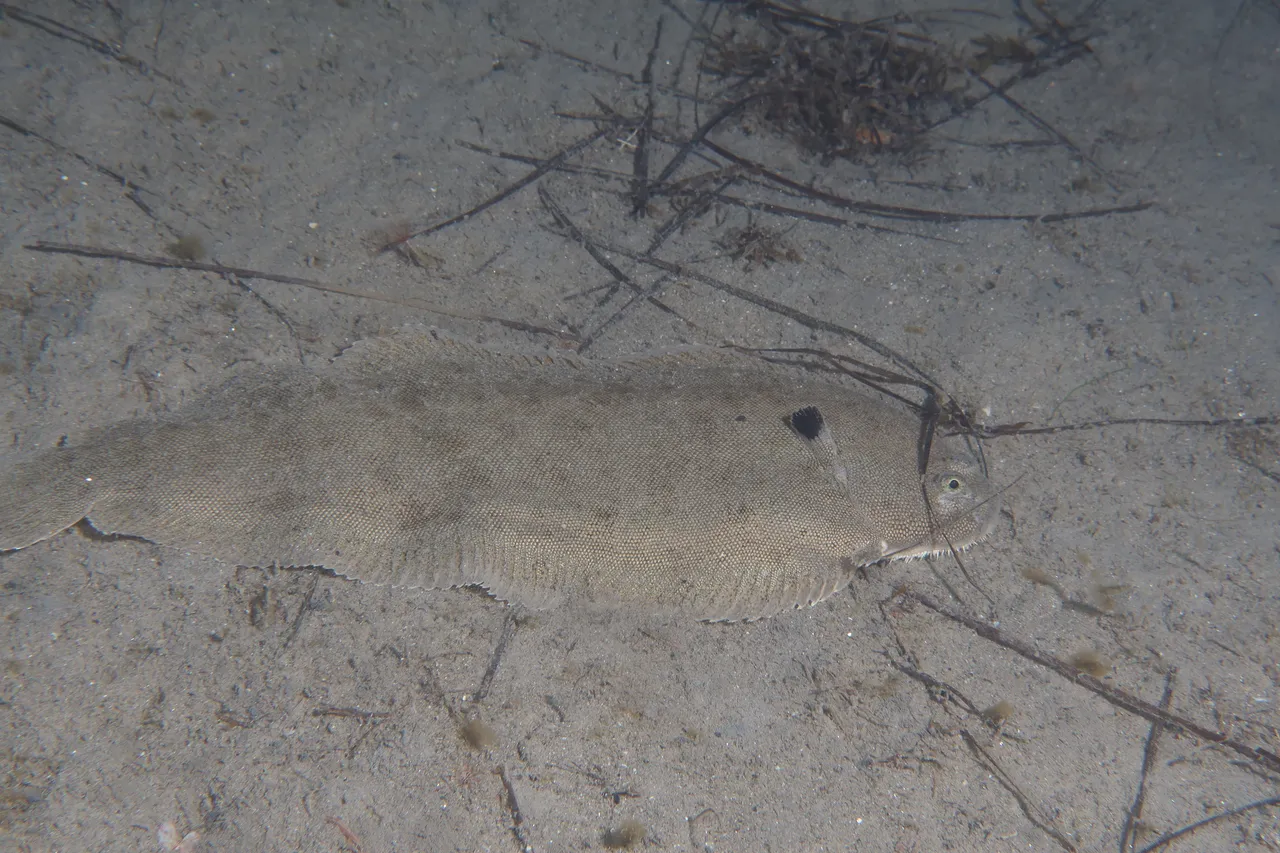
Identified by: Small eyes set close together on the RIGHT side of a rounded head, on an elongate oval body with dorsal and anal fins running almost its full length, plus a distinct dark blotch on the pectoral fin. Critically the fin margins carry NO regularly darkened rays, which rules out the solenette pattern that caused a sibling candidate to be refused.Julien Renoult — CC BY, via iNaturalist — source, licenceAbout the image above: The photograph is an underwater frame of a fish settled on sand, deliberately hard to see, and taken from above. Contrast is low throughout. The pectoral spot the page leads on is visible, and the fin margins are clear enough to show that no rays are regularly darkened.
Look at this first
Turn the fish so the coloured side faces you and the head points away. Both eyes will be on the right, set close together and small in a rounded head. Then look for a dark spot at the tip of the pectoral fin — that mark is what separates this from the small soles it shares ground with.
Diagnostic — settles it on its own
Each of these settles the identification on its own. If one is clear, you have your answer.
A dark spot on the pectoral fin of the eyed side
Lift the small fin just behind the gill cover on the coloured side. There is a distinct dark blotch at or near its tip. It is the most useful single mark on the fish, because the general shape of a sole is shared with several relatives and this mark is not. It reads clearly on a live fish, on a fresh one and in a photograph, and it does not depend on the ground the fish was lying on.
Fins running unbroken from head to tail with no gap
Trace the fin margin along the top of the body from behind the head and along the bottom from behind the gill opening. On a sole both run continuously to the tail fin and join it, so the outline reads as one fin skirting the whole animal. On a dab, a flounder or a plaice there is a clear gap before the tail. This places the fish in the sole family before any species question is asked.
Supporting — use with other characters
Real characters that are not conclusive by themselves. Use two or three together.
Regularly darkened rays as a warning sign, not a confirmation
Look along the fin margin for short dark bars spaced at intervals down its whole length. A common sole does not do this. A solenette does — roughly every fifth or sixth ray is darkened — and it is a much smaller fish found on the same clean sand. If the margin is evenly dotted along its length, the fish is very likely not this species however well everything else matches.
A small mouth twisted round onto the underside
The mouth is not at the front of the head but set low and skewed towards the blind side, small and slightly hooked. It belongs to an animal that works head-down through sediment rather than one that chases. Combined with the rounded snout it gives the sole a head unlike any of the right-eyed flatfishes, and it is visible on any fish in hand.
The size a rod-caught fish runs to
A shore-caught sole is commonly a few hundred grammes and a large one is under a kilogramme. Solenette barely reaches a third of the length of a modest sole. A sole-shaped fish of a hand's length or less is much more likely to be one of the small soles, and that is the point at which the fin margin should be checked carefully rather than assumed.
What it gets confused with
- Solenette, which is much smaller and carries regularly darkened rays along the dorsal and anal fin margins — the character that caused a candidate photograph to be refused for this page.
- Sand sole, which shares the general form and has a differently shaped anterior nostril on the blind side, a character requiring the fish in hand.
- Dab and flounder at a glance in a mixed catch, separated immediately by the gap before the tail fin, which a sole does not have.
- Plaice, which is right-eyed like a sole but has orange spots, a much larger mouth at the front of the head, and a bony ridge behind the eyes.
Side by side: Common sole vs European plaice.
Where this stops working
The soles are a family in which several species share one outline, and the separations between them run to nostril shape, fin ray counts and scale characters rather than to anything visible in a photograph. Small individuals of common sole and adult solenette overlap in size, and a small sole out of clean sand is the case where the page is least able to help. Colour on the eyed side changes with the ground the fish has been lying on and is worth nothing as evidence. Where a sole matters — a survey, a size question, an unusual capture — it needs somebody with the fish and a key, not a page and a picture.
The full record
This page covers identification only. The Common sole record covers behaviour, lifecycle, distribution, handling and the sources behind all of it.
Reviewed 2026-08-16.
More about this fish
Telling it apart is one question. Here are the others.
Similar and related fish
How it is caught
Where you will find it
- Chesil BeachOccupies the softer clean ground offshore of the beach, feeding at night over sand.
- FranceUses the extensive clean sandy ground of the Atlantic and Channel coasts, supporting both a commercial fishery and a shore night fishery over it.
- The Bay of BiscayUses the extensive clean sandy ground of the French coast, and supports both a commercial fishery and a shore night fishery over it.
- The Channel shingle coastsFeeds over the finer sediment beyond the shingle face at night, moving up as the flood covers ground, which is the basis of the shore night fishery here.
- The Moroccan Atlantic coastOccupies the clean sand offshore of the long Atlantic beaches, feeding at night over soft ground.
- The Thames EstuaryOver clean sand in the outer estuary, taken at night in the warmer months. The estuary's flats are also a significant nursery for the species well beyond its own waters.
- The Wadden SeaAs with plaice, the flats are significant juvenile habitat and the species is fished as an adult over a much wider area than it is grown in.
- The Wash and the Lincolnshire coastAs with plaice, the bay is significant juvenile habitat, and adults are taken at night over clean sand along the Lincolnshire beaches through the warmer months.
Why the 11 connections on this page are here, and the sources
Similar and related fish
Backed by research — 1 connection
Supported by peer-reviewed research or fisheries science. The sources are listed and can be checked.
European plaice
An identification and behavioural comparison naming both binomials.
- FishBase: a global information system on fishes — Froese, R. and D. Pauly, eds. — FishBase Consortium (Scientific institute)Relied on for: That Solea solea and Pleuronectes platessa are both right-eyed flatfish of sand and mud bottoms in the North East Atlantic.States this directlyPassage read and verified
- The Fishes of the British Isles and North-West Europe — Macmillan, 1969 (Reference work)Relied on for: The morphological separation of sole from plaice by fin arrangement and mouth structure, and their differing activity patterns.States this directlyCitation checked — the work exists and is described correctly
How it is caught
What experienced anglers do — 2 connections
Widely and independently recommended by experienced anglers and specialist sources. This is real angling knowledge, not proof: controlled evidence for it is limited, and FishingHQ records it as convention rather than as a demonstrated effect.
Ledgering
The page names estuaries beside beaches. In an estuary the presentation is a static bottom bait at short range, and the small hooks matter more than the cast.
- Sea Angler — Bauer Media (Specialist angling publication)Relied on for: Documents which fishery and which technique takes this species.States this directlyCitation checked — the work exists and is described correctly
- FishBase: a global information system on fishes — Froese, R. and D. Pauly, eds. — FishBase Consortium (Scientific institute)Relied on for: Independently corroborates the species' recreational capture and range.Background and mechanism onlyPassage read and verified
Surfcasting
The page names small hooks, ragworm or lugworm, hard on the bottom, from beaches and estuaries, at night. That is a specific and well-defined shore fishery rather than a general one.
- Sea Angler — Bauer Media (Specialist angling publication)Relied on for: Documents which fishery and which technique takes this species.States this directlyCitation checked — the work exists and is described correctly
- FishBase: a global information system on fishes — Froese, R. and D. Pauly, eds. — FishBase Consortium (Scientific institute)Relied on for: Independently corroborates the species' recreational capture and range.Background and mechanism onlyPassage read and verified
Where you will find it
Backed by research — 8 connections
Supported by peer-reviewed research or fisheries science. The sources are listed and can be checked.
Chesil Beach
A distribution association between an animal and a kind of water, rather than a claim about any named mark.
- The Fishes of the British Isles and North-West Europe — Macmillan, 1969 (Reference work)Relied on for: Distribution, habitat association, depth and ground preference of fishes in British and north-west European waters.States this directlyCitation checked — the work exists and is described correctly
- FishBase: a global information system on fishes — Froese, R. and D. Pauly, eds. — FishBase Consortium (Scientific institute)Relied on for: Distribution, habitat association and depth range recorded for the species.Background and mechanism onlyPassage read and verified
France
Occurrence of the species in these waters: a statement about the animal's distribution, not a venue recommendation.
- The Fishes of the British Isles and North-West Europe — Macmillan, 1969 (Reference work)Relied on for: Distribution and habitat association of fishes in north-west European and eastern Atlantic waters.States this directlyCitation checked — the work exists and is described correctly
- FishBase: a global information system on fishes — Froese, R. and D. Pauly, eds. — FishBase Consortium (Scientific institute)Relied on for: Distribution, depth range and habitat association recorded for the species.States this directlyPassage read and verified
The Bay of Biscay
Occurrence of the species in this system or along this coast: a statement about the animal's distribution, not a venue recommendation.
- The Fishes of the British Isles and North-West Europe — Macmillan, 1969 (Reference work)Relied on for: Distribution and habitat association of fishes in British and north-west European waters.States this directlyCitation checked — the work exists and is described correctly
- FishBase: a global information system on fishes — Froese, R. and D. Pauly, eds. — FishBase Consortium (Scientific institute)Relied on for: Distribution, depth range and habitat association recorded for the species.States this directlyPassage read and verified
The Channel shingle coasts
Occurrence of the species in this system or along this coast: a statement about the animal's distribution, not a venue recommendation.
- The Fishes of the British Isles and North-West Europe — Macmillan, 1969 (Reference work)Relied on for: Distribution and habitat association of fishes in British and north-west European waters.States this directlyCitation checked — the work exists and is described correctly
- FishBase: a global information system on fishes — Froese, R. and D. Pauly, eds. — FishBase Consortium (Scientific institute)Relied on for: Distribution, depth range and habitat association recorded for the species.States this directlyPassage read and verified
The Moroccan Atlantic coast
A distribution association between an animal and a kind of water, rather than a claim about any named mark.
- FAO Species Identification Guides for Fishery Purposes and the FAO Species Catalogues — Food and Agriculture Organization of the United Nations (Scientific institute)Relied on for: Distribution, habitat, depth and fishery accounts for the species of the eastern central Atlantic and Mediterranean in the FAO regional identification guides.States this directlyCitation checked — the work exists and is described correctly
- FishBase: a global information system on fishes — Froese, R. and D. Pauly, eds. — FishBase Consortium (Scientific institute)Relied on for: Distribution, habitat association and depth range recorded for the species.States this directlyPassage read and verified
The Thames Estuary
A claim that a place contains the ground, water and seasonal conditions the species is associated with. It is a distributional statement about the world, it rests on the regional reference literature, and it deliberately asserts nothing about access, permission or catch.
- The Fishes of the British Isles and North-West Europe — Macmillan, 1969 (Reference work)Relied on for: Distribution and habitat association of the marine, estuarine and freshwater fishes of the British Isles, including which coasts, estuaries and ground types a species occupies.States this directlyCitation checked — the work exists and is described correctly
- FishBase: a global information system on fishes — Froese, R. and D. Pauly, eds. — FishBase Consortium (Scientific institute)Relied on for: Recorded distribution, depth range and habitat association for the species named.States this directlyPassage read and verified
The Wadden Sea
A claim that a place contains the ground, water and seasonal conditions the species is associated with. It is a distributional statement about the world, it rests on the regional reference literature, and it deliberately asserts nothing about access, permission or catch.
- JNCC species and habitat conservation advice — Joint Nature Conservation Committee (Conservation authority)Relied on for: Habitat classification and description for the intertidal, coastal and freshwater habitats named, and the species characteristically associated with them.States this directlyCitation checked — the work exists and is described correctly
- ICES Advice on fishing opportunities, catch and effort — International Council for the Exploration of the Sea (Scientific institute)Relied on for: Ecoregion description, nursery function and the hydrography of the European sea areas assessed.States this directlyCitation checked — the work exists and is described correctly
The Wash and the Lincolnshire coast
A claim that a place contains the ground, water and seasonal conditions the species is associated with. It is a distributional statement about the world, it rests on the regional reference literature, and it deliberately asserts nothing about access, permission or catch.
- The Fishes of the British Isles and North-West Europe — Macmillan, 1969 (Reference work)Relied on for: Distribution and habitat association of the marine, estuarine and freshwater fishes of the British Isles, including which coasts, estuaries and ground types a species occupies.States this directlyCitation checked — the work exists and is described correctly
- FishBase: a global information system on fishes — Froese, R. and D. Pauly, eds. — FishBase Consortium (Scientific institute)Relied on for: Recorded distribution, depth range and habitat association for the species named.States this directlyPassage read and verified
Safety
Tides and being cut off — Can cause serious injury or death
This is night fishing over open sand and estuary flats on a rising tide, with attention on the rod rather than on the water, which is the classic cut-off scenario made worse by darkness.
What reduces it: Check tide times and heights before going out. Identify the exit and the route back before dark. Leave on a set clock time. Carry a light and tell somebody where you are.
Cold water shock — Can cause injury needing treatment
Autumn and winter night beach fishing in northern Europe puts anglers beside cold water in the dark, where immersion incapacitates quickly.
What reduces it: Wear a buoyancy aid where wading or on steep ground. Do not wade in the dark on unfamiliar beaches. Carry a means of calling for help.