What does common sole eat?
What is established about how common sole feeds, kept separate from what anglers infer from it.
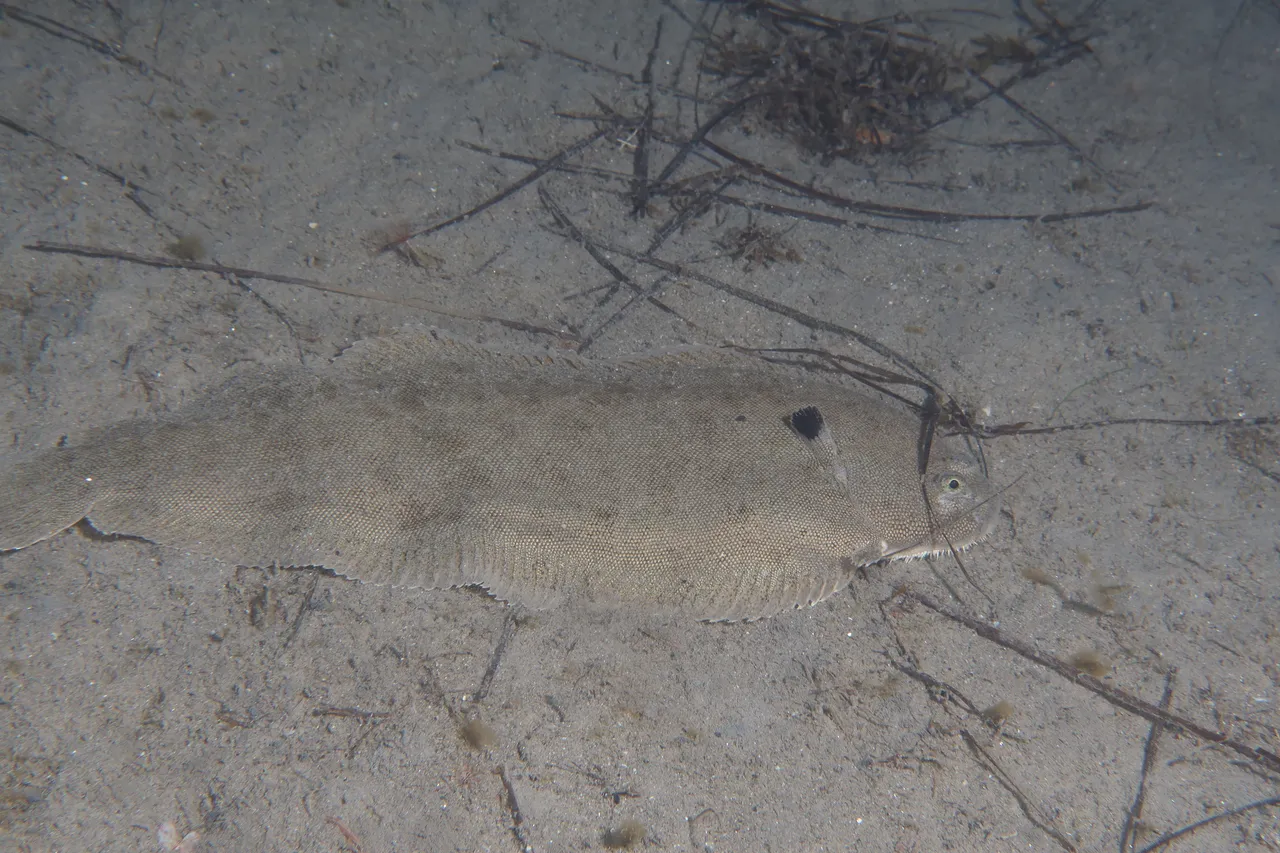
How this was identified, and who took it
Identified by: Small eyes set close together on the RIGHT side of a rounded head, on an elongate oval body with dorsal and anal fins running almost its full length, plus a distinct dark blotch on the pectoral fin. Critically the fin margins carry NO regularly darkened rays, which rules out the solenette pattern that caused a sibling candidate to be refused.Julien Renoult — CC BY, via iNaturalist — source, licenceWhat is known about how it feeds
A sole feeds in the dark, in the sediment, using a sense organ most fish do not have.
The blind underside of the head carries a fringe of sensory papillae — small fleshy projections that detect chemical traces and touch. The fish works head-down over sand and mud, and locates buried worms and small crustaceans through that fringe rather than by sight. Vision contributes almost nothing to the process.
The consequence is that sole feeding is nocturnal to a degree that is close to absolute. A feeding sole is a sole that has emerged after dark; during daylight the fish is buried with only the eyes exposed, and it is not participating in the food web at all.
The mouth matches the method. It is small and twisted towards the blind side, adapted to picking prey out of sediment at close range rather than to seizing anything. There is no ontogenetic shift towards fish prey in this species: a large sole eats larger worms, not different food.
Both verified relationships are recorded at group level — polychaetes and small crustaceans — which is exactly the granularity the sediment diet literature works at, and one of the clearer cases on FishingHQ where a taxon record represents the evidence better than any species could.
The food
Prey with a verified dietary link to this fish. Each entry carries its own evidence, and each is written at the precision the source actually used: a named species where the source named one, a group or food category where it said “polychaetes”, “crustaceans” or “detritus” and meant it. That is why this list is shorter than the animal’s real diet rather than longer.
- Polychaete worms as prey — a group rather than a species: the evidence names the group
Sole feed at night on buried invertebrates located by touch and chemoreception rather than by sight, with polychaetes the dominant item.
- Amphipods and mysids as prey — a group rather than a species: the evidence names the group
Small crustaceans make up the balance of the diet, particularly in juveniles on estuarine and nearshore nursery ground.
Food with no page of its own here yet
These are real components of the diet, listed as plain text because FishingHQ has no page for them yet. Inventing pages to make the list look fuller would be the fabrication this whole approach exists to prevent.
- small bivalve siphons
- brittlestars
- small burrowing shrimps
- sediment-dwelling larvae
What anglers do with this
Everything below is interpretation, not finding. It is what experienced anglers conclude from the biology above, and the reasoning is usually sound and almost never tested. It is separated from the biology deliberately.
The nocturnal habit is the single fact that determines the fishery, and the inference is not subtle: sole are fished after dark, and daylight effort is largely wasted. That is convention with a clear biological cause.
The papillae and the small mouth are used to argue for small, scent-rich baits presented hard on the bottom and left still, and for the observation that visual attraction is irrelevant to this species. The reasoning follows from the sensory anatomy and is not a tested result.
One consequence is worth stating because it cuts against the general pattern on FishingHQ: for sole, a bigger offering is not a route to a bigger fish. The mouth sets the ceiling.
What this does not establish
Both relationships are group-level and neither establishes proportion. Diet composition varies with sediment type and with what the local benthic community holds, which differs between estuaries, sandy bays and offshore grounds. The nocturnal pattern is strong but is a tendency rather than an absolute, and daylight feeding is recorded in turbid water.
Where this connects
These are the baits, lures, methods and explainers FishingHQ already joins to this fish — which is why the list is sometimes short. They are not chosen for this page, and a link here means an evidenced relationship exists, not that it follows from the diet.
Methods used for it
This page covers feeding. The Common sole record covers identification, lifecycle, seasonal behaviour, handling and the sources behind all of it.
Reviewed 2026-08-12.