Thornback ray
Fish · Last reviewed 2026-08-10
The commonest European ray, covered in thorn-like bucklers, laying horny egg cases known as mermaid's purses, and requiring careful handling on release.
Safety: injury while handling fish — minor injury.
How this was identified, and who took it
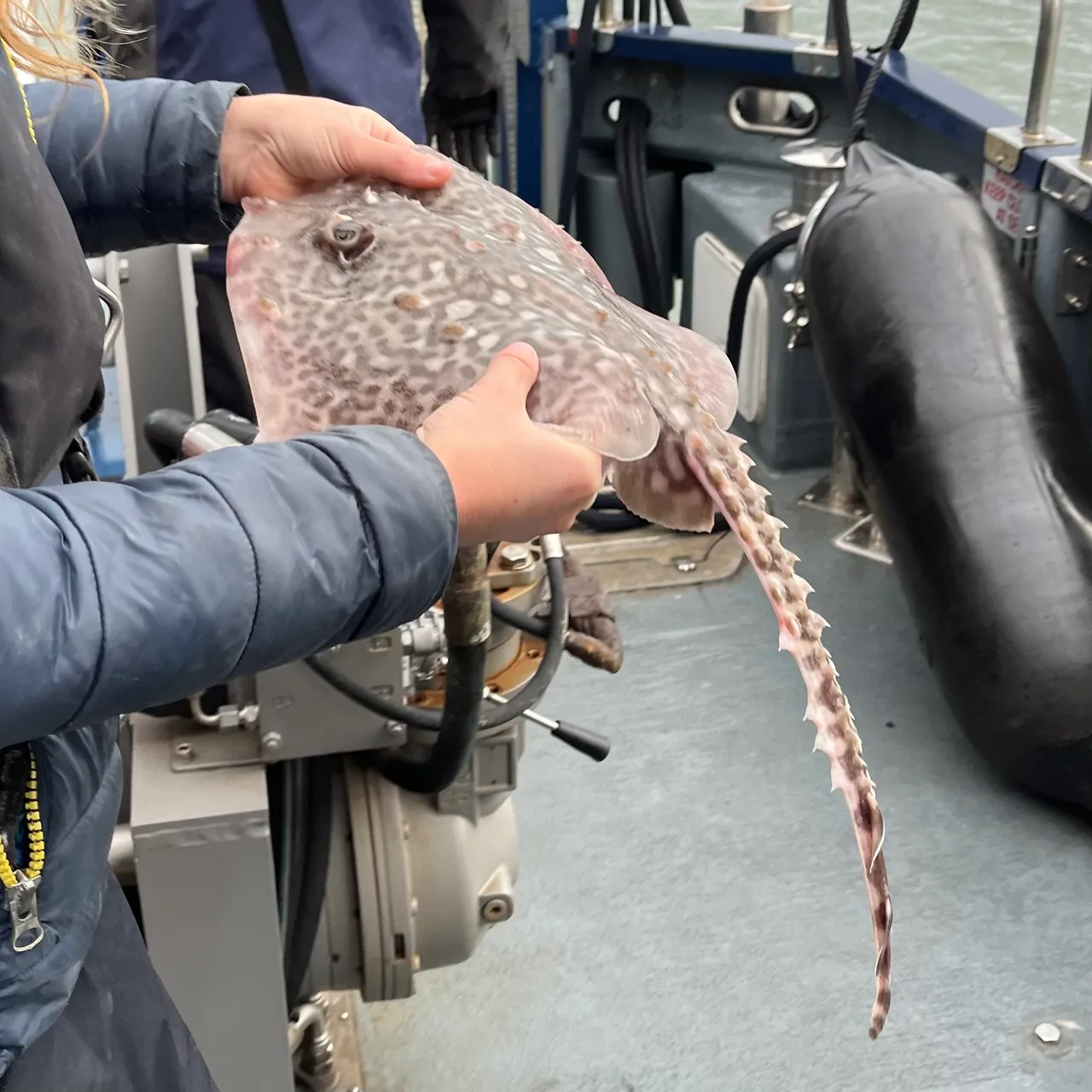
Identified by: A continuous row of large recurved thorns down the tail and scattered button-shaped bucklers across the dorsal surface of the disc, on a marbled brown-on-pale ground, with the eyes and spiracles clearly placed. Three agreeing identifications on the source, none disagreeing.Ella McCausland — CC BY, via iNaturalist — source, licenceCatching Thornback ray
Everything here on fishing for it. Each entry opens the page behind it.
- When
- Mar–Oct — months recorded at the places that document it, not a season for the whole range.
- Where
- 98 places FishingHQ documents — strongest claim anywhere: regular local target · From the shore, From a kayak, From a boat
Thornback ray is the ray most European shore and boat anglers meet. It is a broad, angular skate-family fish of sand, mud and mixed ground, and it takes its name from the rows of curved thorns — bucklers — that run along the back and tail and are far more prominent in females.
It lays horny egg capsules with a tendril at each corner, the mermaid's purses that wash up on beaches. Those capsules take months to develop, and each female produces relatively few, which is the core of the species' vulnerability: rays are slow to reproduce and are easily depleted.
Handling matters. A thornback is not venomous and has no sting, but the thorns cut, and a ray dragged up a beach or lifted by the tail is being injured.
How it is caught
Gear for this fish
- Fish strip and cut baitMackerel and sandeel are what a thornback comes to, and the sources name them together often enough that the pairing is the bait rather than either alone.
- Uptide rigRays feed over the clean and mixed ground uptiding reaches, and a long flowing trace presents a bait on the bottom in the way they take it.
Where Thornback ray is documented
Places where public sources describe this species as fished, with how it is fished and how strongly the evidence supports it. This is not a range map and it is not a recommendation — it is what has been written down about a fishery rather than a record of any individual catch, and being listed is never permission to fish.
The Severn Estuary
9 documented places
Cove
Recorded here
From the shore
Beach section
Regular local target
From the shore
Estuary mark
Regular local target
From the shore
Estuary mark
Recorded here
From the shore
Island
Regular local target
From the shore
Headland
Recorded here
From the shore
Beach
Seasonal
From the shore
Around Jun, Jul, Aug, Sept
Headland
Regular local target
From the shore
Estuary mark
Regular local target
From the shore
The Kerry coast
8 documented places
Pier
Regular local target
From the shore
Estuary mark
Regular local target
From the shore
Estuary mark
Regular local target
From the shore
Surf beach
Occasional
From the shore
Estuary
Occasional
From the shore
Surf beach
Occasional
From the shore
Harbour wall
Regular local target
From the shore
Pier
Occasional
From the shore
The Cornish and Devon coasts
7 documented places
The Tamar estuary
Estuary
Recorded here
From the shore
Beach section
Repeatedly reported
From a kayak
Pier
Recorded here
From the shore
Rock mark
Repeatedly reported
From the shore
Estuary
Recorded here
From the shore
Estuary
Seasonal
From the shore
Around Jun, Jul, Aug, Sept
Surf beach
Regular local target
From the shore
Scottish sea lochs
5 documented places
Sea loch
Recorded here
From the shore
Sea loch
Recorded here
From the shore
Sea loch
Regular local target
From the shore
Oban Bay and the Sound of Kerrera
Sound or strait
Regular local target
From a boat
Sea loch
Recorded here
From a boat
Around Apr
The Thames Estuary
5 documented places
Pier
Seasonal
From the shore
Around May, Jun, Jul, Aug, Sept, Oct
Beach
Regular local target
From the shore
Beach
Recorded here
From the shore
Beach
Recorded here
From the shore
Estuary mark
Regular local target
From the shore
The Clare coast and the Shannon estuary
5 documented places
Rock platform
Regular local target
From the shore
Surf beach
Regular local target
From the shore
Bay
Regular local target
From the shore
Pier
Regular local target
From the shore
Around Jun, Jul, Aug, Sept
Pier
Regular local target
From the shore
The Donegal coast and its sea loughs
5 documented places
Beach
Regular local target
From the shore
Beach
Regular local target
From the shore
Around Jun, Jul, Aug, Sept
Pier
Regular local target
From the shore
Sound or strait
Regular local target
From the shore
Kerrykeel Pier
Pier
Regular local target
From the shore
The Wexford coast
5 documented places
Surf beach
Regular local target
From the shore
Around Jun, Jul, Aug, Sept
Surf beach
Regular local target
From the shore
Surf beach
Recorded here
From the shore
Surf beach
Occasional
From the shore
Beach section
Regular local target
From the shore
Also documented on 23 more coasts
Fewer places each, or less strongly supported. Each one names its own marks.
The Channel shingle coasts (4) · Morecambe Bay and the north-west England coast (4) · Connemara and Galway Bay (4) · The Sligo and Leitrim coast (4) · The Norfolk and Suffolk sandbank coast (3) · Cork Harbour and the east Cork coast (3) · West Cork (2) · Clew Bay and Achill (2) · Anglesey (1) · The Louth and Meath coast (1) · Cardigan Bay and the sarnau (3) · The Welsh coast and Anglesey (2) · Pembrokeshire and the south-west Wales coast (2) · The Solway Firth (2) · The Mourne coast and Carlingford Lough (1) · The Wash and the Lincolnshire coast (1) · Weymouth Bay (1) · The Purbeck coast and Poole Bay (3) · Chesil Beach (2) · The Solent and the Hampshire coast (1) · The Gower and Carmarthen Bay (1) · The north-east England coast (1) · The Waterford coast (1)
What these strengths mean
- Regular local target
- Fishing sources describe this as a normal local target here, not merely as caught.
- Recorded here
- At least one credible public account of this species being caught here. That is all it means.
- Seasonal
- Well supported, and concentrated in part of the year rather than spread through it.
- Repeatedly reported
- Several independent public accounts. Enough to say it happens more than once; not enough to call it a fishery.
- Occasional
- Caught here, and described as unusual rather than normal. Do not plan a session around it.
When to fish for thornback ray
Where the places here state a season for thornback ray, it clusters in May–Sep. This is a count of how many documented places name each month — evidence about when people fish for it, not a prediction of what any particular day will produce.
| Jan | Feb | Mar | Apr | May | Jun | Jul | Aug | Sep | Oct | Nov | Dec |
|---|---|---|---|---|---|---|---|---|---|---|---|
| January: no place here names this month — no place names it. | February: no place here names this month — no place names it. | March: 1 place names this month — few places. | April: 1 place names this month — few places. | May: 10 places name this month — some places. | June: 20 places name this month — most places. | July: 19 places name this month — most places. | August: 19 places name this month — most places. | September: 19 places name this month — most places. | October: 8 places name this month — some places. | November: no place here names this month — no place names it. | December: no place here names this month — no place names it. |
20 of the 96 places that record catches of thornback ray state which months. The other 76 name no season, so they are counted in neither direction: the shape above is what the dated records say, not the whole picture. The dated records span 19 separate areas.
Identification
- Scientific name
- Raja clavata
- Family
- Rajidae
- Water
- Saltwater
- Conservation status
- Near Threatened
- Regions
- Britain & Ireland, Western Europe, Northern Europe, Mediterranean
- Rows of strong curved thorns along the midline of the back and tail, most developed in mature females.
- Broad angular disc, sandy or grey-brown above with dark blotches and pale spots, cream below.
- Two small dorsal fins set close together near the tip of the tail.
- No venomous spine — the thorns are structural, not a sting.
Size
- Typical
- 1.5–4 kg (3.3–8.8 lb)
- Large
- 6–10 kg (13–22 lb)
Exceptional: FishBase records a maximum of 105 cm and 18 kg
Thorns rather than a sting, and a wing that must be supported
Thornback rays are widely and unnecessarily feared because people assume any ray carries a venomous sting. This one does not, and knowing what it does carry is the whole of the answer.
WHAT IT HAS. Rows of stout curved thorns along the back, the tail and — on mature females — the underside as well. They are hard, sharp, backward-curved and set in the skin, and they will tear a hand drawn across them. There is no venom apparatus. The injury is a laceration, and in salt water it is one that should be cleaned properly.
WHERE TO HOLD IT. Along the leading edges of the wings, from underneath, which are smooth and thorn-free, with the ray supported flat. Do not slide a hand along the back. Do not grip the tail.
THE MOUTH IS ON THE UNDERSIDE and contains crushing plates for shellfish. It cannot cut, but a finger in it is gripped hard.
AND THE SUPPORT QUESTION IS THE WELFARE ONE. A ray is a flat animal with no skeletal support out of water. Lifting one by the tail, or by one wing, or hanging it from a grip, causes internal damage. Hold it flat and level, with a hand under the body, and keep the time short.
RETURN THEM CAREFULLY FROM HEIGHT. A ray dropped from a pier or a high rock mark hits the water flat and hard, and the injury is real. Where there is no way to return a fish gently from where it was caught, that is a reason to reconsider the mark rather than to accept the outcome.
What experienced anglers do — why, and the sources (2)
Widely and independently recommended by experienced anglers and specialist sources. This is real angling knowledge, not proof: controlled evidence for it is limited, and FishingHQ records it as convention rather than as a demonstrated effect.
- FishBase: a global information system on fishes — Froese, R. and D. Pauly, eds. — FishBase Consortium (Scientific institute)Relied on for: Dentition, fin and spine morphology, body form, air-breathing capability and distribution for the species, which are the anatomical facts the handling practice below follows from.States this directlyPassage read and verified
- General angling website restatements of established technique — Various (Credible secondary source)Relied on for: Widely restated angling practice for handling this species, recorded as practitioner consensus rather than as tested fact.Background and mechanism onlyCitation checked — the work exists and is described correctly
Lifecycle and reproduction
Slow-growing, late-maturing and long-lived, producing few young. Those traits make rays and skates far more vulnerable to fishing pressure than bony fishes of similar size, and several related species have declined severely.
Lays horny egg capsules on the seabed over several months of the year, each containing a single embryo that develops for months before hatching. Reproductive output is very low compared with bony fishes.
Feeding and senses
Takes crabs, shrimps, worms and small fish from the bottom, pinning prey with the disc and manoeuvring it to the mouth on the underside.
Detects buried prey using electroreception through ampullae on the underside, supported by smell — vision plays little part in feeding, since the eyes are on top and the mouth beneath.
Through the year
Moves inshore into shallow water in spring and summer, often into estuaries and bays, and moves deeper in winter. The inshore movement is what makes them available to shore anglers.
Distribution
Eastern Atlantic and Southwest Indian Ocean: Iceland to Madagascar, including the Mediterranean Sea
This is a biological range — where the species occurs, not a prediction that you will catch one. To browse the fishing geography FishingHQ holds, start at fishing places.
Why anglers care
A principal target of European shore and boat fishing over clean and mixed ground, taken on fish and crustacean baits fished hard on the bottom. Its significance is size and accessibility from open beaches, and it supports a substantial specialist following. Because of the low reproductive rate, catch-and-release is widespread among anglers targeting them and many jurisdictions restrict retention. FishingHQ does not state what any rule is.
Handling and returning
Never lift a ray by the tail, and never drag it up a beach — both cause internal and skin damage. Lift with a hand under the disc, supporting the body. Grip the leading edge of the wing rather than the thorny midline, and use pliers. There is no sting, but the thorns cut readily and gloves are sensible.
Safety
Injury while handling fish — Minor injury
The bucklers along the back and tail are sharp and the skin is abrasive; both cause cuts and grazes during handling.
What reduces it: Handle by the leading edge of the wings with gloves, support the body from underneath, and keep hands off the thorny midline.
Where to go next
Where it lives
Where you will find it
- Brittany and the French Atlantic coastOver the clean sand of the embayments and the ground adjacent to the reefs, which is the counterweight fishery to the rock and is worked with entirely different tackle.
- Cardigan Bay and the sarnauOver the clean sand and mud adjacent to the reefs and along the open beaches, which is the bay's characteristic soft-ground fishery.
- Chesil BeachOccupies the clean sand and shingle ground offshore of the beach.
- Connemara and Galway BayAssociated with the shallow sandy Connemara bays rather than with the rock between them, mostly around low water — a soft-ground, shallow-water fishery sitting immediately beside some of the hardest rock fishing in Ireland.
- Cork Harbour and the east Cork coastPresent through the harbour from spring into autumn over the sand and mud alongside the quays, taken at distance on sandeel in warmer weather.
- Morecambe Bay and the north-west England coastOver the cleaner ground and in the deeper channels of the bay, principally through the warmer months.
- Pembrokeshire and the south-west Wales coastOver the clean sand of the bays and the sheltered ground inside the haven, rather than on the exposed reef.
- Strangford Lough and the Ards coastOver the mixed and softer ground inside the lough, principally through the warmer months.
12 more
- The Causeway and Antrim coast Fishing regions
- The Channel shingle coasts Fishing regions
- The Clare coast and the Shannon estuary Fishing regions
- The Donegal coast and its sea loughs Fishing regions
- The Firth of Clyde Fishing regions
- The Gower and Carmarthen Bay Fishing regions
- The Kerry coast Fishing regions
- The Louth and Meath coast Fishing regions
- The Norfolk and Suffolk sandbank coast Fishing regions
- The Severn Estuary Fishing regions
- The Thames Estuary Fishing regions
- The Yorkshire coast Fishing regions
Told apart from
- Blonde rayBoth are large British rays on overlapping ground. A thornback carries conspicuous broad-based bucklers you can see and feel; a blonde is smooth-backed and densely spotted. If the fish has obvious large thorns, the spotting question does not arise.
- Common stingrayThe comparison that prevents an injury. A thornback has a short stiff thorned tail with small dorsal fins and a rough bucklered disc. A stingray has a long smooth whip tail with no dorsal fins, a serrated venomous spine, and a smooth disc. If the disc is smooth and the tail is a whip, do not handle it like a ray.
- Flapper skateBoth are called skate or ray and the difference in scale is the point: a thornback is a rounded, thorned, blotched fish of under a metre; a flapper skate is an angular, long-snouted animal of over two metres and is Critically Endangered.
Sources and evidence
- FishBase: a global information system on fishes — Froese, R. and D. Pauly, eds. — FishBase Consortium (Scientific institute)Relied on for: Family, maximum size, depth and environment, distribution and the IUCN assessment for Raja clavata.States this directlyPassage read and verified
- The IUCN Red List of Threatened Species — International Union for Conservation of Nature (Conservation authority)Relied on for: The Near Threatened assessment for Raja clavata, assessed 15 April 2023.States this directlyCitation checked — the work exists and is described correctly
Why the 29 connections on this page are here, and the sources
How it is caught
What experienced anglers do — 2 connections
Widely and independently recommended by experienced anglers and specialist sources. This is real angling knowledge, not proof: controlled evidence for it is limited, and FishingHQ records it as convention rather than as a demonstrated effect.
Ledgering
A practitioner claim about how Raja clavata is commonly fished, following from where and how it feeds.
- General angling website restatements of established technique — Various (Credible secondary source)Relied on for: Widely restated practitioner accounts of fishing for thornback ray.Citation checked — the work exists and is described correctly
- Sea Angler — Bauer Media (Specialist angling publication)Relied on for: Practitioner treatment of the methods used for thornback ray and comparable species.Citation checked — the work exists and is described correctly
Surfcasting
A practitioner claim about how Raja clavata is commonly fished, following from where and how it feeds.
- General angling website restatements of established technique — Various (Credible secondary source)Relied on for: Widely restated practitioner accounts of fishing for thornback ray.Citation checked — the work exists and is described correctly
- Sea Angler — Bauer Media (Specialist angling publication)Relied on for: Practitioner treatment of the methods used for thornback ray and comparable species.Citation checked — the work exists and is described correctly
Gear for this fish
What experienced anglers do — 2 connections
Widely and independently recommended by experienced anglers and specialist sources. This is real angling knowledge, not proof: controlled evidence for it is limited, and FishingHQ records it as convention rather than as a demonstrated effect.
Fish strip and cut bait
Named for thornback by three independent publishers across two countries, consistently as mackerel with sandeel.
- Inland Fisheries Ireland: South West Sea Angling Guide — the west and south Cork angling marks — Inland Fisheries Ireland, 2020 (Government fisheries body)Relied on for: The statutory fisheries body naming the bait alongside the species and the tide window, mark by mark.Passage read and verified
- Sea Angling in Ireland: the shore marks of Clare and the Shannon estuary — Sea Angling Ireland (Credible secondary source)Relied on for: A practitioner shore directory naming the bait alongside the species, mark by mark.Passage read and verified
- British Sea Fishing: the ray, smooth-hound, whiting and flatfish entries — British Sea Fishing (Credible secondary source)Relied on for: A regional mark guide naming mackerel or herring strip and bluey for thornback at a run of south-east England marks.Passage read and verified
Uptide rig
That anglers conventionally choose this arrangement when targeting this fish. It is a claim about practice rather than about the fish, and it does not assert that the arrangement is necessary or that it will succeed.
- Sea Angler — Bauer Media (Specialist angling publication)Relied on for: Long-running published description of British sea angling practice, including boat and shore terminal arrangements, grip leads and the conditions each is chosen for.States this directlyCitation checked — the work exists and is described correctly
- Angling Times — Bauer Media (Specialist angling publication)Relied on for: Contemporary UK angling practice as reported by practitioners, including sea terminal tackle convention and its development.States this directlyCitation checked — the work exists and is described correctly
Where it lives
Backed by research — 2 connections
Supported by peer-reviewed research or fisheries science. The sources are listed and can be checked.
Inshore ground
A habitat association for Raja clavata taken from the environment and distribution data on its FishBase summary.
- FishBase: a global information system on fishes — Froese, R. and D. Pauly, eds. — FishBase Consortium (Scientific institute)Relied on for: The environment, depth range and habitat description recorded for Raja clavata.States this directlyPassage read and verified
Surf beaches
A habitat association for Raja clavata taken from the environment and distribution data on its FishBase summary.
- FishBase: a global information system on fishes — Froese, R. and D. Pauly, eds. — FishBase Consortium (Scientific institute)Relied on for: The environment, depth range and habitat description recorded for Raja clavata.States this directlyPassage read and verified
Where you will find it
Backed by research — 20 connections
Supported by peer-reviewed research or fisheries science. The sources are listed and can be checked.
Brittany and the French Atlantic coast
A claim that a place contains the ground, water and seasonal conditions the species is associated with. It is a distributional statement about the world, it rests on the regional reference literature, and it deliberately asserts nothing about access, permission or catch.
- FishBase: a global information system on fishes — Froese, R. and D. Pauly, eds. — FishBase Consortium (Scientific institute)Relied on for: Recorded distribution, depth range and habitat association for the species named.States this directlyPassage read and verified
- The Fishes of the British Isles and North-West Europe — Macmillan, 1969 (Reference work)Relied on for: Distribution and habitat association of the fishes of north-west Europe, including the continental coasts and seas named.States this directlyCitation checked — the work exists and is described correctly
Cardigan Bay and the sarnau
A claim that a place contains the ground, water and seasonal conditions the species is associated with. It is a distributional statement about the world, it rests on the regional reference literature, and it deliberately asserts nothing about access, permission or catch.
- The Fishes of the British Isles and North-West Europe — Macmillan, 1969 (Reference work)Relied on for: Distribution and habitat association of the marine, estuarine and freshwater fishes of the British Isles, including which coasts, estuaries and ground types a species occupies.States this directlyCitation checked — the work exists and is described correctly
- FishBase: a global information system on fishes — Froese, R. and D. Pauly, eds. — FishBase Consortium (Scientific institute)Relied on for: Recorded distribution, depth range and habitat association for the species named.States this directlyPassage read and verified
Chesil Beach
A distribution association between an animal and a kind of water, rather than a claim about any named mark.
- The Fishes of the British Isles and North-West Europe — Macmillan, 1969 (Reference work)Relied on for: Distribution, habitat association, depth and ground preference of fishes in British and north-west European waters.States this directlyCitation checked — the work exists and is described correctly
- FishBase: a global information system on fishes — Froese, R. and D. Pauly, eds. — FishBase Consortium (Scientific institute)Relied on for: Distribution, habitat association and depth range recorded for the species.Background and mechanism onlyPassage read and verified
Connemara and Galway Bay
A claim that a coast contains the ground and conditions the species is associated with. It is a distributional statement about the world, it rests on the regional reference literature, and it deliberately asserts nothing about access, permission or catch.
- The Fishes of the British Isles and North-West Europe — Macmillan, 1969 (Reference work)Relied on for: Distribution and habitat association of the marine and estuarine fishes of the British Isles and north-west Europe, including which coasts and ground types a species occupies.States this directlyCitation checked — the work exists and is described correctly
- FishBase: a global information system on fishes — Froese, R. and D. Pauly, eds. — FishBase Consortium (Scientific institute)Relied on for: Recorded distribution, depth range and habitat association for the species named.States this directlyPassage read and verified
Cork Harbour and the east Cork coast
A claim that a coast contains the ground and conditions the species is associated with. It is a distributional statement about the world, it rests on the regional reference literature, and it deliberately asserts nothing about access, permission or catch.
- The Fishes of the British Isles and North-West Europe — Macmillan, 1969 (Reference work)Relied on for: Distribution and habitat association of the marine and estuarine fishes of the British Isles and north-west Europe, including which coasts and ground types a species occupies.States this directlyCitation checked — the work exists and is described correctly
- FishBase: a global information system on fishes — Froese, R. and D. Pauly, eds. — FishBase Consortium (Scientific institute)Relied on for: Recorded distribution, depth range and habitat association for the species named.States this directlyPassage read and verified
Morecambe Bay and the north-west England coast
A claim that a place contains the ground, water and seasonal conditions the species is associated with. It is a distributional statement about the world, it rests on the regional reference literature, and it deliberately asserts nothing about access, permission or catch.
- The Fishes of the British Isles and North-West Europe — Macmillan, 1969 (Reference work)Relied on for: Distribution and habitat association of the marine, estuarine and freshwater fishes of the British Isles, including which coasts and ground types a species occupies.States this directlyCitation checked — the work exists and is described correctly
- FishBase: a global information system on fishes — Froese, R. and D. Pauly, eds. — FishBase Consortium (Scientific institute)Relied on for: Recorded distribution, depth range and habitat association for the species named.States this directlyPassage read and verified
Pembrokeshire and the south-west Wales coast
A claim that a place contains the ground, water and seasonal conditions the species is associated with. It is a distributional statement about the world, it rests on the regional reference literature, and it deliberately asserts nothing about access, permission or catch.
- The Fishes of the British Isles and North-West Europe — Macmillan, 1969 (Reference work)Relied on for: Distribution and habitat association of the marine, estuarine and freshwater fishes of the British Isles, including which coasts and ground types a species occupies.States this directlyCitation checked — the work exists and is described correctly
- FishBase: a global information system on fishes — Froese, R. and D. Pauly, eds. — FishBase Consortium (Scientific institute)Relied on for: Recorded distribution, depth range and habitat association for the species named.States this directlyPassage read and verified
Strangford Lough and the Ards coast
A claim that a place contains the ground, water and seasonal conditions the species is associated with. It is a distributional statement about the world, it rests on the regional reference literature, and it deliberately asserts nothing about access, permission or catch.
- The Fishes of the British Isles and North-West Europe — Macmillan, 1969 (Reference work)Relied on for: Distribution and habitat association of the marine, estuarine and freshwater fishes of the British Isles, including which coasts, estuaries and ground types a species occupies.States this directlyCitation checked — the work exists and is described correctly
- FishBase: a global information system on fishes — Froese, R. and D. Pauly, eds. — FishBase Consortium (Scientific institute)Relied on for: Recorded distribution, depth range and habitat association for the species named.States this directlyPassage read and verified
The Causeway and Antrim coast
A claim that a place contains the ground, water and seasonal conditions the species is associated with. It is a distributional statement about the world, it rests on the regional reference literature, and it deliberately asserts nothing about access, permission or catch.
- The Fishes of the British Isles and North-West Europe — Macmillan, 1969 (Reference work)Relied on for: Distribution and habitat association of the marine, estuarine and freshwater fishes of the British Isles, including which coasts, estuaries and ground types a species occupies.States this directlyCitation checked — the work exists and is described correctly
- FishBase: a global information system on fishes — Froese, R. and D. Pauly, eds. — FishBase Consortium (Scientific institute)Relied on for: Recorded distribution, depth range and habitat association for the species named.States this directlyPassage read and verified
The Channel shingle coasts
Occurrence of the species in this system or along this coast: a statement about the animal's distribution, not a venue recommendation.
- The Fishes of the British Isles and North-West Europe — Macmillan, 1969 (Reference work)Relied on for: Distribution and habitat association of fishes in British and north-west European waters.States this directlyCitation checked — the work exists and is described correctly
- FishBase: a global information system on fishes — Froese, R. and D. Pauly, eds. — FishBase Consortium (Scientific institute)Relied on for: Distribution, depth range and habitat association recorded for the species.States this directlyPassage read and verified
The Clare coast and the Shannon estuary
A claim that a coast contains the ground and conditions the species is associated with. It is a distributional statement about the world, it rests on the regional reference literature, and it deliberately asserts nothing about access, permission or catch.
- The Fishes of the British Isles and North-West Europe — Macmillan, 1969 (Reference work)Relied on for: Distribution and habitat association of the marine and estuarine fishes of the British Isles and north-west Europe, including which coasts and ground types a species occupies.States this directlyCitation checked — the work exists and is described correctly
- FishBase: a global information system on fishes — Froese, R. and D. Pauly, eds. — FishBase Consortium (Scientific institute)Relied on for: Recorded distribution, depth range and habitat association for the species named.States this directlyPassage read and verified
The Donegal coast and its sea loughs
A claim that a coast contains the ground and conditions the species is associated with. It is a distributional statement about the world, it rests on the regional reference literature, and it deliberately asserts nothing about access, permission or catch.
- The Fishes of the British Isles and North-West Europe — Macmillan, 1969 (Reference work)Relied on for: Distribution and habitat association of the marine and estuarine fishes of the British Isles and north-west Europe, including which coasts and ground types a species occupies.States this directlyCitation checked — the work exists and is described correctly
- FishBase: a global information system on fishes — Froese, R. and D. Pauly, eds. — FishBase Consortium (Scientific institute)Relied on for: Recorded distribution, depth range and habitat association for the species named.States this directlyPassage read and verified
The Firth of Clyde
A claim that a place contains the ground, water and seasonal conditions the species is associated with. It is a distributional statement about the world, it rests on the regional reference literature, and it deliberately asserts nothing about access, permission or catch.
- The Fishes of the British Isles and North-West Europe — Macmillan, 1969 (Reference work)Relied on for: Distribution and habitat association of the marine, estuarine and freshwater fishes of the British Isles, including which coasts and ground types a species occupies.States this directlyCitation checked — the work exists and is described correctly
- FishBase: a global information system on fishes — Froese, R. and D. Pauly, eds. — FishBase Consortium (Scientific institute)Relied on for: Recorded distribution, depth range and habitat association for the species named.States this directlyPassage read and verified
The Gower and Carmarthen Bay
A claim that a place contains the ground, water and seasonal conditions the species is associated with. It is a distributional statement about the world, it rests on the regional reference literature, and it deliberately asserts nothing about access, permission or catch.
- The Fishes of the British Isles and North-West Europe — Macmillan, 1969 (Reference work)Relied on for: Distribution and habitat association of the marine, estuarine and freshwater fishes of the British Isles, including which coasts, estuaries and ground types a species occupies.States this directlyCitation checked — the work exists and is described correctly
- FishBase: a global information system on fishes — Froese, R. and D. Pauly, eds. — FishBase Consortium (Scientific institute)Relied on for: Recorded distribution, depth range and habitat association for the species named.States this directlyPassage read and verified
The Kerry coast
A claim that a coast contains the ground and conditions the species is associated with. It is a distributional statement about the world, it rests on the regional reference literature, and it deliberately asserts nothing about access, permission or catch.
- The Fishes of the British Isles and North-West Europe — Macmillan, 1969 (Reference work)Relied on for: Distribution and habitat association of the marine and estuarine fishes of the British Isles and north-west Europe, including which coasts and ground types a species occupies.States this directlyCitation checked — the work exists and is described correctly
- FishBase: a global information system on fishes — Froese, R. and D. Pauly, eds. — FishBase Consortium (Scientific institute)Relied on for: Recorded distribution, depth range and habitat association for the species named.States this directlyPassage read and verified
The Louth and Meath coast
A claim that a coast contains the ground and conditions the species is associated with. It is a distributional statement about the world, it rests on the regional reference literature, and it deliberately asserts nothing about access, permission or catch.
- The Fishes of the British Isles and North-West Europe — Macmillan, 1969 (Reference work)Relied on for: Distribution and habitat association of the marine and estuarine fishes of the British Isles and north-west Europe, including which coasts and ground types a species occupies.States this directlyCitation checked — the work exists and is described correctly
- FishBase: a global information system on fishes — Froese, R. and D. Pauly, eds. — FishBase Consortium (Scientific institute)Relied on for: Recorded distribution, depth range and habitat association for the species named.States this directlyPassage read and verified
The Norfolk and Suffolk sandbank coast
A claim that a place contains the ground and conditions the species is associated with. It is a distributional statement about the world, it rests on the regional reference literature, and it deliberately asserts nothing about access, permission or catch.
- The Fishes of the British Isles and North-West Europe — Macmillan, 1969 (Reference work)Relied on for: Distribution and habitat association of the marine and estuarine fishes of the British Isles, including which coasts and ground types a species occupies.States this directlyCitation checked — the work exists and is described correctly
- FishBase: a global information system on fishes — Froese, R. and D. Pauly, eds. — FishBase Consortium (Scientific institute)Relied on for: Recorded distribution, depth range and habitat association for the species named.States this directlyPassage read and verified
The Severn Estuary
A distribution association between an animal and a kind of water, rather than a claim about any named mark.
- The Fishes of the British Isles and North-West Europe — Macmillan, 1969 (Reference work)Relied on for: Distribution, habitat association, depth and ground preference of fishes in British and north-west European waters.States this directlyCitation checked — the work exists and is described correctly
- FishBase: a global information system on fishes — Froese, R. and D. Pauly, eds. — FishBase Consortium (Scientific institute)Relied on for: Distribution, habitat association and depth range recorded for the species.Background and mechanism onlyPassage read and verified
The Thames Estuary
A claim that a place contains the ground, water and seasonal conditions the species is associated with. It is a distributional statement about the world, it rests on the regional reference literature, and it deliberately asserts nothing about access, permission or catch.
- The Fishes of the British Isles and North-West Europe — Macmillan, 1969 (Reference work)Relied on for: Distribution and habitat association of the marine, estuarine and freshwater fishes of the British Isles, including which coasts, estuaries and ground types a species occupies.States this directlyCitation checked — the work exists and is described correctly
- FishBase: a global information system on fishes — Froese, R. and D. Pauly, eds. — FishBase Consortium (Scientific institute)Relied on for: Recorded distribution, depth range and habitat association for the species named.States this directlyPassage read and verified
The Yorkshire coast
A claim that a place contains the ground, water and seasonal conditions the species is associated with. It is a distributional statement about the world, it rests on the regional reference literature, and it deliberately asserts nothing about access, permission or catch.
- The Fishes of the British Isles and North-West Europe — Macmillan, 1969 (Reference work)Relied on for: Distribution and habitat association of the marine, estuarine and freshwater fishes of the British Isles, including which coasts and ground types a species occupies.States this directlyCitation checked — the work exists and is described correctly
- FishBase: a global information system on fishes — Froese, R. and D. Pauly, eds. — FishBase Consortium (Scientific institute)Relied on for: Recorded distribution, depth range and habitat association for the species named.States this directlyPassage read and verified
Told apart from
Official guidance — 3 connections
Stated by a fisheries authority, scientific institute or recognised angling body. Authoritative, but summarising rather than demonstrating.
Blonde ray
Two records a reader must hold together, because the animals are confused with one another in the hand and the consequences of getting it wrong are not symmetrical.
- Shark Trust identification guides and angling best practice — The Shark Trust (Angling or fisheries organisation)Relied on for: Identification characters separating the British sharks, skates and rays, and the handling, unhooking and release practice asked of anglers.States this directlyCitation checked — the work exists and is described correctly
Common stingray
Two records a reader must hold together, because the animals are confused with one another in the hand and the consequences of getting it wrong are not symmetrical.
- Shark Trust identification guides and angling best practice — The Shark Trust (Angling or fisheries organisation)Relied on for: Identification characters separating the British sharks, skates and rays, and the handling, unhooking and release practice asked of anglers.States this directlyCitation checked — the work exists and is described correctly
Flapper skate
Two records a reader must hold together, because the animals are confused with one another in the hand and the consequences of getting it wrong are not symmetrical.
- Shark Trust identification guides and angling best practice — The Shark Trust (Angling or fisheries organisation)Relied on for: Identification characters separating the British sharks, skates and rays, and the handling, unhooking and release practice asked of anglers.States this directlyCitation checked — the work exists and is described correctly
How FishingHQ labels evidence is explained in the evidence policy.