What does european sea bass eat?
What is established about how european sea bass feeds, kept separate from what anglers infer from it.
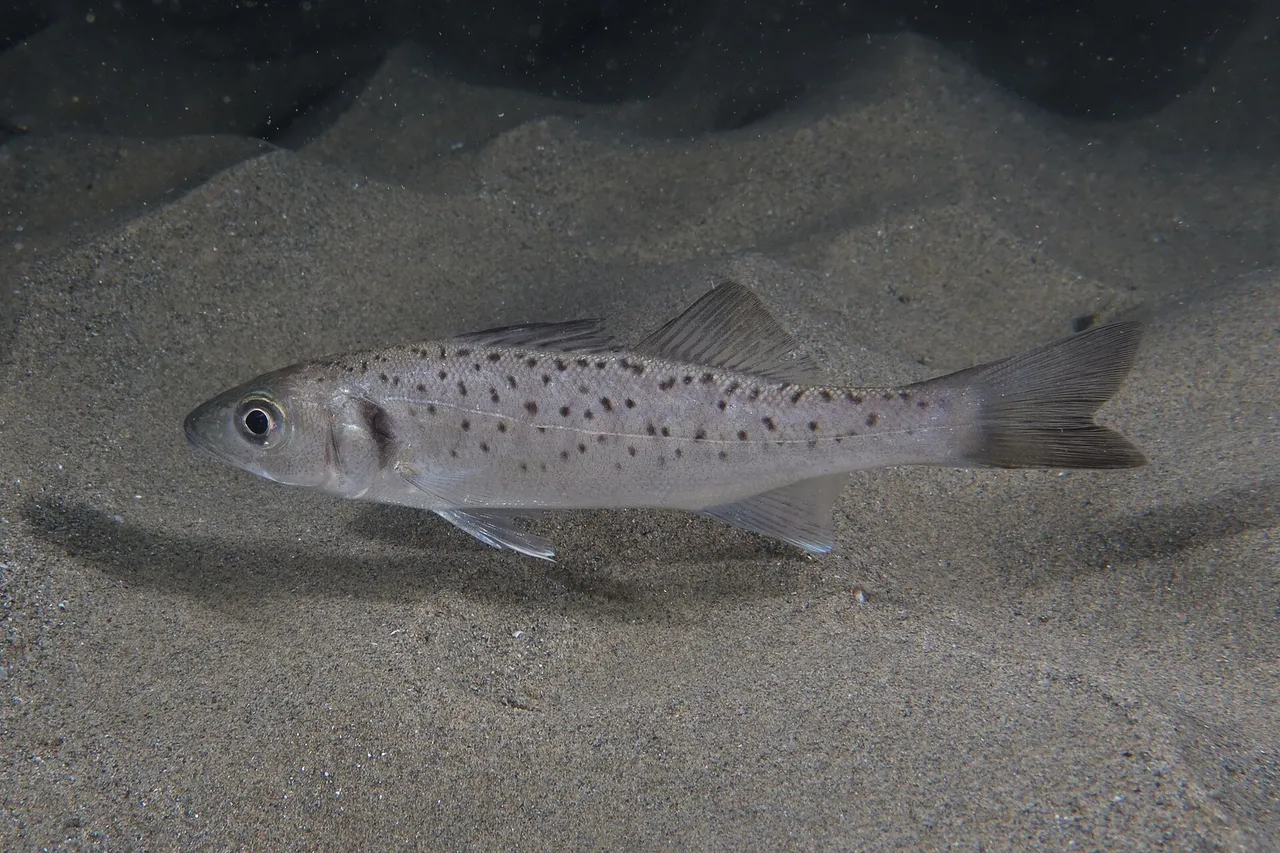
How this was identified, and who took it
Identified by: Full lateral view of a juvenile over sand. Both dorsal fins are separate and distinct, which is the character that separates bass from grey mullet at a glance. Flank spotting is a juvenile trait and the caption says so.Julien Renoult — CC BY 4.0, via Wikimedia Commons — source, licenceWhat is known about how it feeds
Bass hunt turbulence. That is the organising fact, and the three verified prey relationships are best read through it.
The fish exploits water that has lost its order — the undertow of a surf table lifting food off the bottom, a tide race where prey cannot hold position, a gully where a receding tide concentrates whatever was on the flat. In each case the bass is not chasing prey down so much as occupying the place where prey stops being able to escape.
Diet follows availability within that frame. Sandeel over clean sand and around banks; sprat when the winter shoals move inshore; decapod crustaceans in shallow rough ground and estuaries, where crabs and shrimps make up a large part of what is taken. The balance shifts from crustaceans towards fish as the fish grows, in the usual way, but a large bass in a crab-rich estuary is still eating crabs.
The sensory profile is why the turbulence strategy works at all. Vision and the lateral line operate together, and bass feed effectively in white water and in darkness, which is unusual among the European inshore predators and is the reason the species is catchable at night in conditions that would defeat a purely visual hunter.
Feeding is tide-linked rather than clock-linked. A mark has a state of tide at which it works, and the hour of the day is a poor predictor by comparison.
The food
Prey with a verified dietary link to this fish. Each entry carries its own evidence, and each is written at the precision the source actually used: a named species where the source named one, a group or food category where it said “polychaetes”, “crustaceans” or “detritus” and meant it. That is why this list is shorter than the animal’s real diet rather than longer.
- Lesser sandeel — Ammodytes marinus
Sandeel is a principal bass prey over clean sand and around banks, and the timing of bass arrival on many sandy marks tracks sandeel emergence rather than water temperature alone.
- European sprat — Sprattus sprattus
Autumn and winter sprat shoals moving inshore are followed by bass, and a sprat shoal in a bay is one of the more reliable indications that bass are present.
- Decapod crustaceans as prey — a group rather than a species: the evidence names the group
Bass take crabs and shrimps heavily in shallow rough ground and estuaries, and peeler crab's long-standing status as a bass bait rests on that fact rather than the other way round.
Food with no page of its own here yet
These are real components of the diet, listed as plain text because FishingHQ has no page for them yet. Inventing pages to make the list look fuller would be the fabrication this whole approach exists to prevent.
- mullet fry and other juvenile fish
- ragworm and other polychaetes
- squid
- prawns
- small flatfish
What anglers do with this
Everything below is interpretation, not finding. It is what experienced anglers conclude from the biology above, and the reasoning is usually sound and almost never tested. It is separated from the biology deliberately.
The tide relationship is the most useful thing an angler can take from the biology, and it converts into a decision directly: fish the state of tide the mark works on, and treat the clock as secondary. That is convention arrived at independently across every bass fishery in Europe.
The sensory profile is used to argue for surface presentations worked at night and in broken water, and bass are one of the few European species where a genuinely noisy surface presentation is a first-choice rather than a novelty. The reasoning follows from the lateral line's role and is practitioner consensus rather than a tested effect.
The crustacean component underlies the long standing of peeler crab as a bass bait, and it is worth noting the direction of that argument: the diet fact came first and the bait practice follows it, but the practice is evidenced separately on the bait record rather than inferred here.
Bass are slow-growing and late-maturing, stocks have been under substantial pressure, and retention rules vary and change. Check with the relevant authority.
What this does not establish
Three relationships understate a broad and highly variable diet, and the crustacean relationship is recorded at group level. Composition differs sharply between surf beaches, estuaries and reef ground, and between seasons on the same mark. Nothing here establishes proportions or describes any particular fishery.
Where this connects
These are the baits, lures, methods and explainers FishingHQ already joins to this fish — which is why the list is sometimes short. They are not chosen for this page, and a link here means an evidenced relationship exists, not that it follows from the diet.
Baits recorded for this species
Lures recorded for this species
Methods used for it
Where it lives
The science behind the feeding
- Bass: the same word for unrelated fish
- Crustacean imitation in saltwater fly fishing
- Dispatching a fish: doing it properly, or not doing it at all
- Fly fishing for bass in surf, estuary and over rock
- Saltwater fly fishing: what changes
- Shooting heads and what a saltwater fly line is for
- The double haul, and casting a fly in wind
- What salt water does to fly tackle
- When fish feed, and why timing is not a rule
- Why the fish are not where they were last week
This page covers feeding. The European sea bass record covers identification, lifecycle, seasonal behaviour, handling and the sources behind all of it.
Reviewed 2026-08-12.