Garfish
Fish · Last reviewed 2026-08-10
A slender surface-hunting fish with a long beaked jaw and green bones — a harmless pigment that alarms people unnecessarily.
Safety: injury while handling fish — minor injury.
How this was identified, and who took it
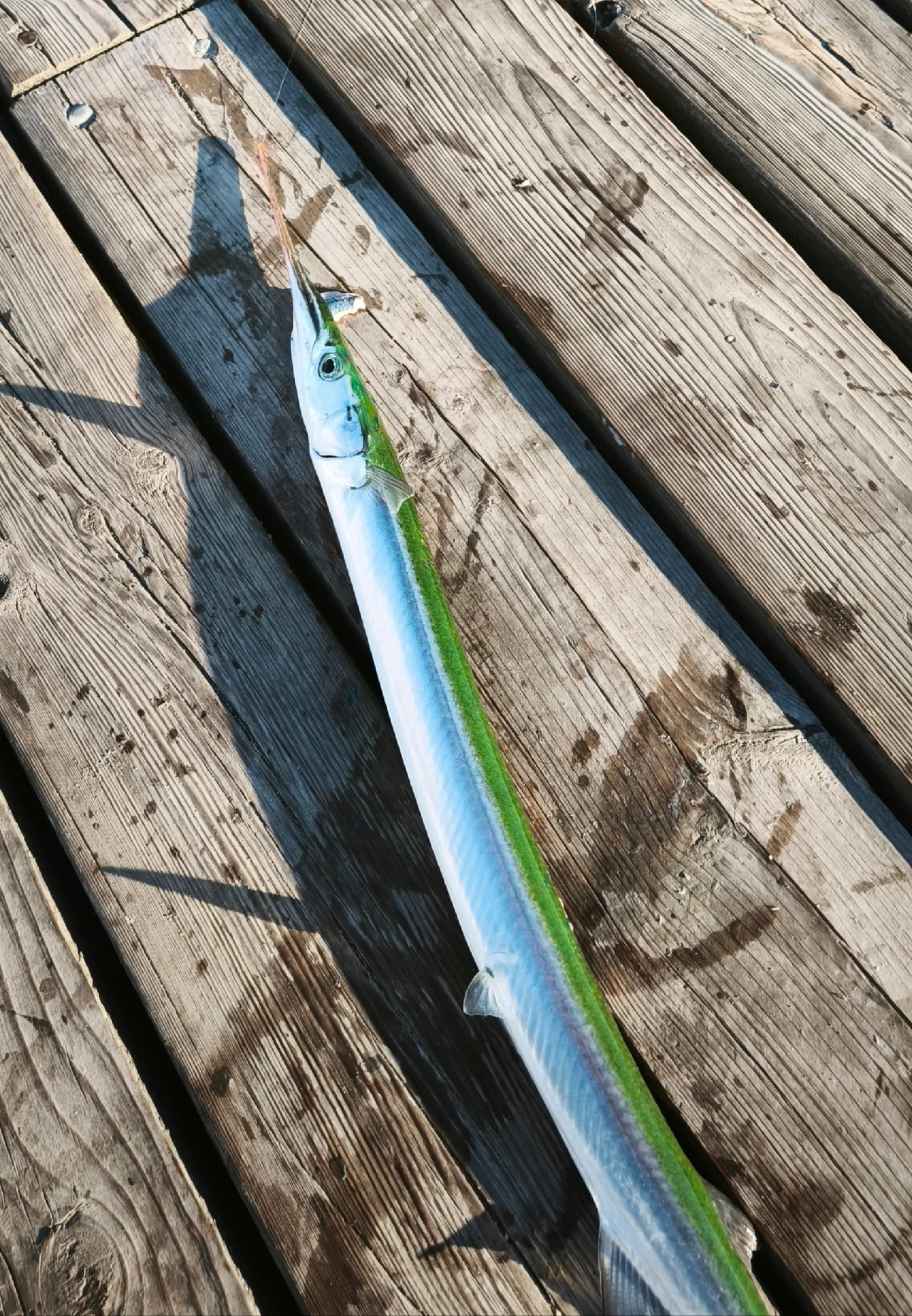
Identified by: The record's character is unambiguous here: BOTH jaws are extended into a long slender beak of roughly equal length, which separates a garfish from every halfbeak, where only the lower jaw is drawn out. The very long slender body, the sharply demarcated green-blue back over a bright silver flank and the small forward-set pectoral are all clear.Dmitry Petrov — CC BY, via iNaturalist — source, licenceCatching Garfish
Everything here on fishing for it. Each entry opens the page behind it.
- When
- Jun–Sept — months recorded at the places that document it, not a season for the whole range.
- Where
- 41 places FishingHQ documents — strongest claim anywhere: regular local target · From the shore, From a kayak
Garfish is a long, thin, brilliantly silver fish with a beak like a heron's, hunting small fish at the surface of inshore European waters through the summer. It is fast, it leaps and tail-walks when hooked, and on light tackle it is genuinely entertaining.
Its famous peculiarity is that the bones are bright green. The pigment responsible is biliverdin, and it is harmless — the flesh is perfectly good eating and the colour has no bearing on freshness or safety. That fact is worth stating plainly, because the appearance puts people off a perfectly good fish every summer.
It arrives inshore just ahead of the mackerel in many areas, which is where the old name mackerel guide comes from.
How it is caught
- Float fishingFloat-fished mackerel strip and small spinners worked in the top of the water.
- Saltwater fly fishingA summer surface fish that follows and takes a fly readily, and a beak full of teeth that makes a wire-free bite section a practical rather than theoretical question.
- SpinningFloat-fished mackerel strip and small spinners worked in the top of the water.
Where Garfish is documented
Places where public sources describe this species as fished, with how it is fished and how strongly the evidence supports it. This is not a range map and it is not a recommendation — it is what has been written down about a fishery rather than a record of any individual catch, and being listed is never permission to fish.
The Waterford coast
2 documented places
Harbour wall
Regular local target
From the shore
Around Jun, Jul, Aug, Sept
Headland
Regular local target
From the shore
Around Jun, Jul, Aug, Sept
Clew Bay and Achill
2 documented places
Pier
Regular local target
From the shore
Around Jun, Jul, Aug, Sept
Headland
Regular local target
From the shore
Around Jun, Jul, Aug, Sept
The Donegal coast and its sea loughs
2 documented places
Headland
Regular local target
From the shore
Around Jun, Jul, Aug, Sept
Beach
Regular local target
From the shore
Around Jun, Jul, Aug, Sept
Dublin Bay and the Wicklow coast
1 documented place
Pier
Regular local target
From the shore
Around Jun, Jul, Aug, Sept
The Sligo and Leitrim coast
1 documented place
Rock mark
Regular local target
From the shore
Around Jun, Jul, Aug, Sept
The Cornish and Devon coasts
19 documented places
Breakwater
Recorded here
From the shore
Around Jun, Jul, Aug, Sept
Headland
Seasonal
From a kayak
Around Jun, Jul, Aug, Sept
Harbour wall
Recorded here
From the shore
Around Jun, Jul, Aug, Sept
Estuary mark
Seasonal
From a kayak
Around Jun, Jul, Aug, Sept
Harbour wall
Recorded here
From the shore
Around Jun, Jul, Aug, Sept
Beach section
Seasonal
From a kayak
Around Jun, Jul, Aug, Sept
Harbour wall
Seasonal
From a kayak
Around Jun, Jul, Aug, Sept
Harbour wall
Repeatedly reported
From the shore
Around Jun, Jul, Aug, Sept
Headland
Seasonal
From a kayak
Around Jun, Jul, Aug, Sept
The Gower and Carmarthen Bay
3 documented places
Pier
Seasonal
From the shore
Around Jun, Jul, Aug, Sept
Rock mark
Seasonal
From the shore
Around Jun, Jul, Aug, Sept
Bay
Seasonal
From the shore
Around Jun, Jul, Aug, Sept
The Purbeck coast and Poole Bay
2 documented places
Swanage Pier
Pier
Seasonal
From the shore
Around Jun, Jul, Aug, Sept
Ledge
Seasonal
From the shore
Around Jun, Jul, Aug, Sept
Also documented on 7 more coasts
Fewer places each, or less strongly supported. Each one names its own marks.
Chesil Beach (2) · Pembrokeshire and the south-west Wales coast (2) · Weymouth Bay (1) · Cardigan Bay and the sarnau (1) · Morecambe Bay and the north-west England coast (1) · Portland Bill and the Portland Race (1) · The Clare coast and the Shannon estuary (1)
What these strengths mean
- Recorded here
- At least one credible public account of this species being caught here. That is all it means.
- Seasonal
- Well supported, and concentrated in part of the year rather than spread through it.
- Repeatedly reported
- Several independent public accounts. Enough to say it happens more than once; not enough to call it a fishery.
- Regular local target
- Fishing sources describe this as a normal local target here, not merely as caught.
When to fish for garfish
Where the places here state a season for garfish, it clusters in Jun–Sep. This is a count of how many documented places name each month — evidence about when people fish for it, not a prediction of what any particular day will produce.
| Jan | Feb | Mar | Apr | May | Jun | Jul | Aug | Sep | Oct | Nov | Dec |
|---|---|---|---|---|---|---|---|---|---|---|---|
| January: no place here names this month — no place names it. | February: no place here names this month — no place names it. | March: no place here names this month — no place names it. | April: no place here names this month — no place names it. | May: no place here names this month — no place names it. | June: 40 places name this month — most places. | July: 40 places name this month — most places. | August: 40 places name this month — most places. | September: 40 places name this month — most places. | October: no place here names this month — no place names it. | November: no place here names this month — no place names it. | December: no place here names this month — no place names it. |
40 of the 41 places that record catches of garfish state which months. The other 1 name no season, so they are counted in neither direction: the shape above is what the dated records say, not the whole picture. The dated records span 14 separate areas.
Identification
- Scientific name
- Belone belone
- Family
- Belonidae
- Water
- Saltwater
- Conservation status
- Least Concern
- Regions
- Britain & Ireland, Western Europe, Northern Europe, Mediterranean
- Very long slender body with a long beaked jaw, both upper and lower, lined with small sharp teeth.
- Brilliant silver flanks with a blue-green back, and dorsal and anal fins set far back near the tail.
- Bones bright green when the fish is cut — harmless biliverdin pigment.
- No finlets behind the dorsal and anal fins, which separates it from the related skippers.
Size
- Typical
- 150–400 g (5–14 oz)
- Large
- 600 g–1 kg (1.3–2.2 lb)
Exceptional: FishBase records a maximum of 104 cm and 1.4 kg
A beak full of small teeth on a fish that will not stop twisting
Garfish are among the least dangerous fish anybody is likely to be injured by, and the injury is entirely a product of the shape of the animal rather than of its power.
THE BEAK IS THE WHOLE PROBLEM. A garfish's jaws are extended into a long, narrow beak lined along their length with numerous small, sharp, needle-like teeth. Individually they are trivial. Collectively, on a fish that is twisting and snapping, they produce a set of shallow punctures across a hand or a finger — and because the beak is long and thin, it reaches places a shorter jaw would not, including around the hand that is holding the body.
AND THE FISH DOES NOT STOP MOVING. Garfish are extremely elongate, extremely flexible, and their escape response is continuous full-body twisting rather than a single burst. A fish held by the body can bring its beak to almost any point on the hand holding it, and it will keep doing so for as long as it is out of the water.
SO CONTROL IS AT THE HEAD, BEHIND THE JOINT. A grip immediately behind the head prevents the beak reaching anything, and a disgorger or long forceps does the unhooking from outside a mouth nobody should be putting fingers into. A cloth over the body helps considerably with a fish this slippery and this determined.
THE GOOD NEWS IS THE RELEASE. Garfish are surface-living, taken in shallow water in warm months, on light tackle, and they suffer none of the depth-related problems that afflict deeper-water species. A garfish returned quickly goes back in excellent condition.
AND THE GREEN BONES ARE NOT A PROBLEM. Garfish skeletons are coloured green by biliverdin, which alarms people who have not seen it and is entirely harmless. The fish is good to eat and the colour is a curiosity rather than a warning.
What experienced anglers do — why, and the sources (4)
Widely and independently recommended by experienced anglers and specialist sources. This is real angling knowledge, not proof: controlled evidence for it is limited, and FishingHQ records it as convention rather than as a demonstrated effect.
- FishBase: a global information system on fishes — Froese, R. and D. Pauly, eds. — FishBase Consortium (Scientific institute)Relied on for: Morphology, dentition, spination, thermal tolerance, reproductive strategy and depth range recorded for the species.States this directlyPassage read and verified
- The IUCN Red List of Threatened Species — International Union for Conservation of Nature (Conservation authority)Relied on for: Assessment, population trend and the life-history traits — longevity, growth rate, sex structure — that determine a population's sensitivity to the removal of large individuals.Background and mechanism onlyCitation checked — the work exists and is described correctly
- Sea Angler — Bauer Media (Specialist angling publication)Relied on for: Established boat and shore practice for handling and returning the species.States this directlyCitation checked — the work exists and is described correctly
- IGFA International Angling Rules and World Record Requirements — International Game Fish Association (Angling or fisheries organisation)Relied on for: Handling, release and tackle conventions in recognised sport fisheries for the species.Background and mechanism onlyPassage read and verified
The top few centimetres of the sea, and why that is a habitat
Garfish occupy a habitat most descriptions of the sea leave out entirely: the immediate surface layer, which is a genuinely distinct environment with its own residents.
THE FISH IS EPIPELAGIC AND NEUSTONIC. Garfish live in the uppermost part of the water column — frequently the top metre or two — in coastal and offshore waters of the north-east Atlantic, the Baltic, the Mediterranean and the Black Sea, moving inshore in the warmer months. They are surface animals in a way that very few fish are, and everything about them reflects it.
WHY THE SURFACE IS A DISTINCT PLACE. The top of the water column is where light is greatest, where small pelagic fish and invertebrates concentrate, where floating material accumulates along convergence lines, and where a predator hunting upward has prey silhouetted against the sky. It is also the most exposed position in the sea, with nowhere to hide in any direction. A fish that lives there has to be fast, thin and hard to see from below.
WHICH IS EXACTLY WHAT A GARFISH IS. Extremely elongate and laterally compressed, so it presents almost no silhouette head-on; countershaded green-blue above and silver below; and equipped with a long, narrow, tooth-lined beak for seizing small fish sideways at speed. It hunts sandeel, sprat and other small shoaling fish in the surface layer, frequently in company with mackerel doing the same thing lower down.
THE INSHORE ASSOCIATION IS SEASONAL AND STRUCTURAL. In summer garfish come close in around rocky shores, reefs, piers, breakwaters and harbour mouths — not for the structure itself but because those features concentrate the small fish they eat, and because tidal flow past a headland or a wall creates the convergence lines where prey collects. That is why they are a shore fishery at all, and why they are taken on float tackle fished shallow rather than on anything near the bottom.
AND THE GREEN BONES ARE UNRELATED TO HABITAT but universally asked about: the skeleton is coloured by biliverdin, it is harmless, and it has nothing to do with where the fish lives or what it has eaten.
Backed by research — why, and the sources (2)
Supported by peer-reviewed research or fisheries science. The sources are listed and can be checked.
- The Fishes of the British Isles and North-West Europe — Macmillan, 1969 (Reference work)Relied on for: Habitat association, depth and ground type of fishes in British and north-west European waters.States this directlyCitation checked — the work exists and is described correctly
- FishBase: a global information system on fishes — Froese, R. and D. Pauly, eds. — FishBase Consortium (Scientific institute)Relied on for: Habitat association, depth range and substrate preference recorded for the species.States this directlyPassage read and verified
Lifecycle and reproduction
Fast-growing and short-lived, maturing within a couple of years. A surface-dwelling pelagic fish present inshore seasonally rather than year-round.
Spawns in coastal waters in late spring and summer, attaching eggs with adhesive filaments to floating weed and drifting material rather than broadcasting them freely.
Feeding and senses
Takes small fish — sand eel, sprat and young herring — at or near the surface, seizing prey sideways in the long beak before turning it to swallow head-first. Feeding happens in the top metre of water, which is why float-fished baits and small surface lures work and why bottom presentations do not.
A daylight surface hunter working in clear water on visible prey, striking at speed in the top of the water column. Vision is the whole of its hunting apparatus, so bright conditions and clear water suit it and coloured water shuts the fishing down.
Through the year
Arrives inshore in late spring, is present through the summer, and departs as water cools — a strictly seasonal fish for shore anglers.
Distribution
Eastern Atlantic and Mediterranean Sea. Three subspecies were recognised by Collette and Parin (1970, ) Belone belone belone (Linnaeus, 1761) (Northeast Atlantic); Belone belone euxini Günther, 1866 (Black Sea and Sea of Azov); Belone belone acus Risso, 1827 (Mediterranean Sea and adjacent parts of Atlantic Ocean, Madeira, Canary Islands, Azores, and south to Cape Verde ; subspecies Belone belone gracilis Lowe, 1839 (France to the Canary Islands including the Mediterranean) in Collette & Parin, 1990
This is a biological range — where the species occurs, not a prediction that you will catch one. To browse the fishing geography FishingHQ holds, start at fishing places.
Why anglers care
A light-tackle summer target taken on float-fished strips of mackerel, small spinners and flies from piers, rocks and small boats. Its significance is as an accessible, fast, acrobatic summer species that requires no specialist tackle, and as a good introduction to light float fishing at sea. The beak makes hooking awkward and long-shank hooks are commonly used.
Handling and returning
The beak is lined with small sharp teeth and the fish thrashes and twists. Hold behind the head, keep fingers clear of the jaws, and use a disgorger. Being a surface fish it recovers well if returned quickly.
Safety
Injury while handling fish — Minor injury
The long jaws carry many small sharp teeth, and the fish twists violently in the hand during unhooking.
What reduces it: Grip behind the head, keep fingers away from the beak, and use a disgorger or long forceps.
Where to go next
Where it lives
- Harbours, piers and breakwatersHunts small fish at the surface of inshore water through the summer.
- Rocky shores and reefsHunts small fish at the surface of inshore water through the summer.
- Surf beachesA surface fish of the warmer months, following bait into shallow inshore water where it is reachable from the beach.
Where you will find it
- Chesil BeachArrives inshore with the mackerel in the warmer months and works the surface layers close to the steep beach.
- CyprusA surface fish taken from breakwaters and rock, and a useful reminder that the productive layer here is frequently the top metre rather than the bottom — which is the reverse of what a bottom-fishing visitor assumes.
- DenmarkArrives in numbers in spring and produces one of the few fisheries in Europe that functions as a public social event, fished by people who are not otherwise sea anglers.
- GermanyArrives on the German Baltic coast in numbers in spring, which makes it one of the few genuinely social and accessible sea fisheries in northern Europe.
- Portland Bill and the Portland RaceWorks the surface layers over deep water close to the headland through the warmer months.
Sources and evidence
- FishBase: a global information system on fishes — Froese, R. and D. Pauly, eds. — FishBase Consortium (Scientific institute)Relied on for: Family, maximum size, depth and environment, distribution and the IUCN assessment for Belone belone.States this directlyPassage read and verified
- The IUCN Red List of Threatened Species — International Union for Conservation of Nature (Conservation authority)Relied on for: The Least Concern assessment for Belone belone, assessed 10 July 2012.States this directlyCitation checked — the work exists and is described correctly
Why the 11 connections on this page are here, and the sources
How it is caught
What experienced anglers do — 3 connections
Widely and independently recommended by experienced anglers and specialist sources. This is real angling knowledge, not proof: controlled evidence for it is limited, and FishingHQ records it as convention rather than as a demonstrated effect.
Float fishing
A practitioner claim about how Belone belone is commonly fished, following from where and how it feeds.
- General angling website restatements of established technique — Various (Credible secondary source)Relied on for: Widely restated practitioner accounts of fishing for garfish.Citation checked — the work exists and is described correctly
- Sea Angler — Bauer Media (Specialist angling publication)Relied on for: Practitioner treatment of the methods used for garfish and comparable species.Citation checked — the work exists and is described correctly
Saltwater fly fishing
A statement about how a species is fished, which is angling convention rather than biology and is labelled as such.
- Still Water Fly-Fishing — Andre Deutsch, 1952 (Specialist angling publication)Relied on for: Fly-fishing practice from a practitioner tradition: line control, depth management, retrieve and the reading of water.States this directlyCitation checked — the work exists and is described correctly
- Sea Angler — Bauer Media (Specialist angling publication)Relied on for: Contemporary UK sea angling practice as reported by practitioners: ground, tackle, presentation and seasonal timing.States this directlyCitation checked — the work exists and is described correctly
Spinning
A practitioner claim about how Belone belone is commonly fished, following from where and how it feeds.
- General angling website restatements of established technique — Various (Credible secondary source)Relied on for: Widely restated practitioner accounts of fishing for garfish.Citation checked — the work exists and is described correctly
- Sea Angler — Bauer Media (Specialist angling publication)Relied on for: Practitioner treatment of the methods used for garfish and comparable species.Citation checked — the work exists and is described correctly
Where it lives
Backed by research — 3 connections
Supported by peer-reviewed research or fisheries science. The sources are listed and can be checked.
Harbours, piers and breakwaters
A habitat association for Belone belone taken from the environment and distribution data on its FishBase summary.
- FishBase: a global information system on fishes — Froese, R. and D. Pauly, eds. — FishBase Consortium (Scientific institute)Relied on for: The environment, depth range and habitat description recorded for Belone belone.States this directlyPassage read and verified
Rocky shores and reefs
A habitat association for Belone belone taken from the environment and distribution data on its FishBase summary.
- FishBase: a global information system on fishes — Froese, R. and D. Pauly, eds. — FishBase Consortium (Scientific institute)Relied on for: The environment, depth range and habitat description recorded for Belone belone.States this directlyPassage read and verified
Surf beaches
A habitat association resting on the standard regional reference works rather than on angling report.
- The Fishes of the British Isles and North-West Europe — Macmillan, 1969 (Reference work)Relied on for: Distribution, habitat association, feeding and biology of the fishes of the British Isles and north-west Europe.States this directlyCitation checked — the work exists and is described correctly
- FAO Species Identification Guides for Fishery Purposes and the FAO Species Catalogues — Food and Agriculture Organization of the United Nations (Scientific institute)Relied on for: Habitat association, prey and distribution as set out in the FAO species identification sheets for the region concerned.States this directlyCitation checked — the work exists and is described correctly
Where you will find it
Backed by research — 5 connections
Supported by peer-reviewed research or fisheries science. The sources are listed and can be checked.
Chesil Beach
A distribution association between an animal and a kind of water, rather than a claim about any named mark.
- The Fishes of the British Isles and North-West Europe — Macmillan, 1969 (Reference work)Relied on for: Distribution, habitat association, depth and ground preference of fishes in British and north-west European waters.States this directlyCitation checked — the work exists and is described correctly
- FishBase: a global information system on fishes — Froese, R. and D. Pauly, eds. — FishBase Consortium (Scientific institute)Relied on for: Distribution, habitat association and depth range recorded for the species.Background and mechanism onlyPassage read and verified
Cyprus
A distribution edge resting on published regional identification and distribution references, written where the species is genuinely characteristic of the destination's fishing rather than merely recorded from its waters.
- FAO Species Identification Guides for Fishery Purposes and the FAO Species Catalogues — Food and Agriculture Organization of the United Nations (Scientific institute)Relied on for: Distribution, habitat association and biology of the fishes of the eastern central Atlantic and the Mediterranean, from the regional identification guides prepared for fishery purposes.States this directlyCitation checked — the work exists and is described correctly
- FishBase: a global information system on fishes — Froese, R. and D. Pauly, eds. — FishBase Consortium (Scientific institute)Relied on for: Recorded environment, depth range, distribution and biology of the species named.States this directlyPassage read and verified
Denmark
That a species occurs in these waters, drawn from distribution science and stock assessment. It is a statement about where the animal lives and is not a statement that anybody will catch one, still less where.
- FishBase: a global information system on fishes — Froese, R. and D. Pauly, eds. — FishBase Consortium (Scientific institute)Relied on for: Recorded distribution, depth range and habitat association of the species named, including its occurrence in the waters of the jurisdiction named.States this directlyPassage read and verified
- ICES Advice on fishing opportunities, catch and effort — International Council for the Exploration of the Sea (Scientific institute)Relied on for: Stock distribution and assessment across the European ecoregions, which is the basis for stating that a species occurs in a given national sea area.States this directlyCitation checked — the work exists and is described correctly
Germany
That a species occurs in these waters, drawn from distribution science and stock assessment. It is a statement about where the animal lives and is not a statement that anybody will catch one, still less where.
- FishBase: a global information system on fishes — Froese, R. and D. Pauly, eds. — FishBase Consortium (Scientific institute)Relied on for: Recorded distribution, depth range and habitat association of the species named, including its occurrence in the waters of the jurisdiction named.States this directlyPassage read and verified
- ICES Advice on fishing opportunities, catch and effort — International Council for the Exploration of the Sea (Scientific institute)Relied on for: Stock distribution and assessment across the European ecoregions, which is the basis for stating that a species occurs in a given national sea area.States this directlyCitation checked — the work exists and is described correctly
Portland Bill and the Portland Race
A distribution association between an animal and a kind of water, rather than a claim about any named mark.
- The Fishes of the British Isles and North-West Europe — Macmillan, 1969 (Reference work)Relied on for: Distribution, habitat association, depth and ground preference of fishes in British and north-west European waters.States this directlyCitation checked — the work exists and is described correctly
- FishBase: a global information system on fishes — Froese, R. and D. Pauly, eds. — FishBase Consortium (Scientific institute)Relied on for: Distribution, habitat association and depth range recorded for the species.Background and mechanism onlyPassage read and verified
How FishingHQ labels evidence is explained in the evidence policy.