Turbot
Fish · Last reviewed 2026-08-10
A large, almost circular left-eyed flatfish with bony tubercles instead of scales, the most valuable flatfish in European waters.
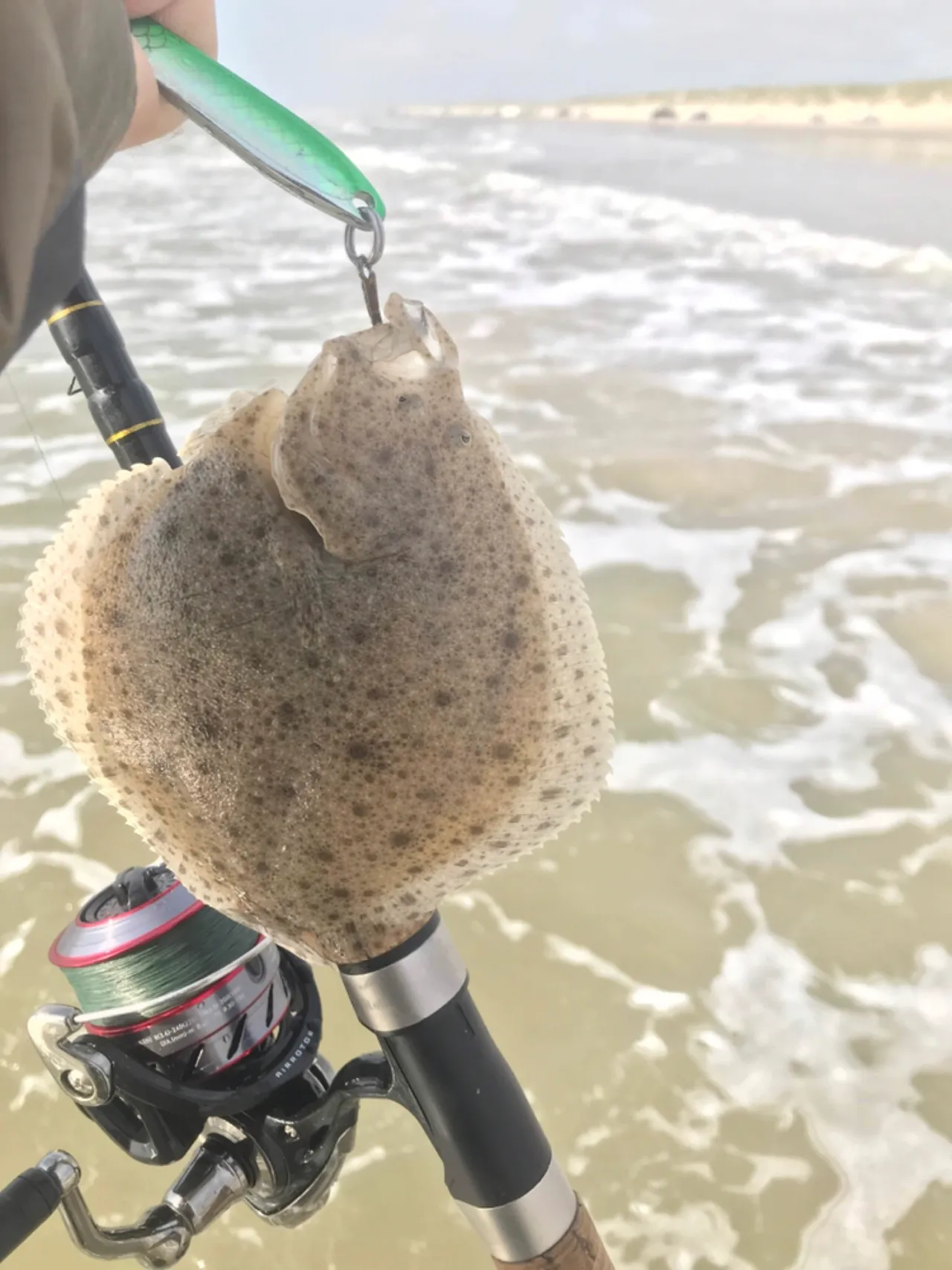
How this was identified, and who took it
Identified by: The near-circular, strongly broader-than-long disc characteristic of Scophthalmus maximus, with sandy mottling and darker spotting on the eyed side. Two agreeing identifications on the source, none disagreeing. The reviewer records that outline alone is the weakest the character ever is on a fish this small, which is why this row is illustrative rather than identification.Jonas Holm Hald Therkildsen — CC0, via iNaturalist — source, licenceCatching Turbot
Everything here on fishing for it. Each entry opens the page behind it.
- Ground
- When
- Apr and Jun–Sept — months recorded at the places that document it, not a season for the whole range.
- Where
- 27 places FishingHQ documents — strongest claim anywhere: regular local target · From the shore, From a kayak
Turbot is the premier flatfish of European seas, both to eat and to catch: a broad, almost circular, left-eyed ambush predator lying on sand and gravel banks, taking sand eels and small fish from concealment.
It is separated from brill — the fish it is most often confused with — by texture rather than by shape. A turbot has no scales; instead the upper surface carries scattered bony tubercles that feel unmistakably rough under a hand. A brill is smooth, with small scales, and has a distinctly fringed front edge to the dorsal fin.
It is a genuinely large flatfish and a prime target over offshore banks, where it is fished with baited rigs presented hard on clean ground.
How it is caught
Gear for this fish
Where Turbot is documented
Places where public sources describe this species as fished, with how it is fished and how strongly the evidence supports it. This is not a range map and it is not a recommendation — it is what has been written down about a fishery rather than a record of any individual catch, and being listed is never permission to fish.
The Kerry coast
3 documented places
Surf beach
Regular local target
From the shore
Estuary
Occasional
From the shore
Surf beach
Regular local target
From the shore
The Donegal coast and its sea loughs
2 documented places
Surf beach
Regular local target
From the shore
Beach
Regular local target
From the shore
The Severn Estuary
1 documented place
Rock mark
Regular local target
From the shore
Around Apr
Observed April 2023
The Cornish and Devon coasts
6 documented places
Harbour wall
Repeatedly reported
From a kayak
Harbour wall
Recorded here
From the shore
Bolt Head and the Salcombe rock
Rock mark
Repeatedly reported
From the shore
Surf beach
Occasional
From a kayak
Beach
Seasonal
From the shore
Around Jun, Jul, Aug, Sept
Harbour wall
Repeatedly reported
From a kayak
Morecambe Bay and the north-west England coast
1 documented place
Rock mark
Seasonal
From the shore
Around Jun, Jul, Aug, Sept
The Causeway and Antrim coast
3 documented places
Harbour wall
Recorded here
From the shore
Harbour wall
Recorded here
From the shore
Beach
Recorded here
From the shore
The Moray Firth
2 documented places
Wick
Harbour wall
Recorded here
From the shore
Beach
Recorded here
From the shore
Also documented on 8 more coasts
Fewer places each, or less strongly supported. Each one names its own marks.
The Wash and the Lincolnshire coast (1) · The Fife, Angus and Mearns coast (1) · Pembrokeshire and the south-west Wales coast (1) · Cardigan Bay and the sarnau (1) · Anglesey (1) · The Solway Firth (1) · Outer Hebrides (1) · The Norfolk and Suffolk sandbank coast (1)
What these strengths mean
- Recorded here
- At least one credible public account of this species being caught here. That is all it means.
- Repeatedly reported
- Several independent public accounts. Enough to say it happens more than once; not enough to call it a fishery.
- Occasional
- Caught here, and described as unusual rather than normal. Do not plan a session around it.
- Regular local target
- Fishing sources describe this as a normal local target here, not merely as caught.
- Seasonal
- Well supported, and concentrated in part of the year rather than spread through it.
Identification
- Scientific name
- Scophthalmus maximus
- Family
- Scophthalmidae
- Water
- Saltwater, Brackish
- Conservation status
- Least Concern
- Regions
- Western Europe, Britain & Ireland, Northern Europe, Mediterranean
- Bony tubercles scattered over the upper surface, giving a rough feel; brill is smooth-scaled.
- Broad, almost circular body outline — wider relative to length than a brill.
- Eyes on the left side, with a large mouth and no fringed rays at the front of the dorsal fin.
- Sandy brown upper surface mottled to match the ground, over a white blind side.
Size
- Typical
- 1–4 kg (2.2–8.8 lb)
- Large
- 6–12 kg (13–26 lb)
Exceptional: FishBase records a maximum of 100 cm and 25 kg
Lifecycle and reproduction
Moderately long-lived with females growing considerably larger than males. Slow-growing in northern waters, and heavily exploited commercially across its range.
Spawns in spring and early summer over sandy ground in relatively shallow coastal water, broadcasting pelagic eggs. Juveniles settle in very shallow inshore water.
Feeding and senses
An ambush predator lying part-buried on sand and gravel, taking sand eels, small fish and crustaceans with a fast upward strike.
Hunts by sight from concealment with both eyes on the upper surface, relying on camouflage against clean ground. Strikes are short-range and upward.
Through the year
Moves onto shallower banks in the warmer months and into deeper water in winter, with the summer bank fishing forming the core of the recreational fishery.
Distribution
Northeast Atlantic: throughout the Mediterranean and along the European coasts to Arctic Circle; also found in most of the Baltic Sea. Subspecies Psetta maxima maeotica in the Black Sea
This is a biological range — where the species occurs, not a prediction that you will catch one. To browse the fishing geography FishingHQ holds, start at fishing places.
Why anglers care
A prime European boat target over sand and gravel banks, taken on sand eel, mackerel strip and launce presented on flowing traces that let the bait work on the ground. Its significance is size and value — turbot is the most sought-after flatfish in European waters. Practitioner consensus is that presentation on the bottom matters more than bait choice, and that turbot banks fish best on a running tide.
Handling and returning
A heavy-bodied fish; support the whole body rather than lifting by the head or gill cover. The tubercles are abrasive rather than dangerous. Undersized fish should be returned promptly and gently, and returned flat rather than dropped.
Going further
- Turbot vs Brill — how to tell them apart.
Where to go next
Similar and related fish
Where it lives
Where you will find it
- BulgariaThe Black Sea turbot is the most valuable fish on this coast and the one its commercial and regulatory attention is organised around.
- Chesil BeachAssociated with clean sand and shingle ground of exactly this kind, ambushing small fish from the bottom.
- The Black SeaThe basin's most valuable demersal fish, living on the shelf within the oxygenated layer. There is nowhere deeper for it to go, which concentrates it and has made it correspondingly vulnerable.
Understanding this fish
Sources and evidence
- FishBase: a global information system on fishes — Froese, R. and D. Pauly, eds. — FishBase Consortium (Scientific institute)Relied on for: Family, maximum size, depth and environment, distribution and the IUCN assessment for Scophthalmus maximus.States this directlyPassage read and verified
- The IUCN Red List of Threatened Species — International Union for Conservation of Nature (Conservation authority)Relied on for: The Least Concern assessment for Scophthalmus maximus, assessed 07 December 2020.States this directlyCitation checked — the work exists and is described correctly
Why the 10 connections on this page are here, and the sources
Similar and related fish
Backed by research — 1 connection
Supported by peer-reviewed research or fisheries science. The sources are listed and can be checked.
Brill
An identification comparison naming both binomials: Scophthalmus maximus and Scophthalmus rhombus.
- FishBase: a global information system on fishes — Froese, R. and D. Pauly, eds. — FishBase Consortium (Scientific institute)Relied on for: Morphological and distributional data for Scophthalmus maximus and for Scophthalmus rhombus.States this directlyPassage read and verified
- The IUCN Red List of Threatened Species — International Union for Conservation of Nature (Conservation authority)Relied on for: Separate assessments treating Scophthalmus maximus and Scophthalmus rhombus as distinct species.States this directlyCitation checked — the work exists and is described correctly
How it is caught
What experienced anglers do — 2 connections
Widely and independently recommended by experienced anglers and specialist sources. This is real angling knowledge, not proof: controlled evidence for it is limited, and FishingHQ records it as convention rather than as a demonstrated effect.
Drift fishing
A practitioner claim about how Scophthalmus maximus is commonly fished, following from where and how it feeds.
- General angling website restatements of established technique — Various (Credible secondary source)Relied on for: Widely restated practitioner accounts of fishing for turbot.Citation checked — the work exists and is described correctly
- Sea Angler — Bauer Media (Specialist angling publication)Relied on for: Practitioner treatment of the methods used for turbot and comparable species.Citation checked — the work exists and is described correctly
Ledgering
A practitioner claim about how Scophthalmus maximus is commonly fished, following from where and how it feeds.
- General angling website restatements of established technique — Various (Credible secondary source)Relied on for: Widely restated practitioner accounts of fishing for turbot.Citation checked — the work exists and is described correctly
- Sea Angler — Bauer Media (Specialist angling publication)Relied on for: Practitioner treatment of the methods used for turbot and comparable species.Citation checked — the work exists and is described correctly
Gear for this fish
What experienced anglers do — 2 connections
Widely and independently recommended by experienced anglers and specialist sources. This is real angling knowledge, not proof: controlled evidence for it is limited, and FishingHQ records it as convention rather than as a demonstrated effect.
Fish strip and cut bait
A practitioner claim about tackle commonly used for Scophthalmus maximus.
- General angling website restatements of established technique — Various (Credible secondary source)Relied on for: Widely restated practitioner accounts of this presentation for turbot.Citation checked — the work exists and is described correctly
- Angling Times — Bauer Media (Specialist angling publication)Relied on for: Practitioner treatment of comparable presentations for the species group.Citation checked — the work exists and is described correctly
Sand eel
A practitioner claim about tackle commonly used for Scophthalmus maximus.
- General angling website restatements of established technique — Various (Credible secondary source)Relied on for: Widely restated practitioner accounts of this presentation for turbot.Citation checked — the work exists and is described correctly
- Angling Times — Bauer Media (Specialist angling publication)Relied on for: Practitioner treatment of comparable presentations for the species group.Citation checked — the work exists and is described correctly
Where it lives
Backed by research — 1 connection
Supported by peer-reviewed research or fisheries science. The sources are listed and can be checked.
Inshore ground
A habitat association for Scophthalmus maximus taken from the environment and distribution data on its FishBase summary.
- FishBase: a global information system on fishes — Froese, R. and D. Pauly, eds. — FishBase Consortium (Scientific institute)Relied on for: The environment, depth range and habitat description recorded for Scophthalmus maximus.States this directlyPassage read and verified
Where you will find it
Backed by research — 3 connections
Supported by peer-reviewed research or fisheries science. The sources are listed and can be checked.
Bulgaria
That a species occurs in these waters, drawn from distribution science and stock assessment. It is a statement about where the animal lives and is not a statement that anybody will catch one, still less where.
- FAO Species Identification Guides for Fishery Purposes and the FAO Species Catalogues — Food and Agriculture Organization of the United Nations (Scientific institute)Relied on for: Identification, distribution and habitat association of the fishes and invertebrates of the Mediterranean and Black Sea.States this directlyCitation checked — the work exists and is described correctly
- FishBase: a global information system on fishes — Froese, R. and D. Pauly, eds. — FishBase Consortium (Scientific institute)Relied on for: Recorded distribution, depth range and habitat association of the species named.States this directlyPassage read and verified
Chesil Beach
A distribution association between an animal and a kind of water, rather than a claim about any named mark.
- The Fishes of the British Isles and North-West Europe — Macmillan, 1969 (Reference work)Relied on for: Distribution, habitat association, depth and ground preference of fishes in British and north-west European waters.States this directlyCitation checked — the work exists and is described correctly
- FishBase: a global information system on fishes — Froese, R. and D. Pauly, eds. — FishBase Consortium (Scientific institute)Relied on for: Distribution, habitat association and depth range recorded for the species.Background and mechanism onlyPassage read and verified
The Black Sea
A distribution edge resting on published identification and distribution references rather than on angling report, written where the species is genuinely characteristic of the system rather than merely recorded in it once.
- FishBase: a global information system on fishes — Froese, R. and D. Pauly, eds. — FishBase Consortium (Scientific institute)Relied on for: Recorded environment, salinity tolerance, depth range, distribution and biology of the species named.States this directlyPassage read and verified
- FAO Species Identification Guides for Fishery Purposes and the FAO Species Catalogues — Food and Agriculture Organization of the United Nations (Scientific institute)Relied on for: Distribution, habitat association and identification of the fishes of the Mediterranean and Black Sea region.States this directlyCitation checked — the work exists and is described correctly
Understanding this fish
What experienced anglers do — 1 connection
Widely and independently recommended by experienced anglers and specialist sources. This is real angling knowledge, not proof: controlled evidence for it is limited, and FishingHQ records it as convention rather than as a demonstrated effect.
Filleting: the principles, not the recipe
A statement about how a species is prepared, which is convention shaped by anatomy rather than a biological claim, and is labelled as practitioner consensus accordingly.
- Sea Angler — Bauer Media (Specialist angling publication)Relied on for: Contemporary UK and European sea angling practice as reported by practitioners, including catch handling convention.States this directlyCitation checked — the work exists and is described correctly
- General angling website restatements of established technique — Various (Credible secondary source)Relied on for: Widely restated angling practice, recorded as consensus rather than as scholarship.Background and mechanism onlyCitation checked — the work exists and is described correctly
How FishingHQ labels evidence is explained in the evidence policy.