Brill
Fish · Last reviewed 2026-08-10
A smooth-skinned left-eyed flatfish of sandy ground, separated from turbot by scales rather than tubercles and by fringed rays at the front of the dorsal fin.
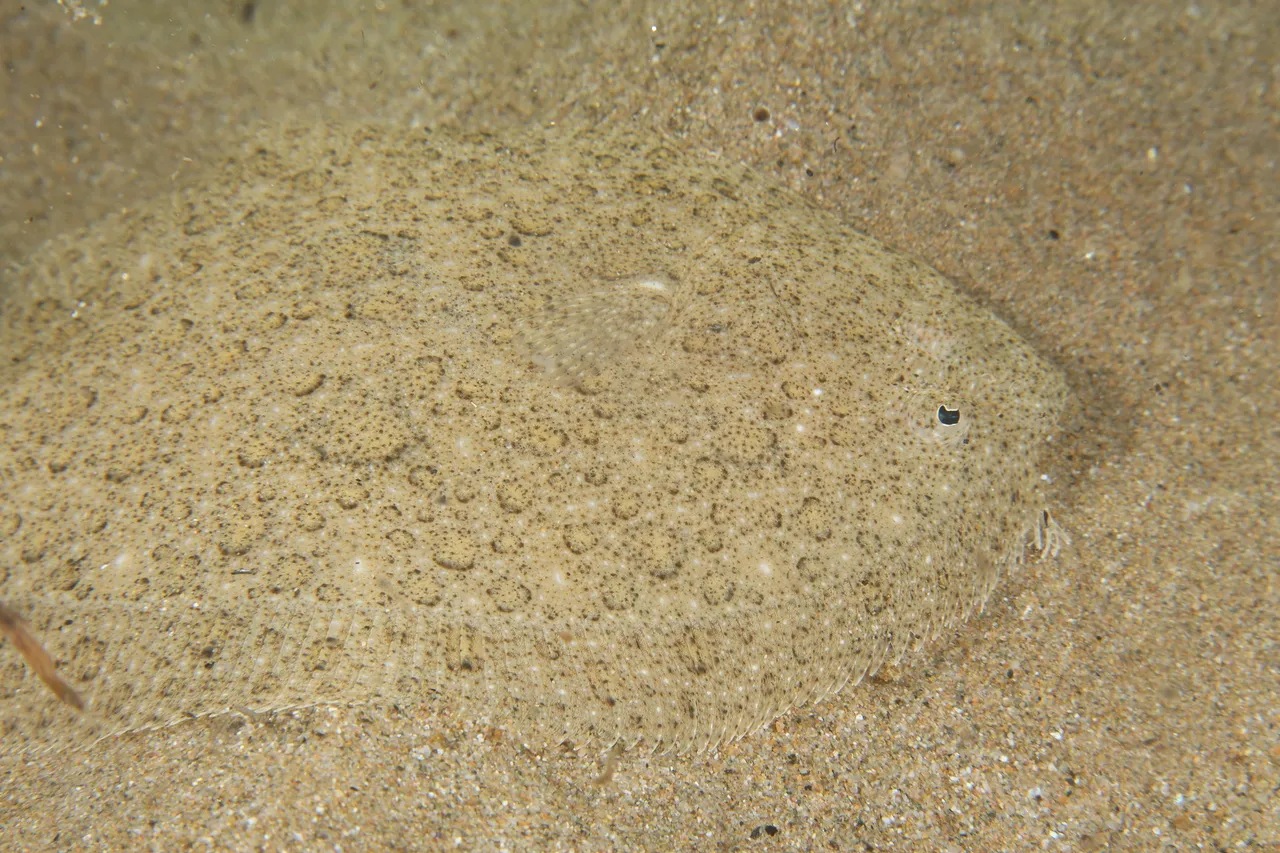
How this was identified, and who took it
Identified by: The separation from turbot is an ABSENCE, and this resolution supports it: smooth finely speckled skin with no bony tubercles anywhere on the eyed side. Supported by an oval outline of roughly 1.6 times as long as deep against a turbot's near-circular proportion, and by free fringed rays at the front of the dorsal fin beside the head.Julien Renoult — CC BY, via iNaturalist — source, licenceCatching Brill
Everything here on fishing for it. Each entry opens the page behind it.
- Ground
- Where
- 1 place FishingHQ documents — strongest claim anywhere: occasional · From a kayak
Brill is turbot's smaller, smoother relative, and the two share the same sandy ground and much of the same fishing. Where a turbot is rough with bony tubercles and almost circular, a brill is smooth-scaled and more oval, and it carries a distinctive feature at the front of the dorsal fin: the first few rays are free and fringed, standing slightly clear of the membrane.
That fringe is the reliable separation, and it is easy to see once known. Both are left-eyed, both lie part-buried on clean ground, and both take small fish and sand eels by ambush.
Brill hybridise with turbot occasionally, producing intermediate fish, which is a genuine complication rather than a theoretical one.
How it is caught
Gear for this fish
Where Brill is documented
Places where public sources describe this species as fished, with how it is fished and how strongly the evidence supports it. This is not a range map and it is not a recommendation — it is what has been written down about a fishery rather than a record of any individual catch, and being listed is never permission to fish.
What these strengths mean
- Occasional
- Caught here, and described as unusual rather than normal. Do not plan a session around it.
Identification
- Scientific name
- Scophthalmus rhombus
- Family
- Scophthalmidae
- Water
- Saltwater, Brackish
- Conservation status
- Least Concern
- Regions
- Western Europe, Britain & Ireland, Northern Europe, Mediterranean
- Smooth skin with small scales — no bony tubercles, which is the definitive separation from turbot.
- The first few dorsal fin rays free and fringed at the front of the head.
- More oval body outline than the almost circular turbot.
- Eyes on the left side; sandy brown mottled upper surface, often with pale and dark flecking, over a white blind side.
Size
- Typical
- 0.7–2 kg (1.5–4.4 lb)
- Large
- 2.5–4.5 kg (5.5–10 lb)
Exceptional: FishBase records a maximum of 75 cm and 8 kg
Lifecycle and reproduction
Moderately long-lived, growing more slowly and reaching a smaller maximum size than turbot. Hybridises with turbot where the two occur together.
Spawns in spring and summer over sandy ground in coastal water, broadcasting pelagic eggs, with juveniles settling in shallow inshore areas.
Feeding and senses
An ambush predator taking sand eels, small fish and crustaceans from a part-buried position on clean or lightly mixed ground.
Hunts visually from concealment, relying on camouflage and a short upward strike rather than pursuit. Both eyes sit on the upper side giving an upward field of view, and the fish adjusts its skin pattern to the ground it lies on, which is why it is so rarely seen before it moves.
Through the year
Follows the same seasonal pattern as turbot, moving shallower in summer and deeper in winter, and is commonly taken alongside it.
Distribution
Eastern Atlantic: 68°N to Morocco. Reported from Iceland . Also known throughout the Mediterranean and Black Sea
This is a biological range — where the species occurs, not a prediction that you will catch one. To browse the fishing geography FishingHQ holds, start at fishing places.
Why anglers care
A European boat and occasionally shore target over sand, taken on the same sand eel and fish-strip presentations used for turbot and frequently as part of the same session. Its significance is partly culinary — it is highly regarded on the table — and partly as the fish anglers must be able to separate from turbot, since the two are commonly managed with different size limits.
Handling and returning
Support the body when lifting rather than holding by the head. Handle with wet hands, return undersized fish flat and promptly, and avoid dropping fish onto hard decks.
Going further
- Brill vs Turbot — how to tell them apart.
Where to go next
Similar and related fish
Where it lives
Where you will find it
More fish
Not related to this page — just the rest of the section. There is little else joined to this subject yet, and a short page should still lead somewhere.
Sources and evidence
- FishBase: a global information system on fishes — Froese, R. and D. Pauly, eds. — FishBase Consortium (Scientific institute)Relied on for: Family, maximum size, depth and environment, distribution and the IUCN assessment for Scophthalmus rhombus.States this directlyPassage read and verified
- The IUCN Red List of Threatened Species — International Union for Conservation of Nature (Conservation authority)Relied on for: The Least Concern assessment for Scophthalmus rhombus, assessed 10 December 2020.States this directlyCitation checked — the work exists and is described correctly
Why the 6 connections on this page are here, and the sources
Similar and related fish
Backed by research — 1 connection
Supported by peer-reviewed research or fisheries science. The sources are listed and can be checked.
Turbot
An identification comparison naming both binomials: Scophthalmus maximus and Scophthalmus rhombus.
- FishBase: a global information system on fishes — Froese, R. and D. Pauly, eds. — FishBase Consortium (Scientific institute)Relied on for: Morphological and distributional data for Scophthalmus maximus and for Scophthalmus rhombus.States this directlyPassage read and verified
- The IUCN Red List of Threatened Species — International Union for Conservation of Nature (Conservation authority)Relied on for: Separate assessments treating Scophthalmus maximus and Scophthalmus rhombus as distinct species.States this directlyCitation checked — the work exists and is described correctly
How it is caught
What experienced anglers do — 2 connections
Widely and independently recommended by experienced anglers and specialist sources. This is real angling knowledge, not proof: controlled evidence for it is limited, and FishingHQ records it as convention rather than as a demonstrated effect.
Drift fishing
A practitioner claim about how Scophthalmus rhombus is commonly fished, following from where and how it feeds.
- General angling website restatements of established technique — Various (Credible secondary source)Relied on for: Widely restated practitioner accounts of fishing for brill.Citation checked — the work exists and is described correctly
- Sea Angler — Bauer Media (Specialist angling publication)Relied on for: Practitioner treatment of the methods used for brill and comparable species.Citation checked — the work exists and is described correctly
Ledgering
A practitioner claim about how Scophthalmus rhombus is commonly fished, following from where and how it feeds.
- General angling website restatements of established technique — Various (Credible secondary source)Relied on for: Widely restated practitioner accounts of fishing for brill.Citation checked — the work exists and is described correctly
- Sea Angler — Bauer Media (Specialist angling publication)Relied on for: Practitioner treatment of the methods used for brill and comparable species.Citation checked — the work exists and is described correctly
Gear for this fish
What experienced anglers do — 1 connection
Widely and independently recommended by experienced anglers and specialist sources. This is real angling knowledge, not proof: controlled evidence for it is limited, and FishingHQ records it as convention rather than as a demonstrated effect.
Sand eel
A practitioner claim about tackle commonly used for Scophthalmus rhombus.
- General angling website restatements of established technique — Various (Credible secondary source)Relied on for: Widely restated practitioner accounts of this presentation for brill.Citation checked — the work exists and is described correctly
- Angling Times — Bauer Media (Specialist angling publication)Relied on for: Practitioner treatment of comparable presentations for the species group.Citation checked — the work exists and is described correctly
Where it lives
Backed by research — 1 connection
Supported by peer-reviewed research or fisheries science. The sources are listed and can be checked.
Inshore ground
A habitat association for Scophthalmus rhombus taken from the environment and distribution data on its FishBase summary.
- FishBase: a global information system on fishes — Froese, R. and D. Pauly, eds. — FishBase Consortium (Scientific institute)Relied on for: The environment, depth range and habitat description recorded for Scophthalmus rhombus.States this directlyPassage read and verified
Where you will find it
Backed by research — 1 connection
Supported by peer-reviewed research or fisheries science. The sources are listed and can be checked.
Chesil Beach
A distribution association between an animal and a kind of water, rather than a claim about any named mark.
- The Fishes of the British Isles and North-West Europe — Macmillan, 1969 (Reference work)Relied on for: Distribution, habitat association, depth and ground preference of fishes in British and north-west European waters.States this directlyCitation checked — the work exists and is described correctly
- FishBase: a global information system on fishes — Froese, R. and D. Pauly, eds. — FishBase Consortium (Scientific institute)Relied on for: Distribution, habitat association and depth range recorded for the species.Background and mechanism onlyPassage read and verified
How FishingHQ labels evidence is explained in the evidence policy.