How to identify brill
Scophthalmus rhombus · Scophthalmidae
The characters that identify brill, ranked by how far each one can be trusted on its own.
How this was identified, and who took it
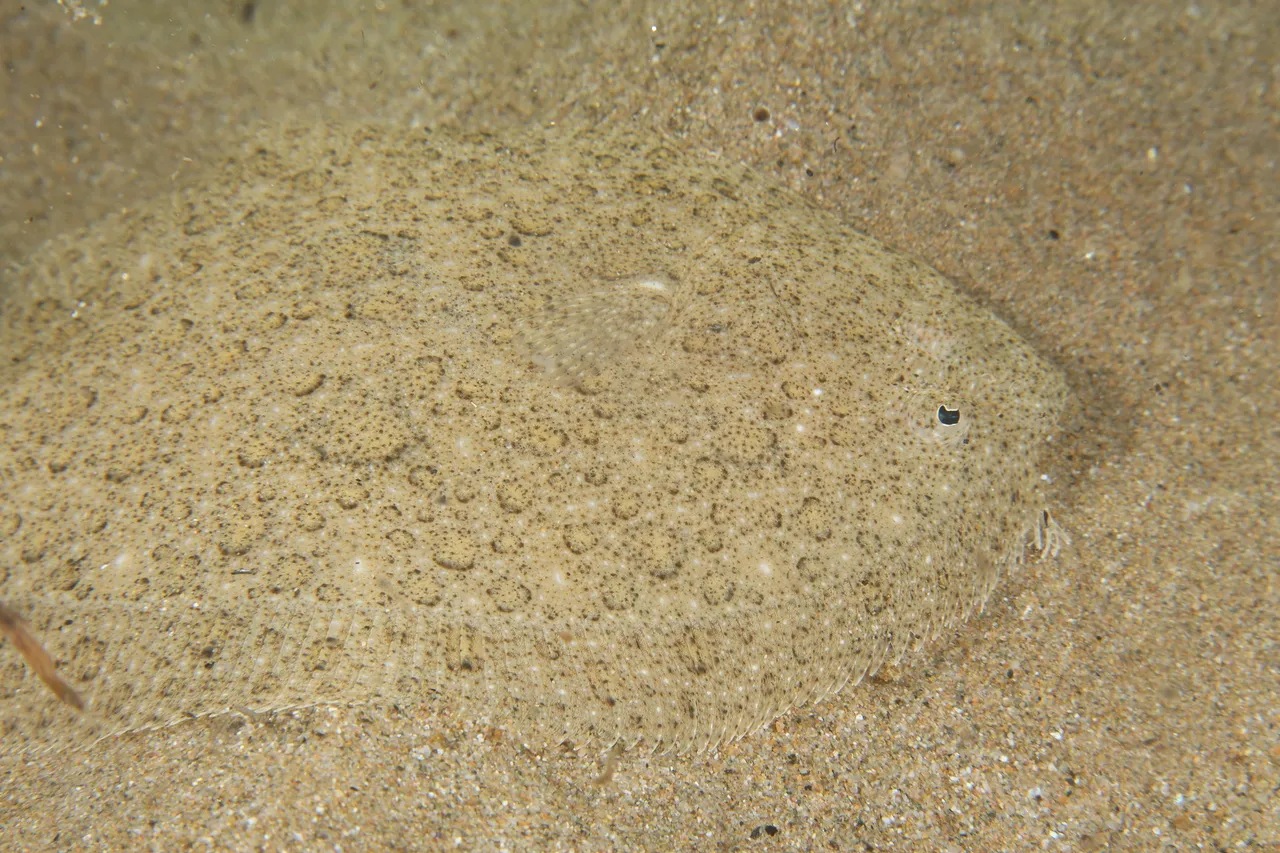
Identified by: The separation from turbot is an ABSENCE, and this resolution supports it: smooth finely speckled skin with no bony tubercles anywhere on the eyed side. Supported by an oval outline of roughly 1.6 times as long as deep against a turbot's near-circular proportion, and by free fringed rays at the front of the dorsal fin beside the head.Julien Renoult — CC BY, via iNaturalist — source, licenceAbout the image above: The photograph is taken through water, from directly above, of a fish lying camouflaged on sand — which is the aspect that shows the eyed side but also the aspect with the least contrast. The absence of tubercles is legible in this frame, and on a poorer one it would not be.
Look at this first
Put your hand flat on the upper surface and push it from tail towards head. A brill is smooth the whole way. A turbot of the same size stops your hand on scattered hard knobs set into the skin, and that difference decides it faster and more reliably than anything you can see.
Diagnostic — settles it on its own
Each of these settles the identification on its own. If one is clear, you have your answer.
Smooth upper surface with no hard knobs in the skin
Turbot carries bony tubercles scattered over the eyed side — raised, hard, unmistakable under a palm. Brill has small scales and nothing else, and the surface reads as continuous. This is the character the whole separation rests on, and it is far better checked by touch than by eye: at photograph resolution, and at the angles people actually shoot fish, tubercles that are plainly there under a hand can be invisible on a screen. If you have the fish, feel it.
Supporting — use with other characters
Real characters that are not conclusive by themselves. Use two or three together.
An oval outline rather than a near-circular one
Lay the fish flat and compare its length against its depth. A brill runs to something like one and a half times as long as it is deep and reads as a rounded oval. A turbot is close to as deep as it is long and reads as a disc. This is judgeable from a photograph, which is the reason to learn it, but the two ranges do touch at the margins and a single specimen near the boundary settles nothing on its own.
Loose fringed rays at the front of the dorsal fin
Where the dorsal fin begins, beside and slightly ahead of the eyes, the first several rays are not bound into the fin membrane but stand free, branched and slightly ragged. It is a small feature and easy to overlook, and it is genuinely present on a brill and not on a turbot. It is most visible on a fish lying flat with the fin relaxed, and least visible on one that has been in a box.
Eyes on the left, over a sandy mottled surface
With the fish laid flat and the eyed side up and the head towards you, the eyes are on the left. The upper surface is sandy to olive-brown with fine pale and dark flecking that changes to match whatever the fish is lying on. Left-eyedness places it with the turbots and away from plaice, dab, flounder and sole, all of which are right-eyed; it does not begin to separate brill from turbot, which are both left-eyed.
Suggestive only — varies with condition
Hints only. These vary with condition, season, water and how long the fish has been out of it, and a fish that contradicts them is still the same species.
The weight a rod-caught fish reaches
A good brill is a fish of a kilogramme or two and a large one is four or five. Turbot grow substantially heavier. A very large left-eyed flatfish is more likely to be a turbot and should be checked by hand rather than by outline, but a fish in the ordinary size range tells you nothing at all and the skin test still has to be made.
What it gets confused with
- Turbot, almost exclusively, over the same ground and in the same season. The bony tubercles decide it and nothing else reliably does.
- Brill and turbot hybrids, which occur where the two spawn together and which carry reduced, patchy tubercles that make the definitive test ambiguous.
- Megrim at a glance, which is left-eyed but much more elongate and thinner in the body, with a larger mouth.
- Topknots on rough ground, which are smaller, hairier at the fin margins, and unlikely to be confused once handled.
Side by side: Brill vs Turbot.
Where this stops working
Brill and turbot hybridise, and a hybrid may carry a few scattered tubercles rather than none or many, which breaks the one test the identification depends on. Small fish of both species have less pronounced tubercles than adults, so a young turbot can feel smoother than expected. The outline ratio overlaps at the extremes of both species. Where an identification carries any consequence, the fish should be handled rather than photographed, and a specimen that is intermediate on skin, intermediate on outline and intermediate on depth is most likely a hybrid and cannot be honestly named from an image.
The full record
This page covers identification only. The Brill record covers behaviour, lifecycle, distribution, handling and the sources behind all of it.
Reviewed 2026-08-16.
More about this fish
Telling it apart is one question. Here are the others.
Similar and related fish
How it is caught
Where it lives
Where you will find it
Why the 5 connections on this page are here, and the sources
Similar and related fish
Backed by research — 1 connection
Supported by peer-reviewed research or fisheries science. The sources are listed and can be checked.
Turbot
An identification comparison naming both binomials: Scophthalmus maximus and Scophthalmus rhombus.
- FishBase: a global information system on fishes — Froese, R. and D. Pauly, eds. — FishBase Consortium (Scientific institute)Relied on for: Morphological and distributional data for Scophthalmus maximus and for Scophthalmus rhombus.States this directlyPassage read and verified
- The IUCN Red List of Threatened Species — International Union for Conservation of Nature (Conservation authority)Relied on for: Separate assessments treating Scophthalmus maximus and Scophthalmus rhombus as distinct species.States this directlyCitation checked — the work exists and is described correctly
How it is caught
What experienced anglers do — 2 connections
Widely and independently recommended by experienced anglers and specialist sources. This is real angling knowledge, not proof: controlled evidence for it is limited, and FishingHQ records it as convention rather than as a demonstrated effect.
Drift fishing
A practitioner claim about how Scophthalmus rhombus is commonly fished, following from where and how it feeds.
- General angling website restatements of established technique — Various (Credible secondary source)Relied on for: Widely restated practitioner accounts of fishing for brill.Citation checked — the work exists and is described correctly
- Sea Angler — Bauer Media (Specialist angling publication)Relied on for: Practitioner treatment of the methods used for brill and comparable species.Citation checked — the work exists and is described correctly
Ledgering
A practitioner claim about how Scophthalmus rhombus is commonly fished, following from where and how it feeds.
- General angling website restatements of established technique — Various (Credible secondary source)Relied on for: Widely restated practitioner accounts of fishing for brill.Citation checked — the work exists and is described correctly
- Sea Angler — Bauer Media (Specialist angling publication)Relied on for: Practitioner treatment of the methods used for brill and comparable species.Citation checked — the work exists and is described correctly
Where it lives
Backed by research — 1 connection
Supported by peer-reviewed research or fisheries science. The sources are listed and can be checked.
Inshore ground
A habitat association for Scophthalmus rhombus taken from the environment and distribution data on its FishBase summary.
- FishBase: a global information system on fishes — Froese, R. and D. Pauly, eds. — FishBase Consortium (Scientific institute)Relied on for: The environment, depth range and habitat description recorded for Scophthalmus rhombus.States this directlyPassage read and verified
Where you will find it
Backed by research — 1 connection
Supported by peer-reviewed research or fisheries science. The sources are listed and can be checked.
Chesil Beach
A distribution association between an animal and a kind of water, rather than a claim about any named mark.
- The Fishes of the British Isles and North-West Europe — Macmillan, 1969 (Reference work)Relied on for: Distribution, habitat association, depth and ground preference of fishes in British and north-west European waters.States this directlyCitation checked — the work exists and is described correctly
- FishBase: a global information system on fishes — Froese, R. and D. Pauly, eds. — FishBase Consortium (Scientific institute)Relied on for: Distribution, habitat association and depth range recorded for the species.Background and mechanism onlyPassage read and verified