What does european perch eat?
What is established about how european perch feeds, kept separate from what anglers infer from it.
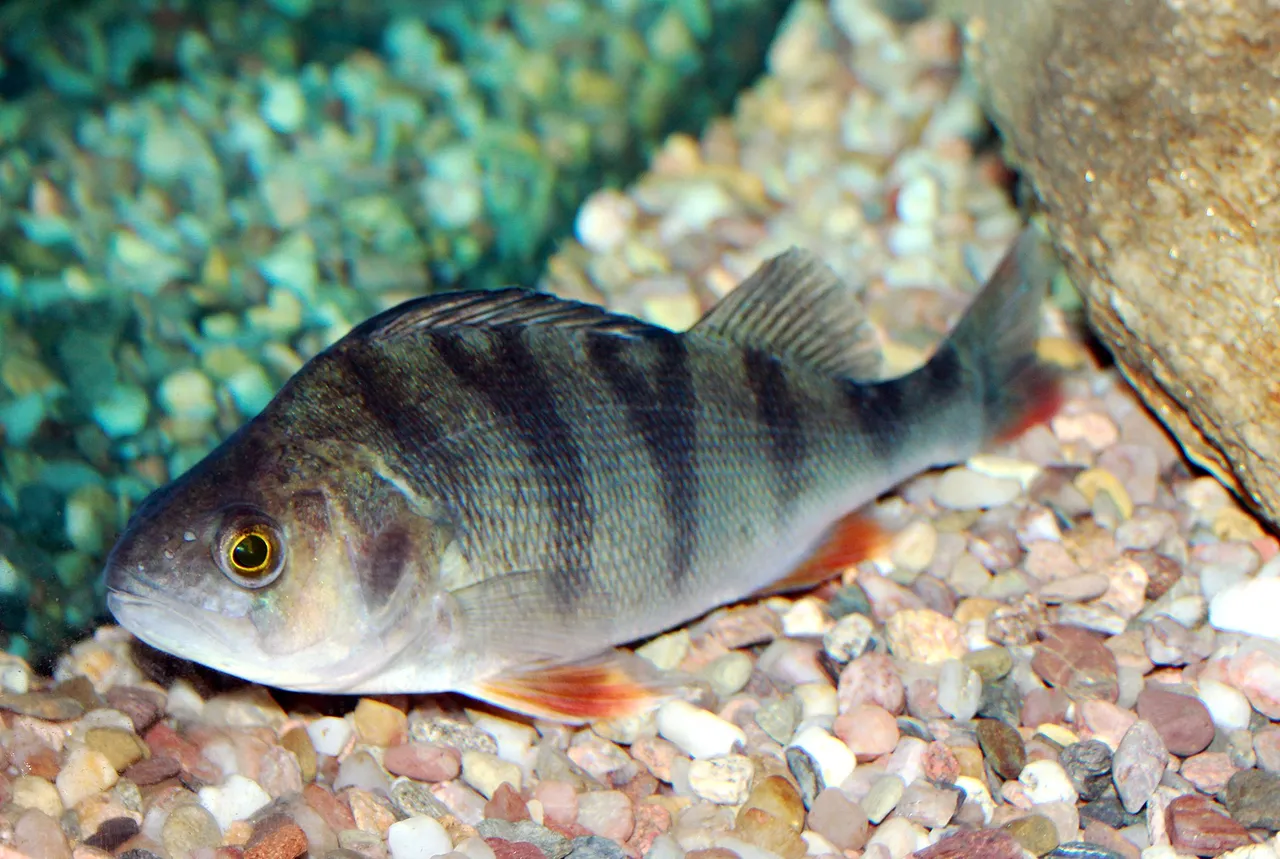
How this was identified, and who took it
Identified by: Two clearly separate dorsal fins with a dark blotch at the rear of the spiny first, five to nine dark vertical flank bars, and bright red-orange pelvic and anal fins.Karelj, Public domain, via Wikimedia Commons — source, licenceWhat is known about how it feeds
Perch cross a threshold. Below roughly 25 cm the diet is mixed and increasingly includes fish fry; above about 35 cm it is close to exclusively piscivorous, and the animal that results hunts differently from the one it was.
The three verified relationships capture the transition rather than a single state. Aquatic insect larvae for the early phase. Roach and bleak for the later one — the two commonest small shoaling cyprinids in European lowland water, and the ones a perch will spend its adult life eating.
The hunting method changes with the diet. Small perch herd fry cooperatively in shoals, driving them into the margins or against the surface. Large perch hunt alone, ambushing from beside structure, and are notably reluctant to move far from cover. Two behaviours, one species, separated by size.
The sensory profile is dual. Perch have good colour vision and hunt visually, and they are also markedly sensitive to vibration through the lateral line, which lets them locate prey in water too coloured for sight to work. Feeding is strongly light-linked, with peaks at dawn and dusk.
The striped flank pattern is worth a sentence because it is functional: it breaks the outline against weed and structure, which suits an ambush predator rather than a pursuit one, and the pattern is most useful to exactly the size of fish that hunts that way.
The food
Prey with a verified dietary link to this fish. Each entry carries its own evidence, and each is written at the precision the source actually used: a named species where the source named one, a group or food category where it said “polychaetes”, “crustaceans” or “detritus” and meant it. That is why this list is shorter than the animal’s real diet rather than longer.
- Roach — Rutilus rutilus
Roach are the principal fish prey of perch across most of Europe, and the shift from invertebrates to roach is what produces the large perch anglers pursue.
- Bleak — Alburnus alburnus
Bleak are taken heavily in open water, and perch shoals working bleak near the surface are a characteristic summer sight on European rivers and canals.
- Aquatic insect larvae as prey — a group rather than a species: the evidence names the group
Small perch feed almost entirely on invertebrates, and the transition to fish prey is gradual and size-dependent rather than sudden.
Food with no page of its own here yet
These are real components of the diet, listed as plain text because FishingHQ has no page for them yet. Inventing pages to make the list look fuller would be the fabrication this whole approach exists to prevent.
- freshwater shrimp
- juvenile perch (cannibalism)
- fish eggs
- small gobies, where established
- leeches
What anglers do with this
Everything below is interpretation, not finding. It is what experienced anglers conclude from the biology above, and the reasoning is usually sound and almost never tested. It is separated from the biology deliberately.
The size threshold is the most actionable fact here, and anglers use it directly: an approach aimed at invertebrate feeders and one aimed at a fish-eating predator select for different sizes, and the change happens over a fairly narrow band of fish length. That is practitioner reasoning from a documented dietary shift.
The dual sensory profile is the basis of the convention that perch can be caught in coloured water on presentations that move and vibrate, where a purely visual approach would fail. It is consistent with the biology and is not a tested comparison.
The reluctance of large perch to leave cover converts into a location argument — fish structure rather than open water for the big ones — which is convention held across Europe.
What this does not establish
Three relationships, one of them group-level, for a fish whose diet changes completely over its life. Nothing here establishes proportions at any size, and the fish component depends entirely on which small species the water holds. In waters with established invasive gobies the diet has changed substantially and is not described by these relationships.
Where this connects
These are the baits, lures, methods and explainers FishingHQ already joins to this fish — which is why the list is sometimes short. They are not chosen for this page, and a link here means an evidenced relationship exists, not that it follows from the diet.
Baits recorded for this species
Lures recorded for this species
Methods used for it
Where it lives
This page covers feeding. The European perch record covers identification, lifecycle, seasonal behaviour, handling and the sources behind all of it.
Reviewed 2026-08-12.