Ballymoney River
River reach · Fresh water · in Northern Ireland
A small spate river known for wild brown trout, with sea trout. DAERA points anglers to the stretch from the Bann confluence to Ballymoney, and to the spring olive hatches and the hawthorn and black gnat hatches of April and May.
Safety: cold water shock — can cause serious injury or death (general advice, not specific to this place).
FishingHQ describes what this place is, not whether you may fish it. Access, permits and who to ask.
What you can catch here
Documented at this place, grouped by how you would be fishing, with how strongly the sources support each one. This is what has been written down, not a forecast, and being listed is never permission to fish.
From the shore · 2
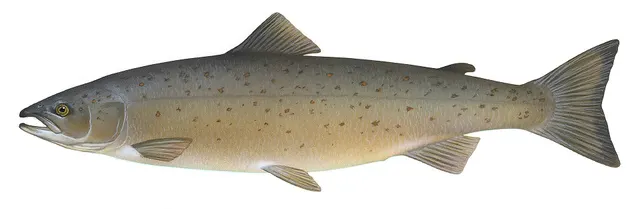 Atlantic salmonRegular local target1 placeBallymoney RiverOver river reachAround Mar–Oct
Illustration: Knepp, Timothy, via Wikimedia Commons, public domain; resized and trimmed to fit
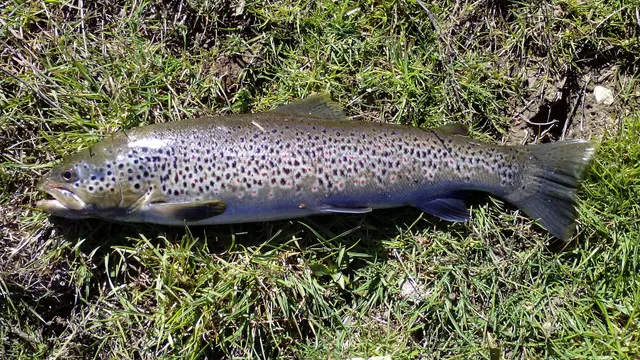 Brown troutRegular local target1 placeBallymoney RiverOver river reachAround Mar–Oct
Photo: Robermix, via Wikimedia Commons, CC0; resized and trimmed to fit


What these strengths mean
- Regular local target
- Fishing sources describe this as a normal local target here, not merely as caught.
- How breadth is counted
- A fish documented at six marks is shown as six marks: breadth never raises the strength on its own. A fishery account describes the fishing; a recorded catch reports one specific catch. How evidence is weighed.
Fish documented nearby, not here
Nothing below has been documented at Ballymoney River itself. Each one has been documented at a named place on the same ground, and the places are listed with it. Treat this as what the water around here holds rather than as a catch list for this mark.
Widely documented on this ground
Documented at three or more neighbouring places, fished a way this place is also fished. That is a pattern about the ground rather than about any one mark, and it is the closest this site comes to saying you will probably meet a fish somewhere nothing has been written about.
From the shore
- Rainbow trout — documented at North Woodburn Reservoir; Middle South Woodburn Reservoir; Lower South Woodburn Reservoir (+3 more)
Also documented at neighbouring places
One or two accounts each, on the ground around here. Enough to know the fish is caught in these waters; not enough to say anything about this place.
From the shore
- Roach — documented at The Lower Bann; Lough Beg
- Common bream — documented at The Lower Bann; Lough Beg
- Northern pike — documented at The Lower Bann; Lough Beg
- European perch — documented at The Lower Bann; Lough Beg
How people fish it
Practised here: Fly fishing.
Methods the sources name for this ground. Each one is explained in full on its own page.
- Dry fly fishing
Presenting a floating artificial to a fish feeding at the surface, so that it drifts exactly as a natural insect would.
- Spinning
Casting an artificial lure and retrieving it so that it moves like something alive — the most direct form of lure fishing.
Baits and lures for these fish
The baits and lures each of the fish above is commonly taken on, from that fish’s own page. This is what works for the fish, not a report of what people use on this particular water — local knowledge and the conditions on the day still decide.
Baits
- Maggots — for Brown trout
Lures
How to catch them: Salmon fishing · Brown trout fishing
Rods, reels and rigs for them: Atlantic salmon · Brown trout
The ground and the water
- The ground
- A small spate river known for wild brown trout, with sea trout. DAERA points anglers to the stretch from the Bann confluence to Ballymoney, and to the spring olive hatches and the hawthorn and black gnat hatches of April and May.
Getting there
What public sources describe, last checked 2026-10-25. Car parks fill, services change and a path existing is not a path anybody may use — none of this is a guarantee of availability and none of it is permission to be anywhere.
- Getting to it
- From the A26 at Ballymoney, follow the signs for Balnamore; the road runs beside the river. DAERA names access at Enagh, Balnamore and Glenstall bridges, with stiles either side of Balnamore Bridge.
Where this access information comes from
- Ballymoney River — Department of Agriculture, Environment and Rural Affairs (DAERA) (Government fisheries body)Relied on for: DAERA's own page for this water: where it is, the fish, the methods, the season, the licence and permit, the bag limit and the facilities.States this directlyPassage read and verified
What is there
Step-free access to the water's edge
DAERA lists fishing stands, including disabled-accessible stands.
Through the year
Open from 1 March to 31 October, DAERA's page says; it points to the fly hatches of spring, April and May.
The months the sources attach to each species here. Where a species carries no season it is listed underneath rather than assumed to run through the year. Rows marked open season show the months this water may be fished for that species, which is a rule rather than a statement about when the fish are there.
| Species | J | F | M | A | M | J | J | A | S | O | N | D |
|---|---|---|---|---|---|---|---|---|---|---|---|---|
| Atlantic salmon — regular local target, fishable under the published open season in March, April, May, June, July, August, September, October. | ||||||||||||
| Brown trout — regular local target, fishable under the published open season in March, April, May, June, July, August, September, October. |
Safety
Cold water shock — Can cause serious injury or death
General safety for this kind of ground, not a finding about this place.
Water around these islands stays cold enough all year to trigger cold water shock — involuntary gasping and hyperventilation on sudden immersion, which can cause somebody to inhale water in the first seconds regardless of swimming ability.
What reduces it: Wear a buoyancy aid where immersion is credible. If immersed, float on your back until the initial response passes rather than trying to swim immediately.
Rules and access
Licence
A rod licence is required, and Northern Ireland has two licensing authorities — DAERA and the Loughs Agency — covering different areas. Which one issues yours depends on where you are fishing.
Permission to fish
Separate, and both are needed. A rod licence plus a permit or day ticket for the specific water is the normal requirement here.
Particular to this water: DAERA's page, read on 25 October 2026, gives the season as 1 March to 31 October and requires a DAERA game rod licence and a DAERA game fishing permit from age 12. Fly, spinning and worm. Four trout a day, minimum 25.4 cm. Salmon and sea trout must be released. No car park and no boats.
Beyond what is stated above, FishingHQ does not know the current access position here. Angling in Northern Ireland generally requires both a rod licence from the relevant fisheries body and a separate permit for the water, and the two are issued by different bodies. Rules, seasons and permit arrangements change. Check with the Department of Agriculture, Environment and Rural Affairs, the Loughs Agency where relevant, and the permit issuer before going.
Who holds the answer:
- The Department of Agriculture, Environment and Rural Affairs, for rod licensing and fisheries regulation.
- The Loughs Agency, in the Foyle and Carlingford catchments.
- The club, association or owner that issues the permit for the water.
- The Northern Ireland department responsible for agriculture, environment and rural affairs, for inland fisheries administration, rod licences and public angling permits across most of the jurisdiction.
- The cross-border loughs agency, which administers fisheries in the Foyle catchment and the Carlingford area across the frontier, and issues its own licences for those areas.
- The club, association, estate or private owner controlling the water, where the fishery is not publicly administered.
- The authority managing any marine protected area, area of special scientific interest or designated site, Strangford Lough in particular.
- The Department of Agriculture, Environment and Rural Affairs (DAERA), which holds the fishing on this water as part of its Public Angling Estate, sets its rules and sells the permit; a rod licence is needed as well.
Nearby fishing
Other publicly documented places within about 40 km, by distance. Positions are approximate public geography and are never exact marks.
- The River Bush — 10–25 km · River reach
- The Lower Bann — 10–25 km · River reach
- River Bush at Bushmills (Town Stretch) — 10–25 km · River reach
- Portballintrae — 10–25 km · Bay
- Portstewart Strand — 10–25 km · Beach
- Portrush and Ramore Head — 10–25 km · Headland
- Altnahinch Reservoir — 10–25 km · Reservoir
- The Bann mouth at Castlerock — 10–25 km · Estuary
Sources for this place
- Ballymoney River — Department of Agriculture, Environment and Rural Affairs (DAERA) (Government fisheries body)Relied on for: DAERA's own page for this water: where it is, the fish, the methods, the season, the licence and permit, the bag limit and the facilities.States this directlyPassage read and verified
- Angling rod licences explained — nidirect (Northern Ireland Government) (Local authority, harbour or protected-area body)Relied on for: Where Northern Ireland rod licences and DAERA permits are bought.States this directlyPassage read and verified
How FishingHQ labels evidence is explained in the evidence policy. Last reviewed 2026-10-25.
Something wrong or out of date?
If something on this page has changed, email us from your own account using the link that fits, with a link to where you saw the change if you can. Every report is checked by a person before anything is changed, and a report never appears on the site by itself. Please don’t send exact private marks.
Before you go
- Fish documented here
- 2 at this place itself. See them.
- Getting there
- Described from public sources, last checked 2026-10-25. Getting there.
- Rules particular to this water
- DAERA's page, read on 25 October 2026, gives the season as 1 March to 31 October and requires a DAERA game rod licence and a DAERA game fishing permit from age 12. Source not tied: no recorded source has been matched to this statement.
- Fly, spinning and worm. Source not tied: no recorded source has been matched to this statement.
- Four trout a day, minimum 25.4 cm. Source not tied: no recorded source has been matched to this statement.
- Salmon and sea trout must be released. Source not tied: no recorded source has been matched to this statement.
- No car park and no boats. Source not tied: no recorded source has been matched to this statement.
Nothing here is watched for change. Sources and who to ask.
- Hazards particular to this place
- None recorded for this place; the hazards of the wider coast or water still apply.
Check before you travel
- Whether you may fish here, and whether a licence or permit is needed — start with the Department of Agriculture.
- Who holds the fishing right on the stretch you mean to fish, and the river level.
- Anything recorded here was true when it was read; it is not watched for change.