How to identify common bream
Abramis brama · Leuciscidae
The characters that identify common bream, ranked by how far each one can be trusted on its own.
How this was identified, and who took it
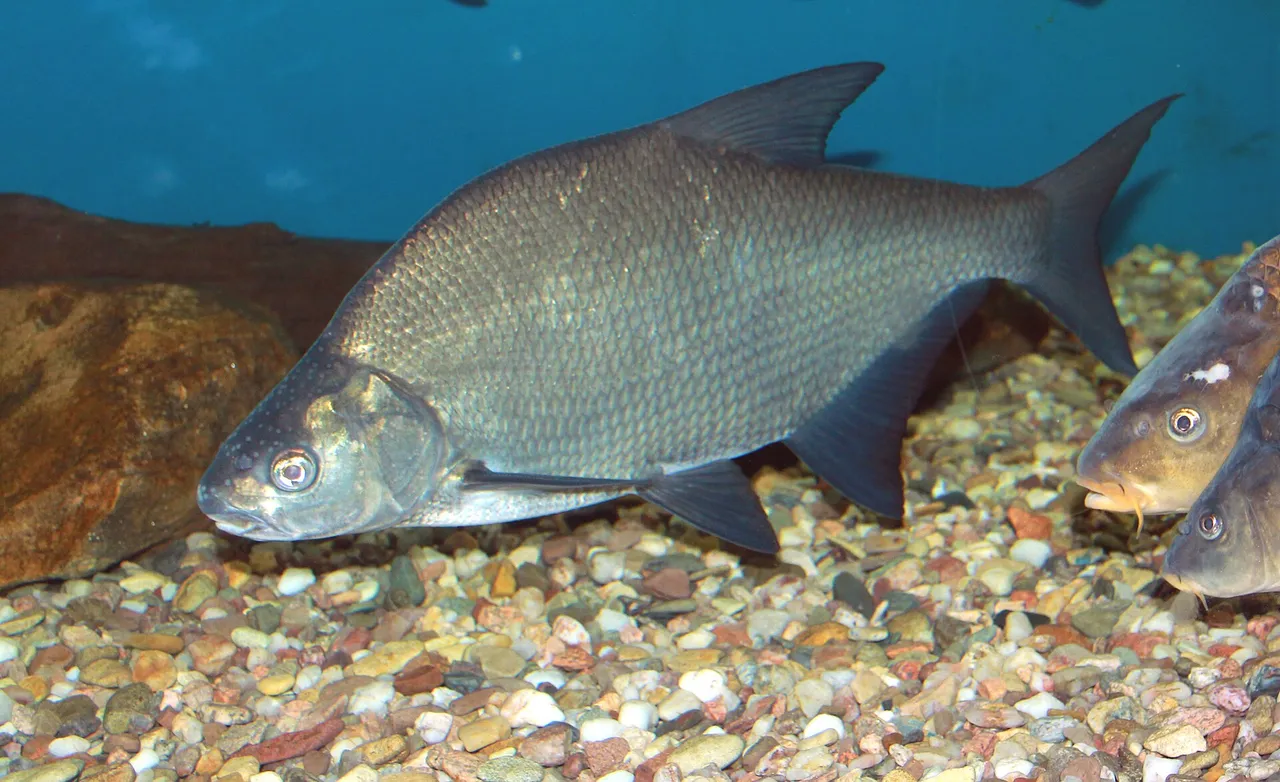
Identified by: Very deep, strongly compressed body with a small head, a long-based anal fin, and a deeply forked tail with a longer lower lobe.Karelj, Public domain, via Wikimedia Commons — source, licenceLook at this first
The profile does it. A bream is extraordinarily deep and flat-sided for its length, with a long anal fin running well back towards the tail, and no other British or Irish coarse fish approaches that shape at size.
Diagnostic — settles it on its own
Each of these settles the identification on its own. If one is clear, you have your answer.
A long anal fin, much longer-based than the dorsal
Compare the two: the anal fin's base is markedly longer and it runs back a considerable way beneath the fish. Silver bream shares the deep shape but has a shorter anal fin, and a roach's is short. This is the character that survives on a fish of any age.
Supporting — use with other characters
Real characters that are not conclusive by themselves. Use two or three together.
An extremely deep, laterally compressed body
Deep from back to belly and very thin from side to side — a shape that is obvious from the moment the fish comes over the net. It identifies the group immediately, though not which bream.
A small mouth that extends into a tube
At rest the mouth is small and set low; in use it protrudes downward into a funnel for sucking invertebrates out of silt. The protrusible mechanism is visible in a fish being unhooked and is characteristic.
A very heavy mucus coating
Bream are conspicuously slimy, more so than the fish they are caught among. It is a real character and an important handling one: that mucus is the fish's protection and wet hands matter more here than usual.
Suggestive only — varies with condition
Hints only. These vary with condition, season, water and how long the fish has been out of it, and a fish that contradicts them is still the same species.
Bronze to dark brown flanks in adults
Old bream are deep bronze. Young ones are bright silver and are regularly mistaken for something else entirely, which is why colour sits at the bottom of this list.
What it gets confused with
- Silver bream, which is smaller, stays silver and has a shorter anal fin.
- Roach × bream hybrids, which are common and intermediate in depth and anal fin length.
- Young common bream and roach, which look far more alike than the adults do.
Side by side: Common bream vs Silver bream.
Where this stops working
Roach–bream hybrids occur wherever both species spawn together and are genuinely intermediate — a fish with a bream's depth and a shorter anal fin is the classic signature, and it cannot be resolved further by eye. Small bream are silver and shallow-bodied and lose most of what makes an adult obvious, so the anal fin is the character to use on them.
The full record
This page covers identification only. The Common bream record covers behaviour, lifecycle, distribution, handling and the sources behind all of it.
Reviewed 2026-08-13.
More about this fish
Telling it apart is one question. Here are the others.
How it is caught
Where it lives
- Commercial coarse fisheriesStocked widely as a mixed-fishery species and a major component of match weights on commercial waters.
- Floodplains, backwaters and oxbowsSlack water, backwaters and flooded margins are where bream shoals move when a lowland river rises, which is a practical fact British river anglers use constantly.
Where you will find it
- Lough ErneIn the sheltered weedy bays and channels of the upper lough, in the shoals that built this system's international reputation from the 1960s and that are a different composition now than they were.
- The Fens and their drainsThe species that built the region's twentieth-century reputation, in shoals whose recorded catches are part of British angling folklore, and whose decline reshaped what the Fens are fished for.
- The IJsselmeerPresent in very large quantities and supporting a major organised match and feeder culture across the connected polder waters as well as the open lake.
- The Moy and Lough ConnPresent on the slower and richer water of this catchment, which is the coarse half of a system better known for its game fishing.
- The Norfolk BroadsBream in quantity on the rivers and broads supported what was historically a major match and pleasure fishery.
- The Republic of IrelandAbundant in very large shoals on the midland loughs and the Shannon system, and the backbone of the visiting-angler coarse fishery.
- The RhineIn the slower water, the harbour basins and the pockets between groynes, which is where a canalised river's coarse fishery necessarily concentrates.
- The River TrentIn the slower, deeper reaches of the lower river and into the tideway, in the shoals that make the Trent a serious match river.
1 more
- The Shannon system Fishing regions
Why the 13 connections on this page are here, and the sources
How it is caught
What experienced anglers do — 2 connections
Widely and independently recommended by experienced anglers and specialist sources. This is real angling knowledge, not proof: controlled evidence for it is limited, and FishingHQ records it as convention rather than as a demonstrated effect.
Feeder fishing
Established practice, independently described.
- Still-Water Angling — MacGibbon & Kee, 1953 (Specialist angling publication)Relied on for: Bream shoal feeding behaviour and the bait strategy that holds them.Citation checked — the work exists and is described correctly
- Angling Times — Bauer Media (Specialist angling publication)Relied on for: Contemporary feeder practice for bream.Citation checked — the work exists and is described correctly
Pole fishing
Established angling practice for this species, recorded as convention. The note states the property of the animal or its water that makes the method the answer.
- Coarse Fishing — A. & C. Black, 1912 (Specialist angling publication)Relied on for: Established coarse-angling technique and its application to the species.States this directlyCitation checked — the work exists and is described correctly
- Angling Times — Bauer Media (Specialist angling publication)Relied on for: Contemporary British coarse practice for this species.Background and mechanism onlyCitation checked — the work exists and is described correctly
Where it lives
Backed by research — 2 connections
Supported by peer-reviewed research or fisheries science. The sources are listed and can be checked.
Commercial coarse fisheries
Habitat association recorded for the species, in an environment FishingHQ describes on its own page.
- Freshwater Fishes of the British Isles — HarperCollins (New Naturalist 75), 1992 (Reference work)Relied on for: Habitat association and distribution of European freshwater fishes, including occurrence in artificial and modified waters.States this directlyCitation checked — the work exists and is described correctly
- FishBase: a global information system on fishes — Froese, R. and D. Pauly, eds. — FishBase Consortium (Scientific institute)Relied on for: Habitat association, depth range and water-type tolerance recorded for the species.States this directlyPassage read and verified
Floodplains, backwaters and oxbows
A habitat association resting on the regional identification and fisheries literature rather than on angling report.
- The Flood Pulse Concept in River-Floodplain Systems — Canadian Special Publication of Fisheries and Aquatic Sciences 106, Department of Fisheries and Oceans, Ottawa, 1989 (Scientific literature)Relied on for: That fish move laterally onto the inundated floodplain to feed and breed and return to the channel as water falls, and that floodplain inundation drives production in large river systems.States this directlyCitation checked — the work exists and is described correctly
- FAO Species Identification Guides for Fishery Purposes and the FAO Species Catalogues — Food and Agriculture Organization of the United Nations (Scientific institute)Relied on for: Habitat association and distribution of the species concerned.States this directlyCitation checked — the work exists and is described correctly
Where you will find it
Backed by research — 9 connections
Supported by peer-reviewed research or fisheries science. The sources are listed and can be checked.
Lough Erne
A claim that a place contains the ground, water and seasonal conditions the species is associated with. It is a distributional statement about the world, it rests on the regional reference literature, and it deliberately asserts nothing about access, permission or catch.
- Freshwater Fishes of the British Isles — HarperCollins (New Naturalist 75), 1992 (Reference work)Relied on for: Distribution, ecology and conservation status of the freshwater fishes of the British Isles, including in artificial and modified waters.States this directlyCitation checked — the work exists and is described correctly
- Environment Agency fisheries management, byelaws and rod licensing information — Environment Agency (Government fisheries body)Relied on for: Fisheries monitoring, water quality and species distribution in English rivers, canals and still waters.States this directlyCitation checked — the work exists and is described correctly
The Fens and their drains
A distributional claim about where a species occurs, which is a claim about the world and rests on the reference literature rather than on angling report.
- Freshwater Fishes of the British Isles — HarperCollins (New Naturalist 75), 1992 (Reference work)Relied on for: Distribution, habitat association and ecology of the freshwater fishes of the British Isles.States this directlyCitation checked — the work exists and is described correctly
- FishBase: a global information system on fishes — Froese, R. and D. Pauly, eds. — FishBase Consortium (Scientific institute)Relied on for: Distribution, habitat association and life history recorded for the species.States this directlyPassage read and verified
The IJsselmeer
A distributional claim taken from reference works and databases on the fishes of the region rather than from angling report. It states presence and asserts nothing about a fishery.
- FishBase: a global information system on fishes — Froese, R. and D. Pauly, eds. — FishBase Consortium (Scientific institute)Relied on for: Distribution, habitat association, life history and size recorded for the species concerned.States this directlyPassage read and verified
- Freshwater Fishes of the British Isles — HarperCollins (New Naturalist 75), 1992 (Reference work)Relied on for: Biology, distribution, life history and conservation status of northern European freshwater and diadromous fishes.States this directlyCitation checked — the work exists and is described correctly
The Moy and Lough Conn
A claim that a coast contains the ground and conditions the species is associated with. It is a distributional statement about the world, it rests on the regional reference literature, and it deliberately asserts nothing about access, permission or catch.
- The Fishes of the British Isles and North-West Europe — Macmillan, 1969 (Reference work)Relied on for: Distribution and habitat association of the marine and estuarine fishes of the British Isles and north-west Europe, including which coasts and ground types a species occupies.States this directlyCitation checked — the work exists and is described correctly
- FishBase: a global information system on fishes — Froese, R. and D. Pauly, eds. — FishBase Consortium (Scientific institute)Relied on for: Recorded distribution, depth range and habitat association for the species named.States this directlyPassage read and verified
The Norfolk Broads
A distributional claim taken from reference works on the fishes of the region rather than from angling report. It states presence and asserts nothing about a fishery.
- FishBase: a global information system on fishes — Froese, R. and D. Pauly, eds. — FishBase Consortium (Scientific institute)Relied on for: Distribution, habitat association, life history and depth range recorded for the species concerned.States this directlyPassage read and verified
- Freshwater Fishes of the British Isles — HarperCollins (New Naturalist 75), 1992 (Reference work)Relied on for: Biology, distribution and conservation status of British and Irish freshwater and diadromous fishes.States this directlyCitation checked — the work exists and is described correctly
- The Fishes of the British Isles and North-West Europe — Macmillan, 1969 (Reference work)Relied on for: Distribution, habitat and biology of the fishes of the British Isles and north-west Europe.States this directlyCitation checked — the work exists and is described correctly
The Republic of Ireland
A distribution claim about the world, so it rests on the reference works rather than on angling report. FishingHQ's evidence policy requires it.
- FishBase: a global information system on fishes — Froese, R. and D. Pauly, eds. — FishBase Consortium (Scientific institute)Relied on for: Distribution, habitat association, water-type tolerance and occurrence records for the species, including its presence in the countries concerned.States this directlyPassage read and verified
- The IUCN Red List of Threatened Species — International Union for Conservation of Nature (Conservation authority)Relied on for: Assessment and range account for the species, including the countries and systems it occupies and its population trend within them.States this directlyCitation checked — the work exists and is described correctly
The Rhine
A claim that a place contains the ground, water and seasonal conditions the species is associated with. It is a distributional statement about the world, it rests on the regional reference literature, and it deliberately asserts nothing about access, permission or catch.
- Freshwater Fishes of the British Isles — HarperCollins (New Naturalist 75), 1992 (Reference work)Relied on for: Distribution, ecology and conservation status of European freshwater and migratory fishes, including in modified and artificial waters.States this directlyCitation checked — the work exists and is described correctly
- FishBase: a global information system on fishes — Froese, R. and D. Pauly, eds. — FishBase Consortium (Scientific institute)Relied on for: Recorded distribution, habitat association and life history for the freshwater and migratory species named.States this directlyPassage read and verified
The River Trent
A claim that a place contains the ground, water and seasonal conditions the species is associated with. It is a distributional statement about the world, it rests on the regional reference literature, and it deliberately asserts nothing about access, permission or catch.
- Freshwater Fishes of the British Isles — HarperCollins (New Naturalist 75), 1992 (Reference work)Relied on for: Distribution, habitat and conservation status of British freshwater fishes, including the isolated glacial-relict populations of northern England.States this directlyCitation checked — the work exists and is described correctly
- Environment Agency fisheries management, byelaws and rod licensing information — Environment Agency (Government fisheries body)Relied on for: Fisheries monitoring, water quality and species distribution in English rivers and still waters.States this directlyCitation checked — the work exists and is described correctly
The Shannon system
A claim that a place contains the ground, water and seasonal conditions the species is associated with. It is a distributional statement about the world, it rests on the regional reference literature, and it deliberately asserts nothing about access, permission or catch.
- Freshwater Fishes of the British Isles — HarperCollins (New Naturalist 75), 1992 (Reference work)Relied on for: Distribution, ecology and conservation status of the freshwater fishes of the British Isles, including in artificial and modified waters.States this directlyCitation checked — the work exists and is described correctly
- Environment Agency fisheries management, byelaws and rod licensing information — Environment Agency (Government fisheries body)Relied on for: Fisheries monitoring, water quality and species distribution in English rivers, canals and still waters.States this directlyCitation checked — the work exists and is described correctly