What does european flounder eat?
What is established about how european flounder feeds, kept separate from what anglers infer from it.
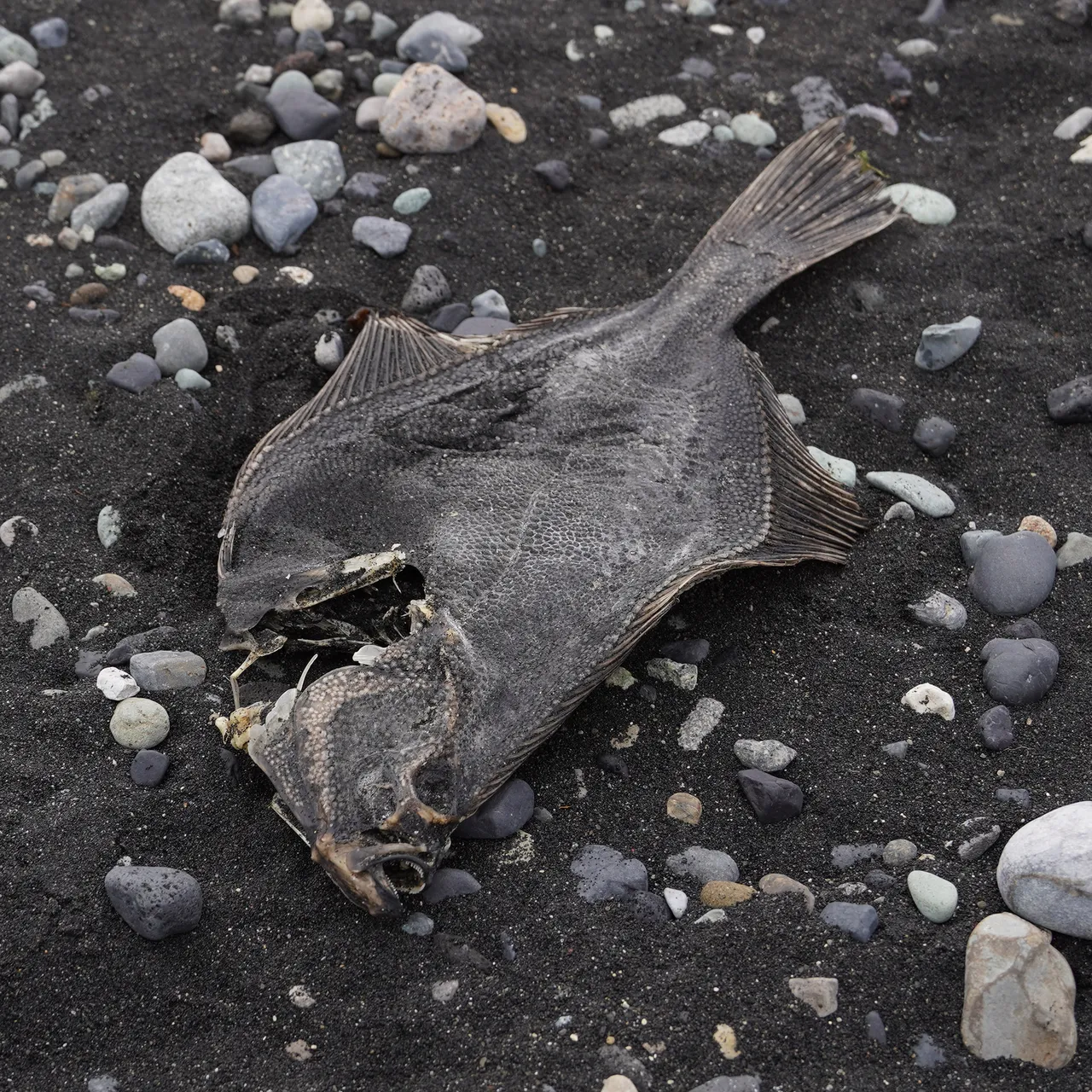
How this was identified, and who took it
Identified by: The record's diagnostic is shown here better than a live fish would show it. A continuous row of rough bony tubercles runs along the base of the dorsal fin and along the base of the anal fin, with a further patch over the head behind the eyes, standing out as hard pale knobs against dried skin. Drying has stripped the mucus and slack tissue that normally hide them. The right-eyed arrangement and the whole diamond outline are in frame.nbasargin — CC BY, via iNaturalist — source, licenceWhat is known about how it feeds
The flounder eats whatever the estuary is producing, and the estuary produces different things in different places and months. That variability is the single most important thing about this diet.
Three groups carry verified relationships: polychaete worms, decapod crustaceans and small bivalve and gastropod molluscs. Ragworm is the dominant component across most of the range and is the reason ragworm is the near-universal flounder bait. Shrimps and small crabs are the crustacean share, and it rises sharply in spring when crabs are moulting and soft. Small fish are taken opportunistically, more by larger fish than by small ones.
Detection is overwhelmingly chemical and tactile, because it has to be. Estuary water is usually coloured and frequently opaque, so the visual approach that serves a plaice over clean sand is simply unavailable for much of a flounder's life. The fish finds food by scent and by detecting disturbance in the sediment, and it will move to both.
That sensitivity to sediment disturbance is worth isolating, because it is unusual enough to explain a whole fishing tradition. A flounder responds to something stirring the mud in a way that a plaice does not, and the response is investigative rather than defensive.
Feeding follows the tide rather than the clock. Flounders work up over intertidal flats on the flood into water that barely covers them, taking invertebrates the tide has just reached, and drop back as it falls. On a big flat that movement is the feeding pattern in its entirety.
Seasonally, fish feed hard through spring and summer up the estuary and in fresh water, and are in their best condition in autumn as they begin to drop back towards the sea to spawn.
The food
Prey with a verified dietary link to this fish. Each entry carries its own evidence, and each is written at the precision the source actually used: a named species where the source named one, a group or food category where it said “polychaetes”, “crustaceans” or “detritus” and meant it. That is why this list is shorter than the animal’s real diet rather than longer.
- Polychaete worms as prey — a group rather than a species: the evidence names the group
Ragworm above all, which is what an estuary offers in quantity and why ragworm is the near-universal flounder bait.
- Decapod crustaceans as prey — a group rather than a species: the evidence names the group
Shrimps and small crabs from intertidal mud and sand — the reason peeler crab takes better flounders than worm in many estuaries in spring.
- Bivalve and gastropod molluscs as prey — a group rather than a species: the evidence names the group
Small molluscs taken from soft sediment, a component that rises where the estuary is rich in them.
Food with no page of its own here yet
These are real components of the diet, listed as plain text because FishingHQ has no page for them yet. Inventing pages to make the list look fuller would be the fabrication this whole approach exists to prevent.
- small fish
- amphipods
- insect larvae in the freshwater reaches
- fish eggs
What anglers do with this
Everything below is interpretation, not finding. It is what experienced anglers conclude from the biology above, and the reasoning is usually sound and almost never tested. It is separated from the biology deliberately.
The baited spoon is the clearest case in British sea angling of a rig built directly from a diet observation, and it is still practitioner reasoning rather than a demonstrated mechanism.
The argument runs: flounders respond to sediment disturbance, so a small spoon or blade drawn slowly along the bottom above a baited hook stirs the mud, produces the signal the fish is tuned to, and brings it in to find a worm. The rig is old, it is widely held to do better than a static bait, and the reasoning is coherent. It has not been tested in any way FishingHQ can cite.
The same reasoning supports movement generally: retrieving a few turns, pausing and retrieving again is standard practice on wide flats where fish are thinly spread, and it is defended as covering ground and repeatedly restarting the disturbance signal.
Ragworm's near-universal use follows straightforwardly from the diet. Peeler crab's reputation for taking BIGGER flounders in spring follows from the moulting-crab component and is a genuinely common practitioner claim.
The estuarine setting carries one consequence that is not about catching. Flounders spend their lives in water that receives whatever the catchment sends down, and whether fish from a particular estuary should be eaten is a question for the local authority and food agency. That is a real question rather than a formality.
What this does not establish
All three relationships are group-level and none establishes proportions. Flounder diet is more variable between systems than most species on FishingHQ, because it is a direct function of what a particular estuary produces, and a composition measured in one river says little about the next. The response to sediment disturbance is well attested by practitioners and is not supported here by controlled work. Nothing establishes how the diet shifts between the marine, brackish and freshwater parts of the range.
Where this connects
These are the baits, lures, methods and explainers FishingHQ already joins to this fish — which is why the list is sometimes short. They are not chosen for this page, and a link here means an evidenced relationship exists, not that it follows from the diet.
Baits recorded for this species
Methods used for it
Where it lives
The science behind the feeding
This page covers feeding. The European flounder record covers identification, lifecycle, seasonal behaviour, handling and the sources behind all of it.
Reviewed 2026-08-15.