How to identify dusky grouper
Epinephelus marginatus · Epinephelidae
The characters that identify dusky grouper, ranked by how far each one can be trusted on its own.
Safety: fish welfare — can cause injury needing treatment. One more point applies here.
How this was identified, and who took it
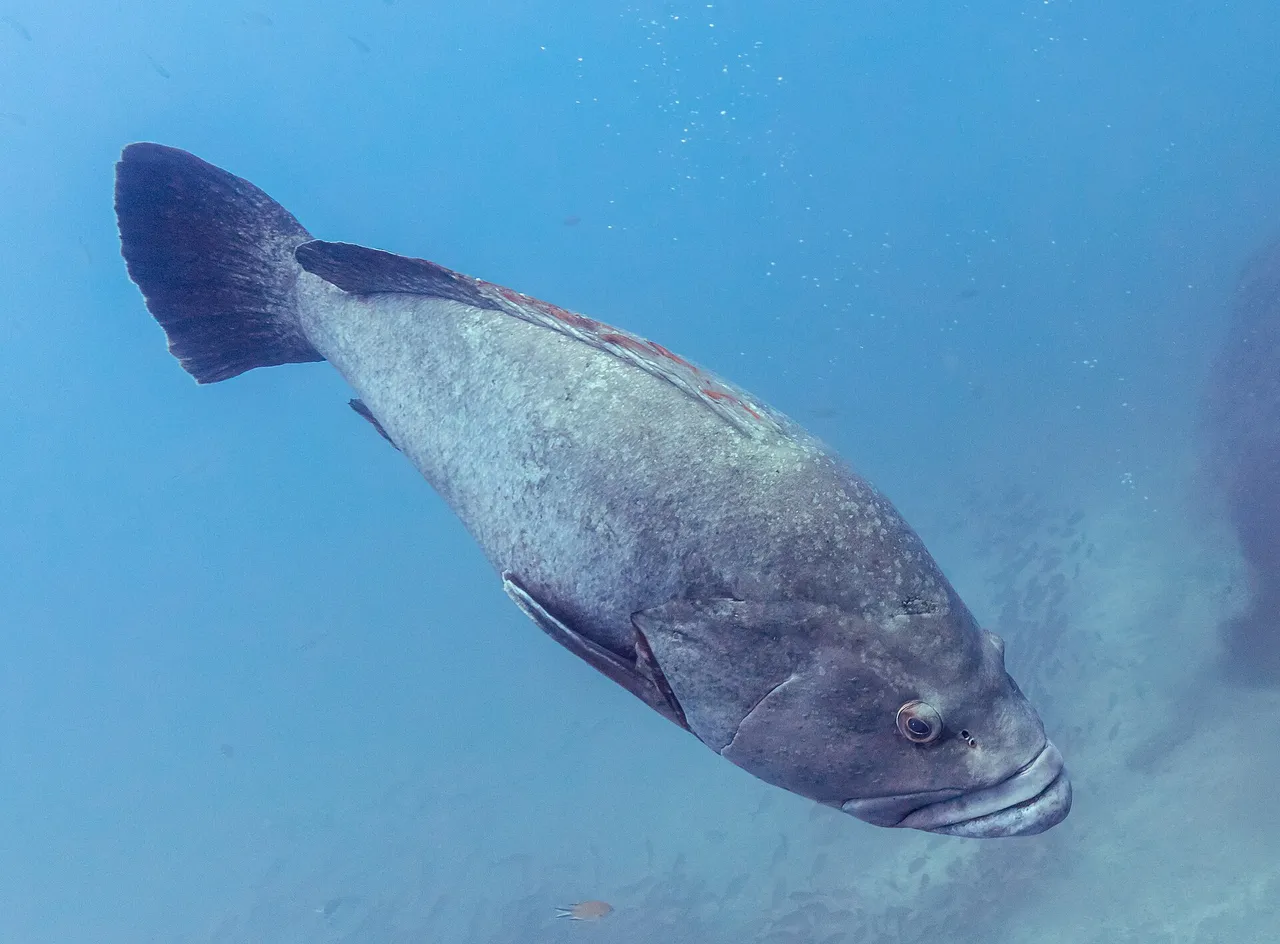
Identified by: Whole fish in near-lateral view. Heavy body, mottled grey-brown flank, thick lips and the rounded caudal fin with its pale margin are all visible.Diego Delso — CC BY-SA 4.0, via Wikimedia Commons — source, licenceLook at this first
Look at the trailing edges of the soft dorsal, the anal and the tail. On most dusky grouper each carries a narrow pale border against a dark fin — the margin the species is named for. Everything else about the fish's colour is a mood.
No single character settles this one. Everything below is supporting or suggestive, and a confident identification needs several of them together — or, for the hardest cases, a count that cannot be made from a photograph.
Supporting — use with other characters
Real characters that are not conclusive by themselves. Use two or three together.
Pale margins on the rear fins
A light edge along the soft dorsal, anal and tail fins, thin but distinct against the darker fin behind it. Present on the majority and absent on some, which is exactly why it supports rather than decides.
A heavy body with a projecting lower jaw
Deep, thick-set and built around a very large mouth whose lower jaw sits proud of the upper. This is the grouper outline and it places the fish in the family before any species character is applied.
One continuous dorsal fin and rounded fins behind
The spiny and soft portions of the dorsal run together without a break, and the pectoral, anal and tail fins are all rounded rather than pointed or forked. The combination separates Epinephelus from several fish sharing the same rock.
Suggestive only — varies with condition
Hints only. These vary with condition, season, water and how long the fish has been out of it, and a fish that contradicts them is still the same species.
Pale blotching over a dark ground
Irregular light patches over dark brown or grey-green. A real pattern and a shifting one — it changes with the fish's state and with the bottom it is over, and juveniles show it far more strongly than adults.
What it gets confused with
- Other Epinephelus in the Mediterranean and eastern Atlantic, which is the whole difficulty and is not fully resolvable by eye.
- Golden grouper, a colour variant of this species rather than a separate one — a frequent source of confident misidentification.
- Comber and painted comber at small sizes, separated by body depth and mouth size.
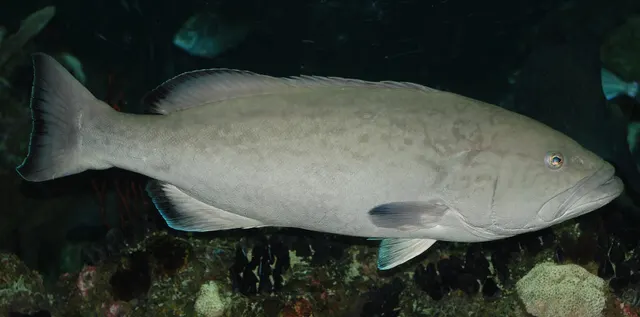
Side by side: Dusky grouper vs Gag grouper.
Where this stops working
This page has no diagnostic character, and it should not: the eastern Atlantic and Mediterranean hold several Epinephelus that overlap in every visible respect, and colour — the thing most people identify groupers by — changes with the animal's mood, its depth and the ground beneath it within seconds. The species is protogynous, so the largest fish are males and are demographically disproportionate. Where the fish is taken by spearfishing there is no release, which means the identification has to be right before the shot rather than after it.
The full record
This page covers identification only. The Dusky grouper record covers behaviour, lifecycle, distribution, handling and the sources behind all of it.
Reviewed 2026-08-14.
More about this fish
Telling it apart is one question. Here are the others.
Similar and related fish
How it is caught
- Hole huntingThe grouper's habit of holding in a known hole and not fleeing makes it findable and makes it exceptionally vulnerable — a fish that stays put is not adapted to a predator that can follow it home.
- Reef spearfishingFour specimens for 8.61 kg in the Canary catch, and EVERY ONE of them below the minimum scientifically advised length. The species is IUCN-vulnerable, sequentially hermaphroditic, and matures late — which is what makes an all-immature catch a finding rather than a footnote.
Where you will find it
- Balearic IslandsOccurs on rocky reef, and its presence and size are used as an indicator of effectively protected ground because it is among the first species lost from accessible coast.
- Cape VerdeResident on the volcanic hard bottom close inshore. A long-lived, slow-growing, heavily fished species whose conservation position is considerably worse than its abundance on a menu suggests, and one of the reasons the vernacular name garoupa is a poor identification.
- CyprusPresent on the rock and reef ground, long-lived, slow-growing and heavily depleted across the Mediterranean. It is the species most often cited when the eastern basin's fishing is described as having been much better within living memory.
- ItalyThe Mediterranean's flagship reef predator and the species around which a great deal of Italian spearfishing ethic and regulation is organised, being long-lived, site-attached and easily over-harvested.
- Malta and GozoThe prize of the local spearfishing tradition, and — being protogynous, territorial and slow-growing — the species where the cost of taking the large ones is highest.
- MediterraneanThe fish Mediterranean spearfishers built a culture around, and the one whose disappearance from much of that sea became the argument for protecting parts of it.
- The Croatian AdriaticIn the caves, overhangs and vertical structure that dissolved limestone produces in quantity. A site-attached, slow-growing, easily targeted fish in habitat that is easy to find is the clearest case for restraint on this coast.
- The Moroccan Mediterranean coastThe iconic Mediterranean rock-dwelling predator, slow-growing, long-lived and of conservation concern across the basin.
1 more
- The Strait of Messina Fishing regions
Why the 13 connections on this page are here, and the sources
Similar and related fish
Backed by research — 2 connections
Supported by peer-reviewed research or fisheries science. The sources are listed and can be checked.
Gag grouper
A comparison resting on shared reproductive biology, naming both binomials, and the basis of the demographic argument on both records.
- FishBase: a global information system on fishes — Froese, R. and D. Pauly, eds. — FishBase Consortium (Scientific institute)Relied on for: That Mycteroperca microlepis and Epinephelus marginatus are both protogynous hermaphrodites in which individuals mature as female and change sex to male with size and age.States this directlyPassage read and verified
Island grouper
Mycteroperca fusca is longer-bodied, reaches 80 cm and 3 kg, and is known with certainty only from four eastern Atlantic archipelagos; Epinephelus marginatus is deeper-bodied, heavier-headed and much larger, with a far wider range. The island grouper is assessed as Vulnerable and the dusky grouper's assessment is its own.
- FishBase: a global information system on fishes — Froese, R. and D. Pauly, eds. — FishBase Consortium (Scientific institute)Relied on for: The morphology, size, depth range and distribution that separate these two species from one another.States this directlyPassage read and verified
How it is caught
Backed by research — 1 connection
Supported by peer-reviewed research or fisheries science. The sources are listed and can be checked.
Hole hunting
A claim resting on the species' documented territoriality and habitat use rather than on practitioner report, because it is the basis of the conservation argument on both records.
- FishBase: a global information system on fishes — Froese, R. and D. Pauly, eds. — FishBase Consortium (Scientific institute)Relied on for: That Epinephelus marginatus is reef-associated on rocky bottom, with adults solitary and territorial, and that it has low resilience with a minimum population doubling time of 4.5 to 14 years and a vulnerability score of 64 out of 100.States this directlyPassage read and verified
- Good Fish Guide — Marine Conservation Society (Conservation authority)Relied on for: That site fidelity and slow replacement are material to whether a local population can sustain harvest.FishingHQ's interpretation of what it saysCitation checked — the work exists and is described correctly
Official guidance — 1 connection
Stated by a fisheries authority, scientific institute or recognised angling body. Authoritative, but summarising rather than demonstrating.
Reef spearfishing
A scientific institute reporting what its own survey of the fishery recorded: a two-year catch-recording programme across the Canary archipelago counted and weighed every specimen, and this species appears in its published catch table. That is what Canary spearfishers were measured taking, rather than an inference from where the species lives or an assertion about what people do.
- Spearfishing in the Canary Islands: is the devil as black as it seems to be? — Pablo Martín-Sosa, Instituto Español de Oceanografía — Revista Scientia Insularum, 2019 (Scientific literature)Relied on for: The Canary spearfishing catch table, in which this species appears with a specimen count and a landed weight over the study's two-year recording period.States this directlyPassage read and verified
Where you will find it
Backed by research — 9 connections
Supported by peer-reviewed research or fisheries science. The sources are listed and can be checked.
Balearic Islands
Occurrence of the species in these waters: a statement about the animal's distribution, not a venue recommendation.
- The Fishes of the British Isles and North-West Europe — Macmillan, 1969 (Reference work)Relied on for: Distribution and habitat association of fishes in north-west European and eastern Atlantic waters.States this directlyCitation checked — the work exists and is described correctly
- FishBase: a global information system on fishes — Froese, R. and D. Pauly, eds. — FishBase Consortium (Scientific institute)Relied on for: Distribution, depth range and habitat association recorded for the species.States this directlyPassage read and verified
Cape Verde
A distribution edge resting on published regional identification and distribution references, written where the species is genuinely characteristic of the destination's fishing rather than merely recorded from its waters.
- FAO Species Identification Guides for Fishery Purposes and the FAO Species Catalogues — Food and Agriculture Organization of the United Nations (Scientific institute)Relied on for: Distribution, habitat association and biology of the fishes of the eastern central Atlantic and the Mediterranean, from the regional identification guides prepared for fishery purposes.States this directlyCitation checked — the work exists and is described correctly
- FishBase: a global information system on fishes — Froese, R. and D. Pauly, eds. — FishBase Consortium (Scientific institute)Relied on for: Recorded environment, depth range, distribution and biology of the species named.States this directlyPassage read and verified
Cyprus
A distribution edge resting on published regional identification and distribution references, written where the species is genuinely characteristic of the destination's fishing rather than merely recorded from its waters.
- FAO Species Identification Guides for Fishery Purposes and the FAO Species Catalogues — Food and Agriculture Organization of the United Nations (Scientific institute)Relied on for: Distribution, habitat association and biology of the fishes of the eastern central Atlantic and the Mediterranean, from the regional identification guides prepared for fishery purposes.States this directlyCitation checked — the work exists and is described correctly
- FishBase: a global information system on fishes — Froese, R. and D. Pauly, eds. — FishBase Consortium (Scientific institute)Relied on for: Recorded environment, depth range, distribution and biology of the species named.States this directlyPassage read and verified
Italy
That a species occurs in these waters, drawn from distribution science and stock assessment. It is a statement about where the animal lives and is not a statement that anybody will catch one, still less where.
- FAO Species Identification Guides for Fishery Purposes and the FAO Species Catalogues — Food and Agriculture Organization of the United Nations (Scientific institute)Relied on for: Identification, distribution and habitat association of the fishes and invertebrates of the Mediterranean and Black Sea.States this directlyCitation checked — the work exists and is described correctly
- FishBase: a global information system on fishes — Froese, R. and D. Pauly, eds. — FishBase Consortium (Scientific institute)Relied on for: Recorded distribution, depth range and habitat association of the species named.States this directlyPassage read and verified
Malta and Gozo
A distributional claim about where a species occurs, resting on the regional identification literature rather than on angling report. It says nothing about where a reader should fish.
- FAO Species Identification Guides for Fishery Purposes and the FAO Species Catalogues — Food and Agriculture Organization of the United Nations (Scientific institute)Relied on for: Species composition, habitat association and distribution for the region concerned, as set out in the FAO species identification sheets.States this directlyCitation checked — the work exists and is described correctly
- The IUCN Red List of Threatened Species — International Union for Conservation of Nature (Conservation authority)Relied on for: Global assessment and distribution for the species concerned.States this directlyCitation checked — the work exists and is described correctly
Mediterranean
A distribution claim held to a scientific standard.
- FishBase: a global information system on fishes — Froese, R. and D. Pauly, eds. — FishBase Consortium (Scientific institute)Relied on for: That Epinephelus marginatus ranges from the Mediterranean Sea through the southern Bay of Biscay to southern Africa, and is reef-associated on rocky bottoms usually shallower than 50 m.States this directlyPassage read and verified
The Croatian Adriatic
A claim that a place contains the ground, water and seasonal conditions the species is associated with. It is a distributional statement about the world, it rests on the regional reference literature, and it deliberately asserts nothing about access, permission or catch.
- FishBase: a global information system on fishes — Froese, R. and D. Pauly, eds. — FishBase Consortium (Scientific institute)Relied on for: Recorded distribution, depth range and habitat association for the Mediterranean species named.States this directlyPassage read and verified
- FAO Species Identification Guides for Fishery Purposes and the FAO Species Catalogues — Food and Agriculture Organization of the United Nations (Scientific institute)Relied on for: Regional species identification and distribution for the Mediterranean and eastern Atlantic, including habitat association.States this directlyCitation checked — the work exists and is described correctly
The Moroccan Mediterranean coast
A distribution claim about the world, so it rests on the reference datasets rather than on angling report. FishingHQ's evidence policy requires it.
- FishBase: a global information system on fishes — Froese, R. and D. Pauly, eds. — FishBase Consortium (Scientific institute)Relied on for: Distribution, habitat association and depth range recorded for the species, including its occurrence in the water body concerned.States this directlyPassage read and verified
- FAO Species Identification Guides for Fishery Purposes and the FAO Species Catalogues — Food and Agriculture Organization of the United Nations (Scientific institute)Relied on for: Distribution, habitat, depth and fishery accounts for the species of the eastern central Atlantic and Mediterranean.States this directlyCitation checked — the work exists and is described correctly
The Strait of Messina
A distribution association between an animal and a kind of water, rather than a claim about any named mark.
- FishBase: a global information system on fishes — Froese, R. and D. Pauly, eds. — FishBase Consortium (Scientific institute)Relied on for: Distribution, habitat association and depth range recorded for the species, including its occurrence in the water body concerned.States this directlyPassage read and verified
- The IUCN Red List of Threatened Species — International Union for Conservation of Nature (Conservation authority)Relied on for: Assessment and range account for the species, including the systems and coasts it occupies.Background and mechanism onlyCitation checked — the work exists and is described correctly
Safety
Fish welfare — Can cause injury needing treatment
A grouper shot in a hole that runs deeper into structure is frequently lost, and a lost fish with a shaft wound is a wounded animal that is not recovered. The species' habit of retreating into cover makes this more likely than for open-water fish.
What reduces it: Take shots only at ranges and angles where placement will stop the fish, and decline the rest. Use a tip adequate for the size. Where a fish cannot be recovered from the structure it is in, the shot should not have been taken.
Injury while handling fish — Can cause injury needing treatment
A large heavy fish with a very large mouth, strong jaws and sharp gill covers, handled at close quarters.
What reduces it: Support the fish's weight properly, keep hands clear of the mouth and gill plates, and use a tool rather than fingers.