What does barbel eat?
What is established about how barbel feeds, kept separate from what anglers infer from it.
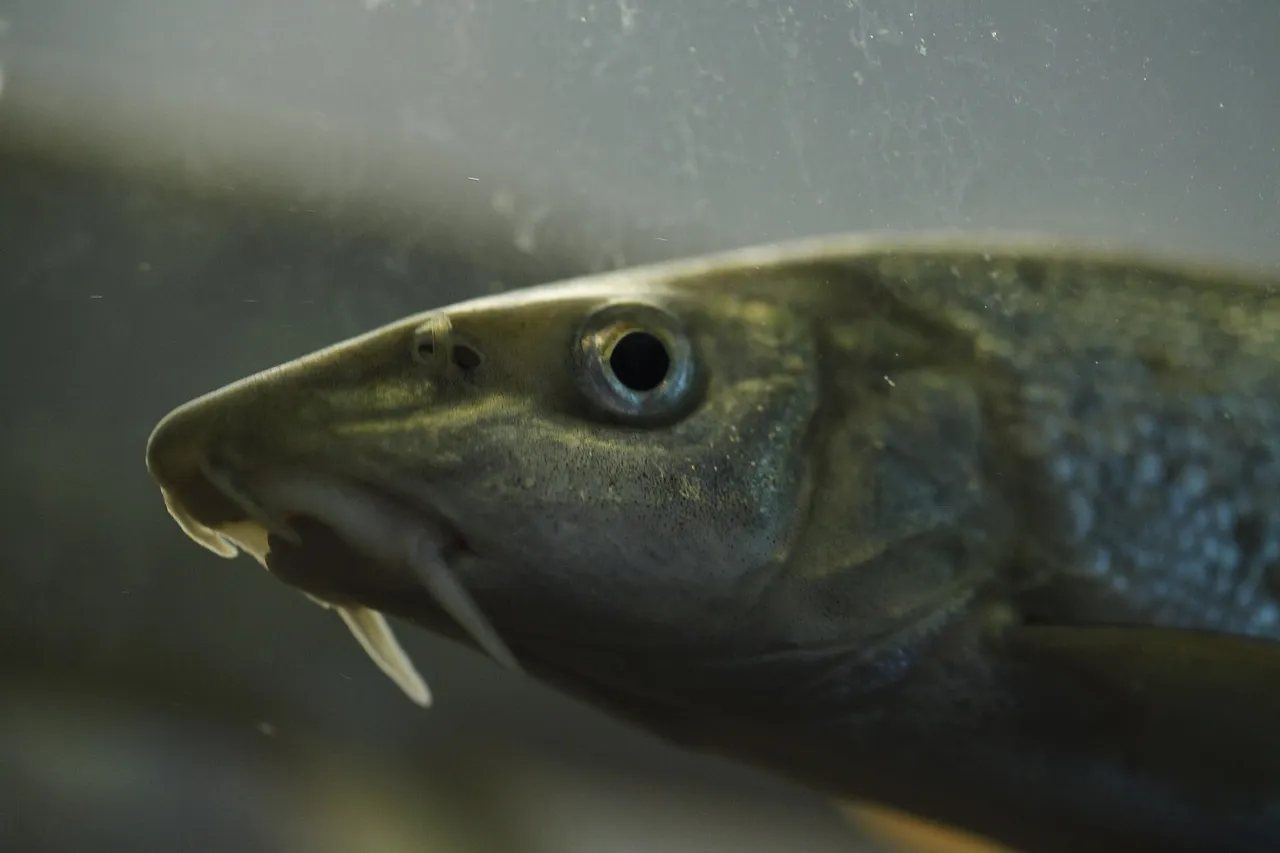
How this was identified, and who took it
Identified by: Four barbels — two long at the corners of the mouth and two shorter on the snout — with a distinctly inferior, underslung mouth beneath a pointed snout.Pmau, CC BY-SA 4.0, via Wikimedia Commons — source, licenceWhat is known about how it feeds
A barbel feeds with its face in gravel it cannot see into, and the whole animal is arranged around that.
The four barbels that give the fish its name carry dense concentrations of taste and touch receptors, and the mouth is underslung and protrusible. The fish works over and into gravel and the downstream edges of weed beds, locating caddis larvae, mayfly nymphs, freshwater shrimp and snails by contact rather than by sight, and it does this as effectively in complete darkness and heavy colour as in clear daylight.
Both verified relationships describe that: aquatic insect larvae and molluscs, each recorded at the group level the sources use.
Current is the second organising fact. Barbel position themselves where flow delivers food to them — gravel runs, creases, the tails of pools — so the feeding station is chosen for what arrives rather than for what lives there. A rise in flow that mobilises the bed is a feeding trigger, which is why the species is associated with rivers in spate rather than with settled low water.
The fish is also a substantial consumer of fish eggs and, in larger individuals, of small fish. That component sits outside the verified relationships and is real.
The food
Prey with a verified dietary link to this fish. Each entry carries its own evidence, and each is written at the precision the source actually used: a named species where the source named one, a group or food category where it said “polychaetes”, “crustaceans” or “detritus” and meant it. That is why this list is shorter than the animal’s real diet rather than longer.
- Aquatic insect larvae as prey — a group rather than a species: the evidence names the group
Barbel feed on the bed of running water, taking insect larvae and other invertebrates located by the barbels in gravel and among stones.
- Bivalve and gastropod molluscs as prey — a group rather than a species: the evidence names the group
Small molluscs are taken from gravel and weed alongside insect larvae, particularly in rivers with hard water and dense snail populations.
Food with no page of its own here yet
These are real components of the diet, listed as plain text because FishingHQ has no page for them yet. Inventing pages to make the list look fuller would be the fabrication this whole approach exists to prevent.
- freshwater shrimp
- fish eggs
- small fish, in large individuals
- algae and plant material
- crayfish
What anglers do with this
Everything below is interpretation, not finding. It is what experienced anglers conclude from the biology above, and the reasoning is usually sound and almost never tested. It is separated from the biology deliberately.
The touch-and-taste sensory profile is the reasoning behind fishing for barbel at night and in coloured water, and it is one of the more securely grounded conventions in British river angling: the fish is not disadvantaged by conditions that would stop a visual feeder.
The current relationship converts into where rather than when. Anglers read gravel runs, creases and weed-bed edges as feeding stations, and that reading is practitioner knowledge with a clear mechanical basis.
A welfare point is not interpretation and matters more for this species than for most. Barbel fight hard in warm, deoxygenated summer water and recover slowly; extended retention after a fight is associated with poor outcomes, and the specialist bodies are explicit that a barbel should be supported in the flow until it swims off under its own power.
What this does not establish
Both relationships are group-level. The diet is genuinely omnivorous and includes plant material and fish eggs that no relationship represents, and in heavily fished rivers a substantial part of what a barbel eats is what anglers introduce — which is not a natural diet fact at all and is not modelled. Nothing here describes a particular river.
Where this connects
These are the baits, lures, methods and explainers FishingHQ already joins to this fish — which is why the list is sometimes short. They are not chosen for this page, and a link here means an evidenced relationship exists, not that it follows from the diet.
Baits recorded for this species
Methods used for it
Where it lives
The science behind the feeding
This page covers feeding. The Barbel record covers identification, lifecycle, seasonal behaviour, handling and the sources behind all of it.
Reviewed 2026-08-12.