How to identify largemouth bass
Micropterus salmoides · Centrarchidae
The characters that identify largemouth bass, ranked by how far each one can be trusted on its own.
Safety: biosecurity and disease transfer — can cause serious injury or death. One more point applies here.
How this was identified, and who took it
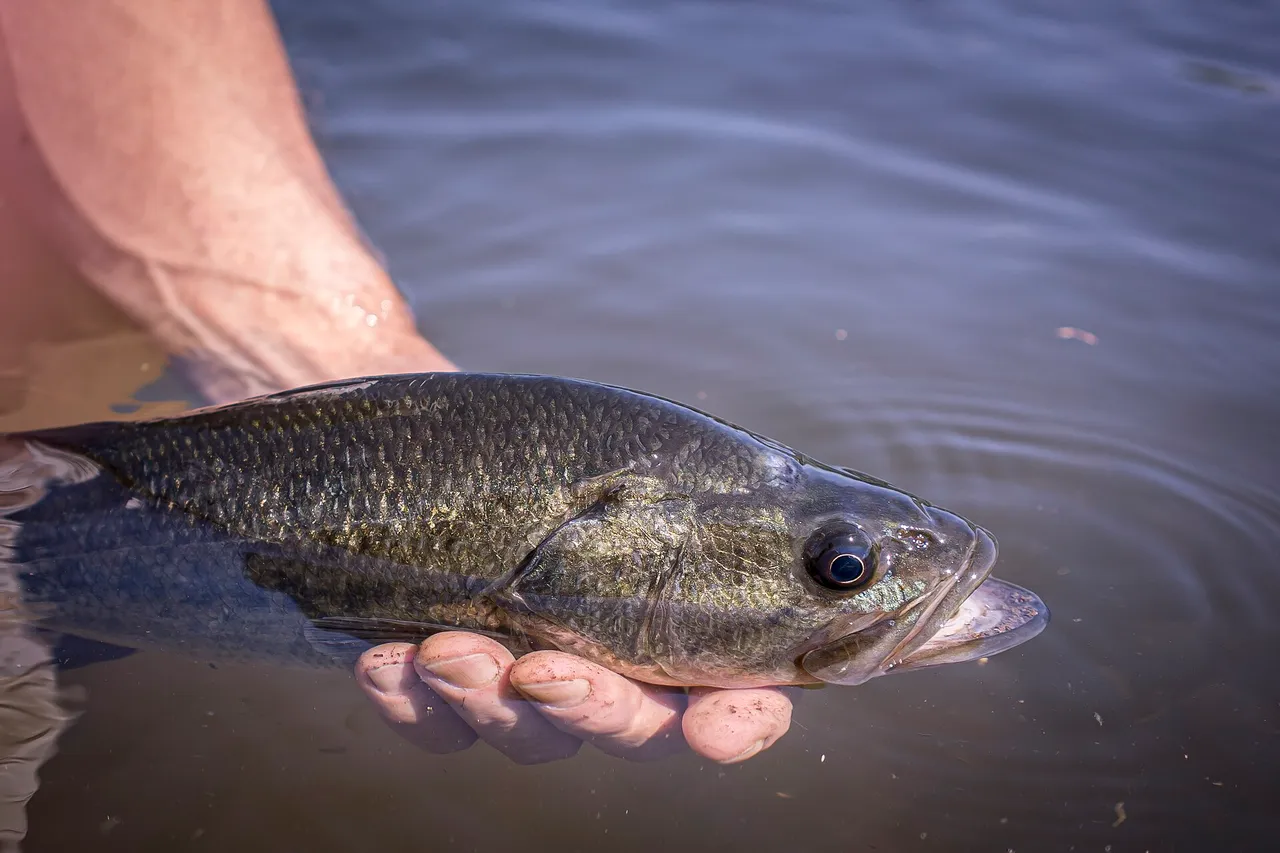
Identified by: The upper jaw extends clearly past the rear edge of the eye, which is the defining separation from smallmouth bass, together with the deep body and the dark mottled flank.USFWS Mountain Prairie, Public domain, via Wikimedia Commons — source, licenceLook at this first
Close the fish's mouth and find the rear corner of it. On a largemouth the hinge sits behind the back of the eye — sometimes well behind. That single relationship settles largemouth against smallmouth and against every spotted bass, and it does it on a fish of any size, in any water, in any condition.
Diagnostic — settles it on its own
Each of these settles the identification on its own. If one is clear, you have your answer.
Where the jaw hinge sits relative to the eye
The maxillary reaches back past the rear margin of the eye. Look at the fish in profile with the mouth shut and the line of the jaw is unmistakable once you know to look for it. Nothing else in the genus does this, and it does not change with season, size or water.
The gap in the dorsal fin
The notch between the spiny and soft halves of the dorsal runs down almost to the back, so the fin reads as two. On a smallmouth the same notch is shallow and the fin reads as one. Useful from a distance and in a photograph where the jaw is obscured.
Supporting — use with other characters
Real characters that are not conclusive by themselves. Use two or three together.
A broken stripe down the side
A dark line of irregular blotches runs from behind the gill cover to the tail wrist. It is a real character and it is not reliable alone: it fades to nothing on fish from stained water and can be almost solid on fish from clear water.
Body depth against length
Deep-bodied and flattened side to side, noticeably heavier through the shoulder than a smallmouth of the same length. A proportion rather than a measurement, so it wants a fish in hand or a good side-on photograph.
Suggestive only — varies with condition
Hints only. These vary with condition, season, water and how long the fish has been out of it, and a fish that contradicts them is still the same species.
How dark the fish is
Almost useless on its own. Bass from clear lakes are dark and strongly marked; the same fish from a turbid river is pale and nearly plain. Two bass from waters ten miles apart can look like different species, and neither is.
What it gets confused with
- Smallmouth bass, everywhere the two share water. Jaw hinge and dorsal notch, in that order.
- Spotted bass, which is closer to a smallmouth in jaw and carries a tooth patch on the tongue that neither of the other two has.
- Any of the several southern Micropterus species now recognised from smaller river systems, where range matters as much as anatomy.
Where this stops working
The genus has been split repeatedly and several regionally restricted Micropterus are recognised that a page written at this level cannot separate — in parts of the south-eastern United States knowing which river you are standing in narrows the possibilities faster than any character does. Hybrids occur where species have been stocked together, and a hybrid is intermediate in exactly the jaw character this page leans on.
The full record
This page covers identification only. The Largemouth bass record covers behaviour, lifecycle, distribution, handling and the sources behind all of it.
Reviewed 2026-08-14.
More about this fish
Telling it apart is one question. Here are the others.
Similar and related fish
How it is caught
- Float-tube fishingFloat tubes are used on small, weedy North American waters where a boat cannot be launched and the shallow, timbered margins that hold bass are unreachable from the bank.
- Kayak fishingKayak bass fishing is a mainstream branch of the North American sport, reaching shallow, weedy and timbered water that a powered boat cannot enter.
- SpinningAlmost all bass fishing is lure fishing, and the tackle industry built around it is the reason so much modern lure design exists at all.
Where it lives
Where you will find it
- FloridaOccupies the state's shallow lakes, marsh and canal systems in numbers, in a freshwater fishery with a genuine trophy reputation.
- KoreaIntroduced and established in reservoirs, where it supports a substantial and technically-minded lure fishery.
- North American freshwater fishingThe organising fish of American freshwater angling, native to the warm-water south and east and introduced far beyond it.
- The River EbroA North American species established in the warmer shallow arms of the reservoirs, and one more line in a fauna assembled by introduction.
Why the 9 connections on this page are here, and the sources
Similar and related fish
Backed by research — 1 connection
Supported by peer-reviewed research or fisheries science. The sources are listed and can be checked.
Bluegill
A predator-prey claim naming the predator binomial, and the basis of the stunting argument on both records.
- FishBase: a global information system on fishes — Froese, R. and D. Pauly, eds. — FishBase Consortium (Scientific institute)Relied on for: That Micropterus salmoides is an opportunistic ambush predator taking fish, occupying the same warm weedy still water as Lepomis macrochirus.States this directlyPassage read and verified
How it is caught
What experienced anglers do — 3 connections
Widely and independently recommended by experienced anglers and specialist sources. This is real angling knowledge, not proof: controlled evidence for it is limited, and FishingHQ records it as convention rather than as a demonstrated effect.
Float-tube fishing
Established angling practice for this species, recorded as convention. The note states the property of the animal or its water that makes the method the answer.
- IGFA International Angling Rules and World Record Requirements — International Game Fish Association (Angling or fisheries organisation)Relied on for: Recognition of the species as an established sport fish and the angling methods and tackle classes conventionally used for it.States this directlyPassage read and verified
- General angling website restatements of established technique — Various (Credible secondary source)Relied on for: Widely restated practice connecting this species and method.Background and mechanism onlyCitation checked — the work exists and is described correctly
Kayak fishing
Established angling practice for this species, recorded as convention. The note states the property of the animal or its water that makes the method the answer.
- IGFA International Angling Rules and World Record Requirements — International Game Fish Association (Angling or fisheries organisation)Relied on for: Recognition of the species as an established sport fish and the angling methods and tackle classes conventionally used for it.States this directlyPassage read and verified
- General angling website restatements of established technique — Various (Credible secondary source)Relied on for: Widely restated practice connecting this species and method.Background and mechanism onlyCitation checked — the work exists and is described correctly
Spinning
A practitioner claim about the dominant method for the species.
- General angling website restatements of established technique — Various (Credible secondary source)Relied on for: Widely restated practitioner accounts of lure fishing as the dominant bass method.Citation checked — the work exists and is described correctly
- Angling Times — Bauer Media (Specialist angling publication)Relied on for: Contemporary lure fishing technique in the angling press.Citation checked — the work exists and is described correctly
Where it lives
Backed by research — 1 connection
Supported by peer-reviewed research or fisheries science. The sources are listed and can be checked.
Lowland stillwaters
A habitat claim held to a scientific standard.
- FishBase: a global information system on fishes — Froese, R. and D. Pauly, eds. — FishBase Consortium (Scientific institute)Relied on for: Recorded habitat and environmental tolerances for Micropterus salmoides.States this directlyPassage read and verified
- Freshwater Fishes of the British Isles — HarperCollins (New Naturalist 75), 1992 (Reference work)Relied on for: Habitat use of introduced centrarchids in European waters.Background and mechanism onlyCitation checked — the work exists and is described correctly
Where you will find it
Backed by research — 4 connections
Supported by peer-reviewed research or fisheries science. The sources are listed and can be checked.
Florida
A distribution association between an animal and a kind of water, rather than a claim about any named mark.
- NOAA National Ocean Service education on estuaries and the National Estuarine Research Reserve System — National Oceanic and Atmospheric Administration, United States (Government fisheries body)Relied on for: Estuarine, seagrass and coastal habitat function in North American waters, and the nursery role of shallow habitat for the species concerned.Background and mechanism onlyCitation checked — the work exists and is described correctly
- FishBase: a global information system on fishes — Froese, R. and D. Pauly, eds. — FishBase Consortium (Scientific institute)Relied on for: Distribution, habitat association, depth range and life history recorded for the species.States this directlyPassage read and verified
Korea
A distribution association between an animal and a kind of water, rather than a claim about any named mark.
- FishBase: a global information system on fishes — Froese, R. and D. Pauly, eds. — FishBase Consortium (Scientific institute)Relied on for: Distribution, habitat association and depth range recorded for the species, including its occurrence in the water body concerned.States this directlyPassage read and verified
- The IUCN Red List of Threatened Species — International Union for Conservation of Nature (Conservation authority)Relied on for: Assessment and range account for the species, including the systems and coasts it occupies.Background and mechanism onlyCitation checked — the work exists and is described correctly
North American freshwater fishing
A distributional claim taken from reference sources on the species rather than from angling report. It states presence and asserts nothing about a fishery.
- FishBase: a global information system on fishes — Froese, R. and D. Pauly, eds. — FishBase Consortium (Scientific institute)Relied on for: Distribution, habitat association, depth range and life history recorded for the species concerned.States this directlyPassage read and verified
- The IUCN Red List of Threatened Species — International Union for Conservation of Nature (Conservation authority)Relied on for: Global distribution, population trend and extinction-risk assessment for the species concerned.States this directlyCitation checked — the work exists and is described correctly
The River Ebro
A distributional claim taken from reference works and databases on the fishes of the region rather than from angling report. It states presence and asserts nothing about a fishery.
- The IUCN Red List of Threatened Species — International Union for Conservation of Nature (Conservation authority)Relied on for: Global extinction-risk assessment, population trend and identified threats for the species concerned.States this directlyCitation checked — the work exists and is described correctly
- FishBase: a global information system on fishes — Froese, R. and D. Pauly, eds. — FishBase Consortium (Scientific institute)Relied on for: Distribution, habitat association and life history recorded for the species concerned.States this directlyPassage read and verified
Safety
Biosecurity and disease transfer — Can cause serious injury or death
Largemouth bass introduced outside their native range prey heavily on native fish and amphibians and have been implicated in serious declines and local extirpations, particularly on islands and in isolated systems. Moving live fish is how that happens.
What reduces it: Never move live fish or water between waters, anywhere, for any reason. Clean, drain, dry and check equipment between waters. Where the species is non-native, find out what the local requirement is before assuming a fish should be returned.
Injury while handling fish — Minor injury
The dorsal spines are sharp and the jaw teeth are abrasive. Neither is dangerous, but both catch out people expecting a smooth fish.
What reduces it: Wet hands before handling. Lip the fish with the body supported rather than lifting it by the jaw alone.