How to identify greater amberjack
Seriola dumerili · Carangidae
The characters that identify greater amberjack, ranked by how far each one can be trusted on its own.
Safety: venomous and spined species — can cause serious injury or death. 2 more points apply here.
How this was identified, and who took it
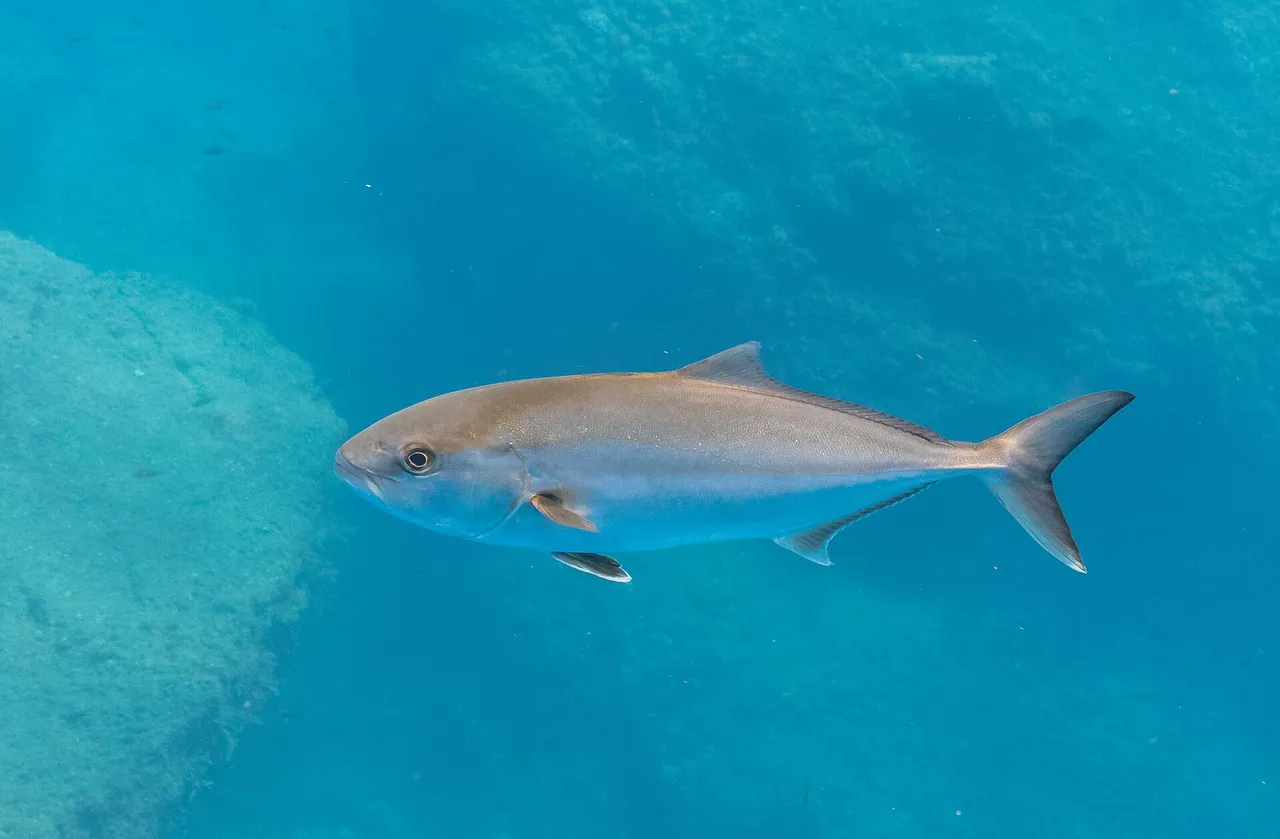
Identified by: Full lateral view in blue water. The amber lateral band, the dark band running back through the eye and the low long-based second dorsal are all clear.Diego Delso — CC BY-SA 4.0, via Wikimedia Commons — source, licenceLook at this first
The dark band through the eye is the character, not the amber stripe. On a greater amberjack that band runs steeply from the upper jaw through the eye and up to where the first dorsal begins, and its angle is what separates this fish from a yellowtail kingfish.
Diagnostic — settles it on its own
Each of these settles the identification on its own. If one is clear, you have your answer.
The angle of the eye band
A dusky diagonal from the jaw through the eye, reaching the dorsal origin. On a yellowtail kingfish the equivalent band is shallower and stops short of the fin. It is present in life and immediately after, and it is the separator worth learning.
Supporting — use with other characters
Real characters that are not conclusive by themselves. Use two or three together.
A raised lobe at the front of the second dorsal
The soft dorsal is long and low along most of its length but lifts into a distinct lobe at its leading edge. The proportion of that lobe to the fin behind it differs between the Seriola and is a character a photograph preserves.
A powerful body on a narrow tail wrist
Heavy through the shoulder, tapering hard to a slim peduncle with a deeply forked tail on the end of it. The build of a fish that lives on deep structure and swims against current, and it separates the amberjacks from the trevallies at a glance.
Suggestive only — varies with condition
Hints only. These vary with condition, season, water and how long the fish has been out of it, and a fish that contradicts them is still the same species.
The amber flank stripe
The character everybody names the fish by, and it has the shortest life of anything on this page. Bright on a live fish, faded within minutes of death, and absent from a photograph taken on ice. Look at the eye band instead.
What it gets confused with
- Yellowtail kingfish, the confusion that matters. The eye band angle and where it terminates.
- Almaco jack, which is deeper-bodied with a much taller front lobe on the second dorsal.
- Lesser amberjack and banded rudderfish, both of which are small and carry stronger juvenile banding.
Side by side: Greater amberjack vs Yellowtail kingfish.
Where this stops working
Seriola is a difficult genus and juveniles are worse: young amberjacks of several species carry vertical banding that adults lose entirely, and those bands look more alike between species than the adults do. Large fish in parts of the range accumulate ciguatoxin, which is not removed by cooking or freezing — that is a matter for local health advice, not for a page about what a fish looks like.
The full record
This page covers identification only. The Greater amberjack record covers behaviour, lifecycle, distribution, handling and the sources behind all of it.
Reviewed 2026-08-14.
More about this fish
Telling it apart is one question. Here are the others.
Similar and related fish
- Almaco jackBody depth and fin lobes. The eye bar both have separates nothing.
- Atlantic horse mackerelBoth are Carangidae with the family's keeled lateral scutes — the horse mackerel is what a jack looks like at small size, and the scutes are sharp on both.
- European spratSmall shoaling clupeids are a principal prey where amberjack range overlaps them, and amberjack hunting behaviour is organised around driving such shoals against structure or the surface.
- Yellowtail kingfishCongeners in Seriola, both structure-oriented and both diving hard for cover when hooked. Separated by the angle of the eye band and body proportion rather than by colour.
How it is caught
- JiggingVertical jigging over deep structure is the defining method, and the tackle is heavy because the fight is a straight-down tug of war against a fish trying to reach cover.
- Reef spearfishingSecond by BIOMASS in the Canary catch on only eight fish, at 84.97 kg — which is the whole story of this species in one pair of numbers. It is taken rarely and it is very large when it is, and at a trophic level of 4.5 it is the top predator in the recorded catch.
Where you will find it
- Cape VerdeThe fish that makes rock fishing here worth the effort. Amberjack hunt right into the rock because there is no shelf keeping them offshore, which is why popping and spinning from a ledge is viable here and close to pointless on a shelving European coast.
- CyprusThe seasonal exception to the island's small-fish rule, and the one time light tackle is the wrong answer. Amberjack come inshore to rock marks in season and are taken on lures, which is a completely different fishery from the resident one that occupies the rest of the year.
- Malta and GozoOver deep water close to shore, and one of the pelagic species the limestone drop-offs put within reach of a rock mark.
- The Croatian AdriaticPatrolling the karst walls and offshore banks in season, which is the pelagic component of a fishery otherwise dominated by resident rock species.
- The Gulf of MexicoHolds on wrecks, reefs, platforms and hard bottom across the shelf, aggregating to spawn on offshore structure in spring.
- The Strait of GibraltarHolds the current-swept structure and drop-offs in and around the strait, feeding on what the exchange flow delivers.
Why the 12 connections on this page are here, and the sources
Similar and related fish
Backed by research — 4 connections
Supported by peer-reviewed research or fisheries science. The sources are listed and can be checked.
Almaco jack
Seriola rivoliana is markedly deeper-bodied than Seriola dumerili at the same length, and the front lobes of its second dorsal and anal fins are long and falcate where the amberjack's are not. Both carry the dark bar running from the upper jaw through the eye, which is the mark most often used to identify an amberjack and which distinguishes neither from the other.
- FishBase: a global information system on fishes — Froese, R. and D. Pauly, eds. — FishBase Consortium (Scientific institute)Relied on for: The morphology, size, depth range and distribution that separate these two species from one another.States this directlyPassage read and verified
Atlantic horse mackerel
A taxonomic and identification comparison naming both binomials.
- FishBase: a global information system on fishes — Froese, R. and D. Pauly, eds. — FishBase Consortium (Scientific institute)Relied on for: That Trachurus trachurus and Seriola dumerili are both Carangidae, the jacks and pompanos.States this directlyPassage read and verified
European sprat
Recorded diet evidence identifies Sprattus sprattus as a food item of this predator at species level. The edge is written at that granularity and no further.
- FishBase: a global information system on fishes — Froese, R. and D. Pauly, eds. — FishBase Consortium (Scientific institute)Relied on for: Food items recorded for this predator, including Sprattus sprattus.States this directlyPassage read and verified
- FAO Species Identification Guides for Fishery Purposes and the FAO Species Catalogues — Food and Agriculture Organization of the United Nations (Scientific institute)Relied on for: Species account describing the diet of this predator in the region where Sprattus sprattus occurs.Background and mechanism onlyCitation checked — the work exists and is described correctly
Yellowtail kingfish
A taxonomic and identification comparison naming both binomials.
- FishBase: a global information system on fishes — Froese, R. and D. Pauly, eds. — FishBase Consortium (Scientific institute)Relied on for: That Seriola dumerili and Seriola lalandi are congeners in the genus Seriola associated with deep reef, wreck and rocky habitat.States this directlyPassage read and verified
How it is caught
What experienced anglers do — 1 connection
Widely and independently recommended by experienced anglers and specialist sources. This is real angling knowledge, not proof: controlled evidence for it is limited, and FishingHQ records it as convention rather than as a demonstrated effect.
Jigging
A practitioner claim about the principal method for the species.
- Sea Angler — Bauer Media (Specialist angling publication)Relied on for: Practitioner treatment of vertical jigging for amberjack and other deep structure predators.Citation checked — the work exists and is described correctly
- IGFA International Angling Rules and World Record Requirements — International Game Fish Association (Angling or fisheries organisation)Relied on for: The tackle classes used for large marine predators fished vertically.Passage read and verified
Official guidance — 1 connection
Stated by a fisheries authority, scientific institute or recognised angling body. Authoritative, but summarising rather than demonstrating.
Reef spearfishing
A scientific institute reporting what its own survey of the fishery recorded: a two-year catch-recording programme across the Canary archipelago counted and weighed every specimen, and this species appears in its published catch table. That is what Canary spearfishers were measured taking, rather than an inference from where the species lives or an assertion about what people do.
- Spearfishing in the Canary Islands: is the devil as black as it seems to be? — Pablo Martín-Sosa, Instituto Español de Oceanografía — Revista Scientia Insularum, 2019 (Scientific literature)Relied on for: The Canary spearfishing catch table, in which this species appears with a specimen count and a landed weight over the study's two-year recording period.States this directlyPassage read and verified
Where you will find it
Backed by research — 6 connections
Supported by peer-reviewed research or fisheries science. The sources are listed and can be checked.
Cape Verde
A distribution edge resting on published regional identification and distribution references, written where the species is genuinely characteristic of the destination's fishing rather than merely recorded from its waters.
- FAO Species Identification Guides for Fishery Purposes and the FAO Species Catalogues — Food and Agriculture Organization of the United Nations (Scientific institute)Relied on for: Distribution, habitat association and biology of the fishes of the eastern central Atlantic and the Mediterranean, from the regional identification guides prepared for fishery purposes.States this directlyCitation checked — the work exists and is described correctly
- FishBase: a global information system on fishes — Froese, R. and D. Pauly, eds. — FishBase Consortium (Scientific institute)Relied on for: Recorded environment, depth range, distribution and biology of the species named.States this directlyPassage read and verified
Cyprus
A distribution edge resting on published regional identification and distribution references, written where the species is genuinely characteristic of the destination's fishing rather than merely recorded from its waters.
- FAO Species Identification Guides for Fishery Purposes and the FAO Species Catalogues — Food and Agriculture Organization of the United Nations (Scientific institute)Relied on for: Distribution, habitat association and biology of the fishes of the eastern central Atlantic and the Mediterranean, from the regional identification guides prepared for fishery purposes.States this directlyCitation checked — the work exists and is described correctly
- FishBase: a global information system on fishes — Froese, R. and D. Pauly, eds. — FishBase Consortium (Scientific institute)Relied on for: Recorded environment, depth range, distribution and biology of the species named.States this directlyPassage read and verified
Malta and Gozo
A distributional claim about where a species occurs, resting on the regional identification literature rather than on angling report. It says nothing about where a reader should fish.
- FAO Species Identification Guides for Fishery Purposes and the FAO Species Catalogues — Food and Agriculture Organization of the United Nations (Scientific institute)Relied on for: Species composition, habitat association and distribution for the region concerned, as set out in the FAO species identification sheets.States this directlyCitation checked — the work exists and is described correctly
- The IUCN Red List of Threatened Species — International Union for Conservation of Nature (Conservation authority)Relied on for: Global assessment and distribution for the species concerned.States this directlyCitation checked — the work exists and is described correctly
The Croatian Adriatic
A claim that a place contains the ground, water and seasonal conditions the species is associated with. It is a distributional statement about the world, it rests on the regional reference literature, and it deliberately asserts nothing about access, permission or catch.
- FishBase: a global information system on fishes — Froese, R. and D. Pauly, eds. — FishBase Consortium (Scientific institute)Relied on for: Recorded distribution, depth range and habitat association for the Mediterranean species named.States this directlyPassage read and verified
- FAO Species Identification Guides for Fishery Purposes and the FAO Species Catalogues — Food and Agriculture Organization of the United Nations (Scientific institute)Relied on for: Regional species identification and distribution for the Mediterranean and eastern Atlantic, including habitat association.States this directlyCitation checked — the work exists and is described correctly
The Gulf of Mexico
A distribution association between an animal and a kind of water, rather than a claim about any named mark.
- FishBase: a global information system on fishes — Froese, R. and D. Pauly, eds. — FishBase Consortium (Scientific institute)Relied on for: Distribution, habitat association and depth range recorded for the species, including its occurrence in the water body concerned.States this directlyPassage read and verified
- The IUCN Red List of Threatened Species — International Union for Conservation of Nature (Conservation authority)Relied on for: Assessment and range account for the species, including the systems and coasts it occupies.Background and mechanism onlyCitation checked — the work exists and is described correctly
The Strait of Gibraltar
A distribution association between an animal and a kind of water, rather than a claim about any named mark.
- FAO Species Identification Guides for Fishery Purposes and the FAO Species Catalogues — Food and Agriculture Organization of the United Nations (Scientific institute)Relied on for: Distribution, habitat, depth and fishery accounts for the species of the eastern central Atlantic and Mediterranean in the FAO regional identification guides.States this directlyCitation checked — the work exists and is described correctly
- FishBase: a global information system on fishes — Froese, R. and D. Pauly, eds. — FishBase Consortium (Scientific institute)Relied on for: Distribution, habitat association and depth range recorded for the species.States this directlyPassage read and verified
Safety
Barotrauma and pressure injury is set out at the top of this page, where it cannot be missed.
Venomous and spined species — Can cause serious injury or death
Ciguatera poisoning from eating large amberjack in parts of the range. The toxin accumulates through the reef food chain, is not destroyed by cooking or freezing, and causes serious and sometimes prolonged illness.
What reduces it: Follow local health authority advice about which reef fish are safe to eat where you are, and treat large reef predators with particular caution. The risk varies regionally and by fish size in ways no general rule captures.
Line under tension — Can cause serious injury or death
Heavy jigging and live-bait tackle with locked drags fished directly above structure. When a leader or knot parts under that load it returns toward the boat at speed.
What reduces it: Keep hands clear of running line and of the leader while a fish is on. Nobody stands in line with a loaded rod. Gloves for leader work. Inspect and replace connections regularly.