How to identify dusky kob
Argyrosomus japonicus · Sciaenidae
The characters that identify dusky kob, ranked by how far each one can be trusted on its own.
Safety: drowning and immersion — can cause serious injury or death. One more point applies here.
How this was identified, and who took it
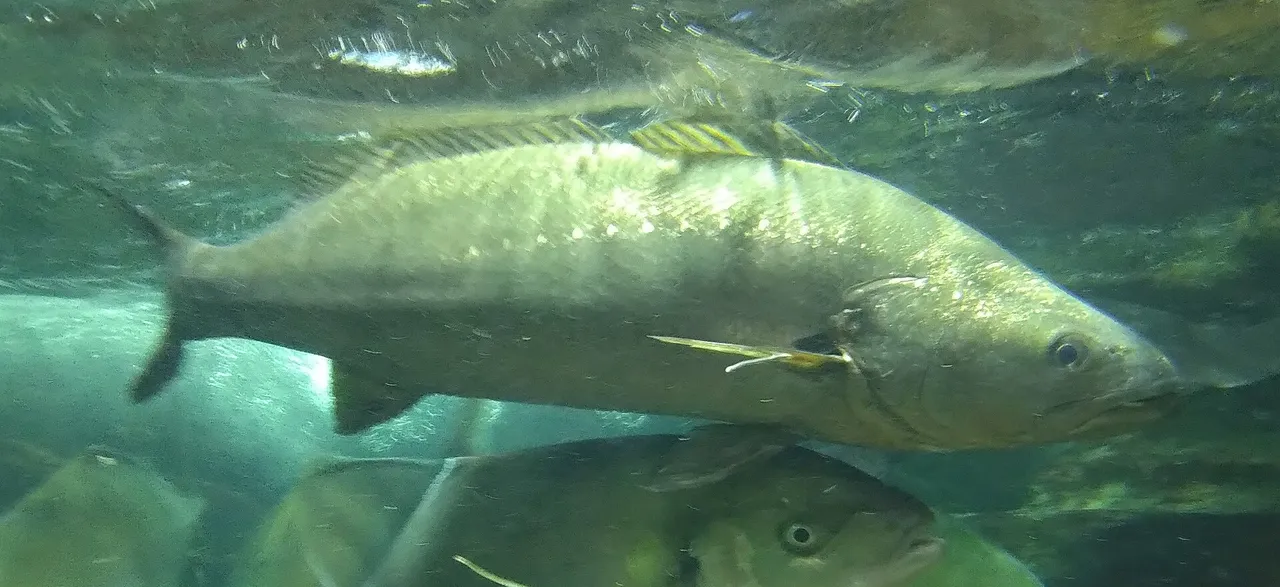
Identified by: Full lateral view showing the elongate body, the two dorsal fins, the pointed snout and the row of pale spots following the lateral line that places it in Argyrosomus. Photographed through aquarium water; colour is green-shifted.タウナギ — CC BY-SA 4.0, via Wikimedia Commons — source, licenceLook at this first
Follow the lateral line from the gill cover backwards. On most kob a row of small pale spots sits along it like stitching, one to a scale. It is the field mark that separates a kob from the other big silver fish in a South African surf zone.
No single character settles this one. Everything below is supporting or suggestive, and a confident identification needs several of them together — or, for the hardest cases, a count that cannot be made from a photograph.
Supporting — use with other characters
Real characters that are not conclusive by themselves. Use two or three together.
Pale spots following the lateral line
A line of light dots tracing the lateral line, clearest on fish under about ten kilos. Ranked as supporting rather than diagnostic because large adults lose them and because related Argyrosomus show something similar.
Two dorsal fins, short then long
A short spiny first dorsal followed by a long low soft-rayed second. The arrangement places the fish among the drums and rules out the mullets and the kingfish it shares a beach with.
A pointed snout with the mouth slightly beneath it
The head tapers to a point and the mouth is set a little below the tip rather than at it. Combined with the elongate body it gives the fish an outline no jack or mullet has.
Size and where it was caught
Adults reach weights nothing else in the same surf approaches, and juveniles are essentially confined to estuaries while adults sit beyond the break. Where a fish came from narrows the possibilities as much as its anatomy does.
Suggestive only — varies with condition
Hints only. These vary with condition, season, water and how long the fish has been out of it, and a fish that contradicts them is still the same species.
The pearly sheen on a fresh fish
Genuinely striking and gone within an hour. Bronze above and iridescent along the flank in a fish just landed, flat grey in the same fish photographed later, which is why no page should build on it.
What it gets confused with
- Silver kob and squaretail kob, the congeners that share the range and are the reason this page has no diagnostic character.
- Meagre, the closely related Atlantic and Mediterranean species, where introduced or where ranges are misremembered.
- Large mullet at a distance in the surf, separated as soon as the mouth is visible.
Side by side: Dusky kob vs Meagre.
Where this stops working
This is a page with no diagnostic character and that is a statement about the fish rather than about the writing. Several Argyrosomus species overlap along the southern African coast and are separated reliably on gas bladder morphology and otolith structure — internal characters — rather than on anything visible in a photograph. Where a size or bag rule is species-specific, a fish that cannot be confidently separated should be treated as the more restricted species.
The full record
This page covers identification only. The Dusky kob record covers behaviour, lifecycle, distribution, handling and the sources behind all of it.
Reviewed 2026-08-14.
More about this fish
Telling it apart is one question. Here are the others.
Similar and related fish
- MeagreCongeners of the same genus on different coasts, routinely conflated in international angling writing.
- Pacific sardineAdult kob feed on pilchards and other shoaling fish in coastal water, and the annual sardine run along the southern African east coast is a substantial feeding event for them.
- Silver kobThe character the institute leads with is a SMELL: dusky kob carry a strong characteristic odour and silver kob do not, which is what the name inodorus records. Beyond that, a slightly narrower and longer caudal peduncle and slightly longer pectorals. Size separates nothing — both pass a metre — and the two carry different limits under four different area rules.
How it is caught
Where it lives
Where you will find it
- South AfricaA principal target of shore, estuary and boat angling along the south and east coasts, and a species whose estuarine nursery habitat governs its recruitment.
- Southern African fishingThe most prized shore species on much of the coast, and a species whose depletion is the clearest local example of why linefish management here is strict.
- The Agulhas CurrentOccupies the estuaries and turbid inshore water of the coast the current runs past, using the estuaries as nursery habitat.
- The Indian subcontinent coastsOccupies estuaries and turbid inshore water on this coast as it does on the southern African one, hunting by sound and lateral line.
- The western Indian Ocean coastOccupies the estuaries and river mouths in the south of the range, connecting this coast's fauna to the southern African one.
Why the 12 connections on this page are here, and the sources
Similar and related fish
Backed by research — 3 connections
Supported by peer-reviewed research or fisheries science. The sources are listed and can be checked.
Meagre
An identification comparison naming both binomials: Argyrosomus regius and Argyrosomus japonicus.
- FishBase: a global information system on fishes — Froese, R. and D. Pauly, eds. — FishBase Consortium (Scientific institute)Relied on for: Morphological and distributional data for Argyrosomus regius and for Argyrosomus japonicus.States this directlyPassage read and verified
- The IUCN Red List of Threatened Species — International Union for Conservation of Nature (Conservation authority)Relied on for: Separate assessments treating Argyrosomus regius and Argyrosomus japonicus as distinct species.States this directlyCitation checked — the work exists and is described correctly
Pacific sardine
Recorded diet evidence identifies Sardinops sagax as a food item of this predator at species level. The edge is written at that granularity and no further.
- FishBase: a global information system on fishes — Froese, R. and D. Pauly, eds. — FishBase Consortium (Scientific institute)Relied on for: Food items recorded for this predator, including Sardinops sagax.States this directlyPassage read and verified
- FAO Species Identification Guides for Fishery Purposes and the FAO Species Catalogues — Food and Agriculture Organization of the United Nations (Scientific institute)Relied on for: Species account describing the diet of this predator in the region where Sardinops sagax occurs.Background and mechanism onlyCitation checked — the work exists and is described correctly
Silver kob
A relatedness claim made for identification rather than for taxonomy: these are the pairs a reader holding one has to tell apart, and in several cases the rules that apply to them differ. The evidence names the object's binomial because the common names are precisely what collides.
- FishBase: a global information system on fishes — Froese, R. and D. Pauly, eds. — FishBase Consortium (Scientific institute)Relied on for: Identity, family placement, distribution and diagnostic characters of Argyrosomus japonicus, and of the species it is confused with in the hand.States this directlyPassage read and verified
- ORI Fish Fact Sheets: the species accounts of the Oceanographic Research Institute — Oceanographic Research Institute, South African Association for Marine Biological Research (SAAMBR), Durban, 2023 (Scientific institute)Relied on for: The description and distribution the research institute publishes for Argyrosomus japonicus, including the characters that separate it from its neighbours.States this directlyPassage read and verified
How it is caught
What experienced anglers do — 3 connections
Widely and independently recommended by experienced anglers and specialist sources. This is real angling knowledge, not proof: controlled evidence for it is limited, and FishingHQ records it as convention rather than as a demonstrated effect.
Livebaiting at sea
Kob take live bait in preference to dead where both are available, and the species page names live bait first. This is a distinct presentation from a static dead bait rather than a refinement of it.
- Assessment of catches in shore angling competitions from the Border region of the Eastern Cape — Pradervand & Govender, African Zoology 38(1), for the Oceanographic Research Institute, 2003 (Scientific literature)Relied on for: Documents which fishery and which technique takes this species.States this directlyPassage read and verified
- Marine Recreational Fishing Regulations in South Africa — South African Association for Marine Biological Research (SAAMBR), summarising the Marine Living Resources Act and its regulations, 2023 (Scientific institute)Relied on for: Independently corroborates the species' recreational capture and range.Background and mechanism onlyPassage read and verified
Spinning
The lure fishery is recent and growing rather than traditional, and the page says so. It is included because it is now a real way the species is caught and excluded from the bait sections because it is not the same fishing.
- Assessment of catches in shore angling competitions from the Border region of the Eastern Cape — Pradervand & Govender, African Zoology 38(1), for the Oceanographic Research Institute, 2003 (Scientific literature)Relied on for: Documents which fishery and which technique takes this species.States this directlyPassage read and verified
- Marine Recreational Fishing Regulations in South Africa — South African Association for Marine Biological Research (SAAMBR), summarising the Marine Living Resources Act and its regulations, 2023 (Scientific institute)Relied on for: Independently corroborates the species' recreational capture and range.Background and mechanism onlyPassage read and verified
Surfcasting
The page describes a fish that hunts by sound and lateral line in turbid water and is fished from surf beaches at night. Surfcasting is the technique that puts a bait into that water from the shore, and the handling section is written around landing a heavy fish through breaking surf.
- Assessment of catches in shore angling competitions from the Border region of the Eastern Cape — Pradervand & Govender, African Zoology 38(1), for the Oceanographic Research Institute, 2003 (Scientific literature)Relied on for: Documents which fishery and which technique takes this species.States this directlyPassage read and verified
- Marine Recreational Fishing Regulations in South Africa — South African Association for Marine Biological Research (SAAMBR), summarising the Marine Living Resources Act and its regulations, 2023 (Scientific institute)Relied on for: Independently corroborates the species' recreational capture and range.Background and mechanism onlyPassage read and verified
Where it lives
Backed by research — 1 connection
Supported by peer-reviewed research or fisheries science. The sources are listed and can be checked.
Estuary
A life-history claim with direct management consequence, held to a scientific standard.
- FishBase: a global information system on fishes — Froese, R. and D. Pauly, eds. — FishBase Consortium (Scientific institute)Relied on for: That Argyrosomus japonicus has adults inhabiting near-shore areas beyond the surf zone while juveniles are found exclusively inshore and recruit to estuaries at around 30 cm length.States this directlyPassage read and verified
Where you will find it
Backed by research — 5 connections
Supported by peer-reviewed research or fisheries science. The sources are listed and can be checked.
South Africa
A distribution association between an animal and a kind of water, rather than a claim about any named mark.
- FishBase: a global information system on fishes — Froese, R. and D. Pauly, eds. — FishBase Consortium (Scientific institute)Relied on for: Distribution, habitat association and depth range recorded for the species, including its occurrence in the water body concerned.States this directlyPassage read and verified
- The IUCN Red List of Threatened Species — International Union for Conservation of Nature (Conservation authority)Relied on for: Assessment and range account for the species, including the systems and coasts it occupies.Background and mechanism onlyCitation checked — the work exists and is described correctly
Southern African fishing
A distributional claim taken from reference sources on the species rather than from angling report. It states presence and asserts nothing about a fishery.
- FishBase: a global information system on fishes — Froese, R. and D. Pauly, eds. — FishBase Consortium (Scientific institute)Relied on for: Distribution, habitat association, depth range and life history recorded for the species concerned.States this directlyPassage read and verified
- The IUCN Red List of Threatened Species — International Union for Conservation of Nature (Conservation authority)Relied on for: Global distribution, population trend and extinction-risk assessment for the species concerned.States this directlyCitation checked — the work exists and is described correctly
The Agulhas Current
A distribution association between an animal and a kind of water, rather than a claim about any named mark.
- FishBase: a global information system on fishes — Froese, R. and D. Pauly, eds. — FishBase Consortium (Scientific institute)Relied on for: Distribution, habitat association and depth range recorded for the species, including its occurrence in the water body concerned.States this directlyPassage read and verified
- The IUCN Red List of Threatened Species — International Union for Conservation of Nature (Conservation authority)Relied on for: Assessment and range account for the species, including the systems and coasts it occupies.Background and mechanism onlyCitation checked — the work exists and is described correctly
The Indian subcontinent coasts
A distribution association between an animal and a kind of water, rather than a claim about any named mark.
- FAO Species Identification Guides for Fishery Purposes and the FAO Species Catalogues — Food and Agriculture Organization of the United Nations (Scientific institute)Relied on for: Distribution, habitat, depth and fishery accounts for the species in the FAO regional identification guides for the ocean area concerned.States this directlyCitation checked — the work exists and is described correctly
- FishBase: a global information system on fishes — Froese, R. and D. Pauly, eds. — FishBase Consortium (Scientific institute)Relied on for: Distribution, habitat association and depth range recorded for the species.States this directlyPassage read and verified
The western Indian Ocean coast
A distribution association between an animal and a kind of water, rather than a claim about any named mark.
- FishBase: a global information system on fishes — Froese, R. and D. Pauly, eds. — FishBase Consortium (Scientific institute)Relied on for: Distribution, habitat association and depth range recorded for the species, including its occurrence in the water body concerned.States this directlyPassage read and verified
- The IUCN Red List of Threatened Species — International Union for Conservation of Nature (Conservation authority)Relied on for: Assessment and range account for the species, including the systems and coasts it occupies.Background and mechanism onlyCitation checked — the work exists and is described correctly
Safety
Drowning and immersion — Can cause serious injury or death
This is largely a surf and estuary night fishery, frequently fished from beaches, rock and sandbanks in the dark. Being knocked over by surf or cut off by a rising tide are the dominant risks, and darkness makes both far worse.
What reduces it: Wear a buoyancy aid. Never fish surf or rock alone at night. Check the tide and identify the exit before starting, and leave on a clock time rather than on how the fishing is going. Carry a light and a means of calling for help, and tell somebody where you are.
Injury while handling fish — Can cause injury needing treatment
Sharp gill covers on a large, heavy, strong fish handled in surf or on a bank in the dark.
What reduces it: Support the body horizontally with wet hands, keep fingers clear of the gill plates, and use long pliers and a light.