Edible crab
Fish · Last reviewed 2026-08-12
The large pie-crust crab of Atlantic Europe: slow-growing, long-lived, heavily regulated, and the animal most people mean when they say they went crabbing and caught something worth keeping.
Safety: cliffs and rock platforms — can cause serious injury or death. 5 more points apply here.
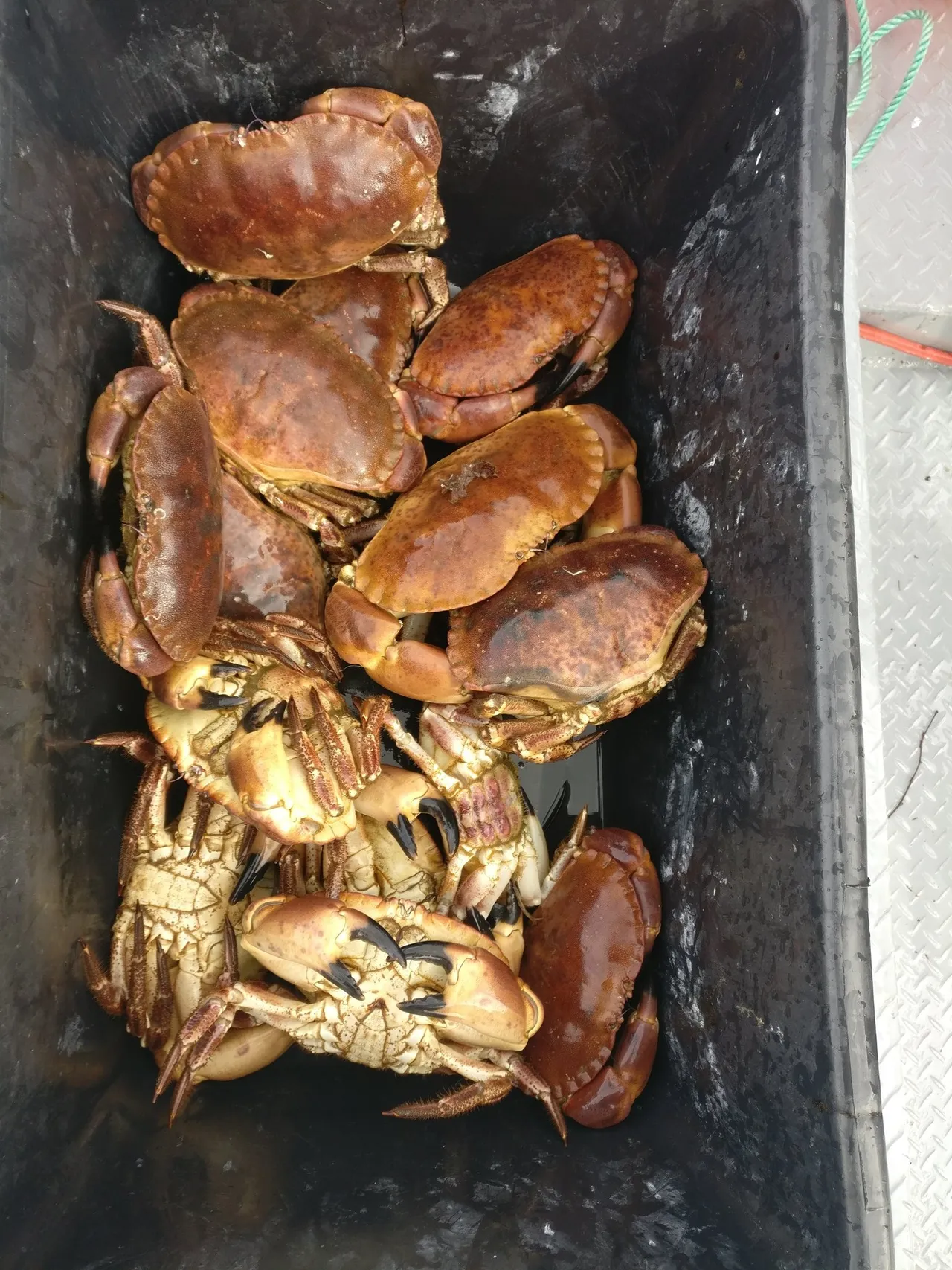
How this was identified, and who took it
Identified by: Both characters, repeated across several animals: a broad oval carapace with the crimped pie-crust margin, shown cleanly and unobstructed on the uppermost crab, and heavy black-tipped chelae on the inverted animals below. Several crabs present the ventral surface, so the frame carries the underside as well as the top.Wouter Koch — CC0, via iNaturalist — source, licenceCatching Edible crab
Everything here on fishing for it. Each entry opens the page behind it.
- When
- Mar–Oct — months recorded at the places that document it, not a season for the whole range.
- Where
- 5 places FishingHQ documents — strongest claim anywhere: characteristic of this water · From the shore
The edible crab is the big one. An adult is a heavy, oval, reddish-brown animal with a shell edged like the crimped rim of a pie, and it is the principal crab fishery of Atlantic Europe both commercially and recreationally. It is also the animal that most clearly exposes what FishingHQ's model was missing: a person lifting a drop net off a harbour wall is fishing, and until an earlier pass FishingHQ had no way to describe what they had caught.
Crabs do not grow continuously. They grow in steps, by shedding the whole shell and expanding rapidly before the new one hardens, and almost every practical fact about them follows from that. A crab that has just moulted is soft, defenceless, hiding, and nearly empty of meat. A crab well into its shell is hard, full and worth taking. The same event is why a peeler crab is the most prized sea bait there is — a fact FishingHQ already modelled, from the fish's point of view, without ever modelling the crab's.
They are slow-growing and long-lived, mature late, and the females carry eggs beneath the abdomen for months. That combination is why the fishery is regulated as tightly as it is, and why the size limit, the berried-female prohibition and the ban on taking parts of animals exist almost everywhere the species is fished.
How it is caught
- Crabbing with a line and a drop netThe animal holds a bait rather than being hooked by it, which is why no hook is involved and why the lift has to be smooth.
- Recreational pottingEdible crab are taken in the same pots and on the same ground as lobster, and they are frequently the larger part of a recreational catch whether or not they were the target.
Where Edible crab is documented
Places where public sources describe this species as fished, with how it is fished and how strongly the evidence supports it. This is not a range map and it is not a recommendation — it is what has been written down about a fishery rather than a record of any individual catch, and being listed is never permission to fish.
The Norfolk and Suffolk sandbank coast
1 documented place
Pier
Characteristic of this water
From the shore
Around Mar, Apr, May, Jun, Jul, Aug, Sept, Oct
East Lothian and the Firth of Forth coast
1 documented place
Headland
Repeatedly reported
From the shore
What these strengths mean
- Characteristic of this water
- This water is strongly identified with this species by the sources that cover it.
- Regular local target
- Fishing sources describe this as a normal local target here, not merely as caught.
- Repeatedly reported
- Several independent public accounts. Enough to say it happens more than once; not enough to call it a fishery.
Identification
- Scientific name
- Cancer pagurus
- Family
- Cancridae
- Water
- Saltwater
- Conservation status
- Least Concern
- Regions
- Britain & Ireland, Northern Europe, Western Europe, Mediterranean, North Africa
- A broad oval shell with a distinctive crimped, pie-crust edge — the single most reliable feature and unlike anything else in the range.
- Reddish-brown above, paler below, with black tips to both claws.
- Claws heavy and unequal in function: one crusher, one cutter.
- Much larger than the green shore crab that dominates recreational crabbing catches, and quite differently shaped.
- Sex is read from the abdominal flap folded under the body — narrow and pointed in males, broad and rounded in females.
Size
- Typical
- Carapace width of 12–15 cm for animals encountered inshore.
- Large
- Over 20 cm carapace width.
Exceptional: Carapace widths approaching 30 cm and weights over 3 kg are recorded. Size in crabs is measured as CARAPACE WIDTH — the widest point across the shell — because that is what minimum size limits are written in, and quoting a body length instead is a regulatory error rather than a stylistic one.
From plankton to a crab that outgrows its own armour
An edible crab's life is a sequence of discrete jumps rather than continuous growth, because an animal in a rigid shell can only get bigger by leaving it.
IT STARTS AS PLANKTON. Larvae hatch and drift for weeks through several stages before settling to the seabed as tiny crabs, which is when the population's distribution is actually decided — settlement depends on where the currents put them, not on where the parents were.
THEN IT MOULTS, REPEATEDLY. Growth happens only at the moult: the crab absorbs water, splits the old shell along a seam, backs out complete with the linings of its gills and gut, and expands before the new shell hardens. Juveniles moult several times a year; large adults may go two years or more between moults, and very large males may effectively stop.
THE PERIOD AFTER A MOULT IS THE VULNERABLE ONE. A newly moulted crab is soft, defenceless and hides — which is why they are found under rock and in holes rather than moving in the open, and why the soft-shelled stage is the basis of the peeler crab bait fishery.
CLAWS REGENERATE ACROSS MOULTS. A crab that sheds a limb regrows it over successive moults, smaller at first and eventually full size. That is why a returned crab missing a claw is not necessarily a wasted animal, and why declawing is nevertheless a real welfare and stock question.
AND LONGEVITY IS SUBSTANTIAL. Edible crabs are long-lived and slow-growing at size, so a large animal represents many years, and grounds fished hard for large crabs do not refill quickly.
Backed by research — why, and the sources (2)
Supported by peer-reviewed research or fisheries science. The sources are listed and can be checked.
- The Fishes of the British Isles and North-West Europe — Macmillan, 1969 (Reference work)Relied on for: Distribution, habitat association, depth, ground preference and biology of fishes in British and north-west European waters.States this directlyCitation checked — the work exists and is described correctly
- FishBase: a global information system on fishes — Froese, R. and D. Pauly, eds. — FishBase Consortium (Scientific institute)Relied on for: Distribution, habitat association, depth range, size, reproduction and life-history parameters recorded for the species.States this directlyPassage read and verified
Berried hens, offshore migration and a year carrying the eggs
Crab reproduction is tied to the moult in a way that decides both the timing and the vulnerability.
MATING HAPPENS WHEN THE FEMALE IS SOFT. A male guards a female approaching her moult, mates immediately after she sheds while her shell is still soft, and then guards her while it hardens. That pairing behaviour is why crabs are sometimes found in twos under the same rock.
THE FEMALE STORES SPERM AND SPAWNS LATER, extruding the eggs onto the underside of the abdomen where they are carried externally, glued to the pleopods. A female in this state is described as berried, and the egg mass can number in the hundreds of thousands to over a million.
SHE THEN CARRIES THEM FOR MONTHS, largely buried and largely not feeding, through the winter in much of the range. That is an extended period of immobility and vulnerability, and it is why a berried hen returned to the water matters more than one crab usually would.
FEMALES MIGRATE TO SPAWN. Females in several populations move substantial distances — tens to hundreds of kilometres in some documented cases — generally offshore and along the coast, so a berried female taken from a ground may represent recruitment somewhere else entirely.
LARVAE RELEASE IN SPRING AND EARLY SUMMER into the plankton, where they drift for weeks before settling.
AND THE PRACTICAL CONSEQUENCE IS SIMPLE. A berried female is carrying a season's recruitment and has invested months in it. Returning her carefully is the single highest-value handling decision in the fishery, and a landing prohibition on berried females is a common measure in several jurisdictions — a rule this page notes exists without stating what any current version of it says.
Backed by research — why, and the sources (2)
Supported by peer-reviewed research or fisheries science. The sources are listed and can be checked.
- The Fishes of the British Isles and North-West Europe — Macmillan, 1969 (Reference work)Relied on for: Distribution, habitat association, depth, ground preference and biology of fishes in British and north-west European waters.States this directlyCitation checked — the work exists and is described correctly
- FishBase: a global information system on fishes — Froese, R. and D. Pauly, eds. — FishBase Consortium (Scientific institute)Relied on for: Distribution, habitat association, depth range, size, reproduction and life-history parameters recorded for the species.States this directlyPassage read and verified
How big edible crabs get, and why the measurement is the rule
A crab's size is not a length. It is CARAPACE WIDTH — the distance across the widest point of the shell — and that is not a convention this site has adopted, it is what minimum size limits are written in. Measuring a crab from front to back, or including the claws, produces a number that answers no question anybody is asking and may produce a legal error.
ORDINARY ANIMALS encountered inshore run twelve to fifteen centimetres across. Many are below the minimum landing size that applies in their area and go straight back.
A GOOD ONE is over twenty centimetres across, which is a heavy crab and a good meal.
THE EXCEPTIONAL END reaches carapace widths approaching thirty centimetres and weights over three kilograms.
WHAT THE NUMBER CONCEALS IS THAT CRABS DO NOT GROW SMOOTHLY. Growth happens only at moulting: the animal sheds the entire shell, takes up water to expand rapidly, and then hardens at the new size over days to weeks. Between moults it does not grow at all. The interval lengthens with age until a large adult may moult only every few years or effectively stop, which is why the biggest animals are very old and why a population fished down does not recover on any convenient timescale.
AND SIZE DOES NOT TELL YOU WHETHER IT IS WORTH TAKING. A crab that has recently moulted is legal-sized and nearly empty, because it has grown into a shell it has not yet filled. Practitioners judge this by weight in the hand and by pressing the shell, and a light crab for its size goes back. That is a quality judgement and a conservation one at once: taking an animal that is mostly water wastes it entirely.
THE MINIMUM SIZE ITSELF IS SET AGAINST SIZE AT MATURITY and differs between areas, sexes and management regimes, and it changes. Establish the current figure for where you are before keeping anything, and carry a measure — judging twelve centimetres by eye is not a skill anybody has.
Backed by research — why, and the sources (2)
Supported by peer-reviewed research or fisheries science. The sources are listed and can be checked.
- FishBase: a global information system on fishes — Froese, R. and D. Pauly, eds. — FishBase Consortium (Scientific institute)Relied on for: Size, growth, moult biology, life history and measurement convention for the species, with SeaLifeBase as its sister database for non-finfish taxa.States this directlyPassage read and verified
- Code of Conduct for Responsible Fisheries — Food and Agriculture Organization of the United Nations, Rome, 1995 (Standards body)Relied on for: That minimum sizes are set against size at maturity and are specified on a body dimension particular to each taxon, which is why the measurement convention is the rule rather than a convention.Background and mechanism onlyCitation checked — the work exists and is described correctly
Picking up a crab, keeping it alive, and the bucket that kills it
Crabs injure very few people and recreational crabbing kills a great many crabs, and almost none of that is on purpose. Both halves are worth taking seriously.
THE GRIP IS FROM BEHIND. Place thumb and fingers on the top and bottom of the shell at the REAR, between the back legs, and lift. Neither claw reaches there. Approaching from the front, or picking a crab up by a claw, is how people are nipped — and a large edible crab's crusher claw is genuinely capable of breaking a finger, not merely of hurting.
NEVER LIFT ONE BY A CLAW. A held claw is shed. The animal escapes, it has lost a limb it will take a moult or more to regrow, and you are left holding a claw.
A CRAB OUT OF WATER IS NOT DROWNING. Crabs tolerate air well for a period. What they do not tolerate is heat, and this is the fact that matters most: the commonest cause of death in recreational crabbing is a bucket. Animals crowded together in water that is warming in the sun deoxygenate it within an hour, and a bucketful of crabs tipped back at the end of an afternoon is frequently a bucketful of dead crabs.
SO: FEW ANIMALS PER BUCKET. Seawater changed often. Shade. A short time before they go back. Return them by lowering rather than dropping — a crab dropped several metres onto rock or water is damaged.
BERRIED FEMALES GO BACK EVERYWHERE. A female carrying a mass of eggs beneath her abdominal flap represents an entire brood rather than an individual, and returning her is a legal requirement across essentially the whole range as well as the obvious thing to do. Sex is read from the flap folded under the body: narrow and pointed in males, broad and rounded in females.
SOFT CRABS GO BACK TOO, for their sake and yours. An animal that has recently moulted is defenceless, poor eating and vulnerable, and it is the one you would want to still be there next year.
AND IF ONE IS BEING KEPT FOR THE TABLE, the welfare position has moved. Several jurisdictions now recognise decapod crustaceans as sentient in law, and current guidance favours chilling to reduce responsiveness followed by rapid mechanical dispatch over placing a live animal into boiling water. That guidance has changed materially in recent years; establish the current position rather than repeating what was standard a decade ago.
Backed by research — why, and the sources (2)
Supported by peer-reviewed research or fisheries science. The sources are listed and can be checked.
- FishBase: a global information system on fishes — Froese, R. and D. Pauly, eds. — FishBase Consortium (Scientific institute)Relied on for: Morphology, moult biology and behaviour underlying the handling described, with SeaLifeBase as its sister database for non-finfish taxa.States this directlyPassage read and verified
- General angling website restatements of established technique — Various (Credible secondary source)Relied on for: Widely restated handling practice for this species, recorded as practitioner consensus rather than as tested fact.Background and mechanism onlyCitation checked — the work exists and is described correctly
The moult, not the month: why a season for crabs is a question about shells
Crab seasonality is genuinely different in kind from fish seasonality, because the dominant cycle is not reproductive or migratory but a matter of the animal periodically discarding and replacing its own skeleton.
WHY A CRAB MUST MOULT. An arthropod's exoskeleton cannot grow. To get bigger, a crab has to construct a soft new shell beneath the old one, split the old one, extract itself entirely — legs, claws, gills and all — swell with water to a larger size, and then harden. It is a dangerous and exhausting process and the animal is defenceless for a period around it.
WHICH PRODUCES A CLEAR SEQUENCE OF CONDITIONS, and every one of them matters to somebody who has caught one. In the run-up, the crab is a peeler: the new shell is formed under the old and the animal hides, stops feeding and is at its most vulnerable — and this is exactly the stage that makes peeler crab the most valued bait in British sea angling, because a fish encountering a defenceless crab treats it as an opportunity it may not get again. Immediately after moulting the crab is soft, and it hides. It then hardens over weeks, filling out gradually, and only after that is it a full, heavy animal with meat in proportion to its shell.
SO A RECENTLY MOULTED CRAB IS POOR EATING and should be returned regardless of its size, because the shell is large and the animal inside it is not. That is a quality judgement and a conservation one simultaneously: the crab that is not worth taking is also the crab that has just made the investment that will make it worth taking later.
THE SEASONAL FRAME AROUND THIS IS ORDINARY. Crabs are most accessible inshore in warmer water and move deeper as it cools, and moulting occurs chiefly in the warmer part of the year — so soft and newly hardened animals are common exactly when the animals are most accessible. Timing is driven by temperature rather than by date and shifts with latitude and with year.
BERRIED FEMALES — carrying eggs beneath the abdomen — are a separate matter entirely and are returned as a matter of course wherever this is fished. What is legally required varies by jurisdiction and is current local information.
Backed by research — why, and the sources (3)
Supported by peer-reviewed research or fisheries science. The sources are listed and can be checked.
- FishBase: a global information system on fishes — Froese, R. and D. Pauly, eds. — FishBase Consortium (Scientific institute)Relied on for: Depth range, migration, spawning season and temperature association recorded for the species.States this directlyPassage read and verified
- ICES Advice on fishing opportunities, catch and effort — International Council for the Exploration of the Sea (Scientific institute)Relied on for: Stock distribution, seasonal movement between spawning and feeding grounds, and the assessment basis for the stock.States this directlyCitation checked — the work exists and is described correctly
- Good Fish Guide — Marine Conservation Society (Conservation authority)Relied on for: Stock and method assessment for recreationally and commercially taken shellfish, and the conservation measures applied to them including the return of berried and undersized animals.Background and mechanism onlyCitation checked — the work exists and is described correctly
Under a rock as a juvenile, out on the ground as an adult, and a long walk in between
Edible crabs occupy two quite different habitats at different stages, and confusing them is the reason people think the species is more shore-dwelling than it is.
THE ANIMAL A SHORE GATHERER MEETS IS A JUVENILE. Small edible crabs are abundant under boulders, in gullies and among rock and weed on the lower shore, and that is genuinely their habitat — a cryptic, shelter-dependent stage using the same broken rocky ground that holds every other intertidal crustacean. It is not, however, where the population lives.
THE ADULT POPULATION IS OFFSHORE, ON MIXED AND SEDIMENT GROUND. As they grow, edible crabs move down and out onto the shallow and mid shelf, occupying rough ground, mixed sediment, sand and gravel with structure, generally in tens of metres of water. That is where the fishery operates and where the biomass is. A large edible crab on the shore is unusual; a large one in a pot in thirty metres is ordinary.
SO THE HABITAT IS BEST DESCRIBED AS A GRADIENT THE ANIMAL WALKS ALONG, and it walks a long way. Mature females in particular undertake substantial directed migrations along coasts, covering distances that are surprising for a walking animal, generally against the prevailing residual current so that larvae released later drift back toward the ground the female came from. Habitat for this species is therefore a stretch of coast rather than a spot.
SHELTER STILL MATTERS BUT DIFFERENTLY. Adults bury in sediment and tuck into ground rather than occupying a defended crevice as a lobster does, which is why the two share ground without competing for the same resource — and why a pot set on clean sand with nothing on it catches crab and not lobster.
MOULTING SETS A SEPARATE HABITAT REQUIREMENT that is easy to overlook. A crab that has just moulted is soft, defenceless and effectively immobile for a period, and it needs somewhere to hide while the shell hardens. Ground with adequate refuge supports moulting; open ground does not, and crabs concentrate in shelter when preparing to moult. That is also why a soft crab in a pot is a poor thing to take: the animal is at its most vulnerable and its worst condition simultaneously.
AND TEMPERATURE MOVES THE WHOLE PICTURE SEASONALLY, with crabs generally shallower in the warmer months and deeper in winter — a movement that shapes when inshore ground fishes at all.
Backed by research — why, and the sources (2)
Supported by peer-reviewed research or fisheries science. The sources are listed and can be checked.
- Cefas science, advice and data on marine and freshwater environments — Centre for Environment, Fisheries and Aquaculture Science (Government fisheries body)Relied on for: Habitat, ground type, depth and distribution of commercially and recreationally gathered shellfish in British and north-west European waters.States this directlyCitation checked — the work exists and is described correctly
- Good Fish Guide — Marine Conservation Society (Conservation authority)Relied on for: Stock and fishery assessment, including the ground the species occupies.Background and mechanism onlyCitation checked — the work exists and is described correctly
A berried female carries the whole next generation under her, for most of a year
Edible crab reproduction has a long, visible, immobile stage that makes the female extraordinarily vulnerable at a specific point in her life, and it is the single most practically important thing about it.
MATING HAPPENS WHEN THE FEMALE IS SOFT. A female edible crab can only mate immediately after moulting, while her shell is still soft, and the male guards her before and after the moult to ensure it. She stores the sperm and uses it to fertilise eggs later — sometimes considerably later, and sometimes for more than one brood.
THE EGGS ARE THEN CARRIED EXTERNALLY FOR MONTHS. A berried female carries an enormous mass of eggs attached to the underside of her abdomen — a very large number of them — and broods them through the winter. During that period she buries in sediment, feeds little or not at all, and moves hardly at all. That is a substantial fraction of a year spent effectively immobile with the entire brood attached.
WHICH IS WHY A BERRIED CRAB SHOULD GO BACK, WHATEVER THE RULE SAYS. Taking a berried female removes not one animal but a whole brood, at the point of maximum investment and minimum ability to escape. Many jurisdictions prohibit landing berried crabs; where the rule does not exist, the arithmetic still does. What the local rule is remains a matter for the competent authority.
THE LARVAE ARE RELEASED INTO THE PLANKTON IN SPRING and drift for an extended period through several developmental stages before settling onto the shore as tiny crabs. Survival through that phase is low and variable, and it is where recruitment is actually decided.
THE FEMALE MIGRATIONS ARE PART OF THE REPRODUCTIVE STRATEGY. Mature females undertake long directed movements along coasts, generally against the residual current, so that larvae released later drift back toward the ground she came from. That is a reproductive behaviour rather than a feeding one, and it means the population's breeding structure operates over a stretch of coast rather than a piece of ground.
AND MOULTING AND REPRODUCTION COMPETE FOR THE SAME YEARS. A female cannot moult while berried, so growth and reproduction alternate, and a heavily reproducing female grows slowly. That trade-off is why large females are old and why they matter.
Official guidance — why, and the sources (2)
Stated by a fisheries authority, scientific institute or recognised angling body. Authoritative, but summarising rather than demonstrating.
- Cefas science, advice and data on marine and freshwater environments — Centre for Environment, Fisheries and Aquaculture Science (Government fisheries body)Relied on for: Reproductive cycle, berried condition, larval development and recruitment of shellfish in British and north-west European waters.States this directlyCitation checked — the work exists and is described correctly
- Good Fish Guide — Marine Conservation Society (Conservation authority)Relied on for: Stock and fishery assessment, including the reproductive parameters that govern how a stock replaces itself.Background and mechanism onlyCitation checked — the work exists and is described correctly
Lifecycle and reproduction
Slow-growing and long-lived, with animals reaching twenty years or more. Growth happens only at moulting, and the interval between moults lengthens with age until large adults may moult only every few years or effectively stop. Maturity comes late. The practical consequence is that a large crab is old, that a population fished down does not recover quickly, and that the size limits applied to the species are set against the size at maturity rather than against the size at which it becomes worth cooking.
Mating takes place while the female is soft immediately after moulting, and the male guards her before and after. The female then carries a mass of fertilised eggs — up to several million — beneath her abdominal flap for several months, buried and largely immobile, before releasing planktonic larvae. A female in this state is described as berried, and returning berried females is a legal requirement across the great majority of the range as well as an obvious conservation measure: she represents an entire brood rather than an individual.
Feeding and senses
A nocturnal scavenger and predator working the bottom for molluscs, other crustaceans, worms and carrion. The crusher claw opens shells and the cutter claw handles softer material. Feeding is led by scent, which is why baited pots and drop nets work at all and why oily fish is the standard bait.
Chemoreception dominates and is acute: crabs locate bait by scent carried on the current, which is why a drop net placed in moving water fishes and one in dead water often does not. Compound eyes on stalks give a wide field of view and good motion detection but poor resolution, and mechanoreceptors on the legs and antennae detect vibration and flow. Colour is largely irrelevant to the fishing; scent and current are not.
Through the year
Crabs are most accessible inshore in the warmer months and move deeper in winter, with the timing driven by temperature rather than by date. The moult cycle overlays this: animals moult chiefly in the warmer part of the year, and soft or newly hardened crabs are common then. Recently moulted crabs are poor eating and should be returned regardless of size, which is a quality judgement and a conservation one at the same time.
Distribution
North-east Atlantic from Norway and the North Sea south to north-west Africa, including all around Britain and Ireland and into the western Mediterranean. Found from the lower shore to around a hundred metres, on mixed, rocky and coarse ground, with juveniles common in the intertidal under rocks and adults progressively deeper.
This is a biological range — where the species occurs, not a prediction that you will catch one. To browse the fishing geography FishingHQ holds, start at fishing places.
Why anglers care
The principal recreational crab of Atlantic Europe, taken in drop nets, hand-worked pots and by hand at low water on rocky shores. It is also the first catch a very large number of people ever catch, since harbour-wall crabbing with a line and a drop net is how children in coastal Britain and Ireland begin. The species sits at the centre of the case for modelling non-finfish catches at all.
Handling and returning
A large edible crab can exert genuinely serious force with the crusher claw and is capable of breaking a finger. Pick it up from behind, thumb and fingers on the top and bottom of the shell at the rear between the back legs, where neither claw can reach. Never pick one up from the front or by a claw — a held claw is shed, which maims the animal and does not release you.
A crab out of water is not drowning and is not in immediate distress, but it is heat-sensitive and will die quickly in a warm bucket or in sun. Keep animals cool, damp and shaded, in a single layer rather than piled, and return anything undersized, berried or soft-shelled promptly and gently to the water rather than dropping it from height.
Where a crab is being kept for the table, current welfare guidance in several jurisdictions now recognises decapod crustaceans as sentient and recommends chilling to reduce responsiveness before rapid mechanical dispatch, rather than placing a live animal into boiling water. That guidance has changed materially in recent years and the current position should be checked rather than assumed.
Safety
Cliffs and rock platforms — Can cause serious injury or death
Most recreational crabbing happens on harbour walls, piers and rocky shores, frequently with children, frequently at the edge, and frequently while everybody is looking down at a net rather than at the water.
What reduces it: Treat the edge as the hazard rather than the crab. Keep children back from unguarded drops, do not lean out to reach a net, and check the tide before working a rocky shore at low water.
Injury while handling fish — Can cause injury needing treatment
The crusher claw of a large edible crab can break the skin and can break a finger. Injuries happen when an animal is picked up from the front or by a claw.
What reduces it: Lift from behind, holding the rear of the shell between the back legs where the claws cannot reach. Use a cloth or gloves for large animals, and put a crab down rather than fighting it in the hand.
Fish welfare — Can cause injury needing treatment
Crabs held in a warm, crowded bucket die of heat and oxygen depletion, and a large proportion of catch-and-release crabbing catch is killed this way without anybody intending it.
What reduces it: Few animals per bucket, cool water changed often, shade, and return them within a short time. A bucket in the sun is the commonest cause of death in recreational crabbing.
Precautions that always apply here
- Check the tide before you go and know your exit route. Being cut off is the commonest way a shore session becomes a rescue.
- Tell somebody where you are going and when you expect to be back.
- Support the fish's weight along its body, keep it out of the water for as short a time as possible, and hold it over something soft.
Check the rules before you fish
Fishing laws, bylaws, access rules, seasons, bait restrictions and permitted methods vary by location and can change. Check the current rules from the relevant authority and the water you intend to fish before fishing.
Check with:
- Current national or regional law for where you are fishing
- Current local bylaws
- The relevant fisheries authority
- The landowner, club or fishery whose water it is
- Any restrictions specific to the species or the method you intend to use
Where to go next
Where it lives
Where you will find it
- Brittany and the French Atlantic coastUnder boulder and in reef gullies across the enormous intertidal, and one of the principal targets of la pêche à pied — which is regulated on size, quantity and tools precisely because the activity is a mass one here.
- ShetlandWorked in creels around the islands alongside velvet crab and lobster, in the inshore fishery the local regulating order governs.
Understanding this fish
- Crabbing from a quaysideThe species a crabbing question is usually really about, though the animal actually caught from a quayside is almost always a shore crab.
- Handling crabs and lobsters: alive, and then notThe crab most often taken recreationally in Britain, and the one whose brown meat raises the viscera question the natural-toxins guidance describes.
Told apart from
- Spiny spider crabThe two large British crabs worth eating, and nothing about them looks alike: one is broad, heavy and pie-crust edged with black-tipped crushing claws, the other is domed, spiny and long-legged.
- Velvet swimming crabBoth are taken in pots and both are eaten, and they are different animals to handle: one has heavy black-tipped crushers and cannot swim, the other has sharper claws, swims, and will not let go.
- Mud crabThe temperate and the tropical version of the same activity: a large crushing-clawed crab taken in baited pots, eaten locally, and handled with conventions that exist because of the claws.
- Shore crabThe comparison a child makes on a quayside within about a minute: is this the crab from the restaurant? It is not, and the separation is straightforward — an edible crab has a smooth pie-crust carapace edge with no teeth and black-tipped claws, where a shore crab has five sharp teeth beside each eye and no black tips.
Rules and access
Sources and evidence
- FishBase: a global information system on fishes — Froese, R. and D. Pauly, eds. — FishBase Consortium (Scientific institute)Relied on for: Taxonomy, distribution, depth range, size and life-history data for the species, with SeaLifeBase as its sister database for non-finfish taxa.States this directlyPassage read and verified
- The IUCN Red List of Threatened Species — International Union for Conservation of Nature (Conservation authority)Relied on for: Conservation assessment and the population trend recorded for this species.States this directlyCitation checked — the work exists and is described correctly
Why the 13 connections on this page are here, and the sources
How it is caught
What experienced anglers do — 2 connections
Widely and independently recommended by experienced anglers and specialist sources. This is real angling knowledge, not proof: controlled evidence for it is limited, and FishingHQ records it as convention rather than as a demonstrated effect.
Crabbing with a line and a drop net
The method is the established way this species is taken recreationally.
- General angling website restatements of established technique — Various (Credible secondary source)Relied on for: Widely restated practice connecting this species to this method.Background and mechanism onlyCitation checked — the work exists and is described correctly
- FAO fishing gear types and fishing technology information — Food and Agriculture Organization of the United Nations (Scientific institute)Relied on for: Gear classification and operating principle for the method described.States this directlyCitation checked — the work exists and is described correctly
Recreational potting
Established angling practice for this species, recorded as convention. The note states the property of the animal or its water that makes the method the answer.
- Fishers' Craft and Lettered Art: Tracts on Fishing from the End of the Middle Ages — University of Toronto Press, 1997 (Scientific literature)Relied on for: That fishing practices develop around the fish and water available to them, and the historical method of reading such traditions.Background and mechanism onlyCitation checked — the work exists and is described correctly
- FAO fishing gear types and fishing technology information — Food and Agriculture Organization of the United Nations (Scientific institute)Relied on for: Classification and operation of the gear type described.States this directlyCitation checked — the work exists and is described correctly
Where it lives
Backed by research — 2 connections
Supported by peer-reviewed research or fisheries science. The sources are listed and can be checked.
Harbours, piers and breakwaters
Habitat association recorded for the species rather than inferred from the fishery.
- FishBase: a global information system on fishes — Froese, R. and D. Pauly, eds. — FishBase Consortium (Scientific institute)Relied on for: Habitat association, depth range, diet and distribution for the species, with SeaLifeBase as its sister database for non-finfish taxa.States this directlyPassage read and verified
Rocky shores and reefs
Habitat association recorded for the species rather than inferred from the fishery.
- FishBase: a global information system on fishes — Froese, R. and D. Pauly, eds. — FishBase Consortium (Scientific institute)Relied on for: Habitat association, depth range, diet and distribution for the species, with SeaLifeBase as its sister database for non-finfish taxa.States this directlyPassage read and verified
Where you will find it
Backed by research — 2 connections
Supported by peer-reviewed research or fisheries science. The sources are listed and can be checked.
Brittany and the French Atlantic coast
A claim that a place contains the ground, water and seasonal conditions the species is associated with. It is a distributional statement about the world, it rests on the regional reference literature, and it deliberately asserts nothing about access, permission or catch.
- JNCC species and habitat conservation advice — Joint Nature Conservation Committee (Conservation authority)Relied on for: Habitat classification and description for the intertidal, coastal and freshwater habitats named, and the species characteristically associated with them.States this directlyCitation checked — the work exists and is described correctly
- ICES Advice on fishing opportunities, catch and effort — International Council for the Exploration of the Sea (Scientific institute)Relied on for: Ecoregion description, nursery function and the hydrography of the European sea areas assessed.States this directlyCitation checked — the work exists and is described correctly
Shetland
A distribution association between an animal and a kind of water, rather than a claim about any named mark.
- The Fishes of the British Isles and North-West Europe — Macmillan, 1969 (Reference work)Relied on for: Distribution, habitat association, depth and ground preference of fishes in British and north-west European waters.States this directlyCitation checked — the work exists and is described correctly
- FishBase: a global information system on fishes — Froese, R. and D. Pauly, eds. — FishBase Consortium (Scientific institute)Relied on for: Distribution, habitat association and depth range recorded for the species.Background and mechanism onlyPassage read and verified
Understanding this fish
What experienced anglers do — 1 connection
Widely and independently recommended by experienced anglers and specialist sources. This is real angling knowledge, not proof: controlled evidence for it is limited, and FishingHQ records it as convention rather than as a demonstrated effect.
Crabbing from a quayside
A species joined to the practice that targets it, so a reader can move between the animal and the activity.
- General angling website restatements of established technique — Various (Credible secondary source)Relied on for: Widely restated practice associating this discipline with this place, recorded as practitioner consensus rather than as tested fact.Background and mechanism onlyCitation checked — the work exists and is described correctly
- Fishers' Craft and Lettered Art: Tracts on Fishing from the End of the Middle Ages — University of Toronto Press, 1997 (Scientific literature)Relied on for: That fishing traditions develop around the water and fish available to them, and the historical method of reading such traditions.States this directlyCitation checked — the work exists and is described correctly
Backed by research — 1 connection
Supported by peer-reviewed research or fisheries science. The sources are listed and can be checked.
Handling crabs and lobsters: alive, and then not
A link from a decapod crustacean to the record covering its handling as a welfare subject and the separate treatment of its viscera.
- Review of the evidence of sentience in cephalopod molluscs and decapod crustaceans — LSE Consulting, LSE Enterprise Ltd, The London School of Economics and Political Science, 2021 (Scientific literature)Relied on for: The review of evidence for sentience in decapod crustaceans and cephalopod molluscs that underpins their treatment as welfare subjects.States this directlyCitation checked — the work exists and is described correctly
Told apart from
What experienced anglers do — 3 connections
Widely and independently recommended by experienced anglers and specialist sources. This is real angling knowledge, not proof: controlled evidence for it is limited, and FishingHQ records it as convention rather than as a demonstrated effect.
Spiny spider crab
A comparison a reader with the animal or the decision in front of them actually needs, joining two records that resolve one another.
- The Fishes of the British Isles and North-West Europe — Macmillan, 1969 (Reference work)Relied on for: Distribution, habitat association, identification and biology of the fishes and inshore fauna of the British Isles and north-west Europe.States this directlyCitation checked — the work exists and is described correctly
- FAO Species Identification Guides for Fishery Purposes and the FAO Species Catalogues — Food and Agriculture Organization of the United Nations (Scientific institute)Relied on for: Diagnostic characters, family placement, habitat and depth range as set out in the FAO species identification sheets for the eastern Atlantic and Mediterranean.States this directlyCitation checked — the work exists and is described correctly
Velvet swimming crab
A comparison a reader with the animal or the decision in front of them genuinely needs.
- The Fishes of the British Isles and North-West Europe — Macmillan, 1969 (Reference work)Relied on for: Distribution, habitat association, identification and biology of the fishes and inshore fauna of the British Isles and north-west Europe.States this directlyCitation checked — the work exists and is described correctly
- FAO Species Identification Guides for Fishery Purposes and the FAO Species Catalogues — Food and Agriculture Organization of the United Nations (Scientific institute)Relied on for: Diagnostic characters, family placement, habitat and depth range as set out in the FAO species identification sheets for the region concerned.States this directlyCitation checked — the work exists and is described correctly
Mud crab
A comparison a reader with the animal or the decision in front of them actually needs, joining two records that resolve one another.
- Cefas science, advice and data on marine and freshwater environments — Centre for Environment, Fisheries and Aquaculture Science (Government fisheries body)Relied on for: UK marine science: distribution, habitat association, shellfish and crustacean monitoring, and the biological basis of management advice.States this directlyCitation checked — the work exists and is described correctly
- FAO Species Identification Guides for Fishery Purposes and the FAO Species Catalogues — Food and Agriculture Organization of the United Nations (Scientific institute)Relied on for: Habitat, depth range and distribution as set out in the FAO species identification sheets for the region concerned.States this directlyCitation checked — the work exists and is described correctly
Backed by research — 3 connections
Supported by peer-reviewed research or fisheries science. The sources are listed and can be checked.
Spiny spider crab
Taxonomic and practical relatedness recorded because confusable species matter more to a reader than a shared family does, with the evidence naming the species the edge is about.
- The Fishes of the British Isles and North-West Europe — Macmillan, 1969 (Reference work)Relied on for: Identification characters, family placement and biology of Cancer pagurus and of the species it is confused with, as set out for the fauna of the British Isles and north-west Europe.States this directlyCitation checked — the work exists and is described correctly
- FAO Species Identification Guides for Fishery Purposes and the FAO Species Catalogues — Food and Agriculture Organization of the United Nations (Scientific institute)Relied on for: Diagnostic characters and family placement of Cancer pagurus as set out in the FAO species identification sheets for the region concerned.States this directlyCitation checked — the work exists and is described correctly
Velvet swimming crab
Taxonomic and practical relatedness, with the evidence naming the species the edge is about.
- The Fishes of the British Isles and North-West Europe — Macmillan, 1969 (Reference work)Relied on for: Identification characters, family placement and biology of Cancer pagurus and of the species it is confused with, as set out for the fauna of the British Isles and north-west Europe.States this directlyCitation checked — the work exists and is described correctly
- FAO Species Identification Guides for Fishery Purposes and the FAO Species Catalogues — Food and Agriculture Organization of the United Nations (Scientific institute)Relied on for: Diagnostic characters and family placement of Cancer pagurus as set out in the FAO species identification sheets for the region concerned.States this directlyCitation checked — the work exists and is described correctly
Shore crab
An identification relationship between two crabs of the same shore, resting on the carapace-margin and claw characters recorded in the reference literature for Carcinus maenas and Cancer pagurus.
- The Fishes of the British Isles and North-West Europe — Macmillan, 1969 (Reference work)Relied on for: Distribution and habitat association of the inshore fauna of the British Isles and the north-east Atlantic.States this directlyCitation checked — the work exists and is described correctly
- FishBase: a global information system on fishes — Froese, R. and D. Pauly, eds. — FishBase Consortium (Scientific institute)Relied on for: Recorded distribution and habitat association for the species where held.Background and mechanism onlyPassage read and verified
- The IUCN Red List of Threatened Species — International Union for Conservation of Nature (Conservation authority)Relied on for: Range and recorded threats for the species where assessed.Background and mechanism onlyCitation checked — the work exists and is described correctly
Rules and access
Official guidance — 1 connection
Stated by a fisheries authority, scientific institute or recognised angling body. Authoritative, but summarising rather than demonstrating.
Taking crabs, lobsters, squid and shellfish: how the rules are structured
The regulatory framework that applies to taking this animal at all.
- Code of Conduct for Responsible Fisheries — Food and Agriculture Organization of the United Nations, Rome, 1995 (Standards body)Relied on for: That size limits and protection of breeding females are standard instruments of fisheries management.States this directlyCitation checked — the work exists and is described correctly
How FishingHQ labels evidence is explained in the evidence policy.