What does zander eat?
What is established about how zander feeds, kept separate from what anglers infer from it.
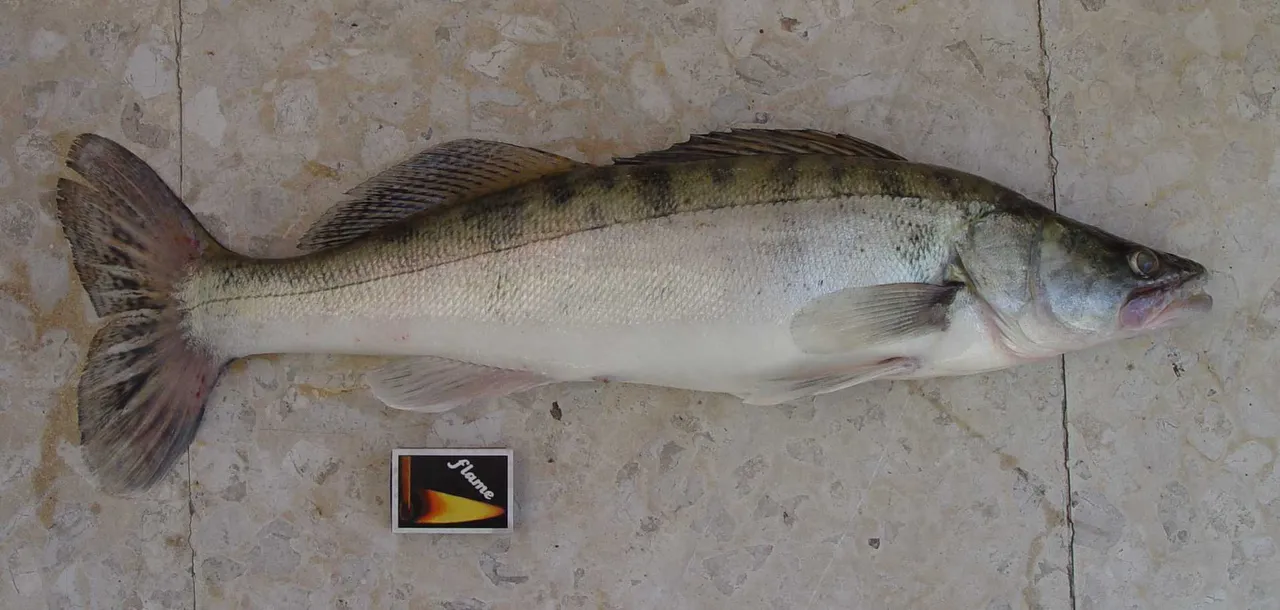
How this was identified, and who took it
Identified by: Full lateral view of a fresh fish. Spiny first dorsal with its rows of dark spots, the flank barring, the canine teeth and the pointed head are all legible. Third zander candidate reviewed; the first two were rejected.eLNuko — Public domain, via Wikimedia Commons — source, licenceWhat is known about how it feeds
Zander are low-light predators, and almost everything about how they feed follows from the eye. The retina carries a reflective tapetum lucidum — the layer that makes the eye glow in a torch beam — which multiplies the available light and gives the fish a hunting advantage in exactly the conditions where prey fish see worst: turbid water, deep water, dusk and dawn. They are pursuit predators rather than ambushers, working in loose groups over open bottom and driving prey shoals rather than waiting in cover. Prey is taken with long canine teeth that puncture and hold rather than cut, and zander swallow prey head-first after a brief hold. FishingHQ carries verified predation on roach, bleak and ruffe. The ruffe edge is the interesting one, because ruffe are themselves adapted to feeding in darkness and turbidity by the lateral line, so the two species are exploiting the same conditions from opposite ends of the relationship. Prey selection skews to slender-bodied fish, which is a gape consequence rather than a preference: the mouth is narrow relative to the fish's length compared with a pike's, so a deep-bodied bream of a given length is a harder proposition than a roach of the same length. Feeding activity is strongly tied to light level rather than to time of day as such, which is why bright clear conditions and heavy turbidity produce very different patterns in the same water.
The food
Prey with a verified dietary link to this fish. Each entry carries its own evidence, and each is written at the precision the source actually used: a named species where the source named one, a group or food category where it said “polychaetes”, “crustaceans” or “detritus” and meant it. That is why this list is shorter than the animal’s real diet rather than longer.
- Roach — Rutilus rutilus
Zander are specialist fish predators and small cyprinids dominate the diet wherever the two occur — which is why they are so effective in the turbid, cyprinid-rich waters they favour.
- Bleak — Alburnus alburnus
Bleak are a principal zander prey in the open water of European rivers and reservoirs, taken in low light where the zander's tapetum gives it an advantage.
- Ruffe — Gymnocephalus cernua
Ruffe appear consistently in zander diets, and both species are adapted to feeding in turbid water where sight-hunting predators do less well.
Food with no page of its own here yet
These are real components of the diet, listed as plain text because FishingHQ has no page for them yet. Inventing pages to make the list look fuller would be the fabrication this whole approach exists to prevent.
- other small shoaling cyprinids
- gobies, in waters where invasive gobies are established
- juvenile zander (cannibalism)
What anglers do with this
Everything below is interpretation, not finding. It is what experienced anglers conclude from the biology above, and the reasoning is usually sound and almost never tested. It is separated from the biology deliberately.
The tapetum is the fact anglers build most of their zander practice on, and the inference — fish the low-light margins of the day, or fish coloured water in daylight — is practitioner consensus with a clear biological rationale rather than a tested result. The slender-prey point is used to argue for slim baits and slim lures, again conventionally rather than experimentally. One handling consequence is not interpretation at all: the same light-gathering eye that makes the fish an effective low-light hunter makes it vulnerable to sudden bright light and to prolonged air exposure, and a zander unhooked under a head torch pointed directly at it is being treated carelessly.
What this does not establish
FishingHQ holds three verified prey edges for zander, which still understates the diet considerably. Regional variation is large, and in parts of the range invasive gobies now dominate a diet that historically did not include them at all. Nothing here supports a claim about what proportion of the diet any prey type forms in any particular water.
Where this connects
These are the baits, lures, methods and explainers FishingHQ already joins to this fish — which is why the list is sometimes short. They are not chosen for this page, and a link here means an evidenced relationship exists, not that it follows from the diet.
Lures recorded for this species
Methods used for it
Where it lives
This page covers feeding. The Zander record covers identification, lifecycle, seasonal behaviour, handling and the sources behind all of it.
Reviewed 2026-08-10.