What does wels catfish eat?
What is established about how wels catfish feeds, kept separate from what anglers infer from it.
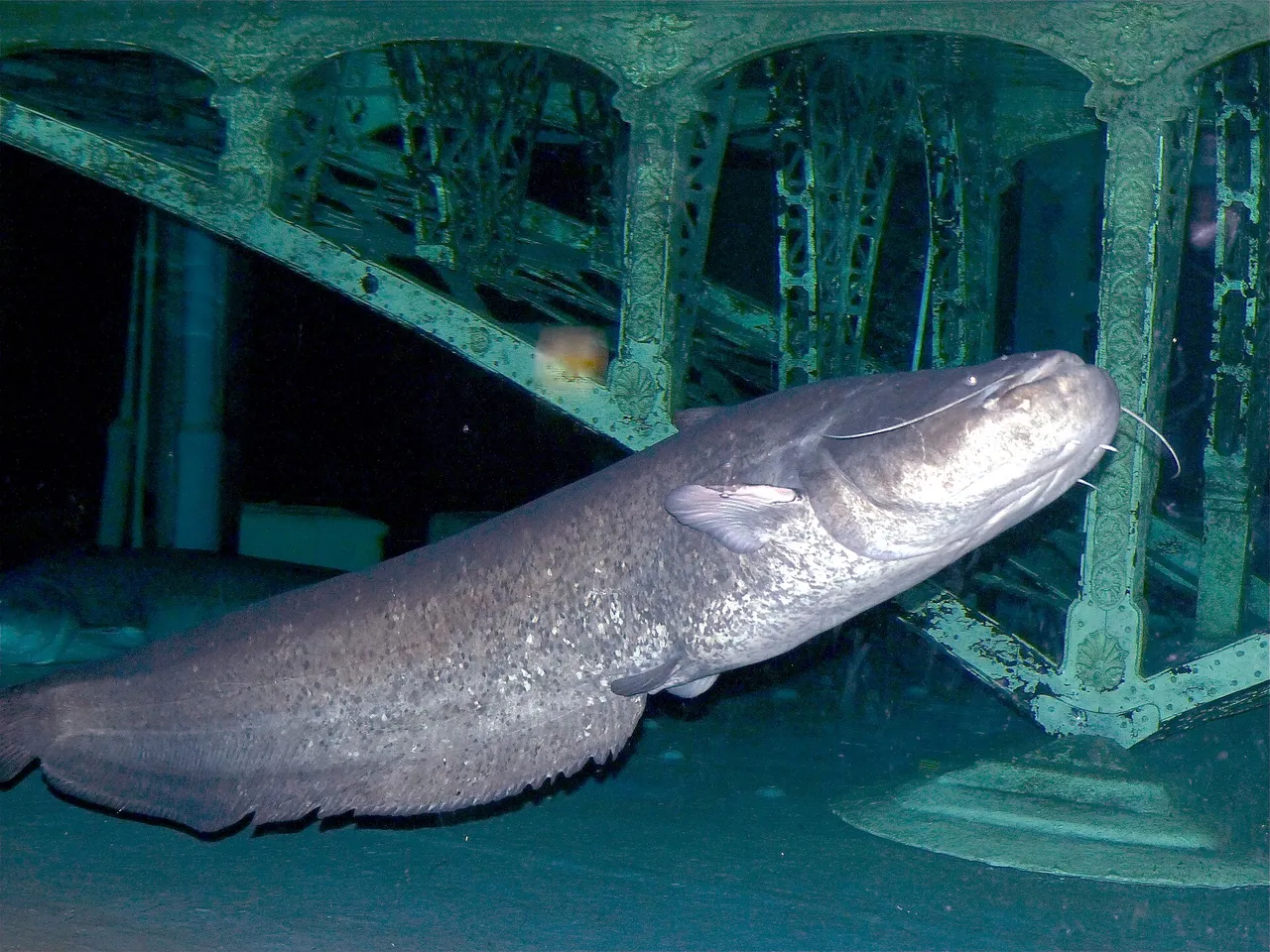
How this was identified, and who took it
Identified by: Broad flattened head with two very long maxillary barbels and shorter chin barbels, small eyes, mottled scaleless body and the extremely long anal fin running to the tail — the character that defines Silurus. Photographed in an aquarium; colour is green-shifted.Bernard DUPONT from FRANCE — CC BY-SA 2.0, via Wikimedia Commons — source, licenceWhat is known about how it feeds
The wels hunts by feel and by taste in water where nothing can see, and it takes prey that ought to be too large for it.
Chemoreception and mechanoreception dominate completely. The long barbels carry dense taste receptors, the lateral line is highly developed, and the fish locates prey in complete darkness and heavy colour without using vision at all. Feeding is largely nocturnal and largely by ambush from cover.
The two verified relationships are roach and bleak — the staple cyprinids of the European lowland waters the species occupies — and they are taken at night, located by scent and vibration rather than by sight.
What the relationships do not convey is the range of prey size. Wels take items very large relative to their own body, and the species is recorded taking amphibians, waterfowl and small mammals. That willingness is characteristic rather than exceptional, and it is the basis of the concern about the species' effect on native fish where it has been introduced outside its natural range.
Size itself is the other fact. The wels is the largest purely freshwater fish in Europe, it is long-lived, and a large individual sits above everything else in its water.
The surface-feeding behaviour anglers report — fish taking prey at the surface at night — follows from the bleak relationship: bleak shoal near the surface, and a predator that hunts by vibration does not need light to follow them there.
The food
Prey with a verified dietary link to this fish. Each entry carries its own evidence, and each is written at the precision the source actually used: a named species where the source named one, a group or food category where it said “polychaetes”, “crustaceans” or “detritus” and meant it. That is why this list is shorter than the animal’s real diet rather than longer.
- Roach — Rutilus rutilus
Roach and other cyprinids are the staple prey of wels across their European range, taken mainly at night and located by the barbels and lateral line rather than by sight.
- Bleak — Alburnus alburnus
Bleak shoaling near the surface at night are a regular item, which is one of the reasons wels are caught on surface-fished baits despite being bottom-associated animals.
Food with no page of its own here yet
These are real components of the diet, listed as plain text because FishingHQ has no page for them yet. Inventing pages to make the list look fuller would be the fabrication this whole approach exists to prevent.
- crayfish
- amphibians
- waterfowl, recorded
- small mammals, recorded
- juvenile wels (cannibalism)
- dead fish and carrion
What anglers do with this
Everything below is interpretation, not finding. It is what experienced anglers conclude from the biology above, and the reasoning is usually sound and almost never tested. It is separated from the biology deliberately.
The sensory profile is the reasoning behind fishing at night with offerings that produce scent and vibration rather than visual appeal, and it is convention with an unusually clear biological basis.
The surface-feeding behaviour underlies the use of surface presentations at night, which is counter-intuitive for a bottom-associated fish and follows directly from where the bleak are.
The handling consequences are not interpretation and they are substantial. A large wels is heavy enough that an unsupported lift causes internal damage, the mouth is abrasive rather than toothed, and the fish is strong enough to be dangerous to a careless angler on a bank.
The biosecurity position is separate again: wels have been introduced well outside their native range, the effect on native fish communities is a live concern, and moving live fish between waters is prohibited in most jurisdictions.
What this does not establish
Two relationships for an extreme opportunist whose recorded diet spans fish, crayfish, amphibians, birds and mammals. Neither establishes proportion, and the composition depends entirely on what the water holds. The account describes adult fish; juveniles feed on invertebrates and are not covered by these relationships.
Where this connects
These are the baits, lures, methods and explainers FishingHQ already joins to this fish — which is why the list is sometimes short. They are not chosen for this page, and a link here means an evidenced relationship exists, not that it follows from the diet.
Lures recorded for this species
Methods used for it
Where it lives
The science behind the feeding
This page covers feeding. The Wels catfish record covers identification, lifecycle, seasonal behaviour, handling and the sources behind all of it.
Reviewed 2026-08-12.