What does roach eat?
What is established about how roach feeds, kept separate from what anglers infer from it.
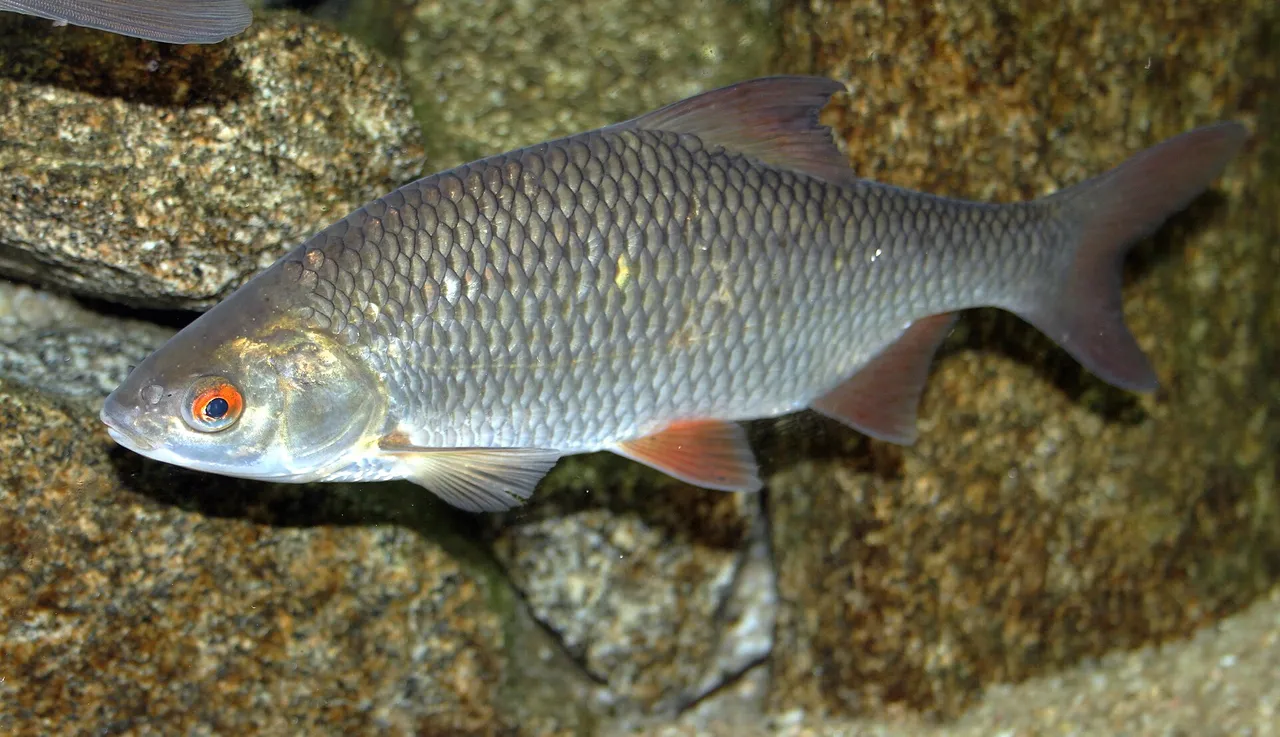
How this was identified, and who took it
Identified by: Red iris, and the dorsal fin origin sitting directly above the pelvic fin base. Both are the standard separation from rudd, which has a yellow iris and a dorsal set further back.Karelj, Public domain, via Wikimedia Commons — source, licenceWhat is known about how it feeds
Roach shoal by size, and that fact turns out to be a statement about diet.
A shoal of small roach and a shoal of large ones are feeding on different things in different parts of the water column: the small fish take zooplankton and small larvae higher up, the larger ones work insect larvae, molluscs and plant material on and near the bed. The species is omnivorous throughout, but what it is eating depends on which shoal it belongs to, and the shoals do not mix.
The single verified relationship is aquatic insect larvae, recorded at group level, and it is the most consistent animal component across sizes and waters.
Vision is good and the fish is notably easy to spook in clear shallow water, which sets the species apart from the bottom-rooting cyprinids it shares water with. Hearing through the Weberian apparatus is acute. Taste and smell matter for feeding but less than for a barbel or a tench.
The practical consequence of the size-shoaling is the useful part: catching small roach means being among small roach, and the response is to move or change approach rather than to wait for a large one to appear in the same group.
Roach also occupy the other side of FishingHQ's food web. They are the verified prey of pike, zander, perch and wels, which makes them one of the few species here with a diet page and a substantial presence on other species' diet pages.
The food
Prey with a verified dietary link to this fish. Each entry carries its own evidence, and each is written at the precision the source actually used: a named species where the source named one, a group or food category where it said “polychaetes”, “crustaceans” or “detritus” and meant it. That is why this list is shorter than the animal’s real diet rather than longer.
- Aquatic insect larvae as prey — a group rather than a species: the evidence names the group
Roach take insect larvae throughout their lives alongside plant material and, in older fish, molluscs, which makes them omnivores rather than the pure invertebrate feeders they are often described as.
Food with no page of its own here yet
These are real components of the diet, listed as plain text because FishingHQ has no page for them yet. Inventing pages to make the list look fuller would be the fabrication this whole approach exists to prevent.
- zooplankton, in smaller fish
- small snails
- filamentous algae
- plant material
- freshwater shrimp
What anglers do with this
Everything below is interpretation, not finding. It is what experienced anglers conclude from the biology above, and the reasoning is usually sound and almost never tested. It is separated from the biology deliberately.
The size-shoaling is the actionable fact and it converts into movement: an angler catching small fish consistently is in the wrong place for large ones, and the response is to relocate rather than to persist. That convention is held across European coarse angling and is a direct inference from the shoaling behaviour.
The visual sensitivity underlies the approach conventions for clear shallow water — fine presentation, careful approach — which is practitioner reasoning from a documented trait.
The species' position as prey is worth reading alongside its position as a catch: a water that produces large roach is usually a water where the predator population is not removing them at size, and anglers use that as a rough indicator.
What this does not establish
One group-level relationship for a genuine omnivore whose plant and zooplankton components are unrepresented. Diet composition differs between size classes to the point where a single description is misleading, and it varies with the productivity and clarity of the water. Nothing here establishes proportions.
Where this connects
These are the baits, lures, methods and explainers FishingHQ already joins to this fish — which is why the list is sometimes short. They are not chosen for this page, and a link here means an evidenced relationship exists, not that it follows from the diet.
Methods used for it
Where it lives
The science behind the feeding
This page covers feeding. The Roach record covers identification, lifecycle, seasonal behaviour, handling and the sources behind all of it.
Reviewed 2026-08-12.