How to identify yellowtail kingfish
Seriola lalandi · Carangidae
The characters that identify yellowtail kingfish, ranked by how far each one can be trusted on its own.
Safety: line under tension — can cause serious injury or death. One more point applies here.
How this was identified, and who took it
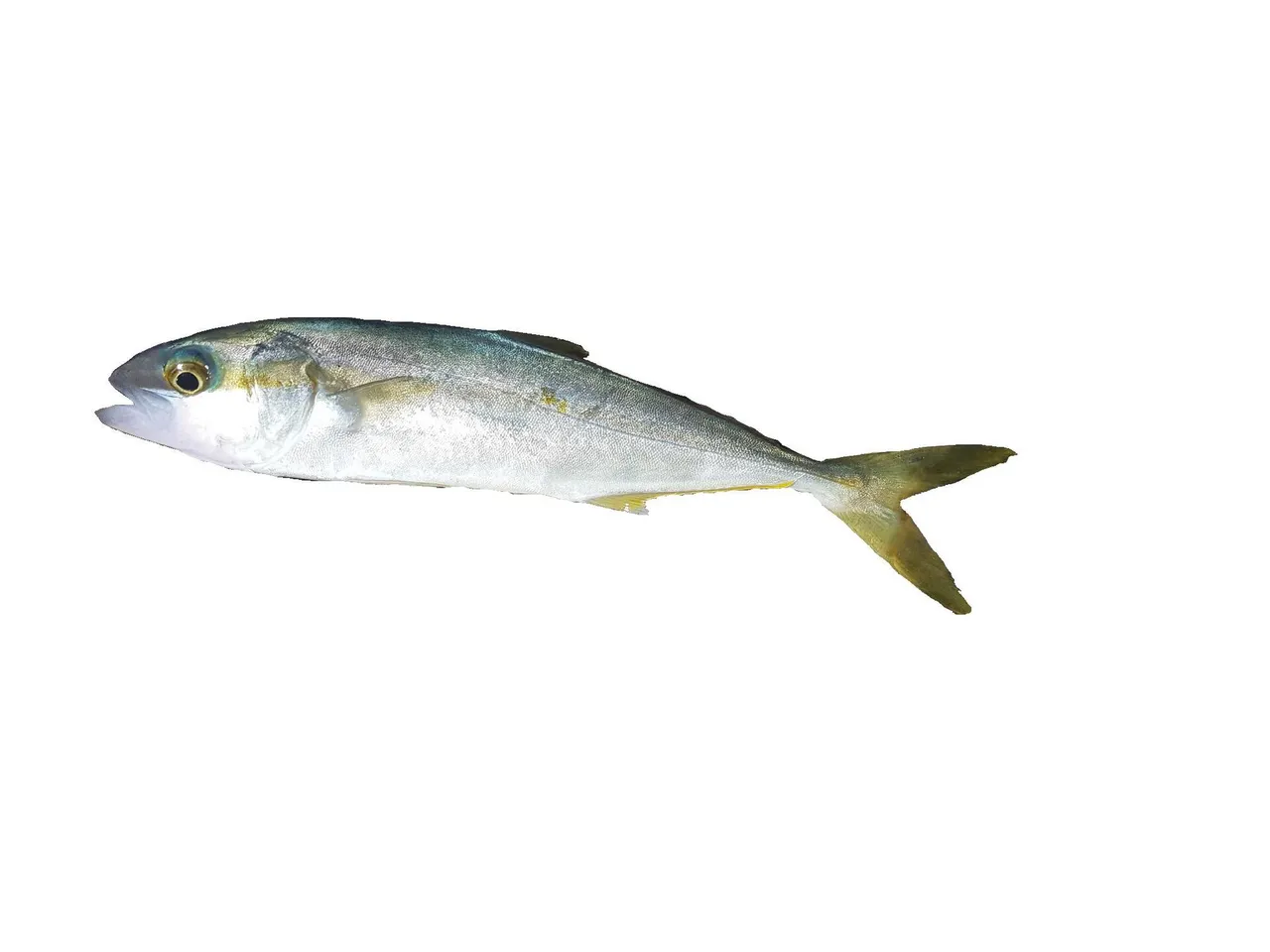
Identified by: Cut-out specimen photograph in full lateral view. Yellow caudal fin, brassy lateral band and the low soft dorsal are the characters that matter and all three are clear.Hugues Evano (IFREMER, Délégation océan Indien (DOI), Département Ressources Biologiques et Environnement (RBE), F-97420 Le Port, France) — CC BY 4.0, via Wikimedia Commons — source, licenceLook at this first
A brassy band runs the whole length of the flank from the eye to the tail, dividing the dark back from the pale belly along a clean line. Combined with a torpedo-shaped body and a deeply forked tail, it places the fish in Seriola before you look at anything else.
No single character settles this one. Everything below is supporting or suggestive, and a confident identification needs several of them together — or, for the hardest cases, a count that cannot be made from a photograph.
Supporting — use with other characters
Real characters that are not conclusive by themselves. Use two or three together.
A flank band running eye to tail
The band sits at mid-flank and continues unbroken to the tail wrist. Its position matters more than its colour: a greater amberjack's is less continuous and sits differently against the lateral line.
Where the eye band stops
A dark diagonal runs through the eye but does not carry on to the origin of the first dorsal the way a greater amberjack's does. Reading the two bands together, rather than either alone, is what separates the two species.
A long low second dorsal
The soft dorsal runs a long way back at low height without the pronounced front lobe of a greater amberjack. Distinctive in profile, and preserved in almost any side-on photograph.
Streamlined build
More slender than a trevally of the same length, with a fine tail wrist and no keeled scutes along the lateral line. The absence of scutes is the quickest way to rule out the jacks entirely.
Suggestive only — varies with condition
Hints only. These vary with condition, season, water and how long the fish has been out of it, and a fish that contradicts them is still the same species.
Yellow in the tail and finlets
Bright on a live fish and the origin of the name. It dulls quickly after death and several congeners show the same thing, so it belongs at the bottom of this page rather than the top.
What it gets confused with
- Greater amberjack, the main confusion. Read the eye band and where it terminates.
- Japanese amberjack, which overlaps in the north-west Pacific and is separated on fin proportion.
- Samson fish in Australian waters, which has much longer pectoral fins and a heavier head.
Side by side: Yellowtail kingfish vs Greater amberjack.
Where this stops working
The species has been split and re-split — populations formerly treated as one widespread Seriola lalandi are now recognised as more than one species across the Pacific and southern hemisphere — so a confident field identification may still be a taxonomically unsettled fish. This page has no diagnostic character for that reason. Juveniles of the genus carry banding that adults lose and are harder than adults.
The full record
This page covers identification only. The Yellowtail kingfish record covers behaviour, lifecycle, distribution, handling and the sources behind all of it.
Reviewed 2026-08-14.
More about this fish
Telling it apart is one question. Here are the others.
Similar and related fish
- Greater amberjackCongeners in Seriola, both structure-oriented and both diving hard for cover when hooked. Separated by the angle of the eye band and body proportion rather than by colour.
- Japanese amberjackCongeners separated by range and fin-ray counts rather than by any obvious field character.
- Pacific sardineSardines are taken heavily where the shoals occur, and kingfish concentrations frequently coincide with sardine movements along the coast.
- Yellowtail scadYellowtail scad are a principal prey of kingfish in Australian and New Zealand waters, which is the ecological basis of the live-bait fishery that dominates kingfish angling there.
How it is caught
- JiggingOne of the few species reachable by nearly every sea method here — jigged over pinnacles, live-baited on reef, trolled, cast to from rock and speared in the shallows.
- Kayak fishingKayak fishing for kingfish is well established in Australia and New Zealand, and it is the clearest example of the platform's limits mattering: a fish that runs hard and deep is being fought from something it can tow.
- Livebaiting at seaNotoriously fussy: a kingfish will follow and refuse a lure repeatedly and take a live bait without hesitation, which is a sight-based evaluation happening at close range.
Where it lives
Where you will find it
Why the 9 connections on this page are here, and the sources
Similar and related fish
Backed by research — 4 connections
Supported by peer-reviewed research or fisheries science. The sources are listed and can be checked.
Greater amberjack
A taxonomic and identification comparison naming both binomials.
- FishBase: a global information system on fishes — Froese, R. and D. Pauly, eds. — FishBase Consortium (Scientific institute)Relied on for: That Seriola dumerili and Seriola lalandi are congeners in the genus Seriola associated with deep reef, wreck and rocky habitat.States this directlyPassage read and verified
Japanese amberjack
An identification comparison naming both binomials: Seriola quinqueradiata and Seriola lalandi.
- FishBase: a global information system on fishes — Froese, R. and D. Pauly, eds. — FishBase Consortium (Scientific institute)Relied on for: Morphological and distributional data for Seriola quinqueradiata and for Seriola lalandi.States this directlyPassage read and verified
- The IUCN Red List of Threatened Species — International Union for Conservation of Nature (Conservation authority)Relied on for: Separate assessments treating Seriola quinqueradiata and Seriola lalandi as distinct species.States this directlyCitation checked — the work exists and is described correctly
Pacific sardine
Recorded diet evidence identifies Sardinops sagax as a food item of this predator at species level. The edge is written at that granularity and no further.
- FishBase: a global information system on fishes — Froese, R. and D. Pauly, eds. — FishBase Consortium (Scientific institute)Relied on for: Food items recorded for this predator, including Sardinops sagax.States this directlyPassage read and verified
- FAO Species Identification Guides for Fishery Purposes and the FAO Species Catalogues — Food and Agriculture Organization of the United Nations (Scientific institute)Relied on for: Species account describing the diet of this predator in the region where Sardinops sagax occurs.Background and mechanism onlyCitation checked — the work exists and is described correctly
Yellowtail scad
Recorded diet evidence identifies Trachurus novaezelandiae as a food item of this predator at species level. The edge is written at that granularity and no further.
- FishBase: a global information system on fishes — Froese, R. and D. Pauly, eds. — FishBase Consortium (Scientific institute)Relied on for: Food items recorded for this predator, including Trachurus novaezelandiae.States this directlyPassage read and verified
- FAO Species Identification Guides for Fishery Purposes and the FAO Species Catalogues — Food and Agriculture Organization of the United Nations (Scientific institute)Relied on for: Species account describing the diet of this predator in the region where Trachurus novaezelandiae occurs.Background and mechanism onlyCitation checked — the work exists and is described correctly
How it is caught
What experienced anglers do — 3 connections
Widely and independently recommended by experienced anglers and specialist sources. This is real angling knowledge, not proof: controlled evidence for it is limited, and FishingHQ records it as convention rather than as a demonstrated effect.
Jigging
A practitioner claim about a species that genuinely spans the methods.
- Sea Angler — Bauer Media (Specialist angling publication)Relied on for: Practitioner treatment of vertical jigging for reef and pinnacle predators.Citation checked — the work exists and is described correctly
- IGFA International Angling Rules and World Record Requirements — International Game Fish Association (Angling or fisheries organisation)Relied on for: The tackle classes used for large marine predators fished vertically and on the troll.Passage read and verified
Kayak fishing
Established angling practice for this species, recorded as convention. The note states the property of the animal or its water that makes the method the answer.
- IGFA International Angling Rules and World Record Requirements — International Game Fish Association (Angling or fisheries organisation)Relied on for: Recognition of the species as an established sport fish and the angling methods and tackle classes conventionally used for it.States this directlyPassage read and verified
- General angling website restatements of established technique — Various (Credible secondary source)Relied on for: Widely restated practice connecting this species and method.Background and mechanism onlyCitation checked — the work exists and is described correctly
Livebaiting at sea
A practitioner claim about why live bait is generally reported to be more effective than lures for this species, labelled as convention because no controlled comparison supports it.
- Sea Angler — Bauer Media (Specialist angling publication)Relied on for: Practitioner treatment of live bait presentation for reef and pinnacle predators.Citation checked — the work exists and is described correctly
- General angling website restatements of established technique — Various (Credible secondary source)Relied on for: Widely restated practitioner accounts of kingfish refusing artificial lures and taking live baits.Citation checked — the work exists and is described correctly
Where it lives
Backed by research — 1 connection
Supported by peer-reviewed research or fisheries science. The sources are listed and can be checked.
Kelp forest
A habitat claim held to a scientific standard.
- FishBase: a global information system on fishes — Froese, R. and D. Pauly, eds. — FishBase Consortium (Scientific institute)Relied on for: That Seriola lalandi is found in coastal and oceanic waters off kelp beds and rocky areas at depths from 3 to 825 m in water of 18 to 24 degrees.States this directlyPassage read and verified
Where you will find it
Backed by research — 1 connection
Supported by peer-reviewed research or fisheries science. The sources are listed and can be checked.
New Zealand
A distribution claim held to a scientific standard.
- FishBase: a global information system on fishes — Froese, R. and D. Pauly, eds. — FishBase Consortium (Scientific institute)Relied on for: That Seriola lalandi is circumglobal in subtropical waters including South Africa, Japan, Australia, New Zealand and Hawaii and from British Columbia to Chile.States this directlyPassage read and verified
Safety
Line under tension — Can cause serious injury or death
Heavy tackle with locked drags fishing tight to structure. When something parts under that load — leader, knot, split ring — it returns toward the angler at speed, and a hand in the line path during a run is seriously injured.
What reduces it: Keep hands clear of running line and of the leader while a fish is on. Nobody stands in line with a loaded rod. Gloves for leader work. Inspect connections regularly and replace rather than hoping.
Cliffs and rock platforms — Can cause serious injury or death
Much of the shore fishery for this species is from ocean rock platforms, where anglers are swept off by unexpected swell while connected to a hard-pulling fish.
What reduces it: Never fish rock platforms alone. Watch a mark for a full set cycle before going onto it. Wear a lifejacket — mandatory in some jurisdictions for exactly this fishing. Plan the escape route first and never turn your back on the sea.