How to identify gag grouper
Mycteroperca microlepis · Epinephelidae
The characters that identify gag grouper, ranked by how far each one can be trusted on its own.
Safety: barotrauma and pressure injury — can cause serious injury or death. One more point applies here.
How this was identified, and who took it
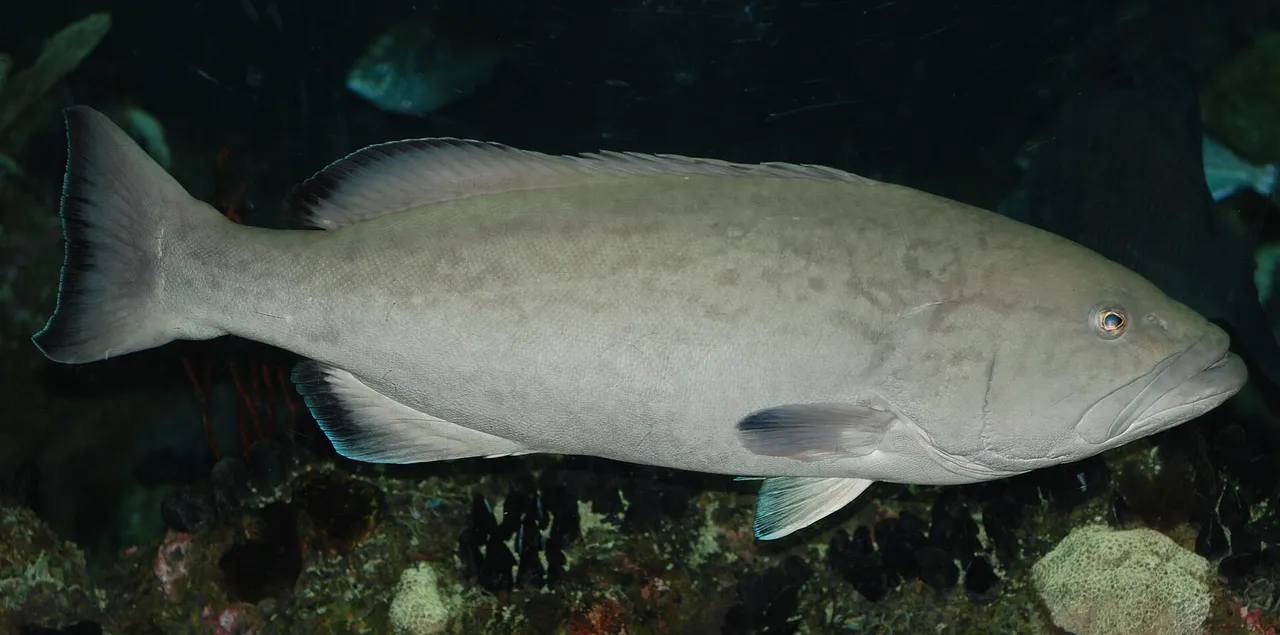
Identified by: Complete lateral view, sharp, with the whole fish in frame. The elongate Mycteroperca body form, the faint darker marbling over a pale grey-brown ground, the dark margins to the soft dorsal, anal and caudal fins and the projecting lower jaw are all visible. Photographed in an aquarium rather than in the wild, which is recorded in the caption.Jarek Tuszyński — CC BY 4.0, via Wikimedia Commons — source, licenceLook at this first
Check the trailing edge of the tail. A gag's is slightly concave with the outer rays drawn out, so the edge reads as notched rather than straight — and that is the separation from black grouper, which is the only fish it is seriously confused with.
No single character settles this one. Everything below is supporting or suggestive, and a confident identification needs several of them together — or, for the hardest cases, a count that cannot be made from a photograph.
Supporting — use with other characters
Real characters that are not conclusive by themselves. Use two or three together.
A notched trailing edge to the tail
The rear margin of the tail is faintly concave and the outer rays extend beyond it. A black grouper's tail edge is squarer. It is a subtle character and it is the most reliable one available, which says something about the pair.
Worm-like or boxy markings on the flank
Darker marks arranged in irregular vermiculate or rectangular shapes, clearest on smaller fish and fading with size. Black grouper carries markings closer to a regular chain of rectangles, which is a real difference and a hard one to use.
A comparatively slim build
More elongate and less heavy-set than most Epinephelus of the same length. It is one of the quicker ways to tell a Mycteroperca from an Epinephelus without going to fin counts.
Suggestive only — varies with condition
Hints only. These vary with condition, season, water and how long the fish has been out of it, and a fish that contradicts them is still the same species.
Blue-white edging on the anal and tail fins
Frequently present and frequently absent, and it dulls quickly once the fish is out of the water. Worth noting on a live fish and worth nothing on a photograph taken on a deck.
What it gets confused with
- Black grouper, the only serious confusion and one that catches out experienced anglers regularly.
- Scamp, which is smaller with much more pronounced trailing rays on the tail.
- Yellowmouth grouper, separated by the yellow at the corner of the mouth.
Side by side: Gag grouper vs Dusky grouper, Gag grouper vs Atlantic goliath grouper.
Where this stops working
Gag and black grouper are close enough that the separation rests on fin margin shape and marking pattern, both of which vary within each species — and identification carries real consequence here, because the two are managed under different rules across much of the range. Fish brought up from reef depth suffer severe barotrauma and cannot return unaided, and the largest fish are the males, which is a demographic argument for getting the decision right before a fish is on the deck.
The full record
This page covers identification only. The Gag grouper record covers behaviour, lifecycle, distribution, handling and the sources behind all of it.
Reviewed 2026-08-14.
More about this fish
Telling it apart is one question. Here are the others.
Similar and related fish
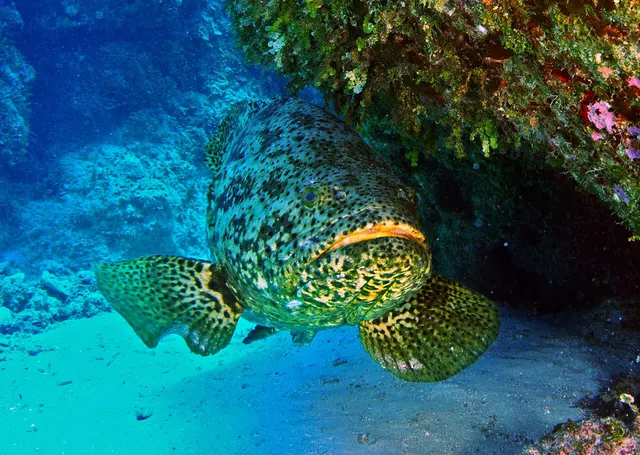 Atlantic goliath grouperGroupers of the same structure separated by size, tail shape and spotting.
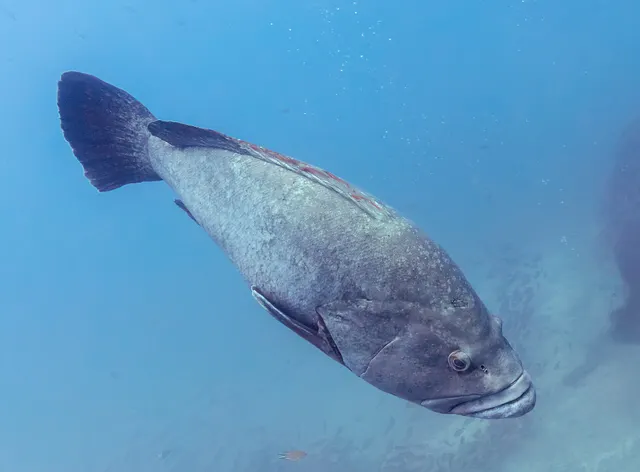 Dusky grouperBoth are protogynous groupers whose entire male population comes from sex-changed females, which is why size-selective fishing removes males specifically in both.
- Scaled sardineSmall clupeids are a principal fish prey for gag over inshore and nearshore structure.
How it is caught
Where you will find it
- FloridaUses estuarine seagrass as a juvenile nursery before moving offshore to ledges and reef as an adult, which links the offshore fishery to inshore habitat condition.
- The Gulf of MexicoUses inshore seagrass as a nursery and offshore hard bottom as adult and spawning habitat, aggregating on known offshore sites.
Why the 7 connections on this page are here, and the sources
Similar and related fish
Backed by research — 3 connections
Supported by peer-reviewed research or fisheries science. The sources are listed and can be checked.
Atlantic goliath grouper
An identification comparison naming both binomials: Epinephelus itajara and Mycteroperca microlepis.
- FishBase: a global information system on fishes — Froese, R. and D. Pauly, eds. — FishBase Consortium (Scientific institute)Relied on for: Morphological and distributional data for Epinephelus itajara and for Mycteroperca microlepis.States this directlyPassage read and verified
- The IUCN Red List of Threatened Species — International Union for Conservation of Nature (Conservation authority)Relied on for: Separate assessments treating Epinephelus itajara and Mycteroperca microlepis as distinct species.States this directlyCitation checked — the work exists and is described correctly
Dusky grouper
A comparison resting on shared reproductive biology, naming both binomials, and the basis of the demographic argument on both records.
- FishBase: a global information system on fishes — Froese, R. and D. Pauly, eds. — FishBase Consortium (Scientific institute)Relied on for: That Mycteroperca microlepis and Epinephelus marginatus are both protogynous hermaphrodites in which individuals mature as female and change sex to male with size and age.States this directlyPassage read and verified
Scaled sardine
Recorded diet evidence identifies Harengula jaguana as a food item of this predator at species level. The edge is written at that granularity and no further.
- FishBase: a global information system on fishes — Froese, R. and D. Pauly, eds. — FishBase Consortium (Scientific institute)Relied on for: Food items recorded for this predator, including Harengula jaguana.States this directlyPassage read and verified
- FAO Species Identification Guides for Fishery Purposes and the FAO Species Catalogues — Food and Agriculture Organization of the United Nations (Scientific institute)Relied on for: Species account describing the diet of this predator in the region where Harengula jaguana occurs.Background and mechanism onlyCitation checked — the work exists and is described correctly
How it is caught
What experienced anglers do — 2 connections
Widely and independently recommended by experienced anglers and specialist sources. This is real angling knowledge, not proof: controlled evidence for it is limited, and FishingHQ records it as convention rather than as a demonstrated effect.
Jigging
The page names jigs as the second technique. It matters separately because area closures protecting spawning aggregations apply to the fishery rather than to the bait.
- Florida saltwater fishing regulations and Keys sanctuary rules — Florida state wildlife authority and the Florida Keys National Marine Sanctuary (Government fisheries body)Relied on for: Documents which fishery and which technique takes this species.States this directlyCitation checked — the work exists and is described correctly
- General angling website restatements of established technique — Various (Credible secondary source)Relied on for: Independently corroborates the species' recreational capture and range.Background and mechanism onlyCitation checked — the work exists and is described correctly
Livebaiting at sea
The page names live and dead bait over structure. A grouper takes a live bait and runs for the reef, and that first run is what the tackle in this fishery is chosen for.
- Florida saltwater fishing regulations and Keys sanctuary rules — Florida state wildlife authority and the Florida Keys National Marine Sanctuary (Government fisheries body)Relied on for: Documents which fishery and which technique takes this species.States this directlyCitation checked — the work exists and is described correctly
- General angling website restatements of established technique — Various (Credible secondary source)Relied on for: Independently corroborates the species' recreational capture and range.Background and mechanism onlyCitation checked — the work exists and is described correctly
Where you will find it
Backed by research — 2 connections
Supported by peer-reviewed research or fisheries science. The sources are listed and can be checked.
Florida
A distribution association between an animal and a kind of water, rather than a claim about any named mark.
- NOAA National Ocean Service education on estuaries and the National Estuarine Research Reserve System — National Oceanic and Atmospheric Administration, United States (Government fisheries body)Relied on for: Estuarine, seagrass and coastal habitat function in North American waters, and the nursery role of shallow habitat for the species concerned.Background and mechanism onlyCitation checked — the work exists and is described correctly
- FishBase: a global information system on fishes — Froese, R. and D. Pauly, eds. — FishBase Consortium (Scientific institute)Relied on for: Distribution, habitat association, depth range and life history recorded for the species.States this directlyPassage read and verified
The Gulf of Mexico
A distribution association between an animal and a kind of water, rather than a claim about any named mark.
- FishBase: a global information system on fishes — Froese, R. and D. Pauly, eds. — FishBase Consortium (Scientific institute)Relied on for: Distribution, habitat association and depth range recorded for the species, including its occurrence in the water body concerned.States this directlyPassage read and verified
- The IUCN Red List of Threatened Species — International Union for Conservation of Nature (Conservation authority)Relied on for: Assessment and range account for the species, including the systems and coasts it occupies.Background and mechanism onlyCitation checked — the work exists and is described correctly
Safety
Barotrauma and pressure injury is set out at the top of this page, where it cannot be missed.
Injury while handling fish — Can cause injury needing treatment
Sharp gill covers and strong jaws on a heavy fish handled quickly on a moving deck.
What reduces it: Support the body, keep fingers clear of the gill plates and the mouth, and use long pliers or a de-hooking tool.