Blue mussel
Fish · Last reviewed 2026-08-12
The commonest gathered shellfish on Atlantic European shores, attached to rock by threads it spins itself, and an animal whose safety is decided entirely by the water it grew in.
Safety: encounters with marine life — can cause serious injury or death. 5 more points apply here.
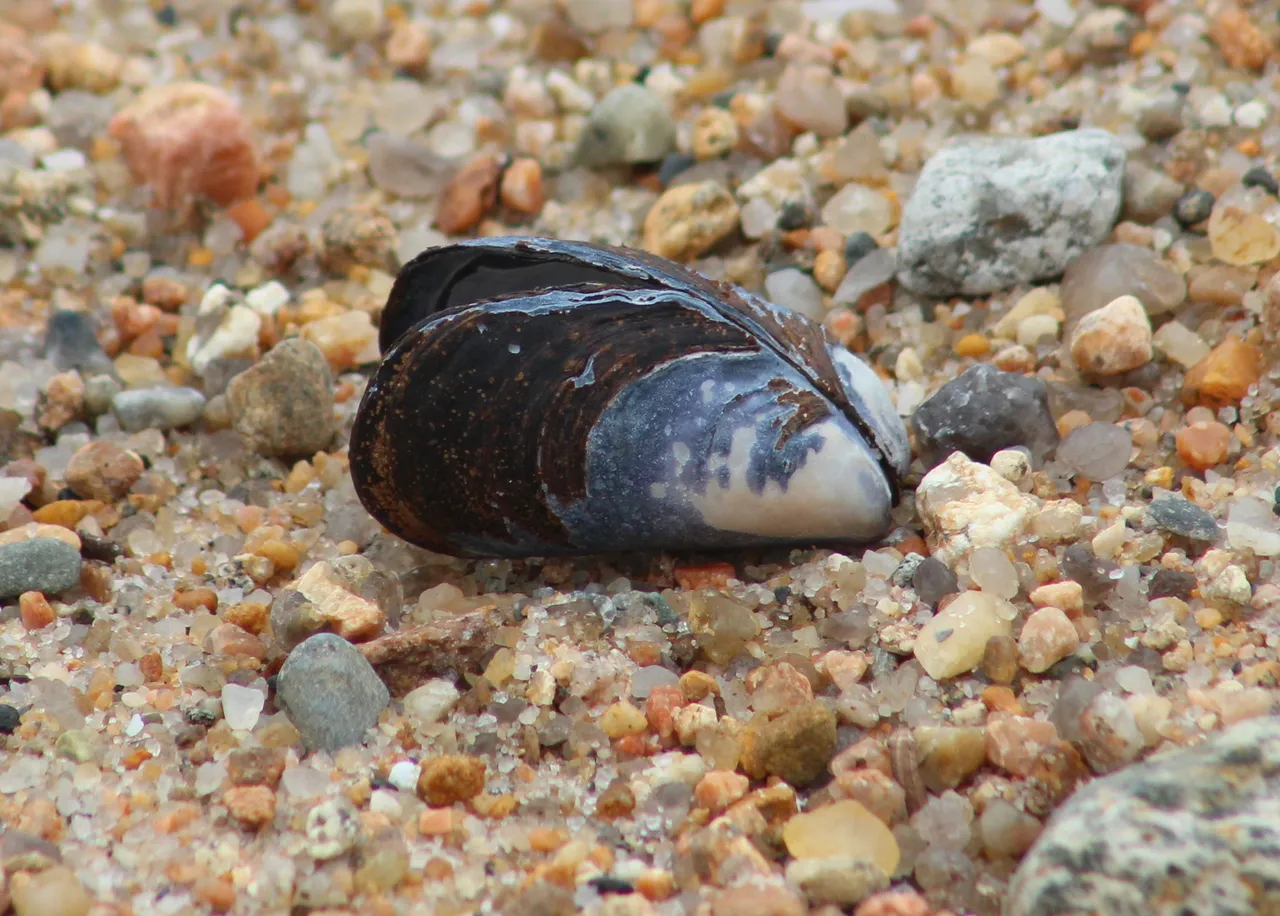
How this was identified, and who took it
Identified by: Shell characters read directly: the wedge or teardrop outline with the hinge at the narrow pointed end, a surface that is smooth and glossy rather than ribbed, the blue-black to brown-black periostracum with a paler worn band, and nacreous violet-white visible where the valves gape.Steven Lamonde — CC BY, via iNaturalist — source, licenceCatching Blue mussel
Everything here on fishing for it. Each entry opens the page behind it.
- Where
- 1 place FishingHQ documents — strongest claim anywhere: recorded here · From the shore
Blue mussels are the dark, wedge-shaped bivalves that carpet rock, pier legs, groynes and harbour walls between the tides across the whole north Atlantic. They attach with byssal threads — tough protein filaments the animal secretes and can release and respin to move slowly — and they live in dense beds because settling next to other mussels is safer than settling alone.
They are the easiest shellfish to gather and the one most likely to be gathered carelessly. A mussel pumps many litres of seawater a day across its gills, retaining what is suspended in it, which is what makes it an excellent indicator of water quality and a poor thing to pick without knowing what that quality is.
For an angler they are also bait — mussel is a long-established sea bait, soft and difficult to keep on a hook, and traditionally bound with elastic. FishingHQ held that use as part of `crab-and-shellfish-bait` and held nothing about the animal itself.
How it is caught
Where Blue mussel is documented
Places where public sources describe this species as fished, with how it is fished and how strongly the evidence supports it. This is not a range map and it is not a recommendation — it is what has been written down about a fishery rather than a record of any individual catch, and being listed is never permission to fish.
What these strengths mean
- Recorded here
- At least one credible public account of this species being caught here. That is all it means.
Identification
- Scientific name
- Mytilus edulis
- Family
- Mytilidae
- Water
- Saltwater, Brackish
- Conservation status
- Not assessed
- Regions
- Britain & Ireland, Northern Europe, Western Europe, North America, Arctic & Subarctic
- A wedge or teardrop-shaped shell, roughly triangular, with the hinge at the narrow pointed end.
- Blue-black to brown-black outside, sometimes with radiating brown bands; smooth and shiny rather than ribbed.
- Nacreous violet-white inside.
- Attached to hard surfaces by a bundle of tough brown byssal threads — the beard, which is removed before cooking.
- Occurs in dense beds. A single isolated mussel on open rock is unusual.
Size
- Typical
- 4–6 cm shell length on exposed shores.
- Large
- Over 8 cm.
Exceptional: Shell lengths approaching 12 cm are recorded in sheltered, food-rich and rarely exposed conditions. Growth is highly variable with exposure and food supply rather than with age alone.
Gathering mussels: what to check before you touch them, and what no test tells you
This is the only handling section in FishingHQ where the animal cannot hurt you and the section is still mostly about safety.
A mussel pumps many litres of seawater a day and keeps what is suspended in it. That makes it an excellent monitor of water quality and a poor thing to gather without knowing what that quality is, because two categories of contaminant accumulate and neither is detectable by anybody standing on a beach.
ALGAL BIOTOXINS come from microalgae that bloom seasonally and unpredictably. The mussel is unharmed; the person eating it may not be. Paralytic shellfish poisoning can kill an adult, and the toxins are heat-stable — cooking, freezing, smoking, salting and pickling all leave them intact.
MICROBIOLOGICAL CONTAMINATION comes from sewage and agricultural run-off, and the same filtering concentrates bacteria and viruses.
AND NOTHING YOU CAN OBSERVE DETECTS EITHER. Contaminated mussels look, smell and taste normal. The water may be clear. The bed may have been safe last month.
SO THE ONLY REAL CONTROL IS THE ONE YOU DO BEFORE LEAVING THE HOUSE: establish the current classification and closure status of the ground with the relevant food safety or environmental health authority, which in most countries is a different body from the fisheries authority. Treat unclassified or unmonitored ground as unknown rather than as safe.
THE FOLK TESTS ARE ALL WORTHLESS AGAINST THIS. The R-in-the-month rule predates refrigeration and toxin monitoring and describes spawning condition rather than contamination — harmful blooms occur in months with an R in them. A silver spoon detects nothing. And the best-known rule of all, discard the ones that do not open on cooking, tests whether the animal was alive and says nothing whatever about toxins. Every one of those is worth naming explicitly, because they are repeated constantly and they sound like knowledge.
THE GATHERING ITSELF is simple and deserves restraint. Cut the byssal threads rather than tearing the animal off, take from beds submerged at most tides rather than the top of the shore, take a scatter across a bed rather than clearing a patch, leave the small ones, and replace any rock you turn.
KEEPING THEM: cool, damp and unsealed. A closed bag suffocates them. Discard broken shells and any that stay open when tapped, because those are dead — which is a spoilage judgement, not a safety one.
Backed by research — why, and the sources (2)
Supported by peer-reviewed research or fisheries science. The sources are listed and can be checked.
- FishBase: a global information system on fishes — Froese, R. and D. Pauly, eds. — FishBase Consortium (Scientific institute)Relied on for: Morphology, growth, moult and reproductive biology underlying the handling described, with SeaLifeBase as its sister database for non-finfish taxa.States this directlyPassage read and verified
- Fish and Fishery Products Hazards and Controls Guidance — US Food and Drug Administration, Center for Food Safety and Applied Nutrition, 2022 (Standards body)Relied on for: That bivalve molluscs accumulate biotoxins and microbiological contamination from the growing water, that these are not destroyed by cooking, and that control is by classification and testing of harvesting areas.States this directlyPassage read and verified
Spent after spawning, and the folklore that confuses condition with safety
Blue mussel reproduction is simple and it is the source of one of the most persistent and most misunderstood pieces of seafood folklore, which this section exists to take apart.
THE REPRODUCTION FIRST. Sexes are separate, and eggs and sperm are released directly into the water column — chiefly in spring and early summer, with the timing driven by temperature. Fertilisation is external and effectively a numbers game: gametes must meet by chance in open water, which is why the quantities released are enormous and why spawning within a bed is synchronised. The resulting larvae drift for a period before settling and attaching.
SPAWNING LEAVES THE ANIMAL SPENT. A mussel builds gonad tissue through the preceding months — that tissue is a substantial fraction of what is inside the shell and a substantial fraction of what a person eats — and releases it. What is left afterwards is thin, watery and poor. A mussel in early spring, full of gonad, is a plump good one. The same mussel weeks later is not.
AND THAT OBSERVATION IS WHERE THE OLD SEASONAL RULE COMES FROM. The traditional advice to avoid shellfish in months without an R in them tracks a real pattern — warm-season mussels are frequently spent and disappointing — and it has been passed down as though it were a safety rule. It is not, and the confusion is worth breaking because it is dangerous in both directions.
THE ACTUAL SAFETY QUESTIONS ARE UNRELATED TO THE MONTH. They are: whether the water the mussels grew in is sanitarily classified, since filter feeders concentrate whatever is in the water including sewage-derived pathogens; and whether harmful algal blooms are present, since biotoxins that cause paralytic, diarrhetic and amnesic shellfish poisoning accumulate in the flesh, are not destroyed by cooking, and cannot be detected by looking, smelling or tasting. Blooms are monitored by authorities, they occur when they occur rather than on a calendar, and a month with an R in it offers no protection from either problem.
So: the season is a QUALITY guide, monitored classification and biotoxin advice are the SAFETY answer, and treating the first as the second is exactly the mistake to avoid.
Official guidance — why, and the sources (3)
Stated by a fisheries authority, scientific institute or recognised angling body. Authoritative, but summarising rather than demonstrating.
- FishBase: a global information system on fishes — Froese, R. and D. Pauly, eds. — FishBase Consortium (Scientific institute)Relied on for: Reproductive mode, spawning season, larval development and condition cycle recorded for the species.States this directlyPassage read and verified
- Good Fish Guide — Marine Conservation Society (Conservation authority)Relied on for: Stock and method assessment for commercially and recreationally taken shellfish, and the conservation measures applied to them.Background and mechanism onlyCitation checked — the work exists and is described correctly
- Fish and Fishery Products Hazards and Controls Guidance — US Food and Drug Administration, Center for Food Safety and Applied Nutrition, 2022 (Standards body)Relied on for: That bivalve molluscs concentrate pathogens and algal biotoxins, that biotoxins are not destroyed by cooking and cannot be detected organoleptically, and that harvest area classification and biotoxin monitoring are the controls.States this directlyPassage read and verified
Shell length, shore position, and why the biggest mussels grow where the sea is kindest
Mussel size is a direct readout of where the animal has been living, and for a gatherer it is the most useful thing about it.
THE MEASUREMENT IS SHELL LENGTH — the longest axis of the shell, from the pointed umbo to the broad rear margin. That is the measurement any minimum size is expressed in, and it is the one to take. It is also the measurement most easily got wrong by eye, because a mussel bed is a jumble of overlapping shells and individual animals are hard to isolate without prising them off.
GROWTH IS SET BY IMMERSION TIME AND BY FOOD, AND BOTH VARY ACROSS A FEW METRES OF SHORE. A mussel is a filter feeder: it can only grow while it is under water with the siphons open. High on the shore, where the bed is exposed for most of the tidal cycle, mussels feed for a few hours a day and stay small — dense beds of small, thick-shelled animals. Low on the shore or fully submerged, feeding time is far longer and the same species reaches several times the size. That is why the largest mussels come from sheltered, food-rich, rarely-exposed positions, which is exactly what this page's exceptional note says.
EXPOSURE ALSO CHANGES THE SHAPE, NOT ONLY THE SIZE. Mussels on wave-hammered open coast are smaller, thicker-shelled and more strongly attached; sheltered-water animals are longer, thinner-shelled and meatier. A gatherer comparing two shores is comparing two growth regimes rather than two populations of different quality.
AGE IS NOT READABLE FROM SIZE HERE. Because growth depends so heavily on position, two mussels of identical size can differ substantially in age, and a small high-shore mussel may be older than a large low-shore one. Shell rings are not a reliable annual count in all populations. This page grades the exceptional figure as unknown-confidence for exactly that reason.
AND THE SIZE QUESTION IS NOT THE SAFETY QUESTION. A large mussel from a closed or unclassified area is not safer than a small one; biotoxin and microbiological risk are properties of the water, not of the animal's dimensions, and nothing about size, appearance or smell indicates them. Whether a bed may be gathered from at all is a matter for the local competent authority.
Official guidance — why, and the sources (2)
Stated by a fisheries authority, scientific institute or recognised angling body. Authoritative, but summarising rather than demonstrating.
- Good Fish Guide — Marine Conservation Society (Conservation authority)Relied on for: Assessment of the stock and the fishery, including growth rate, the size at which the animal is taken, and the sustainability implications of removing large individuals.Background and mechanism onlyCitation checked — the work exists and is described correctly
- FishBase: a global information system on fishes — Froese, R. and D. Pauly, eds. — FishBase Consortium (Scientific institute)Relied on for: Recorded maximum size and growth information for the species.Background and mechanism onlyPassage read and verified
A fixed animal on a moving shore: why the height of the bed explains everything
A mussel cannot move, so everything about its life is decided by where its larva happened to settle — and the vertical distance between two mussels a metre apart on the same rock can matter more than a hundred miles of coastline.
THE HABITAT IS THE INTERTIDAL AND SHALLOW SUBTIDAL, ON HARD SUBSTRATE. Mussels attach with byssus threads — protein fibres secreted by the foot and set like glue — to rock, boulder, pier piling, groyne, breakwater, wreck and to each other. Given nothing hard they will use shell and gravel, binding it into a mat, and on some sheltered shores they build extensive beds over what was previously soft ground. That bed then becomes the habitat for everything else: a mussel bed is a structural habitat in its own right, holding crabs, small fish, worms and predatory whelks and starfish in numbers the bare rock never held.
HEIGHT ON THE SHORE IS THE MASTER VARIABLE. A mussel only feeds when submerged, so the higher the bed the fewer hours of feeding a day, and high-shore mussels are consequently small, thick-shelled and slow-growing while low-shore and sublittoral animals of the same age are much larger. The upper limit of a mussel bed is set by desiccation and heat; the lower limit is set by predation — starfish, crabs and dogwhelks work upward from below and stop where exposure defeats them. So the band you can see on a pier leg is the space between drying out and being eaten.
WAVE EXPOSURE SETS THE CHARACTER. On hammered open coast, mussels are small, heavily attached and densely packed; in sheltered estuaries and sea lochs they are larger, thinner-shelled and more loosely held. Both are ordinary. Exposure also decides who eats them: a bed too rough for starfish is a bed that can extend lower.
SALINITY IS UNUSUALLY WIDE and it is why this animal is everywhere. Blue mussels tolerate substantially reduced salinity, which is why they extend far into estuaries and why they occupy the brackish Baltic across enormous areas — smaller there, in the low-salinity north, but abundant, and forming the principal hard-bottom habitat of a sea that has very little rock exposed.
AND THE FEEDING MODE IS THE REASON THE GROUND MATTERS TO A GATHERER. A mussel filters large volumes of water and concentrates what is in it, so the bed's habitat and its water quality are the same subject. That is a food-safety fact rather than an ecological aside, and the classification of any particular ground is a matter for the local competent authority.
Backed by research — why, and the sources (2)
Supported by peer-reviewed research or fisheries science. The sources are listed and can be checked.
- Good Fish Guide — Marine Conservation Society (Conservation authority)Relied on for: Assessment of the stock and the ground it occupies, including habitat, the effect of gathering methods on it, and its sensitivity to disturbance.Background and mechanism onlyCitation checked — the work exists and is described correctly
- The IUCN Red List of Threatened Species — International Union for Conservation of Nature (Conservation authority)Relied on for: Habitat account and the pressures on the habitat the species depends on, where the species is assessed.Background and mechanism onlyCitation checked — the work exists and is described correctly
Spawning, condition and the reason the old advice about months is half right
Mussel seasonality is a condition cycle with a well-known piece of folklore attached to it, and separating the two is the useful work.
THE CYCLE IS BUILD, SPAWN, RECOVER. Mussels accumulate reserves through the productive months, ripen gonad, and spawn — frequently more than once across a season, cued by temperature and the availability of phytoplankton. After spawning they are spent: thin, watery and poor. Before it they are full and heavy. That is the whole of the condition story and it is why the same bed produces very different animals at different times.
GROWTH TRACKS THE PLANKTON RATHER THAN THE CALENDAR. Mussels are filter feeders, so growth follows the seasonal production of the water they sit in, which means the growing season begins with the spring bloom and can be extended or curtailed by conditions in a way a date cannot predict.
THE OLD RULE ABOUT MONTHS CONTAINING AN 'R' IS HALF RIGHT AND WORTH ADDRESSING PROPERLY. It broadly avoids the warm-month spawning period when condition is poorest, which is a real observation about quality. It is NOT a safety rule and never was: biotoxin risk and microbiological risk are properties of the water and its classification, they occur in months with and without an R, and no traditional rule of thumb detects them. Treating the rhyme as a safety test is the specific error the record's handling material exists to prevent.
RECRUITMENT IS A SEPARATE SEASONAL EVENT. Larvae spend a period in the plankton before settling onto hard substrate, and settlement success varies enormously between years — a bed is restocked by what the tides deliver rather than by the adults on it.
WINTER STORMS REMOVE BEDS PHYSICALLY, which is a seasonal loss that has nothing to do with the animal's condition: a bed on exposed rock can simply be stripped away.
AND WHETHER ANY BED MAY BE GATHERED FROM AT ALL is decided by classification and monitoring rather than by season, changes, and is a matter for the local competent authority.
Official guidance — why, and the sources (2)
Stated by a fisheries authority, scientific institute or recognised angling body. Authoritative, but summarising rather than demonstrating.
- Good Fish Guide — Marine Conservation Society (Conservation authority)Relied on for: Assessment of the stock and the ground it occupies, including habitat and its sensitivity to gathering and disturbance.Background and mechanism onlyCitation checked — the work exists and is described correctly
- Cefas science, advice and data on marine and freshwater environments — Centre for Environment, Fisheries and Aquaculture Science (Government fisheries body)Relied on for: Habitat, ground type, distribution and gathering considerations for shellfish in British and north-west European waters.States this directlyCitation checked — the work exists and is described correctly
Lifecycle and reproduction
Larvae are planktonic for several weeks before settling, and settlement is gregarious — larvae preferentially settle on existing beds, which is why mussels occur in carpets rather than scattered. Growth depends heavily on how long the bed is submerged and how much food passes it, so a mussel high on the shore may be a fraction the size of one of the same age lower down. Individuals live several years and, in sheltered conditions, considerably longer.
Sexes are separate and eggs and sperm are released into the water column, chiefly in spring and early summer with the timing driven by temperature. Fertilisation is external and the resulting larvae drift. Spawning leaves the animal thin and in poor condition, which is the observation that lies behind the old seasonal folklore — and it is a quality observation rather than a safety one, which is exactly the confusion this page exists to break.
Feeding and senses
A suspension feeder. Water is drawn in through a siphon, passed across the gills where particles are trapped in mucus, and moved to the mouth. Phytoplankton, detritus and bacteria are all retained. A single adult can process several litres an hour, which is why beds improve local water clarity and why they concentrate everything that clarity was hiding.
No eyes, no brain in any meaningful sense, and a simple nervous system. The animal responds to shadow, vibration and chemical cues by closing, which is the whole of its behavioural repertoire and the reason a shell shuts as you approach.
Through the year
Condition follows the feeding and spawning cycle rather than the calendar: animals fatten through the productive months and are thin immediately after spawning. That variation is about how good they are to eat and has no relationship whatever to whether they are safe, which is decided by what is in the water at the time.
Distribution
North Atlantic on both sides, from the Arctic south to the Bay of Biscay in the east and to the Carolinas in the west, with related species replacing it further south. Intertidal and shallow subtidal on hard substrate — rock, boulder, pier piling, harbour wall and artificial structure. Tolerates a wide salinity range and penetrates estuaries substantially.
This is a biological range — where the species occurs, not a prediction that you will catch one. To browse the fishing geography FishingHQ holds, start at fishing places.
Why anglers care
Gathered for the table across its whole range and used as sea bait, where it is prized and awkward — soft, quick to wash off a hook, and traditionally bound on with bait elastic. Mussel beds are also fishing ground in their own right, holding the crustaceans and worms that bring wrasse, bream and flatfish onto them.
Handling and returning
Gathering is straightforward and everything important happens before and after it.
BEFORE: establish the current classification and closure status of the ground with the relevant food safety or environmental health authority. This is not a formality. Nothing you can observe about a mussel or the water tells you whether it is safe, and the R-in-the-month rule is not a safety system — it predates refrigeration and toxin monitoring, it describes spawning condition rather than contamination, and harmful blooms occur in months with an R in them.
GATHERING: take from beds that are submerged at most tides rather than from the top of the shore, cut the byssus rather than tearing the animal off, and take a scatter across a bed rather than clearing a patch. Leave small animals. Turn back any rock you move.
AFTER: keep them cool, damp and unsealed — a closed bag suffocates them. Discard any with broken shells, and any that stay open when tapped, because those are already dead. That test detects a DEAD mussel and detects nothing about toxins, and the distinction is the whole point.
And the shell-opens-on-cooking rule is the same category of error. Whether a shell opens says something about the animal's condition and nothing about whether it is safe to eat.
Safety
Encounters with marine life — Can cause serious injury or death
Filter feeding concentrates algal biotoxins and sewage-derived bacteria and viruses from the growing water. Contaminated animals look, smell and taste normal, and biotoxins survive cooking, freezing, smoking and pickling. Paralytic shellfish poisoning can be fatal.
What reduces it: Establish the current classification and closure status of the ground with the relevant food safety or environmental health authority before gathering. Treat unclassified or unmonitored ground as unknown rather than safe. No folk test detects this — not the R-in-the-month rule, not a silver spoon, and not whether a shell opens on cooking.
Tides and being cut off — Can cause serious injury or death
Gathering happens on intertidal ground at low water, facing down, with attention on the beach rather than the sea. Flats and gullies flood from behind, and people have drowned on ground they walked out over an hour earlier.
What reduces it: Know the tide and the exit before starting, and set a time to leave rather than leaving when the bag is full. Do not gather alone on unfamiliar intertidal ground, and tell somebody where you are.
Precautions that always apply here
- Check the tide before you go and know your exit route. Being cut off is the commonest way a shore session becomes a rescue.
- Do not wade alone. Judge depth and flow from the bank first, and turn back sooner than feels necessary.
- Tell somebody where you are going and when you expect to be back.
- Carry a charged phone in a waterproof case, or another means of calling for help.
Check the rules before you fish
Fishing laws, bylaws, access rules, seasons, bait restrictions and permitted methods vary by location and can change. Check the current rules from the relevant authority and the water you intend to fish before fishing.
Check with:
- Current national or regional law for where you are fishing
- Current local bylaws
- The relevant fisheries authority
- The landowner, club or fishery whose water it is
- Any restrictions specific to the species or the method you intend to use
Where to go next
Similar and related fish
Where it lives
- Harbours, piers and breakwatersPier legs, harbour walls and artificial structure carry mussel beds as readily as natural rock, which is why built structure holds the fish that feed on them.
- Rocky shores and reefsAttached by byssal threads to rock, boulder and any hard substrate between the tides, in dense beds rather than as scattered individuals.
Where you will find it
- FranceGathered from rock and cultivated on the Atlantic and Channel coasts, including on the bouchot posts that are a characteristic feature of the Breton and Norman shore.
- Galicia and the Iberian ria coastCultivated on suspended ropes from floating rafts across large areas of sheltered ria water, in a production system whose scale and reputation has no European equal.
- Morecambe Bay and the north-west England coastOn the limestone skears among the sand flats, which are the only hard ground in the bay and carry the mussel beds because of it. Bed status, permits and harvesting classification are set by the authority and change.
- The Wadden SeaExtensive mussel beds across the flats support commercial fisheries and simultaneously feed migratory wader and wildfowl populations of global significance, which is the system's defining management dispute.
- The Wash and the Lincolnshire coastExtensive mussel beds occur on the flats and support both the commercial fishery and the internationally important bird populations the bay is designated for — the same resource counted twice.
Understanding this fish
- Gathering shellfish, and the hazard that cooking does not removeA filter feeder concentrates whatever is in the growing water, and no visual, olfactory or culinary test detects it. The safety framework is the primary content for this animal rather than a caveat on it.
- Shellfish biotoxins, algal blooms and the closure systemThe filter feeder the whole closure system exists for. A mussel concentrates whatever is in the water it filters, and does so without changing in any way a person can detect.
Told apart from
- King scallopBoth are filter-feeding bivalves with the same biotoxin problem and completely different collection: one is picked off a rock at low water, the other is dived for in cold water at depth.
- Native oysterThe two hard-substrate bivalves a British gatherer meets. The mussel is abundant and unambiguous; the oyster requires knowing which of two species is in your hand and which argument applies to it.
Rules and access
Sources and evidence
- FishBase: a global information system on fishes — Froese, R. and D. Pauly, eds. — FishBase Consortium (Scientific institute)Relied on for: Taxonomy, distribution, habitat association, growth and reproductive biology for the species, with SeaLifeBase as its sister database for non-finfish taxa.States this directlyPassage read and verified
- Fish and Fishery Products Hazards and Controls Guidance — US Food and Drug Administration, Center for Food Safety and Applied Nutrition, 2022 (Standards body)Relied on for: That bivalve molluscs accumulate biotoxins and microbiological contamination from the growing water, that biotoxins are not destroyed by cooking, and that control is by classification and routine testing of harvesting areas rather than by any consumer-level test.States this directlyPassage read and verified
Why the 15 connections on this page are here, and the sources
Similar and related fish
Backed by research — 1 connection
Supported by peer-reviewed research or fisheries science. The sources are listed and can be checked.
Canary mussel
Perna perna (Linnaeus, 1758) is a warm-water mytilid of the tropical and subtropical Atlantic, brown to reddish and broader at the umbo. Mytilus edulis is a cold-water northern species, blue-black and more sharply pointed, and does not occur in the Canaries. Both are filter feeders and both carry the same biotoxin risk, but only one of them is the animal a Canary rule is written about.
- WoRMS — the World Register of Marine Species — WoRMS Editorial Board, hosted by the Flanders Marine Institute (VLIZ) (Scientific institute)Relied on for: The accepted names, naming authorities, taxonomic status, synonymy and families that separate these animals from one another.States this directlyPassage read and verified
How it is caught
Official guidance — 1 connection
Stated by a fisheries authority, scientific institute or recognised angling body. Authoritative, but summarising rather than demonstrating.
Digging and raking for shellfish
The species page describes gathering for the table across the whole range and notes that mussel beds are fishing ground in their own right. Bed gathering on mixed and soft ground belongs with the filter feeders and their safety model rather than with the rock grazers.
- Recreational fishing and the shellfish permit — North Eastern IFCA — North Eastern Inshore Fisheries and Conservation Authority (Government fisheries body)Relied on for: An English inshore fisheries authority's own recreational shellfish permit and the byelaws around it, as an instance of the district-by-district regulation of hand gathering.States this directlyPassage read and verified
- Shellfish classification — Food Standards Agency, 2026 (Government fisheries body)Relied on for: The existence of an official classification and monitoring regime for shellfish harvesting areas, and the body that administers it.States this directlyCitation checked — the work exists and is described correctly
What experienced anglers do — 1 connection
Widely and independently recommended by experienced anglers and specialist sources. This is real angling knowledge, not proof: controlled evidence for it is limited, and FishingHQ records it as convention rather than as a demonstrated effect.
Gathering winkles, whelks and limpets
The page describes gathering for the table across the whole range. Hand-gathering from intertidal rock is the technique, and it is the same trip and the same tide as the other shore gathering FishingHQ holds.
- Recreational fishing and the shellfish permit — North Eastern IFCA — North Eastern Inshore Fisheries and Conservation Authority (Government fisheries body)Relied on for: Documents which fishery and which technique takes this species.States this directlyPassage read and verified
- Cefas science, advice and data on marine and freshwater environments — Centre for Environment, Fisheries and Aquaculture Science (Government fisheries body)Relied on for: Independently corroborates the species' recreational capture and range.Background and mechanism onlyCitation checked — the work exists and is described correctly
Where it lives
Backed by research — 2 connections
Supported by peer-reviewed research or fisheries science. The sources are listed and can be checked.
Harbours, piers and breakwaters
Habitat association recorded for the species rather than inferred from the fishery.
- FishBase: a global information system on fishes — Froese, R. and D. Pauly, eds. — FishBase Consortium (Scientific institute)Relied on for: Habitat association, depth range and distribution for the species, with SeaLifeBase as its sister database for non-finfish taxa.States this directlyPassage read and verified
Rocky shores and reefs
Habitat association recorded for the species rather than inferred from the fishery.
- FishBase: a global information system on fishes — Froese, R. and D. Pauly, eds. — FishBase Consortium (Scientific institute)Relied on for: Habitat association, depth range and distribution for the species, with SeaLifeBase as its sister database for non-finfish taxa.States this directlyPassage read and verified
Where you will find it
Backed by research — 5 connections
Supported by peer-reviewed research or fisheries science. The sources are listed and can be checked.
France
Occurrence of the species in these waters: a statement about the animal's distribution, not a venue recommendation.
- FishBase: a global information system on fishes — Froese, R. and D. Pauly, eds. — FishBase Consortium (Scientific institute)Relied on for: Distribution, habitat association and salinity tolerance recorded for the species, including its occurrence in these waters.States this directlyPassage read and verified
- The IUCN Red List of Threatened Species — International Union for Conservation of Nature (Conservation authority)Relied on for: Assessment and range description for the species.Background and mechanism onlyCitation checked — the work exists and is described correctly
Galicia and the Iberian ria coast
Occurrence of the species in this system or along this coast: a statement about the animal's distribution, not a venue recommendation.
- FishBase: a global information system on fishes — Froese, R. and D. Pauly, eds. — FishBase Consortium (Scientific institute)Relied on for: Distribution, salinity tolerance and habitat association recorded for the species, including its occurrence in this system.States this directlyPassage read and verified
- The IUCN Red List of Threatened Species — International Union for Conservation of Nature (Conservation authority)Relied on for: Assessment and range description for the species, including the waters in which it occurs.Background and mechanism onlyCitation checked — the work exists and is described correctly
Morecambe Bay and the north-west England coast
A claim that a place contains the ground, water and seasonal conditions the species is associated with. It is a distributional statement about the world, it rests on the regional reference literature, and it deliberately asserts nothing about access, permission or catch.
- JNCC species and habitat conservation advice — Joint Nature Conservation Committee (Conservation authority)Relied on for: Habitat classification and description for the intertidal, coastal and freshwater habitats named, and the species characteristically associated with them.States this directlyCitation checked — the work exists and is described correctly
- Cefas science, advice and data on marine and freshwater environments — Centre for Environment, Fisheries and Aquaculture Science (Government fisheries body)Relied on for: Characterisation of UK inshore sediment, intertidal habitat and the shellfish beds associated with them.States this directlyCitation checked — the work exists and is described correctly
The Wadden Sea
A claim that a place contains the ground, water and seasonal conditions the species is associated with. It is a distributional statement about the world, it rests on the regional reference literature, and it deliberately asserts nothing about access, permission or catch.
- JNCC species and habitat conservation advice — Joint Nature Conservation Committee (Conservation authority)Relied on for: Habitat classification and description for the intertidal, coastal and freshwater habitats named, and the species characteristically associated with them.States this directlyCitation checked — the work exists and is described correctly
- ICES Advice on fishing opportunities, catch and effort — International Council for the Exploration of the Sea (Scientific institute)Relied on for: Ecoregion description, nursery function and the hydrography of the European sea areas assessed.States this directlyCitation checked — the work exists and is described correctly
The Wash and the Lincolnshire coast
A claim that a place contains the ground, water and seasonal conditions the species is associated with. It is a distributional statement about the world, it rests on the regional reference literature, and it deliberately asserts nothing about access, permission or catch.
- JNCC species and habitat conservation advice — Joint Nature Conservation Committee (Conservation authority)Relied on for: Habitat classification and description for the intertidal, coastal, estuarine and freshwater habitats named, and the species characteristically associated with them.States this directlyCitation checked — the work exists and is described correctly
- Cefas science, advice and data on marine and freshwater environments — Centre for Environment, Fisheries and Aquaculture Science (Government fisheries body)Relied on for: Characterisation of UK inshore sediment, intertidal habitat, estuarine process and the shellfish beds associated with them.States this directlyCitation checked — the work exists and is described correctly
Understanding this fish
Official guidance — 2 connections
Stated by a fisheries authority, scientific institute or recognised angling body. Authoritative, but summarising rather than demonstrating.
Gathering shellfish, and the hazard that cooking does not remove
The concept this species cannot responsibly be described without.
- Fish and Fishery Products Hazards and Controls Guidance — US Food and Drug Administration, Center for Food Safety and Applied Nutrition, 2022 (Standards body)Relied on for: That bivalve molluscs accumulate biotoxins and microbiological contamination from the growing water and that these are not destroyed by cooking.States this directlyPassage read and verified
Shellfish biotoxins, algal blooms and the closure system
A claim that a bivalve accumulates algal biotoxins by filter feeding, which is the mechanism the FDA natural-toxins chapter sets out.
- Fish and Fishery Products Hazards and Controls Guidance — US Food and Drug Administration, Center for Food Safety and Applied Nutrition, 2022 (Standards body)Relied on for: Hazards and controls for fish and fishery products: scombrotoxin formation and the species groups associated with it, seafood parasites, and natural toxins.States this directlyPassage read and verified
Told apart from
What experienced anglers do — 2 connections
Widely and independently recommended by experienced anglers and specialist sources. This is real angling knowledge, not proof: controlled evidence for it is limited, and FishingHQ records it as convention rather than as a demonstrated effect.
King scallop
A comparison a reader with the animal or the decision in front of them actually needs, joining two records that resolve one another.
- Shellfish classification — Food Standards Agency, 2026 (Government fisheries body)Relied on for: The classification of shellfish harvesting areas, the monitoring behind it, and the biotoxin and microbiological risks that make gathered bivalves a food-safety matter.States this directlyCitation checked — the work exists and is described correctly
- Cefas science, advice and data on marine and freshwater environments — Centre for Environment, Fisheries and Aquaculture Science (Government fisheries body)Relied on for: UK biotoxin surveillance and shellfish monitoring.States this directlyCitation checked — the work exists and is described correctly
Native oyster
A comparison a reader with the animal or the decision in front of them actually needs, joining two records that resolve one another.
- Shellfish classification — Food Standards Agency, 2026 (Government fisheries body)Relied on for: The classification of shellfish harvesting areas, the monitoring behind it, and the biotoxin and microbiological risks that make gathered bivalves a food-safety matter.States this directlyCitation checked — the work exists and is described correctly
- Cefas science, advice and data on marine and freshwater environments — Centre for Environment, Fisheries and Aquaculture Science (Government fisheries body)Relied on for: UK biotoxin surveillance and shellfish monitoring.States this directlyCitation checked — the work exists and is described correctly
Rules and access
Official guidance — 1 connection
Stated by a fisheries authority, scientific institute or recognised angling body. Authoritative, but summarising rather than demonstrating.
Taking crabs, lobsters, squid and shellfish: how the rules are structured
The regulatory framework that applies to taking this animal at all.
- Code of Conduct for Responsible Fisheries — Food and Agriculture Organization of the United Nations, Rome, 1995 (Standards body)Relied on for: That closed areas and harvesting controls are standard instruments of fisheries management.States this directlyCitation checked — the work exists and is described correctly
How FishingHQ labels evidence is explained in the evidence policy.