Digging and raking for shellfish
Method · Last reviewed 2026-08-30
Working sand and mud at low water for the animals living inside it — the counterpart to picking rock, with a completely different safety model, because everything taken this way is a filter feeder.
Safety: tides and being cut off — can cause serious injury or death. 5 more points apply here.
Digging and raking for shellfish at a glance
- Compare with
This is the sand-and-mud half of shore gathering, and it is a different practice from picking winkles off rock in every respect that matters.
THE ANIMALS ARE BURIED AND THE GROUND HAS TO BE READ. Nothing is visible. A cockle bed announces itself by a texture in the sand and by the shells of dead ones; a razor clam shows a keyhole-shaped depression and squirts when the ground is disturbed nearby; lugworm and ragworm are found by cast and blow-hole. The skill is entirely in reading the surface, and it is why two people on the same flat come back with very different buckets.
THE TOOLS ARE SIMPLE AND THE REGULATION AROUND THEM IS NOT. A fork, a rake, a spade, a bucket. In England each inshore fisheries district makes its own byelaws about what may be used and by whom, several operate a hand-gathering or shellfish permit, some allow a small personal-consumption take without one and others do not, and particular beds are closed or reserved to a commercial fishery. In Scotland, fishing for razor clams by any means other than limited hand gathering is prohibited by statute and the hand gathering itself is capped.
THE SPRING TIDE IS THE WHOLE CALENDAR. Razor clams uncover on the largest tides of the month and on very few others, so this is a fishery with perhaps a handful of working tides in a cycle rather than a daily one.
AND EVERYTHING TAKEN THIS WAY FILTERS SEAWATER. That single biological fact is the difference between this record and the winkle one. A grazing snail does not concentrate what is in the water; a cockle, a clam and a mussel pump it through themselves continuously, and they concentrate both algal biotoxins and whatever microbiology the water carries. Commercial beds are classified and monitored for exactly this reason. A recreational gatherer on the same sand is outside that system and is in the same water.
What it is
Taking buried intertidal shellfish and worms — cockles, clams, razor clams, and the lugworm and ragworm dug as bait — from sand, mud and mixed intertidal ground at low water, using a fork, rake, spade or hands. Distinct from rock gathering, which takes surface-living grazers, and from potting, which is baited gear on the seabed.
What it is for
It takes food and bait from ground that no rod reaches, with tools that cost nothing, and it supplies two of the most effective sea baits there are — lugworm and razor — as a by-product of the same walk. For a great many people it is also the first thing they ever caught.
Setting it up
- Find out which authority governs the ground and what it requires BEFORE going, because in England this changes at district boundaries and in Scotland one of these animals is governed by statute.
- A fork or a rake for cockles, a spade for worms and razors, and a container that lets air in so the catch stays alive.
- The tide worked out in advance: low water time, the range, and a time to leave decided before starting.
- Ground away from outfalls, marinas and anything that receives run-off, and away from a shore that has just had heavy rain on it.
- Something to fill holes with and the intention to fill them, and stones turned back the way they were found.
- For razors, salt in a container and the patience to wait, rather than a bigger spade.
What it catches
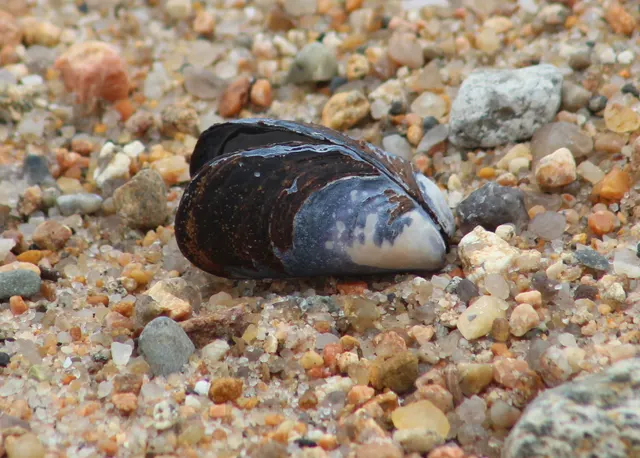 Blue musselTaken from mussel beds on mixed and soft intertidal ground, where they are gathered rather than picked off standing rock.
Photo: Steven Lamonde, via iNaturalist, CC BY; resized and trimmed to fit
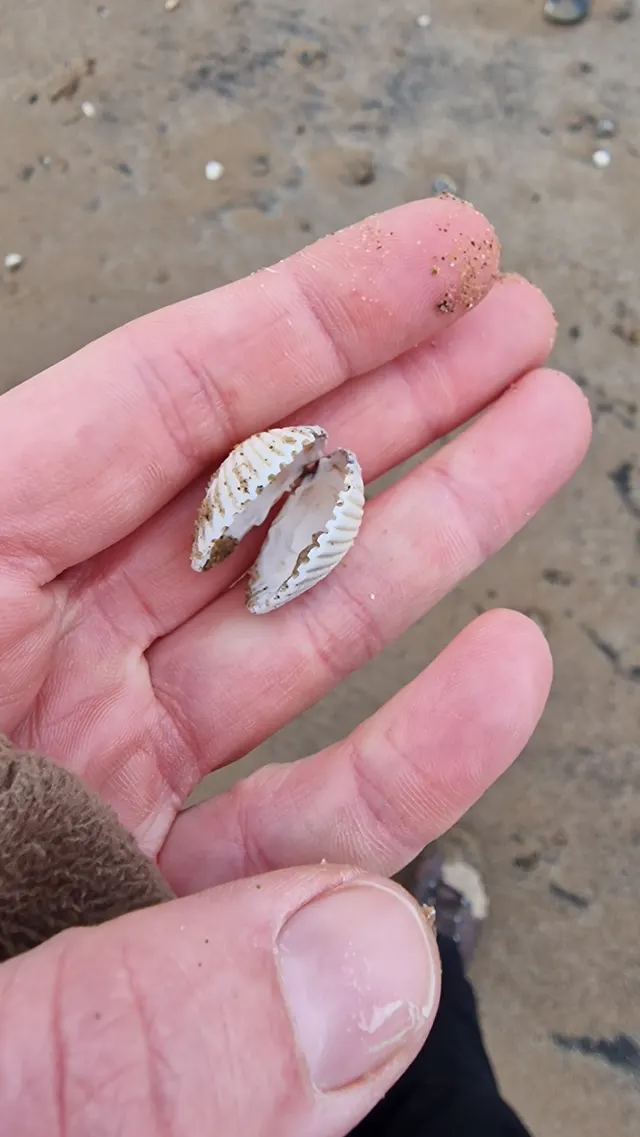 Common cockleRaked and turned from intertidal sand and mud — the animal this method is most associated with, and the one its regulation is mostly about.
Photo: bitsandbugs, via iNaturalist, CC0 1.0; resized and trimmed to fit
- Razor clamWorked from a vertical burrow on the biggest spring tides, for the table and for one of the best sea baits there is.
What you fish it with
How it works
THE SURFACE IS THE ONLY EVIDENCE. Cockles live in the top few centimetres of sand and mud and are raked or turned up in numbers where a bed exists; the bed is located by the shell debris around it and by the feel of the ground underfoot rather than by anything visible in the water.
RAZOR CLAMS SIT VERTICALLY IN A DEEP BURROW AND WITHDRAW FASTER THAN A SPADE. They are found by a keyhole or dumbbell-shaped depression at the surface, and the traditional approaches work by making the animal come up rather than by digging it out — a fast, committed dig beside the burrow, or salt placed at the hole, which the animal responds to by rising. A razor that is grabbed and pulled breaks, and a broken razor is a wasted animal and a cut hand.
WORMS ARE READ FROM CAST AND HOLE. A lugworm's position is triangulated between its cast and its blow-hole, and the worm lies in the U between them; a spade placed by guesswork cuts the worm in half.
THE TIDE SETS THE WINDOW AND THE SPRINGS SET THE MONTH. The working period is the hour or two either side of low water, and the ground exposed depends on the range — razor clams in particular uncover only on the biggest spring tides, which makes their season a set of dates rather than a period.
AND THE GROUND MUST BE PUT BACK. Turned sand, an unfilled hole and an overturned stone each kill what lived there. On soft ground the practice is more disruptive than rock gathering is, and the disruption is to the same habitat the fish feeding over it use.
Conditions
Suits sand, mud and mixed intertidal flats on a falling and low tide, and strongly favours the largest spring tides — for razor clams it effectively requires them. Daylight, so the ground and the exits can be seen. Ruled out by any shore affected by sewage discharge or recent heavy run-off, by a bed that is closed or reserved commercially, by fog on a wide flat, and by soft mud that will not carry weight. It is a year-round practice; the biotoxin risk is not year-round and is not visible, which is why the question goes to the authority rather than to the weather.
Common mistakes
- Going without establishing which authority governs that ground and what it requires. In England the answer changes between neighbouring districts, and 'nobody stopped me last time' is not the answer.
- Assuming a clean-looking beach is clean water. Filter feeders concentrate what is in the water and none of it is visible.
- Treating a commercial classification as a recreational assurance. A classified and monitored bed says something about the commercial harvest from it, not about a bucket carried home.
- Digging a razor clam out. It withdraws faster than a spade moves; the salt or the fast dig beside the burrow are the techniques, and pulling breaks the animal and cuts the hand.
- Guessing at a lugworm rather than triangulating the cast and the blow-hole, and cutting the worm in half.
- Leaving holes unfilled and stones turned. On soft ground this kills more than the take does.
- Walking out across a wide flat without a fixed time to leave. The tide fills channels behind people rather than approaching them from the front, and this is the mechanism behind the mass-casualty incidents this activity has.
- Sealing live shellfish in an airtight box, which kills them before they are cooked.
Advantages
- The equipment is a fork and a bucket, and the ground is public foreshore in most of Britain.
- It produces food and the two best sea baits on the coast from the same tide.
- The catch stays alive until it is cooked, so nothing needs keeping cold on the day.
- Reading ground is a transferable skill: the flats that hold cockles are the flats that hold the flatfish, bass and rays feeding on them, which makes a gathering trip a reconnaissance for a fishing one.
Limitations
- It is the most heavily regulated shore activity FishingHQ covers, and the rules change at district boundaries rather than at national ones.
- Everything taken is a filter feeder, so water quality decides whether a legal catch is safe to eat and nothing visible tells you which it is.
- Razor clams work on a handful of tides a month, not on any low water.
- Soft-ground gathering damages the habitat it happens on more than rock gathering does.
- Soft mud and a rising tide over a wide flat is one of the more dangerous places on the British coast, and the danger is not obvious from the shore.
Terms you will meet
- Cockling
- Raking or turning sand and mud for cockles. The word covers both the recreational take and a substantial commercial fishery, which is part of why the regulation is as tight as it is.
- Keyhole
- The depression a razor clam leaves at the surface of the sand above its burrow, and the only sign that one is there.
- Cast and blow-hole
- The coiled sand a lugworm ejects and the small depression at the other end of its burrow. The worm lies in the U between the two, which is what makes digging a matter of geometry rather than effort.
- Classified bed
- A shellfish harvesting area that is officially classified and monitored so that commercial harvest from it can be controlled. It is a commercial framework, and a recreational gatherer standing on the same sand is outside it.
Legal to collect and safe to eat are two different questions
These are answered by different bodies and the answers do not track each other. A bed can be open, unrestricted and perfectly lawful to gather, and the shellfish on it can still be unsafe to eat that week.
EVERYTHING TAKEN THIS WAY IS A FILTER FEEDER. Cockles, clams, razors and mussels pump seawater through themselves continuously to feed. Two things concentrate in them as a result. The first is the biotoxins produced by certain algal blooms — the paralytic, diarrhetic and amnesic shellfish poisoning groups — which are not destroyed by cooking and are not detectable by taste, smell or appearance. The second is whatever microbiology the water carries, which is why proximity to outfalls, marinas and land run-off matters and why a shore looks exactly the same after heavy rain as before it.
THERE IS AN OFFICIAL SYSTEM AND A RECREATIONAL GATHERER IS OUTSIDE IT. Shellfish harvesting areas used commercially are classified and monitored, and that framework is what allows commercially harvested shellfish to be sold. It says nothing about a bucket carried home from the same sand. Treating a classification as personal reassurance is the specific mistake worth naming, because it is the one that sounds most like diligence.
FISHINGHQ MAKES NO LIVE SAFETY CLAIM ABOUT ANY BED. It holds no monitoring data, closures and blooms move faster than any page here is revised, and implying otherwise would be the most dangerous thing a page like this could do. The food-safety authority and the local inshore fisheries authority are who to ask, and they should be asked close to the day rather than in advance of the season.
Official guidance — why, and the sources (2)
Stated by a fisheries authority, scientific institute or recognised angling body. Authoritative, but summarising rather than demonstrating.
- Shellfish classification — Food Standards Agency, 2026 (Government fisheries body)Relied on for: The existence of an official classification and monitoring regime for shellfish harvesting areas, and the body that administers it.States this directlyCitation checked — the work exists and is described correctly
- Cefas science, advice and data on marine and freshwater environments — Centre for Environment, Fisheries and Aquaculture Science (Government fisheries body)Relied on for: Marine environmental science for UK shelf seas: intertidal sediment characterisation, shellfish bed distribution and the monitoring that describes them.Background and mechanism onlyCitation checked — the work exists and is described correctly
Who governs this, and why no number appears on this page
Shore gathering is the most heavily regulated activity on FishingHQ, and its regulation is unusual in being LOCAL rather than national.
IN ENGLAND THE RULE CHANGES AT DISTRICT BOUNDARIES. Each inshore fisheries and conservation authority makes byelaws for its own district. Several operate a hand-gathering or recreational shellfish permit; some allow a small take for personal consumption without one and others do not; particular beds are closed, seasonally restricted, or reserved to a licensed commercial fishery. Two beaches an hour apart can sit under different rules, and the position is revised.
IN SCOTLAND ONE OF THESE ANIMALS IS GOVERNED BY STATUTE. Fishing for razor clams other than limited hand gathering is prohibited, and the hand gathering that remains permitted is capped by a stated daily number per person. Fishing for them with electric current has been unlawful for decades and remains a live enforcement problem, with a scientific trial fishery operating under derogation to a limited number of named vessels.
NO FIGURE IS PUBLISHED HERE, AND THAT IS DELIBERATE. FishingHQ has no mechanism for following a byelaw amendment, and a permit allowance or a daily limit reproduced from a document read once is a number that will be wrong before it is noticed — while looking exactly as authoritative as a correct one. A reader who finds a number stops looking for one, which makes a stale limit worse than no limit at all. What this page can honestly give is the shape: find out which authority governs the ground you are standing on, expect the answer to differ from the next district, and expect a permit to be part of it.
Official guidance — why, and the sources (2)
Stated by a fisheries authority, scientific institute or recognised angling body. Authoritative, but summarising rather than demonstrating.
- Recreational fishing and the shellfish permit — North Eastern IFCA — North Eastern Inshore Fisheries and Conservation Authority (Government fisheries body)Relied on for: An English inshore fisheries authority's own recreational shellfish permit and the byelaws around it, as an instance of the district-by-district regulation of hand gathering.States this directlyPassage read and verified
- The Razor Clams (Prohibition on Fishing and Landing) (Scotland) Order 2017 — The Scottish Government (Government fisheries body)Relied on for: That razor-clam fishing in Scotland is prohibited other than limited hand gathering, which is capped by statute.States this directlyPassage read and verified
Safety
Tides and being cut off — Can cause serious injury or death
The practice takes people a long way out across flat ground on the biggest tides of the month, facing down, working. A flooding spring tide over a wide flat fills the channels behind a person before it reaches them from in front, so the water arrives between them and the shore rather than at their feet. Soft mud and gullies that were walked out over on a falling tide are not walkable back across on a rising one.
What reduces it: Work out low water and the range before going, fix a time to turn back and keep it, walk out by a route you have looked back along, know where the channels are, and never let the biggest tide of the month tempt you further than the smallest would.
Worse when:
- On spring tides, which are exactly the tides this fishery works
- In fog, or in failing light on a wide flat
- On ground cut by channels and creeks that fill from behind
- Where soft mud slows the walk back below the speed of the tide
Drowning and immersion — Can cause serious injury or death
Soft intertidal mud can hold a foot fast, and a person stuck on a flat with a tide coming in cannot free themselves by pulling. This is a different mechanism from being cut off and it has the same outcome.
What reduces it: Test soft ground before committing weight, spread weight and move rather than standing still in it, carry a means of calling for help that will work when wet, and never gather soft mud alone or without somebody ashore knowing where you are and when you are due.
Knives and cutting tools — Can cause injury needing treatment
Broken razor-clam shells are genuinely sharp, and the animal breaks when it is pulled rather than lifted. Working a fork or spade at speed in cold hands over buried shell debris produces cuts that are then immersed in seawater on a shore that may not be clean.
What reduces it: Lift razors rather than pulling them, wear gloves on shell ground, keep cuts out of the water and clean them properly afterwards.
Precautions that always apply here
- Check the tide before you go and know your exit route. Being cut off is the commonest way a shore session becomes a rescue.
- Tell somebody where you are going and when you expect to be back.
- Carry a charged phone in a waterproof case, or another means of calling for help.
Check the rules before you fish
Fishing laws, bylaws, access rules, seasons, bait restrictions and permitted methods vary by location and can change. Check the current rules from the relevant authority and the water you intend to fish before fishing.
Check with:
- Current national or regional law for where you are fishing
- Current local bylaws
- The relevant fisheries authority
- The landowner, club or fishery whose water it is
- Any restrictions specific to the species or the method you intend to use
Where to go next
Compared with
- Gathering winkles, whelks and limpetsSand and mud against rock — and, more importantly, filter feeders against grazers, which is why the safety advice differs.
More methods
Not related to this page — just the rest of the section. There is little else joined to this subject yet, and a short page should still lead somewhere.
Sources and evidence
- Recreational fishing and the shellfish permit — North Eastern IFCA — North Eastern Inshore Fisheries and Conservation Authority (Government fisheries body)Relied on for: An English inshore fisheries authority's own recreational shellfish permit and the byelaws around it, as an instance of the district-by-district regulation of hand gathering.States this directlyPassage read and verified
- Shellfish classification — Food Standards Agency, 2026 (Government fisheries body)Relied on for: The existence of an official classification and monitoring regime for shellfish harvesting areas, and the body that administers it.States this directlyCitation checked — the work exists and is described correctly
- Cefas science, advice and data on marine and freshwater environments — Centre for Environment, Fisheries and Aquaculture Science (Government fisheries body)Relied on for: Marine environmental science for UK shelf seas: intertidal sediment characterisation, shellfish bed distribution and the monitoring that describes them.Background and mechanism onlyCitation checked — the work exists and is described correctly
Why the 5 connections on this page are here, and the sources
What it catches
Official guidance — 3 connections
Stated by a fisheries authority, scientific institute or recognised angling body. Authoritative, but summarising rather than demonstrating.
Blue mussel
The species page describes gathering for the table across the whole range and notes that mussel beds are fishing ground in their own right. Bed gathering on mixed and soft ground belongs with the filter feeders and their safety model rather than with the rock grazers.
- Recreational fishing and the shellfish permit — North Eastern IFCA — North Eastern Inshore Fisheries and Conservation Authority (Government fisheries body)Relied on for: An English inshore fisheries authority's own recreational shellfish permit and the byelaws around it, as an instance of the district-by-district regulation of hand gathering.States this directlyPassage read and verified
- Shellfish classification — Food Standards Agency, 2026 (Government fisheries body)Relied on for: The existence of an official classification and monitoring regime for shellfish harvesting areas, and the body that administers it.States this directlyCitation checked — the work exists and is described correctly
Common cockle
The species page describes gathering for the table and a traditional and commercially significant fishery in several estuaries. Cockles live in the top few centimetres of sand and are taken by rake and fork, which is this method and not the rock gathering FishingHQ previously held.
- Recreational fishing and the shellfish permit — North Eastern IFCA — North Eastern Inshore Fisheries and Conservation Authority (Government fisheries body)Relied on for: An English inshore fisheries authority's own recreational shellfish permit and the byelaws around it, as an instance of the district-by-district regulation of hand gathering.States this directlyPassage read and verified
- Shellfish classification — Food Standards Agency, 2026 (Government fisheries body)Relied on for: The existence of an official classification and monitoring regime for shellfish harvesting areas, and the body that administers it.States this directlyCitation checked — the work exists and is described correctly
Razor clam
The species page describes gathering for the table and an outstanding sea bait, and notes the tongue is tough enough to stay on a hook. The animal is taken from a deep burrow in intertidal sand, which is this method; the rock-gathering page cannot describe it because razors are not on rock.
- Recreational fishing and the shellfish permit — North Eastern IFCA — North Eastern Inshore Fisheries and Conservation Authority (Government fisheries body)Relied on for: An English inshore fisheries authority's own recreational shellfish permit and the byelaws around it, as an instance of the district-by-district regulation of hand gathering.States this directlyPassage read and verified
- Shellfish classification — Food Standards Agency, 2026 (Government fisheries body)Relied on for: The existence of an official classification and monitoring regime for shellfish harvesting areas, and the body that administers it.States this directlyCitation checked — the work exists and is described correctly
What you fish it with
What experienced anglers do — 1 connection
Widely and independently recommended by experienced anglers and specialist sources. This is real angling knowledge, not proof: controlled evidence for it is limited, and FishingHQ records it as convention rather than as a demonstrated effect.
Crab and shellfish
This is the one method on FishingHQ whose output is simultaneously food and terminal tackle. Razor and mussel are dug on the same tide, from the same ground, with the same fork, and then bound to a hook with elastic — which is why the bait record's presentation instructions read as though the reader already has the animal.
- Sea Angler — Bauer Media (Specialist angling publication)Relied on for: Practitioner treatment of shore-dug shellfish and worm as sea bait.States this directlyCitation checked — the work exists and is described correctly
- General angling website restatements of established technique — Various (Credible secondary source)Relied on for: The widely restated practice of digging one's own bait on the tide before fishing it.Background and mechanism onlyCitation checked — the work exists and is described correctly
Compared with
Official guidance — 1 connection
Stated by a fisheries authority, scientific institute or recognised angling body. Authoritative, but summarising rather than demonstrating.
Gathering winkles, whelks and limpets
The rock-gathering record states in its own description that the bivalve biotoxin framework is not its primary concern. That sentence only makes sense beside the record it is distinguishing itself from, and a reader who arrives at one needs to know the other exists and has a different answer about what is safe to eat.
- Shellfish classification — Food Standards Agency, 2026 (Government fisheries body)Relied on for: The existence of an official classification and monitoring regime for shellfish harvesting areas, and the body that administers it.States this directlyCitation checked — the work exists and is described correctly
- Cefas science, advice and data on marine and freshwater environments — Centre for Environment, Fisheries and Aquaculture Science (Government fisheries body)Relied on for: Marine environmental science for UK shelf seas: intertidal sediment characterisation, shellfish bed distribution and the monitoring that describes them.Background and mechanism onlyCitation checked — the work exists and is described correctly
How FishingHQ labels evidence is explained in the evidence policy.