Common cockle
Fish · Last reviewed 2026-08-12
A ribbed bivalve living just under the surface of intertidal sand and mud, gathered by rake and by foot, and the animal behind one of the most dangerous gathering fisheries there is.
Safety: tides and being cut off — can cause serious injury or death. 6 more points apply here.
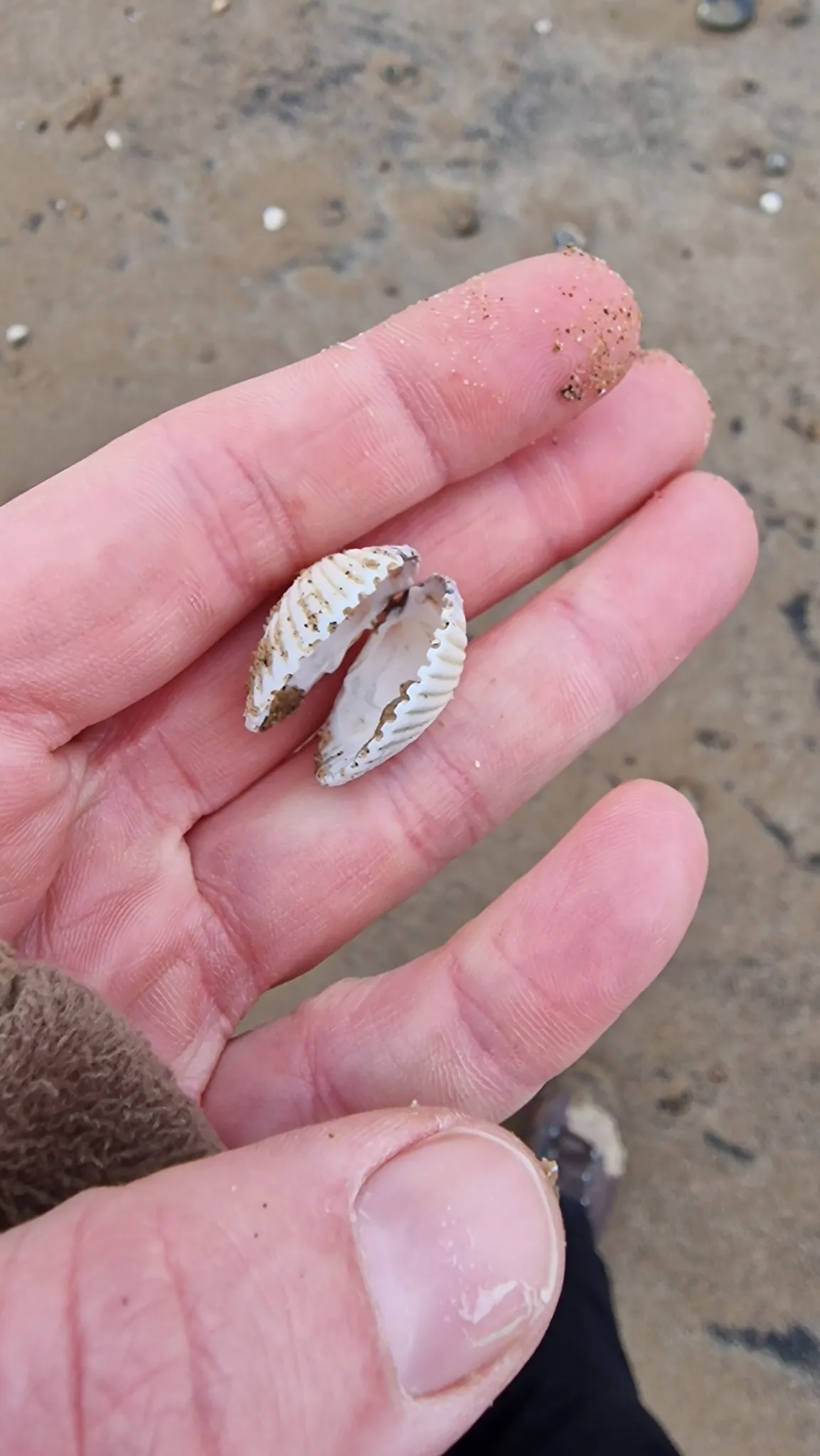
How this was identified, and who took it
Identified by: The record's character is legible and countable at this scale: strong ribs radiate from the umbo to the margin and are crossed by concentric growth lines, on a rounded, slightly heart-shaped outline, with the rib crests raising the shell edge into the scalloped margin a cockle is known by. The valves are still joined at the hinge, so the paired symmetry is visible. The hand gives unambiguous scale.bitsandbugs — CC0, via iNaturalist — source, licenceCatching Common cockle
Everything here on fishing for it. Each entry opens the page behind it.
- Ground
- Where
- 1 place FishingHQ documents — strongest claim anywhere: recorded here · From the shore
Cockles live buried a few centimetres down in intertidal sand and muddy sand, in beds that can cover enormous areas of estuary and bay. They are shallow burrowers with short siphons, which is why they sit so close to the surface and why they can be raked or trodden out rather than dug.
Gathering them is simple and the ground they live on is not. Cockle beds are flat, featureless, far from shore and cut by channels that fill first, and the combination has produced some of the worst loss-of-life incidents in any gathering fishery. The hazard is not the animal; it is the distance, the flatness that makes a returning tide hard to read, and the speed at which water arrives behind you.
They are also a filter feeder in estuarine water, which places them squarely in the biotoxin and microbiological framework — and estuaries, being where rivers arrive, are where sewage and agricultural run-off concentrate.
Where Common cockle is documented
Places where public sources describe this species as fished, with how it is fished and how strongly the evidence supports it. This is not a range map and it is not a recommendation — it is what has been written down about a fishery rather than a record of any individual catch, and being listed is never permission to fish.
What these strengths mean
- Recorded here
- At least one credible public account of this species being caught here. That is all it means.
Identification
- Scientific name
- Cerastoderma edule
- Family
- Cardiidae
- Water
- Saltwater, Brackish
- Conservation status
- Not assessed
- Regions
- Britain & Ireland, Northern Europe, Western Europe, West Africa, Mediterranean
- A rounded, slightly heart-shaped shell with strong radiating ribs — 22 to 28 of them — crossed by growth lines.
- Off-white to pale yellow-brown, often stained by the sediment it lives in.
- Both valves equally domed, so the closed animal is nearly spherical in profile.
- Short siphons and a large muscular foot, which is what allows it to right itself and reburrow quickly.
- Found buried shallowly in sand and muddy sand, never attached to hard substrate.
Size
- Typical
- 2–4 cm shell width.
- Large
- Over 4.5 cm.
Exceptional: Shell widths around 6 cm are recorded. Growth varies substantially with position on the shore and with food supply, and rings on the shell are not a reliable annual count in all populations.
Cockling: the ground is the hazard, and it has killed more people than any fish
Everything about handling a cockle is trivial. Everything about being where cockles are is not, and this section is deliberately weighted that way.
THE GROUND. Cockle beds are wide, flat, featureless expanses of intertidal sand and muddy sand, frequently a long way from the shore and cut by channels. A returning tide on that kind of ground is genuinely difficult to read: it does not arrive as a visible front from the direction you expect, it fills the channels first, and ground you walked out over becomes an island behind you while you are looking down at a rake. Add fog, a rising wind or failing light and the situation compounds fast.
This is not a theoretical hazard. Cockling has caused some of the worst loss-of-life incidents in any gathering fishery anywhere, and the mechanism has been the same every time.
SO THE PROCEDURE IS FIXED. Walk the ground at low water first and identify the channels and the exit. Establish the tide times before starting. Set a time to leave and keep it rather than leaving when the bag is full. Do not gather alone. Tell somebody where you are and when you will be back, and carry a means of calling for help on your person rather than in a bag on the sand.
SOFT GROUND is the second hazard. Muddy sand can be deep enough to trap a foot, and a person stuck on a flat with a flooding tide is in serious trouble regardless of how close the shore looks.
THE HEALTH QUESTION IS THE THIRD, and it is the same as for any filter feeder. Cockles concentrate algal biotoxins and sewage-derived pathogens from the water, none of which can be seen, smelled or tasted, and biotoxins are not destroyed by cooking. Estuaries — where cockles live — are where rivers deliver run-off, so this is not a marginal concern. Establish the current classification and closure status of the bed with the relevant food safety or environmental health authority before eating anything, and note that many beds are also several-order or regulated fisheries where public gathering is restricted or prohibited outright, which is a separate question from the health one.
GATHERING ITSELF: rake shallowly or work with the foot, take a scatter rather than clearing a patch, leave small animals and refill holes. Keep the catch cool, damp and unsealed, and purge it in clean seawater before cooking.
Backed by research — why, and the sources (2)
Supported by peer-reviewed research or fisheries science. The sources are listed and can be checked.
- FishBase: a global information system on fishes — Froese, R. and D. Pauly, eds. — FishBase Consortium (Scientific institute)Relied on for: Morphology, growth, moult and reproductive biology underlying the handling described, with SeaLifeBase as its sister database for non-finfish taxa.States this directlyPassage read and verified
- Fish and Fishery Products Hazards and Controls Guidance — US Food and Drug Administration, Center for Food Safety and Applied Nutrition, 2022 (Standards body)Relied on for: That bivalve molluscs accumulate biotoxins and microbiological contamination from the growing water, that these are not destroyed by cooking, and that control is by classification and testing of harvesting areas.States this directlyPassage read and verified
Measured across the shell, and why a good year class changes everything
Cockle size is the practical heart of cockle gathering, because the size of the animal decides both whether it is worth taking and whether it may be taken at all.
THE MEASUREMENT IS ACROSS THE SHELL — the widest dimension, taken from the front margin to the back rather than from the hinge downwards. Minimum sizes for cockles are expressed that way and are commonly checked with a simple gauge or ring. It is a small animal and the difference between an undersized and a legal one is a few millimetres, so a gatherer working by eye will be wrong regularly. A gauge is not fussiness; it is the only way to be right.
GROWTH IS FAST EARLY AND THEN STOPS ALMOST DEAD. Cockles put on most of their size in their first year or two and then grow very slowly, which means a bed's size structure is really a record of which years produced good recruitment. That is also why beds fluctuate so dramatically: cockle recruitment is highly variable between years, a single strong year class can dominate a bed for its whole life, and a run of poor years empties it.
POSITION ON THE FLAT MATTERS AS MUCH AS AGE. Cockles higher up the shore are exposed longer, feed less and stay smaller; those lower down grow better. A bed can hold visibly different sizes across a few hundred metres of the same sand, and this page notes that growth varies with position and food supply rather than with age alone.
WHICH IS WHY SHELL RINGS ARE NOT A RELIABLE AGE COUNT. Rings form in response to growth interruptions, and interruptions are not reliably annual — storms, exposure and temperature all mark the shell. Counting them gives a number that may or may not be years.
AND SIZE HAS NOTHING TO DO WITH SAFETY. Cockles are filter feeders and carry whatever the water carries; a large cockle from a poor area is exactly as hazardous as a small one. Classification of the ground and any closure or restriction on it are matters for the local competent authority, and the ground itself — soft sand, fast tides, poor visibility — has killed more people at this activity than the animal ever could.
Official guidance — why, and the sources (2)
Stated by a fisheries authority, scientific institute or recognised angling body. Authoritative, but summarising rather than demonstrating.
- Good Fish Guide — Marine Conservation Society (Conservation authority)Relied on for: Assessment of the stock and the fishery, including growth rate, the size at which the animal is taken, and the sustainability implications of removing large individuals.Background and mechanism onlyCitation checked — the work exists and is described correctly
- FishBase: a global information system on fishes — Froese, R. and D. Pauly, eds. — FishBase Consortium (Scientific institute)Relied on for: Recorded maximum size and growth information for the species.Background and mechanism onlyPassage read and verified
Buried in clean sand, high enough to be safe and low enough to eat
Cockles occupy one of the most sharply defined habitats of any animal a British gatherer meets, and the definition is a compromise between two opposing pressures.
THE GROUND IS CLEAN SAND AND SANDY MUD ON SHELTERED TIDAL FLATS. Cockles need sediment they can burrow into — loose enough to work, firm enough to hold a burrow — which in practice means the broad intertidal flats of estuaries, bays and sheltered sandy shores rather than open surf beach or hard ground. They live shallowly buried, typically only a few centimetres down, with two short siphons reaching to the surface to draw water in and expel it.
WHICH IS WHY THEY ARE FOUND WHERE THEY ARE ON THE SHORE. Being a filter feeder, a cockle needs immersion time, so being high on the flat means feeding for fewer hours and growing more slowly. Being low means more food and also more predators — starfish, crabs, flatfish and above all wading birds and shelduck, which work cockle flats systematically. The densest cockle beds sit in the band where feeding time is adequate and predation is survivable, and that band shifts with the shape of the estuary.
THE SEDIMENT ITSELF IS THE OTHER CONSTRAINT AND IT IS FINER THAN IT LOOKS. Too muddy and the animal cannot keep its siphons clear; too coarse and mobile and the burrow will not hold in a storm. Cockle beds are therefore a fairly narrow sediment window, and a bed can be destroyed by a change in sediment supply — a channel moving, a storm redistributing sand — without anything being wrong with the animals.
RECRUITMENT IS THE VOLATILE PART OF THE HABITAT STORY. Cockle larvae drift in the plankton before settling, so a bed is stocked by whatever the tides deliver rather than by the adults on it. A single good settlement can carpet a flat; several poor years in a row can empty it. That is normal cockle behaviour and it is why beds fluctuate so dramatically without necessarily indicating harm.
AND THE FLAT ITSELF IS THE HAZARD. A cockle bed is soft ground a long way from shore over a fast-filling tide with poor visibility in fog, and the habitat description is also the safety description. Whether a bed may be worked at all is a matter for the local competent authority, and the ground is not a matter of opinion.
Backed by research — why, and the sources (2)
Supported by peer-reviewed research or fisheries science. The sources are listed and can be checked.
- Good Fish Guide — Marine Conservation Society (Conservation authority)Relied on for: Assessment of the stock and the ground it occupies, including habitat, the effect of gathering methods on it, and its sensitivity to disturbance.Background and mechanism onlyCitation checked — the work exists and is described correctly
- The IUCN Red List of Threatened Species — International Union for Conservation of Nature (Conservation authority)Relied on for: Habitat account and the pressures on the habitat the species depends on, where the species is assessed.Background and mechanism onlyCitation checked — the work exists and is described correctly
Spawning, condition and the winter that empties the flats
Cockles have a strong seasonal cycle that a gatherer feels directly, and it operates on two axes at once: the condition of the animal, and whether the ground is workable at all.
THE REPRODUCTIVE CYCLE DRIVES CONDITION. Cockles build up gonad through spring, spawn in the warmer months — often in more than one episode across a season — and are spent afterward. A spent cockle is thin and watery; an animal in full pre-spawning condition is heavy and full. That is why the traditional gathering seasons in most places sit outside the peak spawning period, and it is a matter of the animal being worth taking rather than of the animal being fragile.
GROWTH IS ALSO SEASONAL AND IT NEARLY STOPS IN WINTER. Cockles feed on suspended material whose abundance follows the plankton cycle, so growth is concentrated in the warmer productive months and effectively pauses in the cold. A cockle measured in October and again in March will barely have changed.
WINTER MORTALITY IS A REAL AND UNDERAPPRECIATED PART OF THE CYCLE. Severe cold, storms that redistribute sediment, and heavy bird predation through the winter months can remove a large fraction of a bed between autumn and spring. Cockle beds are genuinely volatile, and a flat that was thick with cockles in September may be sparse in April without anybody having gathered a single one.
RECRUITMENT IS THE OTHER SEASONAL EVENT AND IT IS DECISIVE. Larvae spend a period in the plankton before settling, and settlement success varies enormously between years according to timing, temperature and where the water went. One strong settlement can carpet a flat and define the bed for years; several weak years in a row empty it.
AND THE BIOTOXIN QUESTION IS SEASONAL TOO, WHICH IS WHY THE RULES ARE. Algal blooms that produce shellfish biotoxins are strongly seasonal in most waters, and monitoring and closure regimes are built around that. But — and this is the point the whole family exists to make — the biological season described above does not tell anybody when a bed is open. Classification, closure, minimum size, permitted method and quota are all matters for the local competent authority, they change, and they are not derivable from the animal's condition.
Official guidance — why, and the sources (2)
Stated by a fisheries authority, scientific institute or recognised angling body. Authoritative, but summarising rather than demonstrating.
- Cefas science, advice and data on marine and freshwater environments — Centre for Environment, Fisheries and Aquaculture Science (Government fisheries body)Relied on for: Seasonal condition, reproductive cycle and gathering considerations for shellfish in British and north-west European waters.States this directlyCitation checked — the work exists and is described correctly
- Good Fish Guide — Marine Conservation Society (Conservation authority)Relied on for: Stock and fishery assessment, including the seasonal condition of the animal and the periods of greatest sensitivity.Background and mechanism onlyCitation checked — the work exists and is described correctly
Gametes released into the water, and a generation that arrives by tide
Cockle reproduction is the simplest strategy in this batch and produces the most volatile outcome, and both facts follow from the same feature: the adults have no control over anything after spawning.
SPAWNING IS BROADCAST AND EXTERNAL. Cockles are separate-sexed and release eggs and sperm directly into the water column, where fertilisation happens by chance. Spawning is triggered by temperature and food availability and is broadly synchronised across a bed, frequently in more than one episode across a warm season. There is no pairing, no care and no substrate preparation.
THE LARVAE THEN SPEND WEEKS IN THE PLANKTON, drifting wherever the water takes them before settling onto sediment as tiny cockles. That drift is the decisive step: a bed is restocked not by its own adults but by whatever the tides deliver, which may have come from a different estuary entirely.
WHICH IS WHY RECRUITMENT IS SO ERRATIC. Settlement success depends on spawning timing, water temperature, food in the plankton, current patterns and the state of the sediment at the moment of settlement, and any of those can fail. A single good settlement year can carpet a flat and define it for the life of that cohort; a run of poor years empties it while the water and the sediment look unchanged.
SO A COCKLE BED'S SIZE STRUCTURE IS A HISTORY OF SETTLEMENT YEARS, and reading it — a bed dominated by one size class, or holding several — tells you more about the past than about the present condition of the ground.
EARLY MORTALITY IS ENORMOUS AND IT IS NORMAL. Newly settled cockles are eaten in vast numbers by shrimps, crabs, flatfish and birds, and mass mortality of small cockles is a routine feature of an estuary rather than a sign of anything wrong.
MATURITY COMES QUICKLY, generally within a year or two, which is what allows a bed to rebuild fast when settlement does succeed. That responsiveness is the species' main defence against the volatility.
AND MANAGEMENT OF COCKLE BEDS REFLECTS ALL OF IT. Beds are opened, closed, quota'd and size-limited in ways that respond to survey rather than to a fixed calendar, and they change between seasons. What applies on any ground is a matter for the local competent authority.
Backed by research — why, and the sources (2)
Supported by peer-reviewed research or fisheries science. The sources are listed and can be checked.
- Cefas science, advice and data on marine and freshwater environments — Centre for Environment, Fisheries and Aquaculture Science (Government fisheries body)Relied on for: Reproductive cycle, berried condition, larval development and recruitment of shellfish in British and north-west European waters.States this directlyCitation checked — the work exists and is described correctly
- Good Fish Guide — Marine Conservation Society (Conservation authority)Relied on for: Stock and fishery assessment, including the reproductive parameters that govern how a stock replaces itself.Background and mechanism onlyCitation checked — the work exists and is described correctly
Lifecycle and reproduction
Planktonic larvae settle onto intertidal flats after several weeks and burrow immediately. Growth is fast in the first years and slows thereafter, with most animals living two to four years and some considerably longer. Recruitment is extremely variable between years — a bed can be dense one season and nearly empty two years later without any fishing — and severe winters, storms and predation by oystercatchers and shore crabs all drive that variation.
Sexes are separate, with eggs and sperm released into the water column chiefly in spring and summer as temperature rises. Fertilisation is external and the larvae disperse in the plankton before settling. Spawning leaves the animals thin, which again is a condition observation rather than a safety one.
Feeding and senses
A suspension feeder drawing water through a short inhalant siphon and filtering phytoplankton and suspended organic material across the gills. The short siphons are why it must live close to the surface, and why it is exposed to whatever the overlying water carries.
No eyes and a simple nervous system. It detects vibration and pressure and responds by withdrawing the siphons and closing — which is why a heavy tread across a bed causes the animals to close and, in some conditions, to be pushed to the surface.
Through the year
Condition tracks feeding and spawning: animals fill through the productive months and are thin after spawning. Cockles also move within the sediment in response to temperature and storms, and severe winters can kill large numbers outright. None of that seasonal variation bears on safety.
Distribution
Eastern Atlantic from Norway and the Baltic approaches south to west Africa, including all around Britain and Ireland and throughout the North Sea. Intertidal and shallow subtidal sand and muddy sand, particularly in estuaries, bays and sheltered flats.
This is a biological range — where the species occurs, not a prediction that you will catch one. To browse the fishing geography FishingHQ holds, start at fishing places.
Why anglers care
Gathered for the table, and a traditional and commercially significant fishery in several estuaries. Cockle beds are also productive fishing ground: the beds concentrate flatfish, bass and rays that feed on them and on the worms and crustaceans living alongside.
Handling and returning
THE GROUND IS THE HAZARD, and it is worth putting before anything else. Cockle beds are wide, flat, featureless and often a long way from shore, cut by channels that fill before the ground around them. A returning tide on that kind of ground is extremely hard to read and it does not arrive from the direction people expect. Establish the tide, the exit route and the channels at low water before going out, set a time to leave and keep it, do not go alone, tell somebody where you are, and carry a means of calling for help. This fishery has killed more people than every other activity on FishingHQ combined.
BEFORE GATHERING: establish the current classification and closure status of the bed with the relevant food safety or environmental health authority. Many cockle beds are also several-order or regulated fisheries where public gathering is restricted or prohibited entirely, and that is a separate question from the health one.
AND THE R-IN-THE-MONTH RULE IS NOT A SAFETY SYSTEM. It is the best-known piece of shellfish folklore in the English-speaking world, it predates refrigeration and toxin monitoring, and it describes spawning condition and spoilage rather than contamination. Harmful algal blooms occur in months with an R in them. Following it tells you nothing about whether a bed is safe.
GATHERING: rake shallowly or work with the foot. Take a scatter rather than clearing a patch, leave small animals, and refill any holes.
AFTER: keep them cool, damp and unsealed. Cockles hold sediment and are usually left in clean seawater for some hours to purge. Discard any that stay open when tapped — that detects a dead animal and detects nothing about toxins, which is the distinction that matters.
Safety
Tides and being cut off — Can cause serious injury or death
Gathering happens on intertidal ground at low water, facing down, with attention on the beach rather than the sea. Flats and gullies flood from behind, and people have drowned on ground they walked out over an hour earlier.
What reduces it: Know the tide and the exit before starting, and set a time to leave rather than leaving when the bag is full. Do not gather alone on unfamiliar intertidal ground, and tell somebody where you are.
Encounters with marine life — Can cause serious injury or death
Filter feeding concentrates algal biotoxins and sewage-derived bacteria and viruses from the growing water. Contaminated animals look, smell and taste normal, and biotoxins survive cooking, freezing, smoking and pickling. Paralytic shellfish poisoning can be fatal.
What reduces it: Establish the current classification and closure status of the ground with the relevant food safety or environmental health authority before gathering. Treat unclassified or unmonitored ground as unknown rather than safe. No folk test detects this — not the R-in-the-month rule, not a silver spoon, and not whether a shell opens on cooking.
Fishing alone — Can cause serious injury or death
Cockling puts people a long way out on featureless flats, frequently in poor light or fog, where a returning tide fills channels behind them and a person on their own has no margin at all.
What reduces it: Do not gather alone. Tell somebody the plan and the expected return. Carry a means of calling for help on your person, and set a time to leave rather than leaving when the bag is full.
Precautions that always apply here
- Check the tide before you go and know your exit route. Being cut off is the commonest way a shore session becomes a rescue.
- Do not wade alone. Judge depth and flow from the bank first, and turn back sooner than feels necessary.
- Tell somebody where you are going and when you expect to be back.
- Carry a charged phone in a waterproof case, or another means of calling for help.
Check the rules before you fish
Fishing laws, bylaws, access rules, seasons, bait restrictions and permitted methods vary by location and can change. Check the current rules from the relevant authority and the water you intend to fish before fishing.
Check with:
- Current national or regional law for where you are fishing
- Current local bylaws
- The relevant fisheries authority
- The landowner, club or fishery whose water it is
- Any restrictions specific to the species or the method you intend to use
Where to go next
Where it lives
Where you will find it
- FranceWorked on the Channel and Atlantic intertidal flats by pêche à pied gatherers on large spring tides, under species, size, quantity and sanitary rules.
- Galicia and the Iberian ria coastWorked on the extensive intertidal flats of the rias under the licensed, quota-managed, community-administered gathering system that defines this coast.
- Morecambe Bay and the north-west England coastThe bay's cockle beds are among the largest in Britain and have supported gathering for as long as there are records. They are enormously variable between years, and whether any bed is open, permitted or closed is a matter for the fisheries authority and the current shellfish classification, never for a page.
- The Gower and Carmarthen BayThe Burry Inlet beds are among the most important cockle grounds in Britain and have been gathered by the same communities for generations. The fishery is now licensed, quota-managed and closely regulated rather than open.
- The Wadden SeaOn the flats in quantity, subject to a licensed and quota-managed fishery whose mechanical methods have been restricted, litigated and in places prohibited across the three countries.
- The Wash and the Lincolnshire coastThe cockle beds of this bay are among the largest in England and support a commercial fishery of real economic significance, managed under some of the most developed inshore shellfish regulation in the country.
Understanding this fish
- Gathering shellfish, and the hazard that cooking does not removeEstuarine filter feeder, living exactly where rivers deliver sewage and agricultural run-off, on ground that is also the most dangerous gathering ground there is.
- Shellfish biotoxins, algal blooms and the closure systemGathered recreationally more than almost any other shellfish in Britain and Ireland, from exactly the intertidal flats where closures are declared.
Told apart from
Sources and evidence
- FishBase: a global information system on fishes — Froese, R. and D. Pauly, eds. — FishBase Consortium (Scientific institute)Relied on for: Taxonomy, distribution, habitat association, growth and reproductive biology for the species, with SeaLifeBase as its sister database for non-finfish taxa.States this directlyPassage read and verified
- Fish and Fishery Products Hazards and Controls Guidance — US Food and Drug Administration, Center for Food Safety and Applied Nutrition, 2022 (Standards body)Relied on for: That bivalve molluscs accumulate biotoxins and microbiological contamination from the growing water, that biotoxins are not destroyed by cooking, and that control is by classification and routine testing of harvesting areas rather than by any consumer-level test.States this directlyPassage read and verified
Why the 11 connections on this page are here, and the sources
How it is caught
Official guidance — 1 connection
Stated by a fisheries authority, scientific institute or recognised angling body. Authoritative, but summarising rather than demonstrating.
Digging and raking for shellfish
The species page describes gathering for the table and a traditional and commercially significant fishery in several estuaries. Cockles live in the top few centimetres of sand and are taken by rake and fork, which is this method and not the rock gathering FishingHQ previously held.
- Recreational fishing and the shellfish permit — North Eastern IFCA — North Eastern Inshore Fisheries and Conservation Authority (Government fisheries body)Relied on for: An English inshore fisheries authority's own recreational shellfish permit and the byelaws around it, as an instance of the district-by-district regulation of hand gathering.States this directlyPassage read and verified
- Shellfish classification — Food Standards Agency, 2026 (Government fisheries body)Relied on for: The existence of an official classification and monitoring regime for shellfish harvesting areas, and the body that administers it.States this directlyCitation checked — the work exists and is described correctly
Where it lives
Backed by research — 1 connection
Supported by peer-reviewed research or fisheries science. The sources are listed and can be checked.
Estuary
Habitat association recorded for the species rather than inferred from the fishery.
- FishBase: a global information system on fishes — Froese, R. and D. Pauly, eds. — FishBase Consortium (Scientific institute)Relied on for: Habitat association, depth range and distribution for the species, with SeaLifeBase as its sister database for non-finfish taxa.States this directlyPassage read and verified
Where you will find it
Backed by research — 6 connections
Supported by peer-reviewed research or fisheries science. The sources are listed and can be checked.
France
Occurrence of the species in these waters: a statement about the animal's distribution, not a venue recommendation.
- FishBase: a global information system on fishes — Froese, R. and D. Pauly, eds. — FishBase Consortium (Scientific institute)Relied on for: Distribution, habitat association and salinity tolerance recorded for the species, including its occurrence in these waters.States this directlyPassage read and verified
- The IUCN Red List of Threatened Species — International Union for Conservation of Nature (Conservation authority)Relied on for: Assessment and range description for the species.Background and mechanism onlyCitation checked — the work exists and is described correctly
Galicia and the Iberian ria coast
Occurrence of the species in this system or along this coast: a statement about the animal's distribution, not a venue recommendation.
- FishBase: a global information system on fishes — Froese, R. and D. Pauly, eds. — FishBase Consortium (Scientific institute)Relied on for: Distribution, salinity tolerance and habitat association recorded for the species, including its occurrence in this system.States this directlyPassage read and verified
- The IUCN Red List of Threatened Species — International Union for Conservation of Nature (Conservation authority)Relied on for: Assessment and range description for the species, including the waters in which it occurs.Background and mechanism onlyCitation checked — the work exists and is described correctly
Morecambe Bay and the north-west England coast
A claim that a place contains the ground, water and seasonal conditions the species is associated with. It is a distributional statement about the world, it rests on the regional reference literature, and it deliberately asserts nothing about access, permission or catch.
- JNCC species and habitat conservation advice — Joint Nature Conservation Committee (Conservation authority)Relied on for: Habitat classification and description for the intertidal, coastal and freshwater habitats named, and the species characteristically associated with them.States this directlyCitation checked — the work exists and is described correctly
- Cefas science, advice and data on marine and freshwater environments — Centre for Environment, Fisheries and Aquaculture Science (Government fisheries body)Relied on for: Characterisation of UK inshore sediment, intertidal habitat and the shellfish beds associated with them.States this directlyCitation checked — the work exists and is described correctly
The Gower and Carmarthen Bay
A claim that a place contains the ground, water and seasonal conditions the species is associated with. It is a distributional statement about the world, it rests on the regional reference literature, and it deliberately asserts nothing about access, permission or catch.
- JNCC species and habitat conservation advice — Joint Nature Conservation Committee (Conservation authority)Relied on for: Habitat classification and description for the intertidal, coastal, estuarine and freshwater habitats named, and the species characteristically associated with them.States this directlyCitation checked — the work exists and is described correctly
- Cefas science, advice and data on marine and freshwater environments — Centre for Environment, Fisheries and Aquaculture Science (Government fisheries body)Relied on for: Characterisation of UK inshore sediment, intertidal habitat, estuarine process and the shellfish beds associated with them.States this directlyCitation checked — the work exists and is described correctly
The Wadden Sea
A claim that a place contains the ground, water and seasonal conditions the species is associated with. It is a distributional statement about the world, it rests on the regional reference literature, and it deliberately asserts nothing about access, permission or catch.
- JNCC species and habitat conservation advice — Joint Nature Conservation Committee (Conservation authority)Relied on for: Habitat classification and description for the intertidal, coastal and freshwater habitats named, and the species characteristically associated with them.States this directlyCitation checked — the work exists and is described correctly
- ICES Advice on fishing opportunities, catch and effort — International Council for the Exploration of the Sea (Scientific institute)Relied on for: Ecoregion description, nursery function and the hydrography of the European sea areas assessed.States this directlyCitation checked — the work exists and is described correctly
The Wash and the Lincolnshire coast
A claim that a place contains the ground, water and seasonal conditions the species is associated with. It is a distributional statement about the world, it rests on the regional reference literature, and it deliberately asserts nothing about access, permission or catch.
- JNCC species and habitat conservation advice — Joint Nature Conservation Committee (Conservation authority)Relied on for: Habitat classification and description for the intertidal, coastal, estuarine and freshwater habitats named, and the species characteristically associated with them.States this directlyCitation checked — the work exists and is described correctly
- Cefas science, advice and data on marine and freshwater environments — Centre for Environment, Fisheries and Aquaculture Science (Government fisheries body)Relied on for: Characterisation of UK inshore sediment, intertidal habitat, estuarine process and the shellfish beds associated with them.States this directlyCitation checked — the work exists and is described correctly
Understanding this fish
Official guidance — 2 connections
Stated by a fisheries authority, scientific institute or recognised angling body. Authoritative, but summarising rather than demonstrating.
Gathering shellfish, and the hazard that cooking does not remove
The concept this species cannot responsibly be described without.
- Fish and Fishery Products Hazards and Controls Guidance — US Food and Drug Administration, Center for Food Safety and Applied Nutrition, 2022 (Standards body)Relied on for: That bivalve molluscs accumulate biotoxins and microbiological contamination from the growing water and that control is by classification and testing of harvesting areas.States this directlyPassage read and verified
Shellfish biotoxins, algal blooms and the closure system
A claim that a bivalve accumulates algal biotoxins by filter feeding, per the FDA natural-toxins chapter.
- Fish and Fishery Products Hazards and Controls Guidance — US Food and Drug Administration, Center for Food Safety and Applied Nutrition, 2022 (Standards body)Relied on for: Hazards and controls for fish and fishery products: scombrotoxin formation and the species groups associated with it, seafood parasites, and natural toxins.States this directlyPassage read and verified
Told apart from
What experienced anglers do — 1 connection
Widely and independently recommended by experienced anglers and specialist sources. This is real angling knowledge, not proof: controlled evidence for it is limited, and FishingHQ records it as convention rather than as a demonstrated effect.
Native oyster
A comparison a reader with the animal or the decision in front of them actually needs, joining two records that resolve one another.
- Shellfish classification — Food Standards Agency, 2026 (Government fisheries body)Relied on for: The classification of shellfish harvesting areas, the monitoring behind it, and the biotoxin and microbiological risks that make gathered bivalves a food-safety matter.States this directlyCitation checked — the work exists and is described correctly
- Cefas science, advice and data on marine and freshwater environments — Centre for Environment, Fisheries and Aquaculture Science (Government fisheries body)Relied on for: UK biotoxin surveillance and shellfish monitoring.States this directlyCitation checked — the work exists and is described correctly
How FishingHQ labels evidence is explained in the evidence policy.