King scallop
Fish · Last reviewed 2026-08-17
A bivalve that swims, sees with dozens of eyes along the edge of its mantle, and is the reason most British freedivers who are not spearfishing are in the water — and it had no record while FishingHQ explained how to dive for it.
Safety: shallow water blackout and breath-hold loss of consciousness — can cause serious injury or death. 3 more points apply here.
Shallow water blackout and breath-hold loss of consciousness — Can cause serious injury or death
Scallop collection is repeated breath-hold diving that does not feel like diving. A collector fixated on finding and prising animals, working a bag, in cold water and poor visibility, is exposed to shallow-water blackout in exactly the way a spearfisher is — and is far less likely to have had training, a plan or a buddy watching.
What reduces it: Treat it as freediving, because it is. Recognised freediving training, a competent buddy on the surface watching every dive, one up and one down, and conservative dive times well within your comfort. Never dive alone. A full bag is never a reason for one more descent, and stopping is always a valid answer.
Worse when:
- Cold water, which shortens usable breath-hold and degrades judgement
- Poor visibility, in which a buddy cannot see a diver in trouble
- Any hyperventilation before a dive, which removes the urge to breathe without adding oxygen
Contamination and toxins in the catch — Can cause serious injury or death
Scallops are filter feeders and concentrate marine biotoxins and microbiological contamination from the water they sit in. Amnesic shellfish poisoning toxin has been a recurrent problem in this species in particular. Marine biotoxins are not destroyed by cooking, there is no visual sign of them in the animal, and harvesting areas are opened and closed on monitoring results a gatherer cannot see.
What reduces it: Treat the classification and current status of the harvesting area as the deciding fact, and obtain it from the food safety authority and the local authority for that shore rather than from any fishing source. Shucking to the adductor muscle discards the tissues where toxins concentrate most and does not make an unsafe animal safe.
Worse when:
- During or after a harmful algal bloom, which may leave no visible trace
- Waters receiving sewage discharge or heavy runoff, and periods after heavy rain
Catching King scallop
Everything here on fishing for it. Each entry opens the page behind it.
- Ground
Diving for scallops is well documented; the scallop itself usually is not. It tends to be described as something to eat rather than an animal to identify, size and handle safely — which is a gap worth closing, because it is a stranger animal than its reputation suggests.
IT IS A BIVALVE THAT DOES NOT SIT STILL. A king scallop lies recessed in gravel or coarse sand with the flat right valve uppermost, and when a starfish touches it — or a diver does — it claps its valves and jets away in a series of jerks, sometimes for several metres. Almost nothing else in its class moves under its own power at all.
IT HAS EYES. Dozens of them, small and blue, spaced along the mantle edge inside the shell margin, each with a concave mirror behind the retina rather than a lens in front of it. They resolve movement well enough to trigger the escape response, and they are one of the most remarkable optical systems in any animal.
AND THE OLD RULE DOES NOT HELP. The best-known shellfish safety rule in English — eat them only in months with an R in them — is not a safety system. It predates refrigeration and toxin monitoring, it describes spawning condition rather than contamination, and harmful algal blooms occur perfectly happily in months with an R in them. It is named here so that it can be refused rather than left to survive by not being mentioned.
AND IT IS DIVED FOR RATHER THAN GATHERED. That is what separates it from every other bivalve on FishingHQ. Cockles are raked from a flat and mussels are picked off a rock; scallops are collected by hand by a diver working in cold water, at depth, on a breath-hold — which puts this animal at the intersection of a food-safety problem and a diving-safety problem, and it is the only bivalve here that sits in both.
Identification
No photograph of King scallop has passed identity review yet, so none is shown. A photograph is published only once somebody has checked the animal in it against the diagnostic features described on this page.
- Scientific name
- Pecten maximus
- Family
- Pectinidae
- Water
- Saltwater
- Conservation status
- Not assessed
- Regions
- Britain & Ireland, Western Europe, Northern Europe
- ONE FLAT VALVE AND ONE CUPPED VALVE. The right valve is deeply cupped and the animal lies on it; the LEFT valve, uppermost in life, is flat or nearly so. That asymmetry separates the king scallop from the queen scallop, in which both valves are convex.
- LARGE — commonly 10–15 cm across and up to about 20. A queen scallop rarely exceeds 9 cm.
- FIFTEEN OR SO BROAD RADIATING RIBS on each valve, with 'ears' of unequal size either side of the hinge.
- A ROW OF SMALL BRIGHT BLUE EYES along the mantle edge, visible when the shell gapes. Nothing else a British gatherer meets looks like this.
- RECESSED INTO GRAVEL OR COARSE SAND, with the flat valve at sediment level and frequently covered by a film of silt and encrusting growth. A scallop in situ is a shape rather than a shell, and finding them is the skill.
- GROWTH RINGS on the shell are annual and readable, which is why age and size are unusually well understood in this species.
Size
- Typical
- 10–14 cm shell width.
- Large
- Over 16 cm is a large king scallop.
Exceptional: Around 20 cm is the widely reported maximum, representing an animal of many years.
The bivalve that swims, and the eyes that watch you reach for it
Almost everything on FishingHQ that is gathered rather than caught is stationary. A scallop is not.
THE ESCAPE RESPONSE IS REAL AND IT IS FAST. Clapping the valves together expels water through two jets either side of the hinge, and the animal moves — in a series of erratic hops, sometimes several metres, occasionally further. It evolved against starfish, which are slow, and it works surprisingly well against a hand.
THE EYES ARE THE STRANGEST PART. Sixty or so, spaced along the mantle edge, each a few hundred microns across. Instead of focusing light with a lens, each eye uses a concave mirror of stacked guanine crystals behind the retina to reflect light back onto it — the same principle as a reflecting telescope, and vanishingly rare in animal eyes. There are two retinal layers, apparently used for different parts of the visual field.
WHAT THEY ACTUALLY SEE is a matter of ongoing research, but they resolve enough spatial detail to detect an approaching shadow or moving object rather than merely registering light and dark. A scallop that closes as a diver's shadow crosses it has seen the shadow.
AND THAT CHANGES HOW THEY ARE COLLECTED. A diver approaching a recessed scallop wants to be quick and low, and experienced hand-divers work in a way that reflects an animal that can both detect them and move — which nobody would guess from the word 'shellfish'.
WHY THIS BELONGS ON A FISHING PLATFORM. Because a guide that explains how to dive for an animal and cannot tell you what it is, how big it gets, how old the one in your hand might be or that it is looking at you has explained the human half of the activity and none of the other one.
Backed by research — why, and the sources (3)
Supported by peer-reviewed research or fisheries science. The sources are listed and can be checked.
- FAO Species Identification Guides for Fishery Purposes and the FAO Species Catalogues — Food and Agriculture Organization of the United Nations (Scientific institute)Relied on for: Diagnostic identification characters, family placement, depth range and distribution as set out in the FAO species identification sheets for the eastern Atlantic and Mediterranean.States this directlyCitation checked — the work exists and is described correctly
- Cefas science, advice and data on marine and freshwater environments — Centre for Environment, Fisheries and Aquaculture Science (Government fisheries body)Relied on for: UK marine science: shellfish and crustacean stock monitoring, biotoxin surveillance, distribution and the biological basis of management advice.States this directlyCitation checked — the work exists and is described correctly
- The Fishes of the British Isles and North-West Europe — Macmillan, 1969 (Reference work)Relied on for: Distribution, habitat and identification of the marine fauna of the British Isles and north-west Europe.States this directlyCitation checked — the work exists and is described correctly
Dived rather than gathered, and why that puts it in two hazard models at once
Every other bivalve on FishingHQ is collected by somebody standing on the shore. This one is not, and the difference is the whole reason it needs its own record.
IT IS A BREATH-HOLD ACTIVITY WITH A JOB TO DO. Recreational scallop collection means repeated descents, usually in five to twenty metres, in cold British water, frequently with tide running and visibility measured in a few metres. The diver is searching, prising animals out of gravel, and filling a bag that gets heavier and more awkward as the dive goes on.
AND TASK FIXATION IS THE SPECIFIC RISK. A spearfisher waiting on the bottom knows they are diving. A person collecting shellfish is doing something that feels like picking, and the mental frame of 'collecting' is a poor one for managing breath-hold. Every element of FishingHQ's spearfishing safety posture applies here without modification: recognised freediving training, a competent buddy who is watching, one up one down, conservative judgement, and never diving alone. Stopping is always a valid answer, and a full bag is not a reason to make one more descent.
THE BAG ITSELF IS A HAZARD. A heavy catch bag attached to a diver is negative buoyancy that arrived after the weighting was set. It belongs on a float line, releasable, not clipped to a belt.
AND THE FOOD SAFETY PROBLEM IS THE ORDINARY BIVALVE ONE. Scallops filter large volumes of water and concentrate what is in it: marine biotoxins from harmful algal blooms, and microbiological contamination from sewage and runoff. Shucking to the adductor muscle — the white disc most people eat — removes a large part of the risk because the gut and other tissues where toxins concentrate are discarded, and it does not remove all of it, and amnesic shellfish poisoning toxin in particular has been a recurring issue in this species. Cooking does not destroy biotoxins.
WHETHER A GATHERING AREA IS SAFE IS NOT SOMETHING THIS PAGE CAN TELL YOU. Filter-feeding shellfish concentrate marine biotoxins and microbiological contamination out of the water they sit in, neither cooking nor the animal's appearance, smell or taste removes a biotoxin, and harvesting areas are opened and closed on monitoring results a gatherer cannot see. The food safety authority and the local authority for the shore concerned are the only sources for that.
WHAT MAY BE TAKEN, WHERE, WHEN AND HOW IS NOT ON THIS PAGE. Minimum sizes, licensing, closed areas, protected status and gathering restrictions differ between administrations and are revised. Check the current position with the fisheries or environmental authority for the water concerned.
Official guidance — why, and the sources (4)
Stated by a fisheries authority, scientific institute or recognised angling body. Authoritative, but summarising rather than demonstrating.
- Shellfish classification — Food Standards Agency, 2026 (Government fisheries body)Relied on for: The classification of shellfish harvesting areas, the monitoring that underlies it, and the marine biotoxin and microbiological risks that make gathered bivalves a food-safety matter rather than an angling one.States this directlyCitation checked — the work exists and is described correctly
- Cefas science, advice and data on marine and freshwater environments — Centre for Environment, Fisheries and Aquaculture Science (Government fisheries body)Relied on for: UK marine science: shellfish and crustacean stock monitoring, biotoxin surveillance, distribution and the biological basis of management advice.States this directlyCitation checked — the work exists and is described correctly
- Good Fish Guide — Marine Conservation Society (Conservation authority)Relied on for: Assessment of the sustainability of UK-caught seafood by species, gear and stock, used here for the fishery context rather than for any statement of rules.States this directlyCitation checked — the work exists and is described correctly
- Sea Angler — Bauer Media (Specialist angling publication)Relied on for: Contemporary UK sea angling and shore gathering practice as reported by practitioners.States this directlyCitation checked — the work exists and is described correctly
Lifecycle and reproduction
King scallops are functional hermaphrodites, carrying both an orange-red ovary and a cream testis in the same gonad — the 'coral' and the 'roe' of a shucked scallop are one organ. Spawning occurs in spring and again in late summer in most British populations, releasing eggs and sperm into the water column. Larvae are planktonic for several weeks, settle by attaching with byssus threads to weed or gravel, and then adopt the recessed adult life on coarse sediment. Growth is well documented from the annual rings on the shell: animals reach a commercially interesting size in three to five years and may live twenty. Slow growth on a fixed patch of seabed makes local populations easy to deplete and slow to refill.
Broadcast spawning, twice a year in most British waters, with the timing driven by temperature and food. Because the adult is effectively sedentary and the larvae drift for weeks, recruitment to any particular ground depends on currents and on spawning stock somewhere upstream rather than on the animals present. That is the central awkwardness of scallop management: a bed can be fished out and refill from elsewhere, or fail to, and which of those happens is a property of the hydrography rather than of the bed.
Feeding and senses
A suspension feeder. Cilia on the gills draw water in, filter out phytoplankton, detritus and suspended organic particles, and pass them to the mouth. An adult processes a substantial volume of water daily. That is the mechanism behind everything on the food-safety side of this page: a filter feeder concentrates whatever is suspended in the water it sits in, including the toxins produced by harmful algal blooms and the microbiological contamination carried by runoff and sewage.
Dozens of eyes along the mantle edge, each using a concave mirror of guanine crystals to focus light onto a double retina — an optical design closer to a reflecting telescope than to a vertebrate eye. They resolve shadow and movement well enough to trigger escape. Chemoreception detects predators, notably starfish, and tentacles along the mantle sense contact. A scallop that jets away before a diver's hand arrives has genuinely seen them coming.
Through the year
Sedentary and present year-round on suitable ground. Condition varies through the year with spawning: animals are in poorest condition immediately after spawning and best some months later, which is the biological basis of the traditional seasonality of scallop eating. Water clarity and temperature govern when diving for them is realistic in Britain, and that is a diver's season rather than the animal's.
Distribution
North-east Atlantic from Norway to Iberia, including all around the British Isles and Ireland, on clean sand, gravel and shell ground from a few metres down to around two hundred, with the greatest densities in the shallower part of that range. Beds are patchy and associated with particular sediment types and tidal conditions rather than being continuous.
This is a biological range — where the species occurs, not a prediction that you will catch one. To browse the fishing geography FishingHQ holds, start at fishing places.
Why anglers care
Not caught on a rod, and one of the most significant recreational marine species in Britain nonetheless. Recreational hand collection by breath-hold divers is a substantial activity around the west coast of Scotland, the south-west of England, Wales and Ireland, and it is the main reason people freedive here when they are not spearfishing. The commercial fishery, by dredge and by hand-diving, is one of the most valuable shellfish fisheries in the UK, and the difference in seabed impact between those two methods is one of the clearest illustrations in British fisheries of gear mattering more than species.
Handling and returning
Two separate problems, and they are not usually thought about together. THE DIVING: hand collection means repeated breath-hold descents in cold water, often in tide, frequently in poor visibility, with a bag that fills and gets heavy — and a diver concentrating on finding and prising animals is a diver not concentrating on their own state. Everything the spearfishing safety records say about breath-hold diving, buddies, blackout and never diving alone applies here in full, and applies to more people, because scallop diving looks like collecting rather than like diving. THE FOOD SAFETY: a scallop is a filter feeder and carries what its water carries. Shucking to the adductor muscle removes much but not all of the risk, and biotoxins are not destroyed by cooking. The classification of a harvesting area is not a thing that can be judged by looking at the water, and it is not a fisheries question: the food safety or environmental health authority for that shore is the body that classifies it and the only source for its current status.
WHETHER A GATHERING AREA IS SAFE IS NOT SOMETHING THIS PAGE CAN TELL YOU. Filter-feeding shellfish concentrate marine biotoxins and microbiological contamination out of the water they sit in, neither cooking nor the animal's appearance, smell or taste removes a biotoxin, and harvesting areas are opened and closed on monitoring results a gatherer cannot see. The food safety authority and the local authority for the shore concerned are the only sources for that.
Safety
Shallow water blackout and breath-hold loss of consciousness and Contamination and toxins in the catch are set out at the top of this page, where they cannot be missed.
Entanglement — Can cause injury needing treatment
A catch bag clipped to a diver becomes progressively heavier negative buoyancy that was not part of the weighting plan, and a bag, its line or discarded fishing gear on the ground can snag a diver at depth.
What reduces it: Run the catch bag on a float line at the surface rather than on the diver. Carry a cutting tool where it can be reached with either hand. Nothing on a diver should be attached in a way that cannot be released immediately.
Worse when:
- Tide running
- Ground carrying lost nets, pot lines or monofilament
Hypothermia — Can cause injury needing treatment
Repeated immersion in British coastal water, often for extended periods while searching, produces progressive cooling that degrades decision-making before the diver notices it.
What reduces it: Adequate exposure protection for the water temperature and the planned duration, a hard time limit set before entry, and a buddy briefed to call the dive on shivering or on any deterioration in coordination or speech.
Worse when:
- Long sessions
- Wind and exposure on the surface between dives
- Early season, when water is coldest
Further safety reading
- Breath-hold blackout — Scallop collection is freediving that does not feel like diving, done by people far less likely to have had training than a spearfisher.
- The spearfishing buddy system — One up, one down, with somebody watching every dive. The task fixation of collecting is the specific reason this matters here.
Check the rules before you fish
Fishing laws, bylaws, access rules, seasons, bait restrictions and permitted methods vary by location and can change. Check the current rules from the relevant authority and the water you intend to fish before fishing.
Check with:
- Current national or regional law for where you are fishing
- Current local bylaws
- The relevant fisheries authority
- The landowner, club or fishery whose water it is
- Any restrictions specific to the species or the method you intend to use
Where to go next
Where it lives
Understanding this fish
- Diving for scallopsThe record that existed before the animal did. It describes how to collect a scallop and had nothing to point at for what one is, how big it gets or why it matters where it was taken from.
- Gathering shellfish, and the hazard that cooking does not removeThe food-safety half of the record, and the half no fishing page can resolve for a reader.
- Shellfish biotoxins, algal blooms and the closure systemHarvesting areas are opened and closed on monitoring results a gatherer cannot see, which is the fact the whole activity depends on.
Told apart from
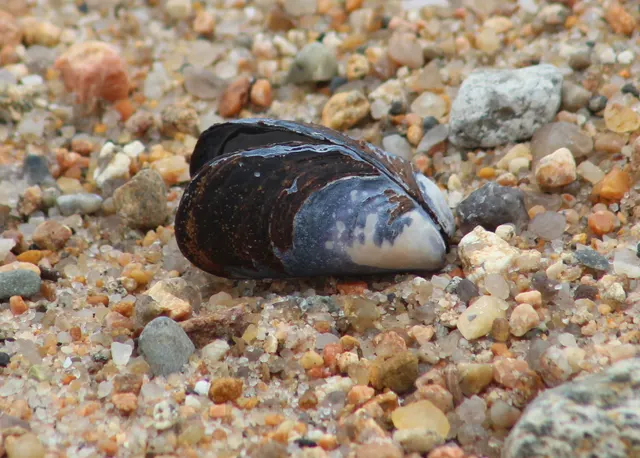 Blue musselBoth are filter-feeding bivalves with the same biotoxin problem and completely different collection: one is picked off a rock at low water, the other is dived for in cold water at depth.
- Razor clamThe two bivalves that require the biggest low springs and the most specific technique, and the pair that shows how much the sediment decides.
Rules and access
Sources and evidence
- FAO Species Identification Guides for Fishery Purposes and the FAO Species Catalogues — Food and Agriculture Organization of the United Nations (Scientific institute)Relied on for: Diagnostic identification characters, family placement, depth range and distribution as set out in the FAO species identification sheets for the eastern Atlantic and Mediterranean.States this directlyCitation checked — the work exists and is described correctly
- Cefas science, advice and data on marine and freshwater environments — Centre for Environment, Fisheries and Aquaculture Science (Government fisheries body)Relied on for: UK marine science: shellfish and crustacean stock monitoring, biotoxin surveillance, distribution and the biological basis of management advice.States this directlyCitation checked — the work exists and is described correctly
- Shellfish classification — Food Standards Agency, 2026 (Government fisheries body)Relied on for: The classification of shellfish harvesting areas, the monitoring that underlies it, and the marine biotoxin and microbiological risks that make gathered bivalves a food-safety matter rather than an angling one.States this directlyCitation checked — the work exists and is described correctly
- Good Fish Guide — Marine Conservation Society (Conservation authority)Relied on for: Assessment of the sustainability of UK-caught seafood by species, gear and stock, used here for the fishery context rather than for any statement of rules.States this directlyCitation checked — the work exists and is described correctly
- ICES Advice on fishing opportunities, catch and effort — International Council for the Exploration of the Sea (Scientific institute)Relied on for: Stock assessment and scientific advice for north-east Atlantic fisheries including shellfish and cephalopods.States this directlyCitation checked — the work exists and is described correctly
Why the 10 connections on this page are here, and the sources
How it is caught
What experienced anglers do — 1 connection
Widely and independently recommended by experienced anglers and specialist sources. This is real angling knowledge, not proof: controlled evidence for it is limited, and FishingHQ records it as convention rather than as a demonstrated effect.
Shore diving
Practice, recorded as practice.
- CMAS technical and sporting standards for underwater activities — Confédération Mondiale des Activités Subaquatiques (Standards body)Relied on for: Breath-hold diving and spearfishing practice, training structure and safety expectations as set out by the international underwater federation.States this directlyCitation checked — the work exists and is described correctly
- BlueWater Hunting and Freediving — BlueWater Freedivers, Ventura, California, 1995 (Practitioner report)Relied on for: Spearfishing practice: approach, fish behaviour and the handling of speared fish, from a practitioner tradition distinct from the European one.States this directlyCitation checked — the work exists and is described correctly
Where it lives
Backed by research — 1 connection
Supported by peer-reviewed research or fisheries science. The sources are listed and can be checked.
Inshore ground
A distributional claim about where a species is found, resting on the standard regional reference works rather than on angling report.
- The Fishes of the British Isles and North-West Europe — Macmillan, 1969 (Reference work)Relied on for: Distribution, habitat association, identification and biology of the fishes and inshore fauna of the British Isles and north-west Europe.States this directlyCitation checked — the work exists and is described correctly
- FAO Species Identification Guides for Fishery Purposes and the FAO Species Catalogues — Food and Agriculture Organization of the United Nations (Scientific institute)Relied on for: Diagnostic characters, family placement, habitat and depth range as set out in the FAO species identification sheets for the eastern Atlantic and Mediterranean.States this directlyCitation checked — the work exists and is described correctly
Understanding this fish
What experienced anglers do — 3 connections
Widely and independently recommended by experienced anglers and specialist sources. This is real angling knowledge, not proof: controlled evidence for it is limited, and FishingHQ records it as convention rather than as a demonstrated effect.
Diving for scallops
An explainer that carries the mechanism the subject record depends on.
- CMAS technical and sporting standards for underwater activities — Confédération Mondiale des Activités Subaquatiques (Standards body)Relied on for: Breath-hold diving and spearfishing practice, training structure and safety expectations as set out by the international underwater federation.States this directlyCitation checked — the work exists and is described correctly
- BlueWater Hunting and Freediving — BlueWater Freedivers, Ventura, California, 1995 (Practitioner report)Relied on for: Spearfishing practice: approach, fish behaviour and the handling of speared fish, from a practitioner tradition distinct from the European one.States this directlyCitation checked — the work exists and is described correctly
Gathering shellfish, and the hazard that cooking does not remove
An explainer that carries the mechanism the subject record depends on.
- Shellfish classification — Food Standards Agency, 2026 (Government fisheries body)Relied on for: The classification of shellfish harvesting areas, the monitoring behind it, and the biotoxin and microbiological risks that make gathered bivalves a food-safety matter.States this directlyCitation checked — the work exists and is described correctly
- Cefas science, advice and data on marine and freshwater environments — Centre for Environment, Fisheries and Aquaculture Science (Government fisheries body)Relied on for: UK biotoxin surveillance and shellfish monitoring.States this directlyCitation checked — the work exists and is described correctly
Shellfish biotoxins, algal blooms and the closure system
An explainer that carries the mechanism the subject record depends on.
- Shellfish classification — Food Standards Agency, 2026 (Government fisheries body)Relied on for: The classification of shellfish harvesting areas, the monitoring behind it, and the biotoxin and microbiological risks that make gathered bivalves a food-safety matter.States this directlyCitation checked — the work exists and is described correctly
- Cefas science, advice and data on marine and freshwater environments — Centre for Environment, Fisheries and Aquaculture Science (Government fisheries body)Relied on for: UK biotoxin surveillance and shellfish monitoring.States this directlyCitation checked — the work exists and is described correctly
Told apart from
What experienced anglers do — 2 connections
Widely and independently recommended by experienced anglers and specialist sources. This is real angling knowledge, not proof: controlled evidence for it is limited, and FishingHQ records it as convention rather than as a demonstrated effect.
Blue mussel
A comparison a reader with the animal or the decision in front of them actually needs, joining two records that resolve one another.
- Shellfish classification — Food Standards Agency, 2026 (Government fisheries body)Relied on for: The classification of shellfish harvesting areas, the monitoring behind it, and the biotoxin and microbiological risks that make gathered bivalves a food-safety matter.States this directlyCitation checked — the work exists and is described correctly
- Cefas science, advice and data on marine and freshwater environments — Centre for Environment, Fisheries and Aquaculture Science (Government fisheries body)Relied on for: UK biotoxin surveillance and shellfish monitoring.States this directlyCitation checked — the work exists and is described correctly
Razor clam
A comparison a reader with the animal or the decision in front of them actually needs, joining two records that resolve one another.
- Shellfish classification — Food Standards Agency, 2026 (Government fisheries body)Relied on for: The classification of shellfish harvesting areas, the monitoring behind it, and the biotoxin and microbiological risks that make gathered bivalves a food-safety matter.States this directlyCitation checked — the work exists and is described correctly
- Cefas science, advice and data on marine and freshwater environments — Centre for Environment, Fisheries and Aquaculture Science (Government fisheries body)Relied on for: UK biotoxin surveillance and shellfish monitoring.States this directlyCitation checked — the work exists and is described correctly
Safety reading
Official guidance — 2 connections
Stated by a fisheries authority, scientific institute or recognised angling body. Authoritative, but summarising rather than demonstrating.
Breath-hold blackout
A link to a safety topic substantial enough to be read in full.
- RNLI water safety guidance: cold water shock and Float to Live — Royal National Lifeboat Institution (Water-safety or diver-training authority)Relied on for: Water safety guidance for coastal and inland users.States this directlyPassage read and verified
The spearfishing buddy system
A link to a safety topic substantial enough to be read in full.
- RNLI water safety guidance: cold water shock and Float to Live — Royal National Lifeboat Institution (Water-safety or diver-training authority)Relied on for: Water safety guidance for coastal and inland users.States this directlyPassage read and verified
Rules and access
Official guidance — 1 connection
Stated by a fisheries authority, scientific institute or recognised angling body. Authoritative, but summarising rather than demonstrating.
Taking crabs, lobsters, squid and shellfish: how the rules are structured
This points to the kind of rule that applies rather than to any rule itself, so the page carries the notice that the requirement varies.
- Angling Trust guidance for anglers — Angling Trust (Angling or fisheries organisation)Relied on for: The structure of angling regulation and representation in England, and the framework within which anglers are asked to check local rules.States this directlyCitation checked — the work exists and is described correctly
- JNCC species and habitat conservation advice — Joint Nature Conservation Committee (Conservation authority)Relied on for: UK conservation designation and the framework of protected species and habitats.States this directlyCitation checked — the work exists and is described correctly
How FishingHQ labels evidence is explained in the evidence policy.