What does tench eat?
What is established about how tench feeds, kept separate from what anglers infer from it.
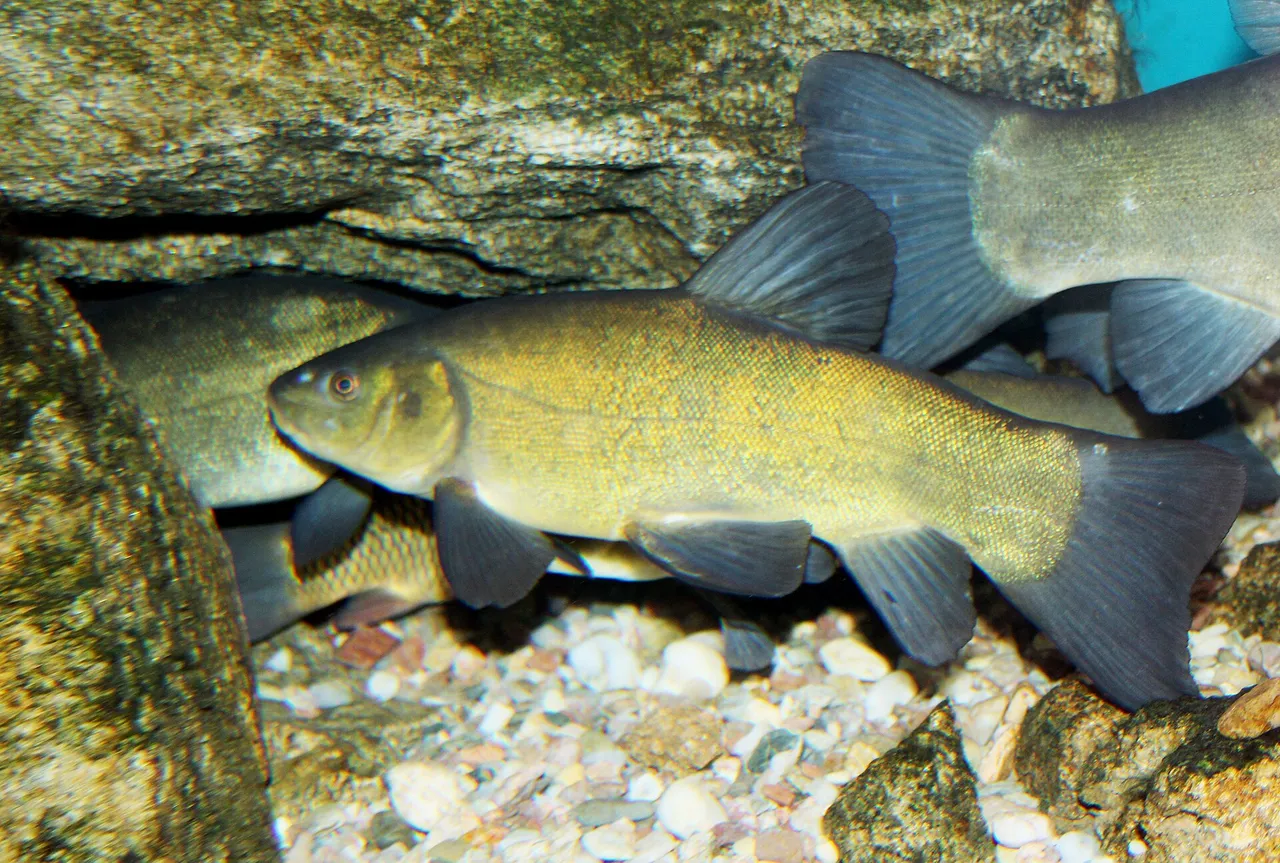
How this was identified, and who took it
Identified by: Deep olive-gold colouring, very small scales set in thick skin, uniformly rounded fins including a near-square tail, and a small red-orange eye.Karelj, Public domain, via Wikimedia Commons — source, licenceWhat is known about how it feeds
A tench gives itself away by breathing out the bed.
The fish roots through the top few centimetres of soft silt for bloodworm, snails and small crustaceans, working blind by touch and taste through the barbels and lips. That disturbance releases gas trapped in the sediment, and the resulting fine pinprick bubbling on the surface is the classic sign of feeding tench — a behavioural signature produced by the mechanics of the feeding rather than by the fish itself.
The single verified relationship is aquatic insect larvae at group level, and chironomid larvae dominate it in the silty, weedy, productive stillwaters the species favours.
Two physiological facts shape when this happens. Feeding is heavily temperature-dependent and close to absent in cold water, and tench are unusually tolerant of low dissolved oxygen, which allows them to feed in warm, weedy, silty margins that would be uninhabitable for most of the fish on FishingHQ.
The combination produces the strong dawn weighting the species is known for: warm shallow margins with the day's oxygen minimum behind them and the light still low.
There is no shift to fish prey at any size. A large tench is a large invertebrate feeder.
The food
Prey with a verified dietary link to this fish. Each entry carries its own evidence, and each is written at the precision the source actually used: a named species where the source named one, a group or food category where it said “polychaetes”, “crustaceans” or “detritus” and meant it. That is why this list is shorter than the animal’s real diet rather than longer.
- Aquatic insect larvae as prey — a group rather than a species: the evidence names the group
Tench feed in and on soft sediment among weed, taking insect larvae and small crustaceans, and the tell-tale bubbling of feeding tench comes from that sediment disturbance.
Food with no page of its own here yet
These are real components of the diet, listed as plain text because FishingHQ has no page for them yet. Inventing pages to make the list look fuller would be the fabrication this whole approach exists to prevent.
- snails and small bivalves
- freshwater shrimp
- plant material
- sediment detritus
- zooplankton, in smaller fish
What anglers do with this
Everything below is interpretation, not finding. It is what experienced anglers conclude from the biology above, and the reasoning is usually sound and almost never tested. It is separated from the biology deliberately.
The bubbling is the most directly usable observation in this file: it locates feeding fish, in real time, without any equipment. Anglers have used it for as long as the species has been fished for, and the mechanism above explains why it works and why it is specific to soft-sediment feeding rather than to tench as such.
The dawn weighting and the temperature dependence together produce the standard expectation about when the fishery works, and both follow from documented physiology rather than from tradition.
The oxygen tolerance has a less obvious consequence anglers use: tench remain catchable in warm, weedy, low-oxygen margins in conditions where other species have moved out, which turns an apparently poor swim into a good one.
What this does not establish
One group-level relationship for an omnivore that also takes substantial plant and detrital material. Composition varies with sediment and productivity, and nothing here establishes proportions. The bubbling sign indicates feeding on soft sediment and is not exclusive to this species.
Where this connects
These are the baits, lures, methods and explainers FishingHQ already joins to this fish — which is why the list is sometimes short. They are not chosen for this page, and a link here means an evidenced relationship exists, not that it follows from the diet.
Methods used for it
The science behind the feeding
This page covers feeding. The Tench record covers identification, lifecycle, seasonal behaviour, handling and the sources behind all of it.
Reviewed 2026-08-12.