What does largemouth bass eat?
What is established about how largemouth bass feeds, kept separate from what anglers infer from it.
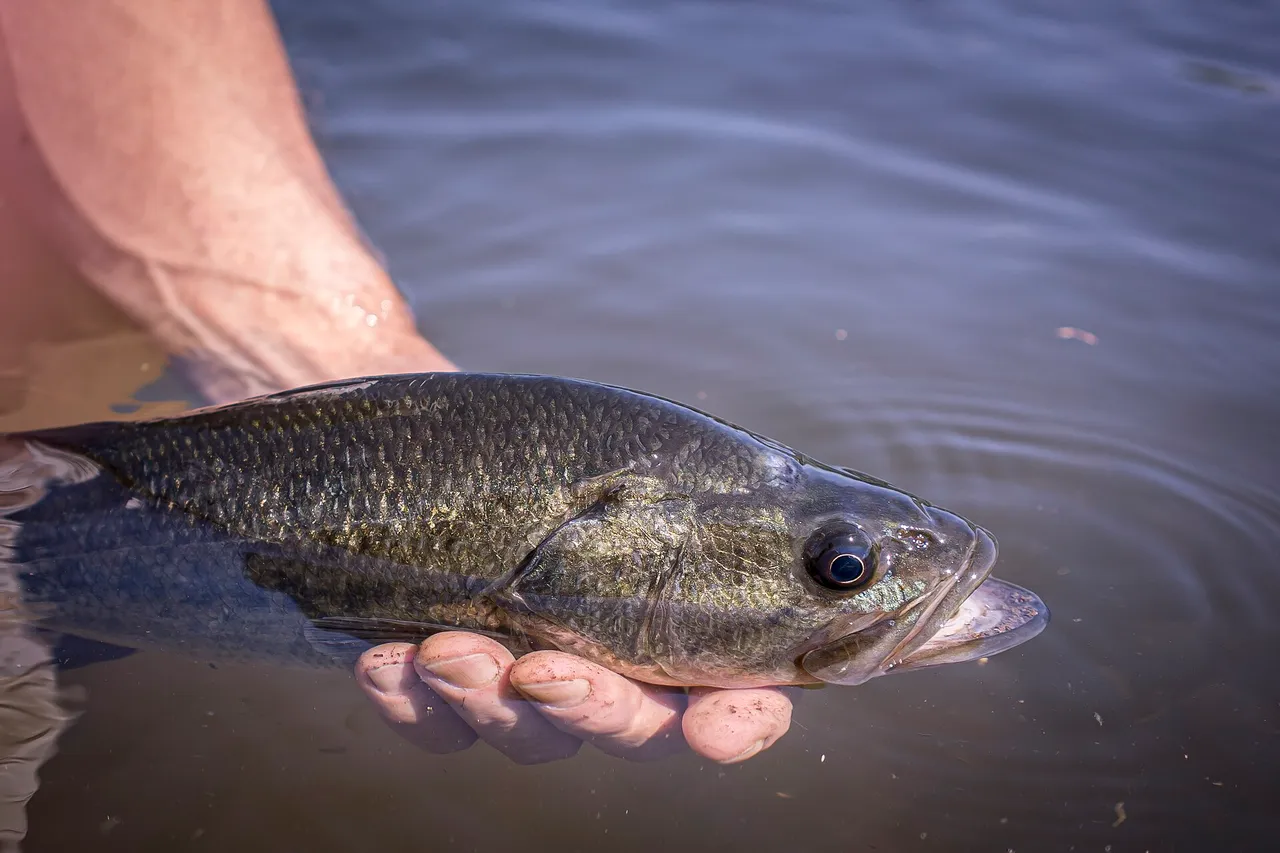
How this was identified, and who took it
Identified by: The upper jaw extends clearly past the rear edge of the eye, which is the defining separation from smallmouth bass, together with the deep body and the dark mottled flank.USFWS Mountain Prairie, Public domain, via Wikimedia Commons — source, licenceWhat is known about how it feeds
FishingHQ holds NO verified record of what largemouth bass eat, and this page says so rather than inventing one. What it does hold is the feeding biology, and the central fact is the gape. The upper jaw extends past the rear margin of the eye — the character that identifies the species — and that jaw is the functional expression of how the fish feeds: a very large mouth opened suddenly creates an inrush of water that draws prey in, so the fish engulfs rather than bites. The mechanism, suction feeding, does not require the fish to overtake anything, which is why an ambush position beside cover is worth more to a largemouth than open-water speed. Diet is broadly opportunistic within the size the gape allows and includes fish, crayfish, amphibians and large invertebrates. Feeding is strongly temperature-linked: metabolic rate, and with it feeding frequency, rises and falls with water temperature across the species' range, which is a physiological relationship rather than a seasonal generalisation. Prey size scales with fish size in the usual way, and large individuals take prey that would be implausible for the same species at half the length.
The food
There is no verified dietary link here for this species yet. That is a gap in what has been checked rather than a statement about the fish, and this page says so rather than filling it with food nobody can stand behind.
Food with no page of its own here yet
These are real components of the diet, listed as plain text because FishingHQ has no page for them yet. Inventing pages to make the list look fuller would be the fabrication this whole approach exists to prevent.
- sunfish species
- crayfish
- amphibians
- large aquatic insects
- juvenile largemouth bass (cannibalism)
What anglers do with this
Everything below is interpretation, not finding. It is what experienced anglers conclude from the biology above, and the reasoning is usually sound and almost never tested. It is separated from the biology deliberately.
Almost the whole edifice of largemouth lure fishing rests on the suction-feeding and ambush points above, and almost none of it has been tested experimentally — it is practitioner consensus of unusual depth and consistency, which is a different thing from evidence. Presentations worked close to cover, and the convention that a bass will take a bait disproportionately large for its length, both follow reasonably from the biology. What does not depend on interpretation: the temperature relationship means a bass fought hard in warm water is recovering under worse conditions than the same fight in spring, and that is a handling constraint rather than a tactic.
What this does not establish
This page is built on feeding behaviour rather than on verified prey edges, because FishingHQ carries none for this species — a gap it names rather than fills. The prey groups listed are not modelled as entities and carry no edge-level evidence. Diet composition varies with water type, forage base and season, and nothing here describes any particular fishery.
Where this connects
These are the baits, lures, methods and explainers FishingHQ already joins to this fish — which is why the list is sometimes short. They are not chosen for this page, and a link here means an evidenced relationship exists, not that it follows from the diet.
Lures recorded for this species
Methods used for it
Where it lives
The science behind the feeding
This page covers feeding. The Largemouth bass record covers identification, lifecycle, seasonal behaviour, handling and the sources behind all of it.
Reviewed 2026-08-10.