What does chub eat?
What is established about how chub feeds, kept separate from what anglers infer from it.
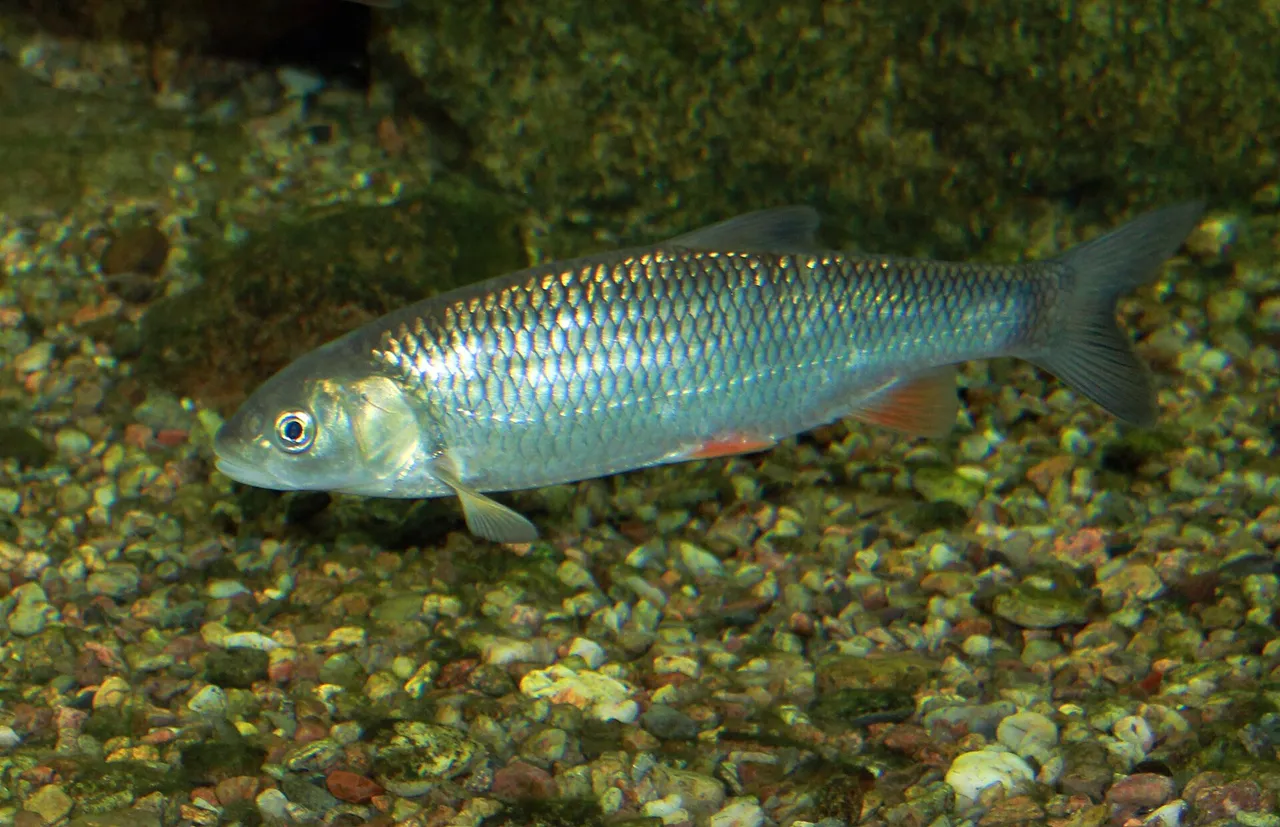
How this was identified, and who took it
Identified by: Blunt broad head with a large mouth, large scales with dark edging producing a net pattern, and a convex anal fin — the last being the standard separation from dace, whose anal fin is concave.Karelj, Public domain, via Wikimedia Commons — source, licenceWhat is known about how it feeds
The chub is the species on FishingHQ that most clearly changes what it is over a lifetime, and the change is visible in what it eats.
A small chub is an invertebrate feeder taking insect larvae from the bed and the drift. A large chub is a predator, taking small fish and crayfish, and it will do so with a decisiveness that surprises anglers who think of the species as a coarse fish.
The two verified relationships bracket that transition: aquatic insect larvae for the early phase, freshwater crayfish for the later one. The crayfish relationship carries a further complication worth stating — the spread of introduced crayfish across European rivers has measurably changed what large chub eat, so this is a diet that is still moving.
Vision dominates throughout, and it is acute. Chub feed heavily on items falling from the bank and therefore watch upwards and outwards, which is unusual for a river cyprinid and explains the species' reputation for being difficult to approach: the same attention that intercepts a beetle off an overhanging branch registers an angler on the skyline.
The practical consequence of the whole picture is that chub occupy an awkward position in angling, targeted as a coarse fish by one person and as a predator by another on the same stretch on the same day. Both are correct, and which one is correct depends on the size of the fish.
The food
Prey with a verified dietary link to this fish. Each entry carries its own evidence, and each is written at the precision the source actually used: a named species where the source named one, a group or food category where it said “polychaetes”, “crustaceans” or “detritus” and meant it. That is why this list is shorter than the animal’s real diet rather than longer.
- Aquatic insect larvae as prey — a group rather than a species: the evidence names the group
Chub are omnivores whose diet is dominated by invertebrates for most of their lives, with fish prey becoming significant only in large individuals.
- Freshwater crayfish as prey — a group rather than a species: the evidence names the group
Crayfish are taken readily where they occur, and the spread of introduced crayfish across European rivers has measurably changed what large chub eat.
Food with no page of its own here yet
These are real components of the diet, listed as plain text because FishingHQ has no page for them yet. Inventing pages to make the list look fuller would be the fabrication this whole approach exists to prevent.
- terrestrial insects fallen from the bank
- minnows and bullheads
- berries and fruit falling from overhanging trees
- fish eggs
- amphibians, occasionally
What anglers do with this
Everything below is interpretation, not finding. It is what experienced anglers conclude from the biology above, and the reasoning is usually sound and almost never tested. It is separated from the biology deliberately.
The upward-watching habit is the reasoning behind the approach conventions the species is known for — staying off the skyline, working upstream, keeping low — and it is convention derived from a documented sensory orientation.
The ontogenetic shift is the reason two quite different angling approaches both work, and anglers use it deliberately: an approach aimed at invertebrate feeders and one aimed at a predator select for different sizes of fish on the same water. That is practitioner reasoning rather than a tested selection effect.
The willingness to take items falling from the bank underlies the long tradition of using terrestrial baits for chub, which is a practice evidenced separately from the diet fact that motivates it.
What this does not establish
Both relationships are group-level. The diet is broadly omnivorous and includes plant material, terrestrial insects and fish, none of which is fully represented. The balance shifts continuously with fish size, and the crayfish component depends on whether introduced crayfish are present, which varies river by river and is changing.
Where this connects
These are the baits, lures, methods and explainers FishingHQ already joins to this fish — which is why the list is sometimes short. They are not chosen for this page, and a link here means an evidenced relationship exists, not that it follows from the diet.
Baits recorded for this species
Lures recorded for this species
Methods used for it
Where it lives
The science behind the feeding
This page covers feeding. The Chub record covers identification, lifecycle, seasonal behaviour, handling and the sources behind all of it.
Reviewed 2026-08-12.