What does bonefish eat?
What is established about how bonefish feeds, kept separate from what anglers infer from it.
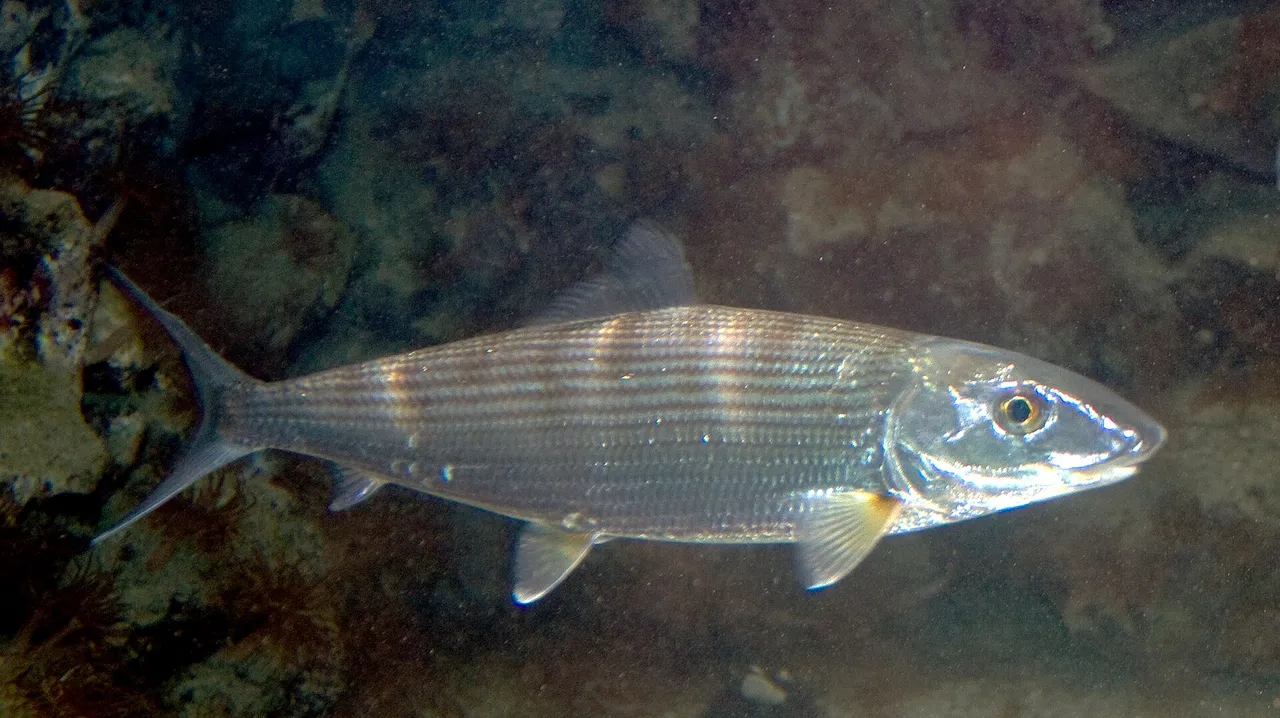
How this was identified, and who took it
Identified by: Sharp, complete lateral view of a free-swimming fish. The conical pointed snout with a distinctly inferior mouth, the slender silver body with faint longitudinal striping, the single dorsal fin and the deeply forked tail together identify the species, and the head shape in particular separates it from the mullets it is superficially similar to at a distance.Brian Gratwicke — CC BY 2.0, via Wikimedia Commons — source, licenceWhat is known about how it feeds
The bonefish is built to eat things that are buried and armoured, on a flat where there is nothing to hide behind.
Feeding is head-down rooting in sediment for crabs, shrimps, worms and small molluscs, and the prey is crushed with heavy pharyngeal plates rather than bitten. The mouth is inferior and the snout is conical, which is the shape of an animal that works the bottom.
Both verified relationships describe that: decapod crustaceans and molluscs, each at group level.
The posture produces the fishery. A feeding fish in shallow water tips down and the tail breaks the surface — tailing — and the sight fishery on the flats depends entirely on that visual signature.
The other side of feeding on an open flat is exposure. A bonefish on a shallow flat is visible to birds from above and to sharks from the channels, and the species' extreme wariness is a rational response rather than a temperament. That wariness is the reason approach matters more in this fishery than in almost any other.
Tide governs access. The fish move onto the flats to feed as water covers them and off again as it drops, so the feeding window is set by depth and the whole activity is tidal rather than diurnal.
The food
Prey with a verified dietary link to this fish. Each entry carries its own evidence, and each is written at the precision the source actually used: a named species where the source named one, a group or food category where it said “polychaetes”, “crustaceans” or “detritus” and meant it. That is why this list is shorter than the animal’s real diet rather than longer.
- Decapod crustaceans as prey — a group rather than a species: the evidence names the group
Bonefish feed on crustaceans taken from sand and grass flats, rooting head-down in a manner that produces the tailing behaviour the fishery depends on for sight casting.
- Bivalve and gastropod molluscs as prey — a group rather than a species: the evidence names the group
Small molluscs are taken from flats sediment alongside crustaceans and are crushed with heavy pharyngeal teeth.
Food with no page of its own here yet
These are real components of the diet, listed as plain text because FishingHQ has no page for them yet. Inventing pages to make the list look fuller would be the fabrication this whole approach exists to prevent.
- marine worms
- small snapping shrimps
- juvenile fish
- sea urchins
- clams
What anglers do with this
Everything below is interpretation, not finding. It is what experienced anglers conclude from the biology above, and the reasoning is usually sound and almost never tested. It is separated from the biology deliberately.
Tailing is the location method and the fishery exists because of it. That is observation rather than inference.
The crustacean diet is the reasoning behind the whole design tradition of bonefish flies, which imitate shrimps and small crabs and are weighted to sit on the bottom in the attitude of prey trying to hide. The connection from diet to imitation is explicit and long-established, and it is practitioner reasoning rather than a tested comparison.
The wariness converts into approach discipline — distance, quiet, sun angle, line control — which is convention with an obvious basis in a fish that is being hunted while it feeds.
Bonefish are almost universally released, and the presence of sharks on many flats makes a prolonged fight and a slow release a genuine risk to the fish rather than a theoretical one.
What this does not establish
Both relationships are group-level. Composition varies between flats, sediment types and regions, and nothing here establishes proportions. The account describes the western Atlantic species; several related bonefish species occur elsewhere and are not covered.
Where this connects
These are the baits, lures, methods and explainers FishingHQ already joins to this fish — which is why the list is sometimes short. They are not chosen for this page, and a link here means an evidenced relationship exists, not that it follows from the diet.
Baits recorded for this species
Lures recorded for this species
Methods used for it
Where it lives
The science behind the feeding
This page covers feeding. The Bonefish record covers identification, lifecycle, seasonal behaviour, handling and the sources behind all of it.
Reviewed 2026-08-12.