What does black seabream eat?
What is established about how black seabream feeds, kept separate from what anglers infer from it.
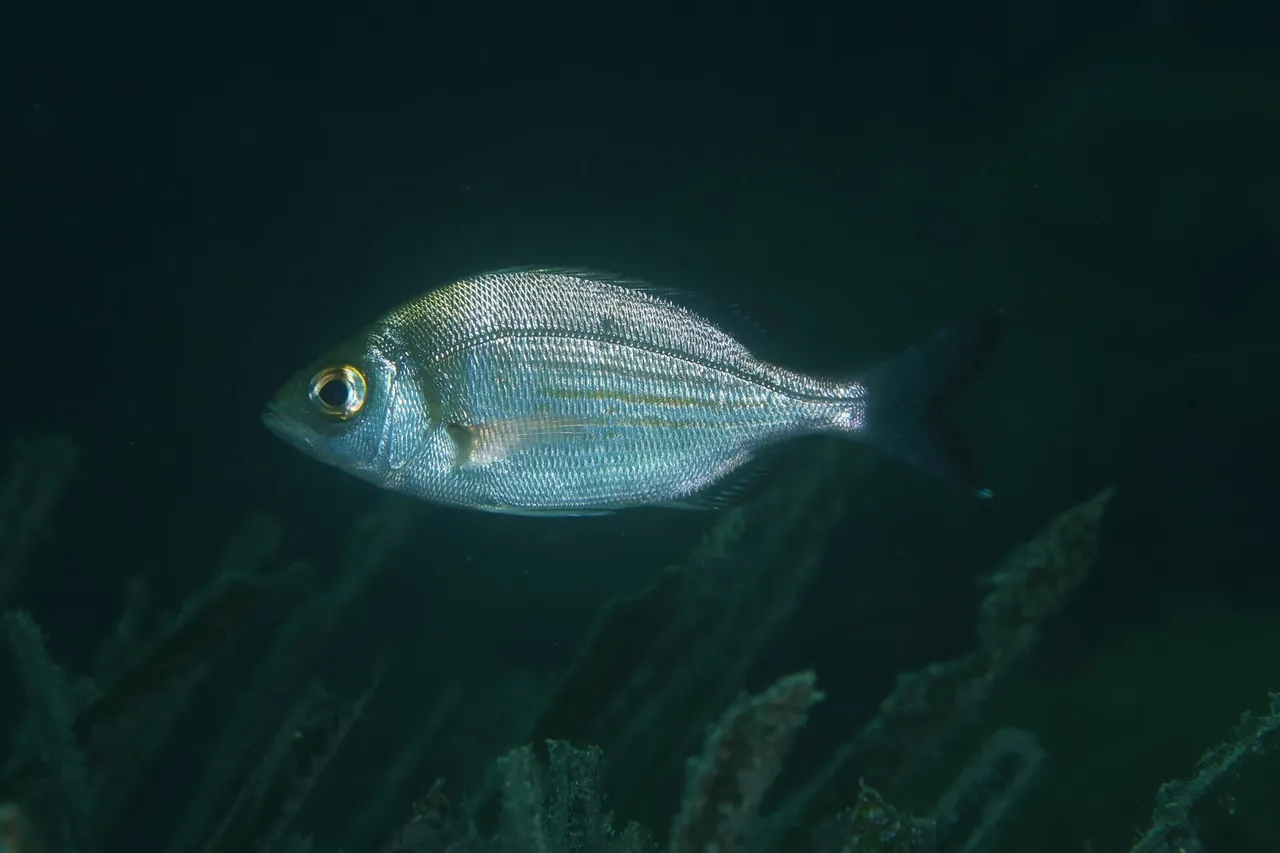
How this was identified, and who took it
Identified by: A deep strongly compressed oval body carrying a single long dorsal whose spiny portion runs continuously into the soft portion, with faint golden longitudinal lines over silver, a small mouth and a gold-ringed eye. The bold vertical bars and dark caudal saddle that would make it a white seabream are absent. Three agreeing identifications.Julien Renoult — CC BY, via iNaturalist — source, licenceWhat is known about how it feeds
A black bream browses. It does not hunt, and almost every practical difficulty in catching one follows from that.
The three verified relationships are decapod crustaceans, polychaete worms and small bivalve and gastropod molluscs, and to those should be added hydroids, bryozoans and the general weed-associated growth that coats reef, wreck and coarse ground. The fish works over structure taking small items off it.
The mouth is the evidence. A black bream has a small mouth carrying rows of small, close-set teeth at the front — no canines, no cutting edges, nothing built for seizing or shearing. That is a picking and nipping apparatus, and it means the fish does not engulf a food item so much as take pieces out of it.
Vision leads. These are daylight fish over structure in generally clear summer water, and they are noticeably wary in it, which is a different sensory profile from the scent-led bottom feeders on the sand nearby.
Feeding changes markedly around spawning. A male guarding a nest feeds little for the whole incubation, defending the nest instead, and his behaviour becomes aggressive rather than cautious. That is a genuine behavioural switch rather than a reduction in appetite, and it is why fish that are hard to approach in high summer can be easy to catch in late spring.
The sex-change biology sits underneath all of this. Individuals generally function as females first and some later become males, so the largest fish in a population are disproportionately male and disproportionately likely to be the ones guarding.
The food
Prey with a verified dietary link to this fish. Each entry carries its own evidence, and each is written at the precision the source actually used: a named species where the source named one, a group or food category where it said “polychaetes”, “crustaceans” or “detritus” and meant it. That is why this list is shorter than the animal’s real diet rather than longer.
- Decapod crustaceans as prey — a group rather than a species: the evidence names the group
Small crustaceans picked off reef, wreck and weed. The small mouth and close-set front teeth suit nipping rather than engulfing.
- Polychaete worms as prey — a group rather than a species: the evidence names the group
Worms taken from coarse ground and from among weed-associated growth.
- Bivalve and gastropod molluscs as prey — a group rather than a species: the evidence names the group
Small molluscs browsed from structure, part of a diet gathered rather than hunted.
Food with no page of its own here yet
These are real components of the diet, listed as plain text because FishingHQ has no page for them yet. Inventing pages to make the list look fuller would be the fabrication this whole approach exists to prevent.
- hydroids
- bryozoans
- weed-associated invertebrates
- algae taken incidentally
- small fish, occasionally
What anglers do with this
Everything below is interpretation, not finding. It is what experienced anglers conclude from the biology above, and the reasoning is usually sound and almost never tested. It is separated from the biology deliberately.
Everything black bream anglers converge on follows from the mouth, and it is practitioner reasoning throughout.
SMALL BAITS ON SMALL HOOKS is the near-universal conclusion, and the argument is direct: a fish that nibbles a bait apart will produce a series of rattles on a large bait and take the hook on none of them. Cutting squid strip small so that the first proper bite includes the hook is the standard answer to the standard complaint about unhittable bream bites.
FINE TRACES follow from the visual profile rather than from the diet. Bream are wary in clear water, so the emphasis falls on presentation rather than on scent — the opposite emphasis from dab or flounder fishing, and a good illustration of why generic bait advice fails.
Squid strip and ragworm are the conventional baits and both sit within the diet.
The restraint question is not interpretation and belongs on this page rather than only on the species page. The fishing is best precisely when males are guarding nests on known gravel grounds, and a guarding male taken off a nest costs the brood he was defending as well as the fish. Combined with the sex-change biology, keeping only the largest fish is, in this species specifically, a decision to remove breeding males.
What this does not establish
All three relationships are group-level and none establishes proportions. The hydroid, bryozoan and general browsing component is substantial in the literature and rests on no modelled relationship, because FishingHQ holds no records to point at. Nothing here quantifies the reduction in feeding during nest guarding, and nothing establishes how diet differs between the northern edge of the range and the Mediterranean, where the species is present year-round rather than seasonally.
Where this connects
These are the baits, lures, methods and explainers FishingHQ already joins to this fish — which is why the list is sometimes short. They are not chosen for this page, and a link here means an evidenced relationship exists, not that it follows from the diet.
Baits recorded for this species
Methods used for it
Where it lives
The science behind the feeding
This page covers feeding. The Black seabream record covers identification, lifecycle, seasonal behaviour, handling and the sources behind all of it.
Reviewed 2026-08-15.