How to identify japanese sea bass
Lateolabrax japonicus · Lateolabracidae
The characters that identify japanese sea bass, ranked by how far each one can be trusted on its own.
Safety: injury while handling fish — minor injury.
How this was identified, and who took it
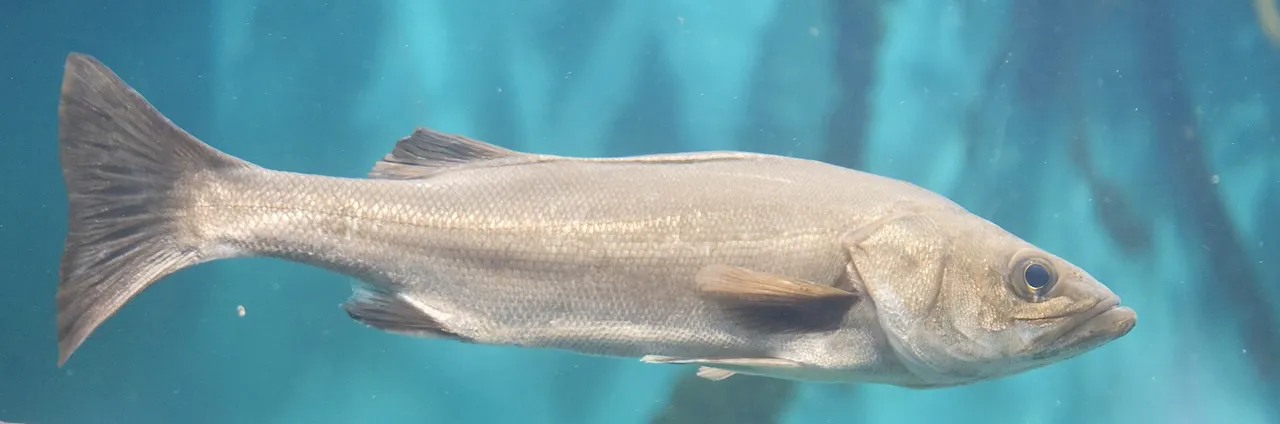
Identified by: A full lateral view of an adult against a plain ground. Slim silver body with a greenish-grey back, a pointed snout with a projecting lower jaw, a large oblique mouth, sharp-edged gill covers and a deeply forked tail. Spotting is absent, which agrees with the record's statement that it fades progressively in larger adults rather than contradicting it. The first dorsal is laid flat against the back, so the spiny fin reads as a ridge rather than a raised fan.Kinori — CC0 1.0, via Wikimedia Commons — source, licenceLook at this first
Take the profile first: a long slim silver fish with a pointed snout, a projecting lower jaw and a deeply forked tail, in an estuary or surf line in the western Pacific. Then accept that separating it from its own close congener is genuinely difficult, and read the limits below before calling it.
No single character settles this one. Everything below is supporting or suggestive, and a confident identification needs several of them together — or, for the hardest cases, a count that cannot be made from a photograph.
Supporting — use with other characters
Real characters that are not conclusive by themselves. Use two or three together.
Projecting lower jaw on a pointed snout
The lower jaw extends beyond the upper and the snout is drawn to a point, giving the head a distinctly predatory wedge. The mouth is large and set obliquely. It places the fish among the temperate basses and rules out the mullets and the sea breams sharing the same estuary water.
Two dorsal fins, the first strongly spiny
The first dorsal is a separate spiny fin standing ahead of the soft-rayed second. When the fish is relaxed the first dorsal lies flat and reads as a ridge, so raise it or look for the spine bases before deciding a fish has only one dorsal.
Sharp-edged gill covers
The rear edges of the gill plates are sharp enough to cut a hand that slides across them. Worth knowing for handling, and a shared character with the temperate basses generally rather than a species-level one.
Suggestive only — varies with condition
Hints only. These vary with condition, season, water and how long the fish has been out of it, and a fish that contradicts them is still the same species.
Spotting that fades with size
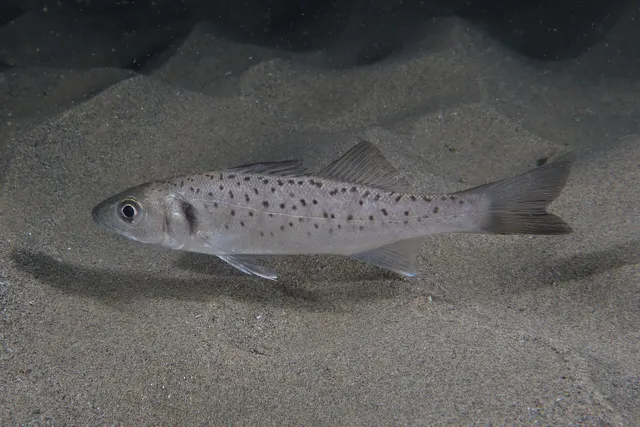
Younger fish carry small dark spots on the back and on the first dorsal fin. These fade progressively as the fish grows, so a large adult is plain silver. The spots help on a small fish and their absence says nothing about a big one.
What it gets confused with
- Blackfin sea bass (Lateolabrax latus), which overlaps in southern Japan and is separated on scale counts and on the depth of the caudal peduncle rather than on anything a photograph shows well.
- Chinese sea bass (Lateolabrax maculatus), which retains its spotting into adulthood where L. japonicus loses it, and dominates in continental Asian estuaries.
- European sea bass, which the species resembles closely but does not overlap with — range settles this one entirely.
Side by side: Japanese sea bass vs European sea bass.
Where this stops working
This page leads with difficulty rather than a character because the honest answer is that *Lateolabrax* is a genus whose members are separated by counts. Adults of the Japanese and blackfin sea bass are told apart on lateral-line scale counts and on peduncle proportions, neither of which a reader is likely to make on a wet fish at night, and the retention of spotting in *L. maculatus* is a tendency rather than a rule. Where a fish is to be retained under a species-specific rule, the count is what the rule means. The generic identification — a temperate sea bass rather than something else — is straightforward; the species-level one frequently is not, and saying so is more useful than a confident page would be.
The full record
This page covers identification only. The Japanese sea bass record covers behaviour, lifecycle, distribution, handling and the sources behind all of it.
Reviewed 2026-08-15.
More about this fish
Telling it apart is one question. Here are the others.
Similar and related fish
How it is caught
Where it lives
Where you will find it
Why the 8 connections on this page are here, and the sources
Similar and related fish
Backed by research — 2 connections
Supported by peer-reviewed research or fisheries science. The sources are listed and can be checked.
European sea bass
An identification comparison naming both binomials: Lateolabrax japonicus and Dicentrarchus labrax.
- FishBase: a global information system on fishes — Froese, R. and D. Pauly, eds. — FishBase Consortium (Scientific institute)Relied on for: Morphological and distributional data for Lateolabrax japonicus and for Dicentrarchus labrax.States this directlyPassage read and verified
- The IUCN Red List of Threatened Species — International Union for Conservation of Nature (Conservation authority)Relied on for: Separate assessments treating Lateolabrax japonicus and Dicentrarchus labrax as distinct species.States this directlyCitation checked — the work exists and is described correctly
Japanese anchovy
Recorded diet evidence identifies Engraulis japonicus as a food item of this predator at species level. The edge is written at that granularity and no further.
- FishBase: a global information system on fishes — Froese, R. and D. Pauly, eds. — FishBase Consortium (Scientific institute)Relied on for: Food items recorded for this predator, including Engraulis japonicus.States this directlyPassage read and verified
- FAO Species Identification Guides for Fishery Purposes and the FAO Species Catalogues — Food and Agriculture Organization of the United Nations (Scientific institute)Relied on for: Species account describing the diet of this predator in the region where Engraulis japonicus occurs.Background and mechanism onlyCitation checked — the work exists and is described correctly
How it is caught
What experienced anglers do — 2 connections
Widely and independently recommended by experienced anglers and specialist sources. This is real angling knowledge, not proof: controlled evidence for it is limited, and FishingHQ records it as convention rather than as a demonstrated effect.
Popping and stickbaiting
A practitioner claim about how Lateolabrax japonicus is commonly fished, following from where and how it feeds.
- General angling website restatements of established technique — Various (Credible secondary source)Relied on for: Widely restated practitioner accounts of fishing for japanese sea bass.Citation checked — the work exists and is described correctly
- Sea Angler — Bauer Media (Specialist angling publication)Relied on for: Practitioner treatment of the methods used for japanese sea bass and comparable species.Citation checked — the work exists and is described correctly
Spinning
A practitioner claim about how Lateolabrax japonicus is commonly fished, following from where and how it feeds.
- General angling website restatements of established technique — Various (Credible secondary source)Relied on for: Widely restated practitioner accounts of fishing for japanese sea bass.Citation checked — the work exists and is described correctly
- Sea Angler — Bauer Media (Specialist angling publication)Relied on for: Practitioner treatment of the methods used for japanese sea bass and comparable species.Citation checked — the work exists and is described correctly
Where it lives
Backed by research — 3 connections
Supported by peer-reviewed research or fisheries science. The sources are listed and can be checked.
Estuary
A habitat association for Lateolabrax japonicus taken from the environment and distribution data on its FishBase summary.
- FishBase: a global information system on fishes — Froese, R. and D. Pauly, eds. — FishBase Consortium (Scientific institute)Relied on for: The environment, depth range and habitat description recorded for Lateolabrax japonicus.States this directlyPassage read and verified
Harbours, piers and breakwaters
A habitat association for Lateolabrax japonicus taken from the environment and distribution data on its FishBase summary.
- FishBase: a global information system on fishes — Froese, R. and D. Pauly, eds. — FishBase Consortium (Scientific institute)Relied on for: The environment, depth range and habitat description recorded for Lateolabrax japonicus.States this directlyPassage read and verified
Surf beaches
A habitat association for Lateolabrax japonicus taken from the environment and distribution data on its FishBase summary.
- FishBase: a global information system on fishes — Froese, R. and D. Pauly, eds. — FishBase Consortium (Scientific institute)Relied on for: The environment, depth range and habitat description recorded for Lateolabrax japonicus.States this directlyPassage read and verified
Where you will find it
Backed by research — 1 connection
Supported by peer-reviewed research or fisheries science. The sources are listed and can be checked.
Korea
A distribution association between an animal and a kind of water, rather than a claim about any named mark.
- FishBase: a global information system on fishes — Froese, R. and D. Pauly, eds. — FishBase Consortium (Scientific institute)Relied on for: Distribution, habitat association and depth range recorded for the species, including its occurrence in the water body concerned.States this directlyPassage read and verified
- The IUCN Red List of Threatened Species — International Union for Conservation of Nature (Conservation authority)Relied on for: Assessment and range account for the species, including the systems and coasts it occupies.Background and mechanism onlyCitation checked — the work exists and is described correctly
Safety
Injury while handling fish — Minor injury
The rear edges of the gill covers are sharp and cause deep cuts to hands during landing and unhooking.
What reduces it: Grip the lower jaw or support the body, and keep hands clear of the gill plate edges. Use a lip grip tool where available.