Nile perch
Fish · Last reviewed 2026-08-10
A huge African predator that is a major food fishery, a sport fish, and the cause of one of the worst extinction events on record.
Safety: biosecurity and disease transfer — can cause serious injury or death. 6 more points apply here.
How this was identified, and who took it
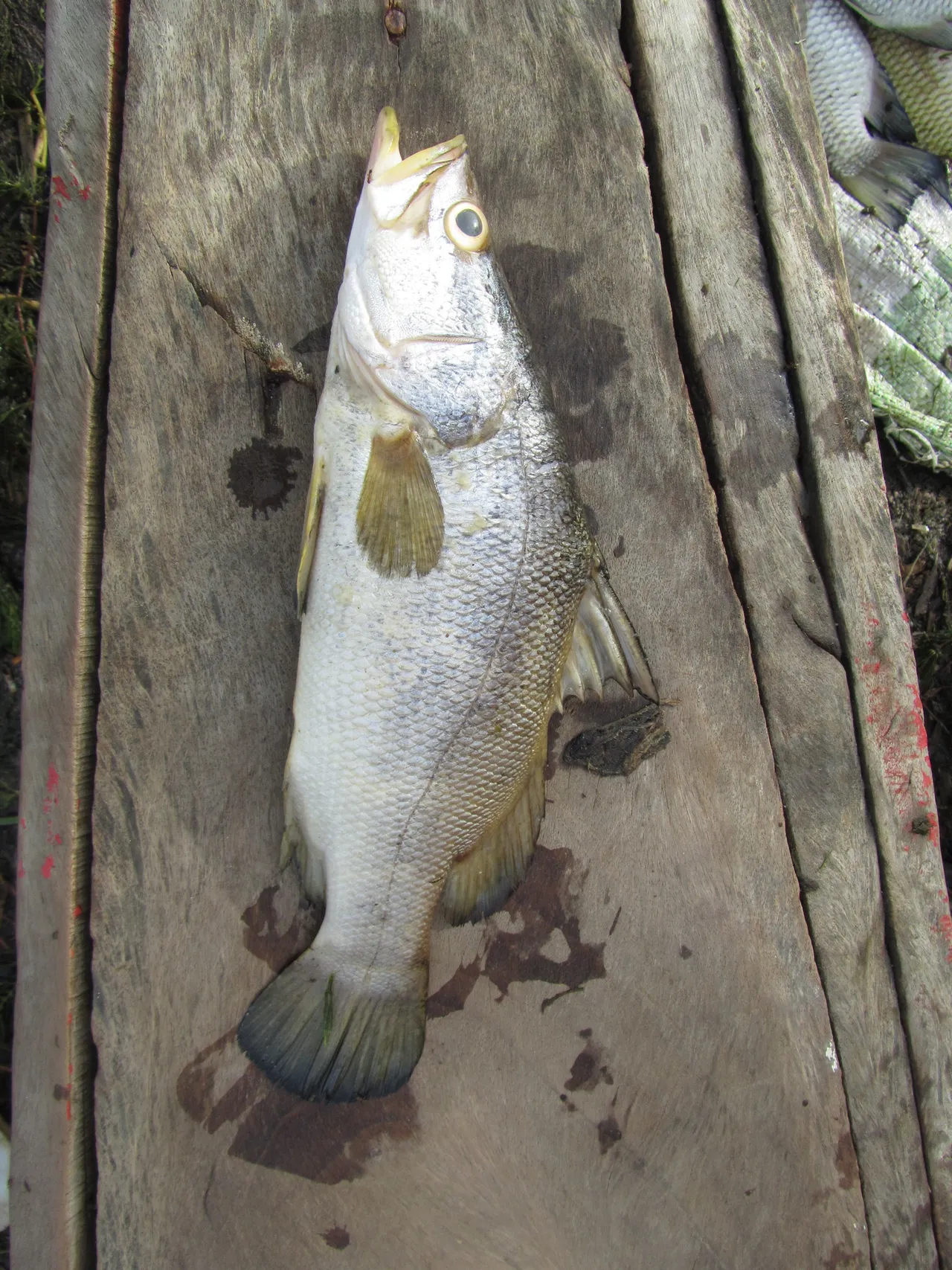
Identified by: The distinctly CONCAVE head profile the record leads on, dipping between snout and nape, above a deep body with a large gold-ringed eye and the heavy jaw of a large protrusible mouth. The spiny dorsal and the soft dorsal behind it are both visible with the notch between them.Lucy Keith-Diagne — CC BY, via iNaturalist — source, licenceCatching Nile perch
Everything here on fishing for it. Each entry opens the page behind it.
The Nile perch is one of the largest freshwater fish in the world, reaching close to two metres and nearly two hundred kilograms. It is native to the Nile and to much of the river systems of northern and western Africa, where it has been fished and eaten for thousands of years — it appears in ancient Egyptian art, and was mummified.
It is also the subject of the clearest ecological cautionary tale in fishing.
In the 1950s and early 1960s Nile perch were introduced into Lake Victoria, a lake that had held one of the most remarkable assemblages of fish on Earth: several hundred species of haplochromine cichlid, most found nowhere else, produced by an exceptionally rapid radiation. The perch population expanded through the 1980s, and the cichlid community collapsed. Estimates of the number of species lost or reduced to remnant populations run into the hundreds. It is routinely described as one of the largest vertebrate extinction events attributable to a single human action.
The complication, and the reason this is not a simple morality tale, is that the resulting Nile perch fishery became a major economic activity supporting very large numbers of people, and an export industry. The fish that destroyed the lake's biodiversity also feeds a great many people who had little say in either.
FishingHQ includes it because both facts are true, and because a species catalogue that only celebrates is not a reference work.
How it is caught
- SpinningCasting to visible structure from a boat or a shoreline takes Nile perch holding tight to rock, and it is how most shore-based fishing for them is conducted.
- TrollingTrolling large lures around rocky structure and drop-offs is the established Lake Nasser and Rift lake method, covering the volume a shore or drifting angler cannot.
Gear for this fish
Identification
- Scientific name
- Lates niloticus
- Family
- Latidae
- Water
- Freshwater, Brackish
- Conservation status
- Least Concern
- Regions
- East & Southern Africa, West Africa, North Africa
- Very large, deep-bodied fish with a distinctly concave head profile and a large protrusible mouth — the family resemblance to barramundi is immediately obvious.
- Dorsal fin deeply notched between spiny and soft portions.
- Silver with a blue tinge overall; large scales; rounded tail.
- The eye is distinctly black with a bright yellow outer ring, which is the most useful single field character.
- Separated from congeners in Africa principally by size, head profile and the eye colouration.
Size
- Typical
- 5–20 kg (11–44 lb)
- Large
- 40–80 kg (88–176 lb)
Exceptional: Over 150 kg (330 lb); a widely reported angling figure rather than a published scientific maximum
Lake Victoria, and what an introduction can cost
Lake Victoria before the introduction held one of the most striking evolutionary radiations known: several hundred species of haplochromine cichlid, the great majority endemic to the lake, having diversified over a geologically very short period into an extraordinary range of feeding specialisms.
Nile perch were introduced in the 1950s and early 1960s. The population remained modest for roughly two decades and then expanded rapidly through the 1980s. The haplochromine community collapsed over the same period, and a large proportion of those species have not been recorded since. The number is genuinely uncertain — many were described only shortly before the collapse and some were probably never described at all — but the scale is not in dispute, and the event is routinely cited as among the largest vertebrate extinction episodes attributable to a single human decision.
Several factors acted together rather than predation alone. Eutrophication from catchment agriculture and population growth reduced water clarity, which mattered enormously for fish whose mate choice depends on seeing colour; deoxygenation of deeper water removed refuge habitat; and the fishery itself intensified. But the perch was the proximate agent and, being a generalist predator, it did not become less effective as its prey became rarer — which is the mechanism by which a predator can drive prey species to extinction rather than to a low equilibrium.
The honest coda is that the fishery which replaced the cichlids became economically important to a very large number of people. That does not make the loss acceptable, and it does make the situation irreversible in practice. The general lesson for anglers everywhere is the one FishingHQ repeats: NEVER MOVE LIVE FISH BETWEEN WATERS. Almost nobody who has ever done it expected this outcome, and that is precisely the point.
Backed by research — why, and the sources (3)
Supported by peer-reviewed research or fisheries science. The sources are listed and can be checked.
- FishBase: a global information system on fishes — Froese, R. and D. Pauly, eds. — FishBase Consortium (Scientific institute)Relied on for: That Lates niloticus was introduced to Lake Victoria, that it is a generalist piscivore, and its native distribution and size.States this directlyPassage read and verified
- The IUCN Red List of Threatened Species — International Union for Conservation of Nature (Conservation authority)Relied on for: The assessment of Lake Victoria haplochromine cichlids, a large number of which are listed in threatened categories or as extinct, with the introduction of Nile perch identified among the causes.States this directlyCitation checked — the work exists and is described correctly
- Check Clean Dry — biosecurity guidance for water users — GB Non-native Species Secretariat (Conservation authority)Relied on for: The general principle that introduced generalist predators can drive native species to extinction rather than to a reduced equilibrium, and that live fish movement is the transmission route.FishingHQ's interpretation of what it saysPassage read and verified
Open water, deep lake and river channel: a predator with room
Nile perch occupy large open freshwater bodies, and their habitat use changes markedly with size.
ADULTS USE OPEN AND DEEPER WATER. Large Nile perch occupy the pelagic and deeper benthic zones of lakes and the main channels of large rivers, moving over open ground rather than holding to cover.
JUVENILES USE SHALLOW, VEGETATED AND INSHORE HABITAT, where cover protects them from larger conspecifics — cannibalism is significant in this species and drives the separation.
OXYGEN IS THE LIMIT IN DEEP LAKES. In Lake Victoria, deoxygenation of deeper water restricts the habitable depth range, so the fish are confined to an upper layer whose thickness varies with mixing. Where that layer thins, the population is compressed.
THEY TOLERATE A RANGE OF CONDITIONS but need reasonable oxygen and are not a swamp or floodplain fish in the way tilapia and catfish are.
RIVER POPULATIONS OCCUPY MAIN CHANNELS AND LARGE POOLS, and the species is native across a wide swathe of African river systems.
AND THE LAKE VICTORIA POPULATION IS AN INTRODUCTION OCCUPYING HABITAT IT DID NOT EVOLVE IN. Its expansion there, and the consequences for the endemic cichlid fauna, is one of the largest documented ecological changes attributable to a single fish introduction — context that belongs in any habitat description of this species.
Backed by research — why, and the sources (2)
Supported by peer-reviewed research or fisheries science. The sources are listed and can be checked.
- FishBase: a global information system on fishes — Froese, R. and D. Pauly, eds. — FishBase Consortium (Scientific institute)Relied on for: Distribution, habitat association, depth range, size, reproduction and life-history parameters recorded for the species.States this directlyPassage read and verified
- The IUCN Red List of Threatened Species — International Union for Conservation of Nature (Conservation authority)Relied on for: Assessment and range account for the species, including the habitats it depends on, its life history and the pressures acting on it.States this directlyCitation checked — the work exists and is described correctly
A tropical fish with a season made of oxygen and rain
Nile perch live in warm water year-round, so their seasonality comes from rainfall, mixing and oxygen rather than from temperature.
THE RAINS DRIVE THE RIVER POPULATIONS. Rising water expands habitat, triggers movement and spawning, and the flood-pulse pattern that governs African river fisheries governs Nile perch within them.
IN THE GREAT LAKES, MIXING IS THE SEASONAL EVENT. Seasonal wind-driven mixing changes the depth of the oxygenated layer, and when deoxygenated water rises, fish are compressed into a thinner habitable band or displaced entirely. Upwelling events of this kind can concentrate or kill fish, and they are a real seasonal feature rather than an anomaly.
SPAWNING IS PROTRACTED, occurring over extended periods rather than in a single event, with peaks associated with the rains in river systems.
PREY AVAILABILITY DRIVES FEEDING SEASONALITY. In Lake Victoria the collapse and partial recovery of different prey groups has changed Nile perch diet and condition over decades, so what the fish eats is a function of which decade you ask about — an unusual kind of seasonality operating on a long timescale.
THE FISHERY'S OWN SEASONALITY IS PARTLY WEATHER, with small-boat access on very large lakes limited by wind and squalls.
AND NOTHING HERE INDICATES WHAT ANY CURRENT FISHERY MEASURE PERMITS. Mesh sizes, landing sizes and closed areas are set by the riparian authorities and differ across each lake.
Backed by research — why, and the sources (2)
Supported by peer-reviewed research or fisheries science. The sources are listed and can be checked.
- FishBase: a global information system on fishes — Froese, R. and D. Pauly, eds. — FishBase Consortium (Scientific institute)Relied on for: Distribution, habitat association, depth range, size, reproduction and life-history parameters recorded for the species.States this directlyPassage read and verified
- The IUCN Red List of Threatened Species — International Union for Conservation of Nature (Conservation authority)Relied on for: Assessment and range account for the species, including the habitats it depends on, its life history and the pressures acting on it.States this directlyCitation checked — the work exists and is described correctly
A very large fish in very warm water, and a mouth that abrades rather than cuts
Nile perch handling is a mass-and-temperature problem. The fish itself is not equipped to injure anybody badly.
THE MOUTH IS LARGE AND SAFE. Bands of small rasping teeth, no cutting edge. A hand can be used to grip the lower jaw and will be abraded rather than cut. The gill covers are hard-edged and worth avoiding.
THE MASS IS THE INJURY TO THE FISH. A large Nile perch is a heavy, deep-bodied animal, and lifting one vertically by the jaw loads a joint and a spine that never carry it. Horizontal support with two hands, or two people, and preferably not lifted clear at all.
THE WATER TEMPERATURE IS WHAT KILLS RELEASED FISH. This is tropical fresh water, frequently very warm at the surface, and fish taken from deeper cooler water and held in hot air are subject to a thermal insult on top of exhaustion. The margin is small and the mortality is delayed, so it is invisible to the angler.
SO THE SEQUENCE IS: fish in the water, hook out with pliers, lift briefly or not at all, and revive by holding the fish upright and moving it forward until it takes hold and swims off. In hot conditions expect that to take a while, and be prepared to spend it.
AND THE ECOLOGICAL CONTEXT IS UNAVOIDABLE. Nile perch introduced to Lake Victoria are among the most consequential fish introductions ever made, with documented effects on the native cichlid fauna. This is a species that must never be moved between waters, and where local rules require introduced individuals to be killed rather than returned, that instruction takes precedence.
Official guidance — why, and the sources (1)
Stated by a fisheries authority, scientific institute or recognised angling body. Authoritative, but summarising rather than demonstrating.
- Check Clean Dry — biosecurity guidance for water users — GB Non-native Species Secretariat (Conservation authority)Relied on for: General principle that live movement between waters is the primary vector for freshwater fish introductions and their ecological consequences.Background and mechanism onlyPassage read and verified
Fecundity without care, and why an introduced predator becomes irreversible
Nile perch reproduction is the textbook case of a strategy that makes a species both spectacularly productive and, where it does not belong, impossible to remove.
THE STRATEGY IS PURE NUMBERS. Nile perch spawn in open water, producing very large numbers of small pelagic eggs with no parental care of any kind. The eggs and larvae drift; survival of any individual is extremely low; and the population's recruitment depends on the sheer quantity produced. This is the exact opposite of the largemouth bass or zander approach, where a small clutch is protected by a parent, and the difference in outcome is worth understanding.
A NEST-GUARDING SPECIES BUYS RELIABILITY. Fewer eggs, higher survival per egg, and recruitment that is fairly stable between years because a guarded clutch mostly works. A broadcast spawner buys UPSIDE. Most years the lottery pays out poorly, and occasionally conditions align and an enormous year class survives — and one such year class can restock a system by itself.
WHICH IS WHY HIGH FECUNDITY PLUS GENERALIST FEEDING IS THE COMBINATION THAT MAKES AN INTRODUCTION IRREVERSIBLE. To eliminate a broadcast spawner you must suppress it continuously for long enough that no favourable year occurs, across the whole of its range, while it is capable of rebuilding from a small remnant in a single good season. That is not achievable in a large lake, and Lake Victoria is the demonstration: the introduction of Nile perch there is associated with the loss or severe decline of a very large number of endemic haplochromine cichlids, and there has never been any realistic prospect of reversing it.
SPAWNING IS ASSOCIATED WITH WARMER PERIODS and, in river systems, with seasonal flooding — the flood pulse opening habitat and triggering the productivity that larvae need. That ties recruitment to hydrology, which is why flow regulation and damming affect these populations in ways that fishing pressure does not.
AND IN ITS NATIVE RANGE none of the above reads as a problem. It is a large, productive, valuable native predator, and it is the introductions rather than the animal that this section is about.
Backed by research — why, and the sources (2)
Supported by peer-reviewed research or fisheries science. The sources are listed and can be checked.
- FishBase: a global information system on fishes — Froese, R. and D. Pauly, eds. — FishBase Consortium (Scientific institute)Relied on for: Reproductive mode, spawning season, fecundity, parental care, sex-change pattern and larval development recorded for the species.States this directlyPassage read and verified
- The IUCN Red List of Threatened Species — International Union for Conservation of Nature (Conservation authority)Relied on for: Assessment, population trend, and the life-history traits — age at maturity, longevity, reproductive strategy — that determine sensitivity to exploitation.States this directlyCitation checked — the work exists and is described correctly
The largest freshwater fish most anglers will ever see, and a maximum that describes an ecosystem
Nile perch reach a size that has no equivalent among the fish most readers of FishingHQ will encounter, and the interesting question is not how big they get but what allows it.
THE SIZE IS A CONSEQUENCE OF WARM WATER, LARGE SYSTEMS AND UNLIMITED PREY. A Nile perch lives at a temperature that permits year-round growth with no winter shutdown, in very large lakes and rivers, eating fish. There is no thermal season to interrupt the growth curve and no shortage of food in a productive tropical lake, so the animal simply keeps growing for as long as it survives. That combination — permanent growing season plus abundant prey plus a big system — is what produces a freshwater fish measured in hundreds of kilos.
WHICH ALSO MEANS THE SIZE IS CONTINGENT ON THE ECOSYSTEM HOLDING UP. The very largest Nile perch reported come from a period and a place — Lake Victoria in the decades after the introduction took hold, with an enormous naive prey base to convert. As that prey base changed and as fishing pressure rose, the size structure of the population changed with it. A maximum recorded under those conditions is a historical statement as much as a biological one.
THE EXCEPTIONAL FIGURE ON THIS PAGE IS AN ANGLING NUMBER and is labelled as such. Very large Nile perch are weighed on lake shores, and the figures that circulate are not a scientific survey.
GROWTH IS FAST AND THE LARGEST FISH ARE FEMALE. Nile perch grow rapidly by any standard, mature at a size that is small relative to their maximum, and females reach considerably greater sizes than males. So the very large fish are old, female and disproportionately valuable to the population — the same structure that makes the species' introduction so ecologically consequential.
AND THE PRACTICAL POINT FOR AN ANGLER IS SCALE. A fish in the ordinary range on this page is already a serious animal that will test tackle intended for the sea. The 'large' band describes fish that require boat handling and two people. The exceptional band describes animals that cannot be lifted at all, and no handling technique makes an unsupported vertical lift of a fish that size acceptable.
What experienced anglers do — why, and the sources (2)
Widely and independently recommended by experienced anglers and specialist sources. This is real angling knowledge, not proof: controlled evidence for it is limited, and FishingHQ records it as convention rather than as a demonstrated effect.
- IGFA International Angling Rules and World Record Requirements — International Game Fish Association (Angling or fisheries organisation)Relied on for: The rules under which a record claim is measured, weighed and witnessed, and the line-class structure that record lists are organised by.States this directlyPassage read and verified
- FishBase: a global information system on fishes — Froese, R. and D. Pauly, eds. — FishBase Consortium (Scientific institute)Relied on for: Maximum recorded length and weight and reported longevity for the species.Background and mechanism onlyPassage read and verified
Lifecycle and reproduction
Grows to very large size and lives a long time. Juveniles occupy shallow, sheltered marginal habitat and move into open and deeper water as they grow, at which point they become the dominant predator in most systems they occupy. Rapid growth combined with a generalist diet is what made the Lake Victoria introduction so consequential: the population could expand on whatever was available rather than waiting on any particular prey.
Spawns in open water, producing very large numbers of small pelagic eggs with no parental care — the opposite strategy to a nest-guarding species such as largemouth bass, and one that allows extremely rapid population growth where conditions permit. Spawning is associated with warmer periods and, in river systems, with seasonal flooding. High fecundity plus generalist feeding is the combination that turns an introduced predator into an irreversible one.
Feeding and senses
A dominant piscivore taking whatever fish are available, including its own young, with crustaceans and insects featuring in the diet of smaller individuals. Its lack of prey specialisation is precisely what made it so destructive in Lake Victoria: it did not need any particular prey species, so no prey species was protected by becoming rare — the mechanism by which a generalist predator can drive prey to extinction rather than to a low equilibrium.
Adapted to the turbid, productive waters it occupies, where sight is limited and the lateral line and hearing carry much of the load. It hunts effectively in low light and at night, which is why trolled and retrieved lures with strong vibration are conventional for it, and why depth rather than clarity tends to determine where the fish are found.
Through the year
In river systems, movement and spawning follow the flood cycle rather than a temperate seasonal pattern. In large lakes the population is present year-round, with distribution driven by temperature stratification, dissolved oxygen and the distribution of prey. Deoxygenation of deeper water — a growing problem in Lake Victoria — compresses the habitat available and concentrates both predator and prey, which changes the fishery independently of any season.
Distribution
Native to the Nile basin and to the Congo, Niger, Volta, Senegal and Chad systems, and to several lakes in that range. Introduced to Lake Victoria and Lake Kyoga in the mid-twentieth century, where it established and expanded dramatically.
This is a biological range — where the species occurs, not a prediction that you will catch one. To browse the fishing geography FishingHQ holds, start at fishing places.
Why anglers care
A major sport fish where it is fished recreationally, particularly on the Nile and on Lake Nasser, taken on large lures and by trolling. Far more significant as a commercial and subsistence food fishery, notably on Lake Victoria, where it supports a very large export and local industry.
Handling and returning
A very large fish that cannot safely be lifted and must be handled in the water. Large individuals should be supported horizontally with several people or not lifted at all. The gill covers and preoperculum are sharp in the manner of the family. Where the species is a food fishery this is often not a catch-and-release context, and this page does not pretend otherwise.
Going further
- What does nile perch eat? — feeding biology, kept separate from what anglers infer from it.
Safety
Biosecurity and disease transfer — Can cause serious injury or death
The Nile perch is the canonical demonstration of what an introduced generalist predator does to an isolated fish community. The mechanism — somebody moving live fish to a new water for what seemed like a good reason — is available to any angler anywhere.
What reduces it: Never move live fish or water between waters. Clean, drain, dry and check equipment. Report unexpected species to the relevant authority rather than moving them.
Injury while handling fish — Can cause injury needing treatment
A fish of this size is dangerous to handle simply by mass and strength, and the gill covers and preoperculum are sharp.
What reduces it: Do not attempt to lift large individuals. Handle in the water, with help, keeping hands away from the gill plates.
Precautions that always apply here
- Wet your hands before touching a fish. Dry hands strip the protective mucus layer that keeps infection out.
- Support the fish's weight along its body, keep it out of the water for as short a time as possible, and hold it over something soft.
- Keep fingers out of the gills and clear of the teeth. Gill damage is usually fatal to the fish, and several species will remove skin from a finger.
- Check, clean and dry your kit between different waters — the published guidance is 48 hours’ drying, in sunlight where possible, because a number of invasive species survive over two weeks in damp conditions. Nets, boots and wet mats move invasive species and disease more effectively than anything else anglers do.
- Never move live fish, live bait or water from one water to another.
Where to go next
Similar and related fish
Where you will find it
- East and West African fishingA very large predator native to the Nile and West African systems, and — introduced to Lake Victoria — the central figure in one of the most consequential ecological changes of the last century.
- Lake Victoria and the Rift Valley lakesIntroduced to Lake Victoria in the mid-twentieth century, where it created an enormous export fishery and contributed to the loss of a very large number of endemic cichlid species.
Understanding this fish
- Contaminants, and what accumulates in a fishA large introduced piscivore that came to dominate the food web it was introduced into, which is both why it grows to the size it does and why accumulation is relevant to it.
- Decapod crustaceans as preyThe freshwater prawn Caridina is recorded as a major dietary component in Lake Victoria alongside dagaa, particularly in smaller Nile perch.
Told apart from
Environment and conservation
Sources and evidence
- FishBase: a global information system on fishes — Froese, R. and D. Pauly, eds. — FishBase Consortium (Scientific institute)Relied on for: Scientific name, family placement, morphology, maximum size, native distribution, introduction to Lake Victoria, habitat and diet.States this directlyPassage read and verified
- FishBase: a global information system on fishes — Froese, R. and D. Pauly, eds. — FishBase Consortium (Scientific institute)Relied on for: The IUCN Red List category for Lates niloticus as republished by FishBase with its assessment date — Least Concern, assessed 15 May 2019. The Red List itself was not reachable during this review.States this directlyPassage read and verified
Why the 10 connections on this page are here, and the sources
Similar and related fish
Backed by research — 1 connection
Supported by peer-reviewed research or fisheries science. The sources are listed and can be checked.
Dagaa
Recorded diet evidence identifies Rastrineobola argentea as a food item of this predator at species level. The edge is written at that granularity and no further.
- FishBase: a global information system on fishes — Froese, R. and D. Pauly, eds. — FishBase Consortium (Scientific institute)Relied on for: Food items recorded for this predator, including Rastrineobola argentea.States this directlyPassage read and verified
- FAO Species Identification Guides for Fishery Purposes and the FAO Species Catalogues — Food and Agriculture Organization of the United Nations (Scientific institute)Relied on for: Species account describing the diet of this predator in the region where Rastrineobola argentea occurs.Background and mechanism onlyCitation checked — the work exists and is described correctly
How it is caught
What experienced anglers do — 2 connections
Widely and independently recommended by experienced anglers and specialist sources. This is real angling knowledge, not proof: controlled evidence for it is limited, and FishingHQ records it as convention rather than as a demonstrated effect.
Spinning
Established angling practice for this species, recorded as convention. The note states the property of the animal or its water that makes the method the answer.
- IGFA International Angling Rules and World Record Requirements — International Game Fish Association (Angling or fisheries organisation)Relied on for: Recognition of the species as an established sport fish and the angling methods and tackle classes conventionally used for it.States this directlyPassage read and verified
- General angling website restatements of established technique — Various (Credible secondary source)Relied on for: Widely restated practice connecting this species and method.Background and mechanism onlyCitation checked — the work exists and is described correctly
Trolling
Established angling practice for this species, recorded as convention. The note states the property of the animal or its water that makes the method the answer.
- IGFA International Angling Rules and World Record Requirements — International Game Fish Association (Angling or fisheries organisation)Relied on for: Recognition of the species as an established sport fish and the angling methods and tackle classes conventionally used for it.States this directlyPassage read and verified
- General angling website restatements of established technique — Various (Credible secondary source)Relied on for: Widely restated practice connecting this species and method.Background and mechanism onlyCitation checked — the work exists and is described correctly
Gear for this fish
What experienced anglers do — 1 connection
Widely and independently recommended by experienced anglers and specialist sources. This is real angling knowledge, not proof: controlled evidence for it is limited, and FishingHQ records it as convention rather than as a demonstrated effect.
Spoons
A practitioner claim about which lure family answers this species' feeding or holding behaviour.
- IGFA International Angling Rules and World Record Requirements — International Game Fish Association (Angling or fisheries organisation)Relied on for: Recognition of the species as an established sport fish taken on artificial lures, and the line and tackle classes used for it.States this directlyPassage read and verified
- General angling website restatements of established technique — Various (Credible secondary source)Relied on for: Widely restated lure practice for this species.Background and mechanism onlyCitation checked — the work exists and is described correctly
Where you will find it
Backed by research — 2 connections
Supported by peer-reviewed research or fisheries science. The sources are listed and can be checked.
East and West African fishing
A distributional claim taken from reference sources on the species rather than from angling report. It states presence and asserts nothing about a fishery.
- FishBase: a global information system on fishes — Froese, R. and D. Pauly, eds. — FishBase Consortium (Scientific institute)Relied on for: Distribution, habitat association, depth range and life history recorded for the species concerned.States this directlyPassage read and verified
- The IUCN Red List of Threatened Species — International Union for Conservation of Nature (Conservation authority)Relied on for: Global distribution, population trend and extinction-risk assessment for the species concerned.States this directlyCitation checked — the work exists and is described correctly
Lake Victoria and the Rift Valley lakes
A distribution association between an animal and a kind of water, rather than a claim about any named mark.
- The IUCN Red List of Threatened Species — International Union for Conservation of Nature (Conservation authority)Relied on for: Assessment and habitat account for the species, including the river or lake system it occupies and the pressures acting on it.States this directlyCitation checked — the work exists and is described correctly
- FishBase: a global information system on fishes — Froese, R. and D. Pauly, eds. — FishBase Consortium (Scientific institute)Relied on for: Distribution, habitat association, size and life history recorded for the species in the system concerned.States this directlyPassage read and verified
Understanding this fish
Backed by research — 2 connections
Supported by peer-reviewed research or fisheries science. The sources are listed and can be checked.
Contaminants, and what accumulates in a fish
That bioaccumulation is relevant to this species, because it is large, long-lived and high in a food web. It states no consumption limit and no frequency — those are issued by authorities, differ by water body and by who is eating, and the record it points at says so.
- Fish and Fishery Products Hazards and Controls Guidance — US Food and Drug Administration, Center for Food Safety and Applied Nutrition, 2022 (Standards body)Relied on for: Chemical contaminants in fishery products, the accumulation of methylmercury with age and trophic position, and the basis on which consumption advice is issued.States this directlyPassage read and verified
- FishBase: a global information system on fishes — Froese, R. and D. Pauly, eds. — FishBase Consortium (Scientific institute)Relied on for: Trophic level, maximum size, maximum reported age and feeding biology of the species named.States this directlyPassage read and verified
Decapod crustaceans as prey
Recorded diet evidence identifies freshwater prawns as a food item of this predator at group level rather than to species. The edge points at the taxon record for that reason, and encoding it as a species-level claim would assert something the source does not.
- FishBase: a global information system on fishes — Froese, R. and D. Pauly, eds. — FishBase Consortium (Scientific institute)Relied on for: Food items recorded for this predator, given as freshwater prawns.States this directlyPassage read and verified
- FAO Species Identification Guides for Fishery Purposes and the FAO Species Catalogues — Food and Agriculture Organization of the United Nations (Scientific institute)Relied on for: Species account describing this predator's diet, recorded at the level of freshwater prawns.Background and mechanism onlyCitation checked — the work exists and is described correctly
Told apart from
Official guidance — 1 connection
Stated by a fisheries authority, scientific institute or recognised angling body. Authoritative, but summarising rather than demonstrating.
Zander
A comparison between two introduction cases, held to an authoritative standard because it is a claim about management rather than about technique.
- Check Clean Dry — biosecurity guidance for water users — GB Non-native Species Secretariat (Conservation authority)Relied on for: The framework for assessing introduced aquatic species and the range of outcomes from introduction.States this directlyPassage read and verified
- FishBase: a global information system on fishes — Froese, R. and D. Pauly, eds. — FishBase Consortium (Scientific institute)Relied on for: Introduction records and reported ecological impact for both species.States this directlyPassage read and verified
Environment and conservation
Backed by research — 1 connection
Supported by peer-reviewed research or fisheries science. The sources are listed and can be checked.
Invasive species and biosecurity
An introduction-impact claim held to a scientific standard, because it is FishingHQ's principal worked example of the biosecurity argument.
- FishBase: a global information system on fishes — Froese, R. and D. Pauly, eds. — FishBase Consortium (Scientific institute)Relied on for: That Lates niloticus was introduced outside its native range and that several countries report adverse ecological impact following introduction.States this directlyPassage read and verified
- Check Clean Dry — biosecurity guidance for water users — GB Non-native Species Secretariat (Conservation authority)Relied on for: The mechanism by which introduced generalist predators affect native communities, and live movement as the transmission route.FishingHQ's interpretation of what it saysPassage read and verified
How FishingHQ labels evidence is explained in the evidence policy.