How to identify nile perch
Lates niloticus · Latidae
The characters that identify nile perch, ranked by how far each one can be trusted on its own.
Safety: biosecurity and disease transfer — can cause serious injury or death. One more point applies here.
How this was identified, and who took it
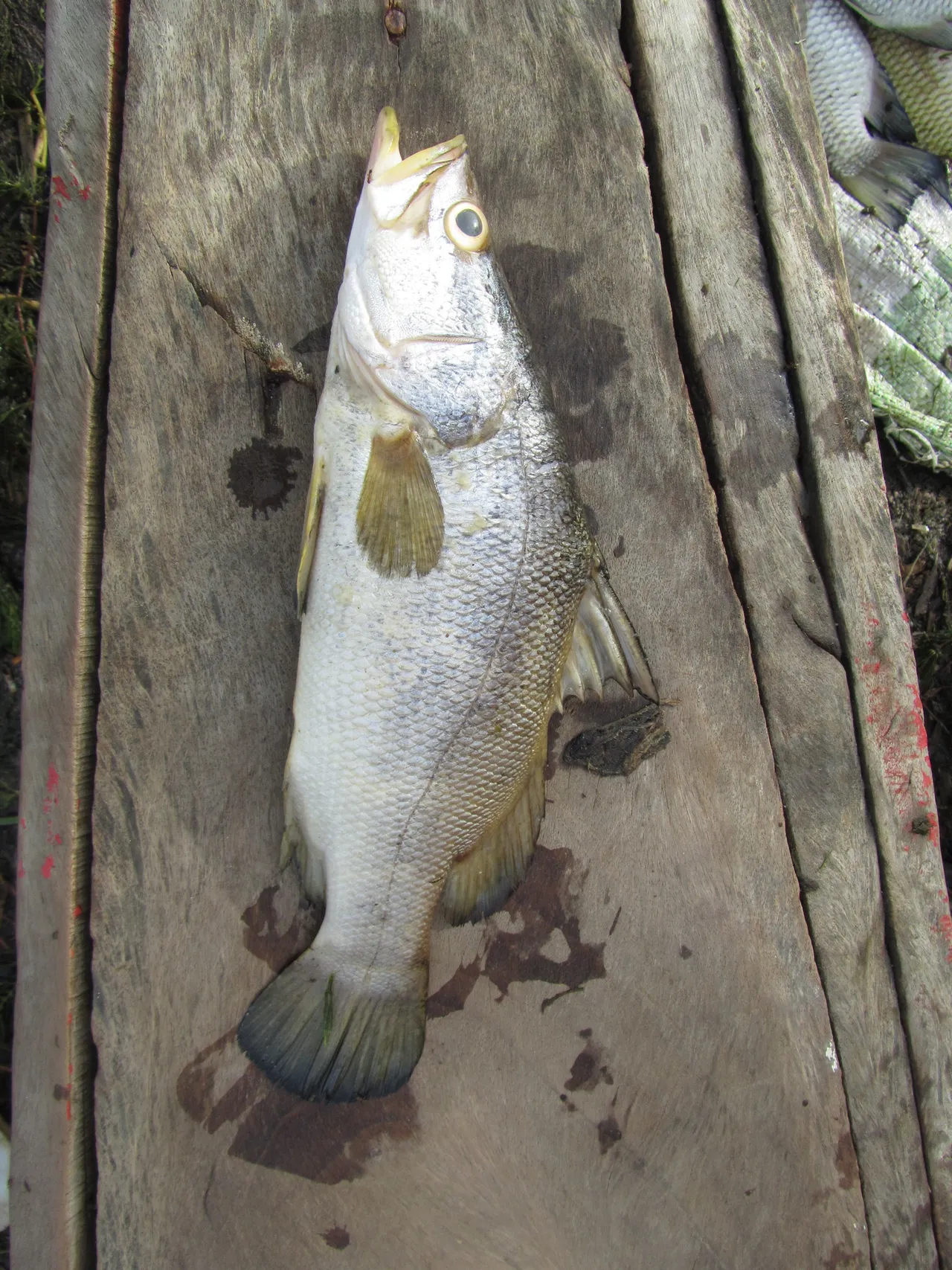
Identified by: The distinctly CONCAVE head profile the record leads on, dipping between snout and nape, above a deep body with a large gold-ringed eye and the heavy jaw of a large protrusible mouth. The spiny dorsal and the soft dorsal behind it are both visible with the notch between them.Lucy Keith-Diagne — CC BY, via iNaturalist — source, licenceAbout the image above: The photograph shows a dead fish lying on the planks of a canoe, angled head-up and slightly rolled rather than in true side view, so the body proportions are a little compressed. The concave head profile the page leads on is clear; the yellow eye ring reads but is duller than on a live fish.
Look at this first
Check the eye before anything else. A Nile perch has a black pupil set inside a bright yellow ring, and that ring is a structure rather than a passing colour: it is there on a fish in the water, on one in a boat, and in the poor light of a landing at dusk.
Diagnostic — settles it on its own
Each of these settles the identification on its own. If one is clear, you have your answer.
A yellow ring around a black eye
The iris carries a clear bright yellow band around the dark centre. This project normally ranks colour below shape, because most colour is mood, season or water. This one is admitted because it does not behave that way — it does not wash out as the fish tires, it is present on a dead fish on a plank, and it reads at a distance across a boat. It is the fastest single field mark the species offers.
A head profile that dips inwards between snout and nape
Look at the outline of the head in profile. It does not run in a straight or bulging line from the mouth up to the start of the back; it curves inwards, giving the fish a scooped forehead. That concave profile over a deep body is the family shape, and it is why anybody who has seen a barramundi recognises a Nile perch immediately. It holds on fish of every size and it survives any handling.
Supporting — use with other characters
Real characters that are not conclusive by themselves. Use two or three together.
A dorsal fin split deeply into two parts
The fin along the back is one fin with a deep notch cut into it, so that the hard spiny front section and the soft rear section read almost as two separate fins standing close together. It is clear on any fish with the fin raised and it is a useful cross-check against the large silvery cichlids and characins that share the same water and do not have it.
Large scales over a silver body with a rounded tail
The body carries large obvious scales and reads silver, sometimes with a faint blue cast over the back, and the tail is rounded rather than forked. Body silver is the least reliable thing here — it varies with water and dulls quickly after death — and the rounded tail is worth more, because most of the large fish it might be confused with in African waters are forked.
The sheer size the fish attains
This is one of the largest freshwater fishes anywhere in its range, and a mature one is unmistakable on bulk alone. Size cannot identify a small fish, and small ones are common, but it does mean that a very large deep-bodied silver perch-shaped fish in the Nile basin or in the great lakes has few alternatives. The head profile and the eye should still be checked.
What it gets confused with
- Other African Lates species, which share the body plan closely and are separated principally by adult size, the exact head profile and the eye colouration.
- Barramundi, which is the same family and looks strikingly similar, and which does not occur in African fresh water — so range does most of the work here.
- Large tilapias at a distance or in a net, which are much deeper for their length, have a continuous dorsal without the deep notch, and lack the yellow eye ring.
- African tigerfish in a mixed catch, which is silver and large but has an obviously different head, a forked tail and conspicuous teeth.
Where this stops working
The genus contains several species across African fresh waters, some of them local, and where two overlap the separations run to counts and proportions rather than to anything in this page. Juveniles are much less distinctive than adults: the yellow eye ring is present but the concave head profile is far less developed on a small fish, so a young Lates is genuinely hard. Where the species has been introduced, the population may contain fish outside their described range and be locally poorly documented. A fish photographed from directly above, which is how a great many are recorded on a boat, hides both the head profile and the eye, and cannot be used.
The full record
This page covers identification only. The Nile perch record covers behaviour, lifecycle, distribution, handling and the sources behind all of it.
Reviewed 2026-08-16.
More about this fish
Telling it apart is one question. Here are the others.
Similar and related fish
How it is caught
- SpinningCasting to visible structure from a boat or a shoreline takes Nile perch holding tight to rock, and it is how most shore-based fishing for them is conducted.
- TrollingTrolling large lures around rocky structure and drop-offs is the established Lake Nasser and Rift lake method, covering the volume a shore or drifting angler cannot.
Where you will find it
- East and West African fishingA very large predator native to the Nile and West African systems, and — introduced to Lake Victoria — the central figure in one of the most consequential ecological changes of the last century.
- Lake Victoria and the Rift Valley lakesIntroduced to Lake Victoria in the mid-twentieth century, where it created an enormous export fishery and contributed to the loss of a very large number of endemic cichlid species.
Why the 5 connections on this page are here, and the sources
Similar and related fish
Backed by research — 1 connection
Supported by peer-reviewed research or fisheries science. The sources are listed and can be checked.
Dagaa
Recorded diet evidence identifies Rastrineobola argentea as a food item of this predator at species level. The edge is written at that granularity and no further.
- FishBase: a global information system on fishes — Froese, R. and D. Pauly, eds. — FishBase Consortium (Scientific institute)Relied on for: Food items recorded for this predator, including Rastrineobola argentea.States this directlyPassage read and verified
- FAO Species Identification Guides for Fishery Purposes and the FAO Species Catalogues — Food and Agriculture Organization of the United Nations (Scientific institute)Relied on for: Species account describing the diet of this predator in the region where Rastrineobola argentea occurs.Background and mechanism onlyCitation checked — the work exists and is described correctly
How it is caught
What experienced anglers do — 2 connections
Widely and independently recommended by experienced anglers and specialist sources. This is real angling knowledge, not proof: controlled evidence for it is limited, and FishingHQ records it as convention rather than as a demonstrated effect.
Spinning
Established angling practice for this species, recorded as convention. The note states the property of the animal or its water that makes the method the answer.
- IGFA International Angling Rules and World Record Requirements — International Game Fish Association (Angling or fisheries organisation)Relied on for: Recognition of the species as an established sport fish and the angling methods and tackle classes conventionally used for it.States this directlyPassage read and verified
- General angling website restatements of established technique — Various (Credible secondary source)Relied on for: Widely restated practice connecting this species and method.Background and mechanism onlyCitation checked — the work exists and is described correctly
Trolling
Established angling practice for this species, recorded as convention. The note states the property of the animal or its water that makes the method the answer.
- IGFA International Angling Rules and World Record Requirements — International Game Fish Association (Angling or fisheries organisation)Relied on for: Recognition of the species as an established sport fish and the angling methods and tackle classes conventionally used for it.States this directlyPassage read and verified
- General angling website restatements of established technique — Various (Credible secondary source)Relied on for: Widely restated practice connecting this species and method.Background and mechanism onlyCitation checked — the work exists and is described correctly
Where you will find it
Backed by research — 2 connections
Supported by peer-reviewed research or fisheries science. The sources are listed and can be checked.
East and West African fishing
A distributional claim taken from reference sources on the species rather than from angling report. It states presence and asserts nothing about a fishery.
- FishBase: a global information system on fishes — Froese, R. and D. Pauly, eds. — FishBase Consortium (Scientific institute)Relied on for: Distribution, habitat association, depth range and life history recorded for the species concerned.States this directlyPassage read and verified
- The IUCN Red List of Threatened Species — International Union for Conservation of Nature (Conservation authority)Relied on for: Global distribution, population trend and extinction-risk assessment for the species concerned.States this directlyCitation checked — the work exists and is described correctly
Lake Victoria and the Rift Valley lakes
A distribution association between an animal and a kind of water, rather than a claim about any named mark.
- The IUCN Red List of Threatened Species — International Union for Conservation of Nature (Conservation authority)Relied on for: Assessment and habitat account for the species, including the river or lake system it occupies and the pressures acting on it.States this directlyCitation checked — the work exists and is described correctly
- FishBase: a global information system on fishes — Froese, R. and D. Pauly, eds. — FishBase Consortium (Scientific institute)Relied on for: Distribution, habitat association, size and life history recorded for the species in the system concerned.States this directlyPassage read and verified
Safety
Biosecurity and disease transfer — Can cause serious injury or death
The Nile perch is the canonical demonstration of what an introduced generalist predator does to an isolated fish community. The mechanism — somebody moving live fish to a new water for what seemed like a good reason — is available to any angler anywhere.
What reduces it: Never move live fish or water between waters. Clean, drain, dry and check equipment. Report unexpected species to the relevant authority rather than moving them.
Injury while handling fish — Can cause injury needing treatment
A fish of this size is dangerous to handle simply by mass and strength, and the gill covers and preoperculum are sharp.
What reduces it: Do not attempt to lift large individuals. Handle in the water, with help, keeping hands away from the gill plates.