What does european plaice eat?
What is established about how european plaice feeds, kept separate from what anglers infer from it.
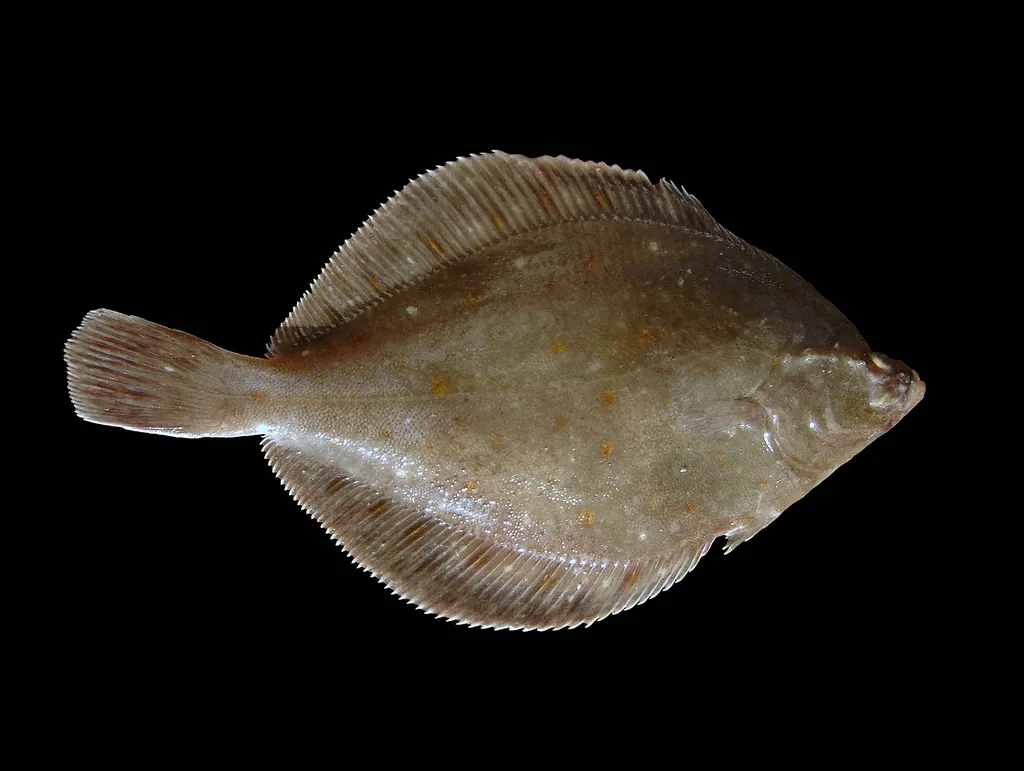
How this was identified, and who took it
Identified by: Specimen photograph on black showing the whole right-eyed fish. The orange spots on a smooth brown upper side are the diagnostic character and they are unambiguous here.Hans Hillewaert — CC BY-SA 4.0, via Wikimedia Commons — source, licenceWhat is known about how it feeds
A plaice can be buried and still be watching. The eyes sit on short stalks that can be raised above the sediment surface, so a fish that has covered itself in sand retains a working field of view — an arrangement that makes vision a usable sense for an animal that spends most of its time out of sight.
Feeding is bottom-restricted and selective rather than opportunistic. The two verified relationships are polychaete worms and molluscs, both at group level, and the mollusc component involves a distinctive behaviour: plaice crop the exposed siphons of buried bivalves rather than excavating the animal. The prey survives, regenerates and is available again, which makes a bivalve bed a renewable resource rather than a diminishing one.
The mouth is small and set to one side, and the dentition is adapted to nipping rather than seizing. There is no shift to fish prey at any size.
Movement attracts. Plaice respond to small disturbance on the sediment, which is consistent with an animal that watches a limited field for the movement of prey it cannot otherwise detect, and with the mixed visual and olfactory strategy the species uses.
Seasonally the fish moves offshore to spawn in winter and returns to shallower feeding ground afterwards, arriving thin and feeding hard through spring.
The food
Prey with a verified dietary link to this fish. Each entry carries its own evidence, and each is written at the precision the source actually used: a named species where the source named one, a group or food category where it said “polychaetes”, “crustaceans” or “detritus” and meant it. That is why this list is shorter than the animal’s real diet rather than longer.
- Polychaete worms as prey — a group rather than a species: the evidence names the group
Plaice feed on worms in soft sediment, frequently by cropping exposed siphons and tentacles rather than by excavating the animal, which is why they can feed continuously without moving far.
- Bivalve and gastropod molluscs as prey — a group rather than a species: the evidence names the group
Bivalve siphons are a substantial part of the diet on muddy ground, a form of feeding that leaves the prey alive and available again.
Food with no page of its own here yet
These are real components of the diet, listed as plain text because FishingHQ has no page for them yet. Inventing pages to make the list look fuller would be the fabrication this whole approach exists to prevent.
- brittlestars
- small crustaceans
- sand mason worm tubes
- razorfish siphons
What anglers do with this
Everything below is interpretation, not finding. It is what experienced anglers conclude from the biology above, and the reasoning is usually sound and almost never tested. It is separated from the biology deliberately.
The combination of a visual sense and an attraction to movement is the reasoning behind the long-standing practice of adding attractors above a worm bait and working it slowly rather than leaving it static. That convention is old, widely held and untested, and it is a reasonable inference from the sensory arrangement above.
The post-spawning condition cycle matters more than it usually gets credit for: a plaice in early spring is thin and feeding hard, and the same fish later in the season is in much better condition. Anglers use that to explain seasonal patterns in both catch rate and quality.
The siphon-cropping behaviour has no angling application at all, and is included because it is one of the more interesting things on FishingHQ about how a fish makes a living.
What this does not establish
Both relationships are group-level and neither establishes proportion. Diet composition varies substantially with sediment type and with the local benthic community. The account describes the north-east Atlantic population, and nothing here says what any plaice is eating on any particular ground.
Where this connects
These are the baits, lures, methods and explainers FishingHQ already joins to this fish — which is why the list is sometimes short. They are not chosen for this page, and a link here means an evidenced relationship exists, not that it follows from the diet.
Methods used for it
Where it lives
The science behind the feeding
This page covers feeding. The European plaice record covers identification, lifecycle, seasonal behaviour, handling and the sources behind all of it.
Reviewed 2026-08-12.