What does common bream eat?
What is established about how common bream feeds, kept separate from what anglers infer from it.
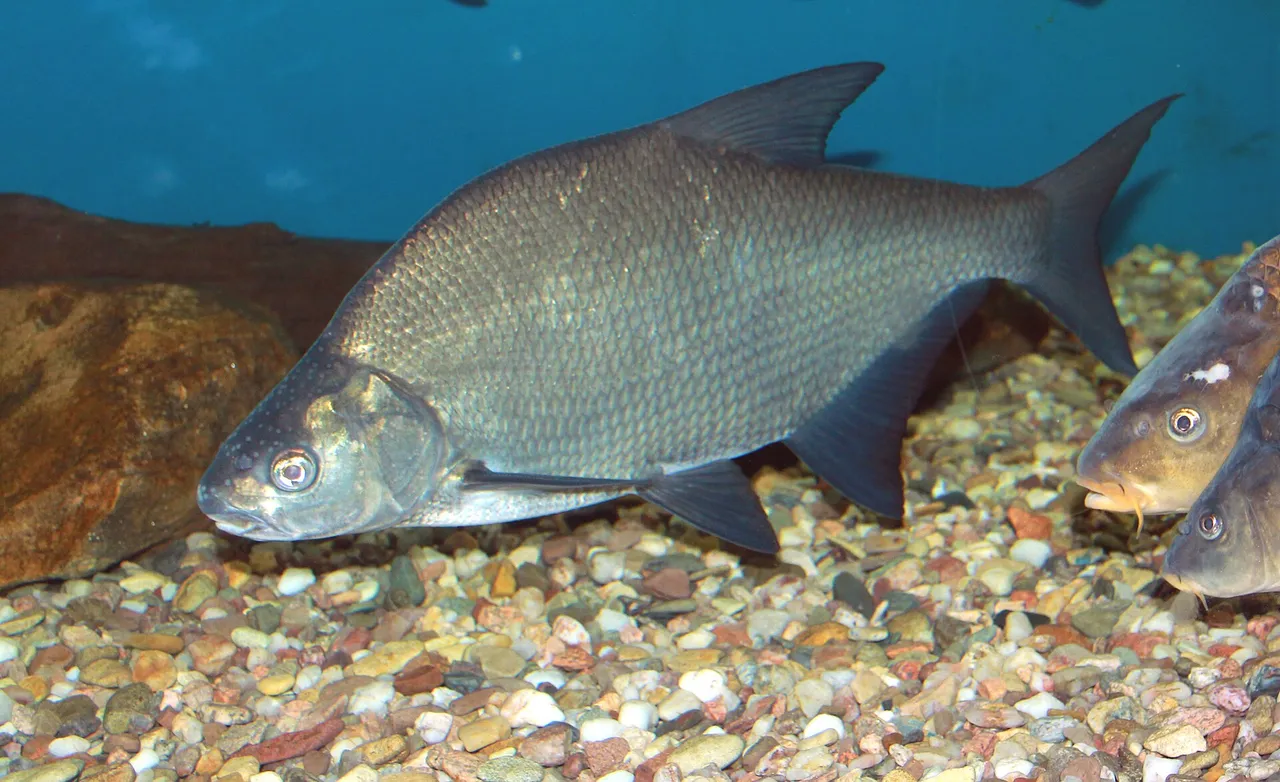
How this was identified, and who took it
Identified by: Very deep, strongly compressed body with a small head, a long-based anal fin, and a deeply forked tail with a longer lower lobe.Karelj, Public domain, via Wikimedia Commons — source, licenceWhat is known about how it feeds
A bream eats with a tube. The mouth extends forwards and downwards into a protrusible funnel, and the fish works nose-down over soft sediment, sucking bloodworm and small invertebrates out of the top layer of silt.
That posture explains almost everything else about the species. The single verified relationship — aquatic insect larvae, dominated in most stillwaters by chironomid larvae — is what the method delivers. Vision matters less than for roach because the working face is buried in silt; taste and touch dominate at the point of contact, backed by the acute hearing typical of the carp order.
Bream feed as a shoal and work an area over methodically, moving across it rather than staying still. A feeding shoal is a visible event: the silt is disturbed, gas is released from the sediment, and the water colours. That collective, systematic working of a patch is the important behavioural fact, because it means the fish are a moving resource rather than a static one.
Size shifts the diet very little. A large bream eats the same things in larger quantities and from slightly deeper in the sediment; there is no transition to piscivory of the kind chub or perch make.
Seasonally the fish is temperature-driven, feeding hard in warm water and very little in cold, and the shoals move between deep water and shallow feeding areas on a daily as well as a seasonal cycle.
The food
Prey with a verified dietary link to this fish. Each entry carries its own evidence, and each is written at the precision the source actually used: a named species where the source named one, a group or food category where it said “polychaetes”, “crustaceans” or “detritus” and meant it. That is why this list is shorter than the animal’s real diet rather than longer.
- Aquatic insect larvae as prey — a group rather than a species: the evidence names the group
Bream feed by sucking soft sediment and sorting out invertebrates, and chironomid larvae are the dominant item in most stillwaters — the reason a feeding bream shoal clouds the water.
Food with no page of its own here yet
These are real components of the diet, listed as plain text because FishingHQ has no page for them yet. Inventing pages to make the list look fuller would be the fabrication this whole approach exists to prevent.
- small bivalves and snails
- freshwater shrimp
- zooplankton, in smaller fish
- plant material and algae
- sediment detritus
What anglers do with this
Everything below is interpretation, not finding. It is what experienced anglers conclude from the biology above, and the reasoning is usually sound and almost never tested. It is separated from the biology deliberately.
The shoal behaviour is the fact that converts, and it converts into a strategy rather than a tactic: the objective is to hold a shoal in one place rather than to interest an individual fish, which is why the supply of loose offerings matters more than what is on the hook. That is convention held with unusual consistency across European coarse angling.
The feeding posture explains a practical detail anglers have described for a century: bites from bream are frequently slow lifts rather than pulls, because a fish feeding face-down and then levelling out moves the line upwards. That is a mechanical inference from the posture and is not tested.
The visible signs of a feeding shoal — coloured water, released gas — are used as location evidence, which is observation rather than folklore.
What this does not establish
One group-level relationship for an omnivorous bottom feeder understates the diet substantially, and the plant and detritus components are not represented at all. Composition varies with sediment type and productivity, and nothing here establishes proportions or describes a particular water.
Where this connects
These are the baits, lures, methods and explainers FishingHQ already joins to this fish — which is why the list is sometimes short. They are not chosen for this page, and a link here means an evidenced relationship exists, not that it follows from the diet.
Methods used for it
The science behind the feeding
This page covers feeding. The Common bream record covers identification, lifecycle, seasonal behaviour, handling and the sources behind all of it.
Reviewed 2026-08-12.