How to identify pouting
Trisopterus luscus · Gadidae
The characters that identify pouting, ranked by how far each one can be trusted on its own.
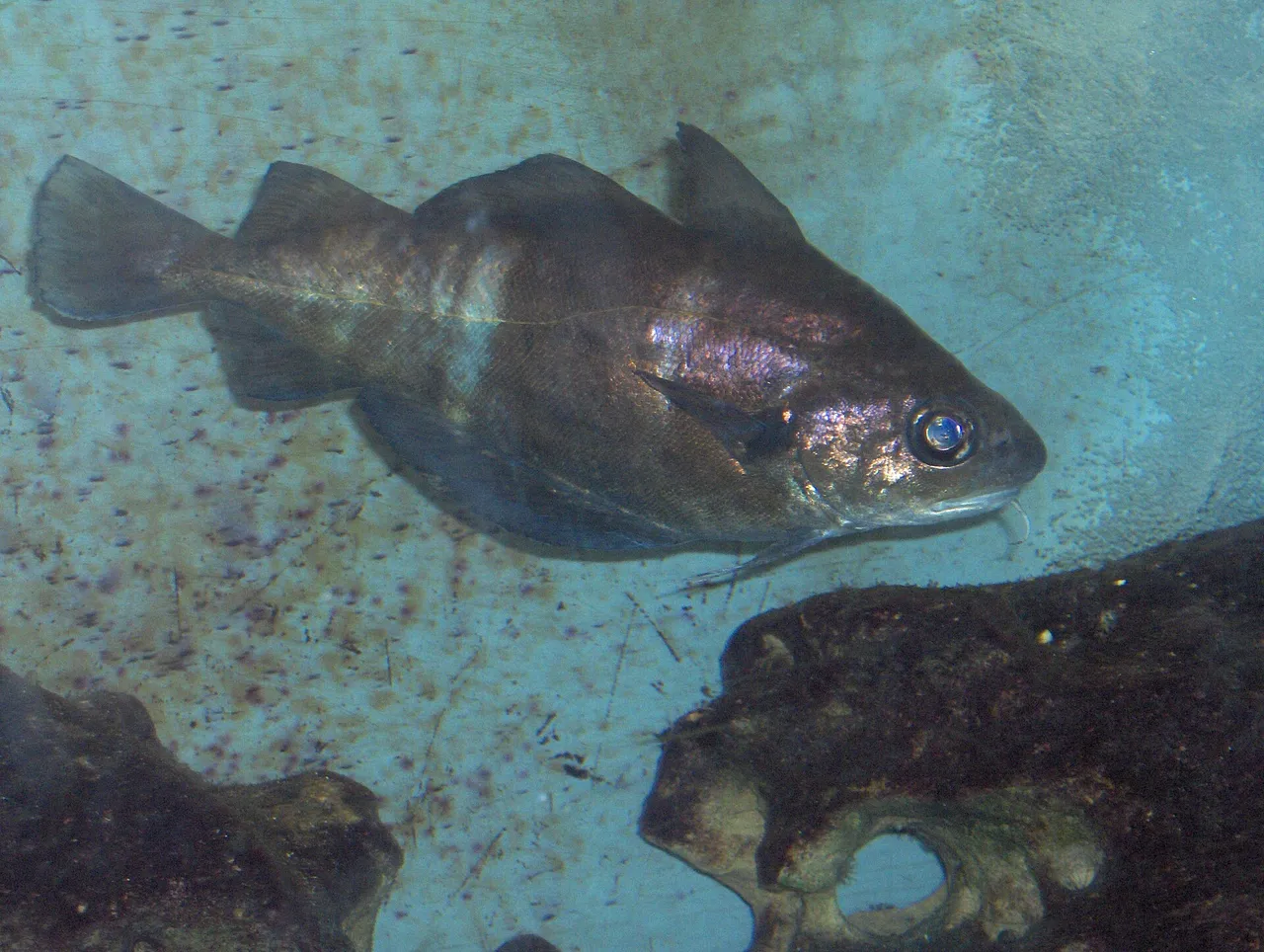
How this was identified, and who took it
Identified by: Identified on three characters that together separate Trisopterus luscus from T. minutus: a LONG chin barbel where a poor cod's is shorter, a distinct dark blotch at the pectoral base, and a body notably deeper at comparable length. Three dorsals and two anals place it in the cod family. STATED LIMITATION: shot through aquarium glass with a blue cast that washes out the coppery banding which would have confirmed it a fourth time.Georges Jansoone (JoJan) — CC BY-SA 3.0, via Wikimedia Commons — source, licenceLook at this first
Look for a long barbel under the chin and a dark spot at the base of the pectoral fin, on a fish that is noticeably deep-bodied for a member of the cod family. All three should agree before you call it — this is a fish separated from poor cod by proportion rather than by a single mark.
No single character settles this one. Everything below is supporting or suggestive, and a confident identification needs several of them together — or, for the hardest cases, a count that cannot be made from a photograph.
Supporting — use with other characters
Real characters that are not conclusive by themselves. Use two or three together.
A long chin barbel
A single well-developed barbel hangs from the chin, long enough to be obvious. Poor cod — Trisopterus minutus, the near-identical relative — has a barbel too, but a shorter one. Pollack and coalfish, the other common confusions, have no barbel at all in adult fish, which makes this the first cut.
A dark blotch at the base of the pectoral fin
A distinct dark spot sits where the pectoral fin joins the body. It is more pronounced and more consistently present in pouting than in poor cod, and it is one of the characters that most reliably survives on a landed fish.
A deep body for a gadoid
Pouting are noticeably deep-bodied and laterally compressed compared with the slender, tapering poor cod of similar length. It is a proportion rather than a mark and it is the character experienced anglers actually use, which is why the page states it rather than pretending the barbel does the work alone.
Three dorsal fins and two anal fins
The gadoid fin formula places the family. It does no work at all within it — pouting, poor cod, whiting, pollack, coalfish and cod all share it — and it is here so that a reader who has never held a cod-family fish knows what group they are in.
Suggestive only — varies with condition
Hints only. These vary with condition, season, water and how long the fish has been out of it, and a fish that contradicts them is still the same species.
Coppery vertical bands on the flank
A fresh pouting shows four or five broad coppery or bronze vertical bands, which fade within minutes of the fish leaving the water and vanish entirely in a fish that has been in a bag. Striking when present and gone almost immediately, which is the definition of a suggestive character.
What it gets confused with
- Poor cod, constantly and legitimately. Take the three characters together: long barbel, pectoral-base blotch, and a body deeper than the fish beside it.
- Whiting, which has no barbel as an adult, a slimmer body and a distinct black spot at the upper pectoral origin rather than at the base.
- Small pollack and coalfish, both barbel-less with a very different lateral line.
Side by side: Pouting vs Whiting.
Where this stops working
Pouting and poor cod are separated by degree rather than by a single decisive mark, and small fish of both are genuinely difficult. Where it matters, fin ray counts settle it; for an angler it usually does not matter, since both are handled and returned the same way. The colour banding is the most striking character and the least usable, because it is gone before most people look. This is a page that names its confusion honestly rather than promising a clean answer. The photograph beside it was taken through aquarium glass and carries a blue colour cast, so the coppery banding is washed out in it; the chin barbel and the pectoral-base blotch are clear.
The full record
This page covers identification only. The Pouting record covers behaviour, lifecycle, distribution, handling and the sources behind all of it.
Reviewed 2026-08-15.
More about this fish
Telling it apart is one question. Here are the others.
Similar and related fish
How it is caught
Where it lives
Where you will find it
- Chesil BeachOccupies the same clean ground as whiting and is taken in numbers through the colder months.
- Portland Bill and the Portland RaceHolds around the rough ground and structure below the headland throughout much of the year.
- The Severn EstuaryOccupies the same ground as whiting and is taken in numbers around structure.
Why the 7 connections on this page are here, and the sources
Similar and related fish
Backed by research — 1 connection
Supported by peer-reviewed research or fisheries science. The sources are listed and can be checked.
Whiting
An identification comparison naming both binomials: Merlangius merlangus and Trisopterus luscus.
- FishBase: a global information system on fishes — Froese, R. and D. Pauly, eds. — FishBase Consortium (Scientific institute)Relied on for: Morphological and distributional data for Merlangius merlangus and for Trisopterus luscus.States this directlyPassage read and verified
- The IUCN Red List of Threatened Species — International Union for Conservation of Nature (Conservation authority)Relied on for: Separate assessments treating Merlangius merlangus and Trisopterus luscus as distinct species.States this directlyCitation checked — the work exists and is described correctly
How it is caught
What experienced anglers do — 1 connection
Widely and independently recommended by experienced anglers and specialist sources. This is real angling knowledge, not proof: controlled evidence for it is limited, and FishingHQ records it as convention rather than as a demonstrated effect.
Ledgering
A practitioner claim about how Trisopterus luscus is commonly fished, following from where and how it feeds.
- General angling website restatements of established technique — Various (Credible secondary source)Relied on for: Widely restated practitioner accounts of fishing for pouting.Citation checked — the work exists and is described correctly
- Sea Angler — Bauer Media (Specialist angling publication)Relied on for: Practitioner treatment of the methods used for pouting and comparable species.Citation checked — the work exists and is described correctly
Where it lives
Backed by research — 2 connections
Supported by peer-reviewed research or fisheries science. The sources are listed and can be checked.
Harbours, piers and breakwaters
A habitat association for Trisopterus luscus taken from the environment and distribution data on its FishBase summary.
- FishBase: a global information system on fishes — Froese, R. and D. Pauly, eds. — FishBase Consortium (Scientific institute)Relied on for: The environment, depth range and habitat description recorded for Trisopterus luscus.States this directlyPassage read and verified
Inshore ground
A habitat association for Trisopterus luscus taken from the environment and distribution data on its FishBase summary.
- FishBase: a global information system on fishes — Froese, R. and D. Pauly, eds. — FishBase Consortium (Scientific institute)Relied on for: The environment, depth range and habitat description recorded for Trisopterus luscus.States this directlyPassage read and verified
Where you will find it
Backed by research — 3 connections
Supported by peer-reviewed research or fisheries science. The sources are listed and can be checked.
Chesil Beach
A distribution association between an animal and a kind of water, rather than a claim about any named mark.
- The Fishes of the British Isles and North-West Europe — Macmillan, 1969 (Reference work)Relied on for: Distribution, habitat association, depth and ground preference of fishes in British and north-west European waters.States this directlyCitation checked — the work exists and is described correctly
- FishBase: a global information system on fishes — Froese, R. and D. Pauly, eds. — FishBase Consortium (Scientific institute)Relied on for: Distribution, habitat association and depth range recorded for the species.Background and mechanism onlyPassage read and verified
Portland Bill and the Portland Race
A distribution association between an animal and a kind of water, rather than a claim about any named mark.
- The Fishes of the British Isles and North-West Europe — Macmillan, 1969 (Reference work)Relied on for: Distribution, habitat association, depth and ground preference of fishes in British and north-west European waters.States this directlyCitation checked — the work exists and is described correctly
- FishBase: a global information system on fishes — Froese, R. and D. Pauly, eds. — FishBase Consortium (Scientific institute)Relied on for: Distribution, habitat association and depth range recorded for the species.Background and mechanism onlyPassage read and verified
The Severn Estuary
A distribution association between an animal and a kind of water, rather than a claim about any named mark.
- The Fishes of the British Isles and North-West Europe — Macmillan, 1969 (Reference work)Relied on for: Distribution, habitat association, depth and ground preference of fishes in British and north-west European waters.States this directlyCitation checked — the work exists and is described correctly
- FishBase: a global information system on fishes — Froese, R. and D. Pauly, eds. — FishBase Consortium (Scientific institute)Relied on for: Distribution, habitat association and depth range recorded for the species.Background and mechanism onlyPassage read and verified