How to identify huchen
Hucho hucho · Salmonidae
The characters that identify huchen, ranked by how far each one can be trusted on its own.
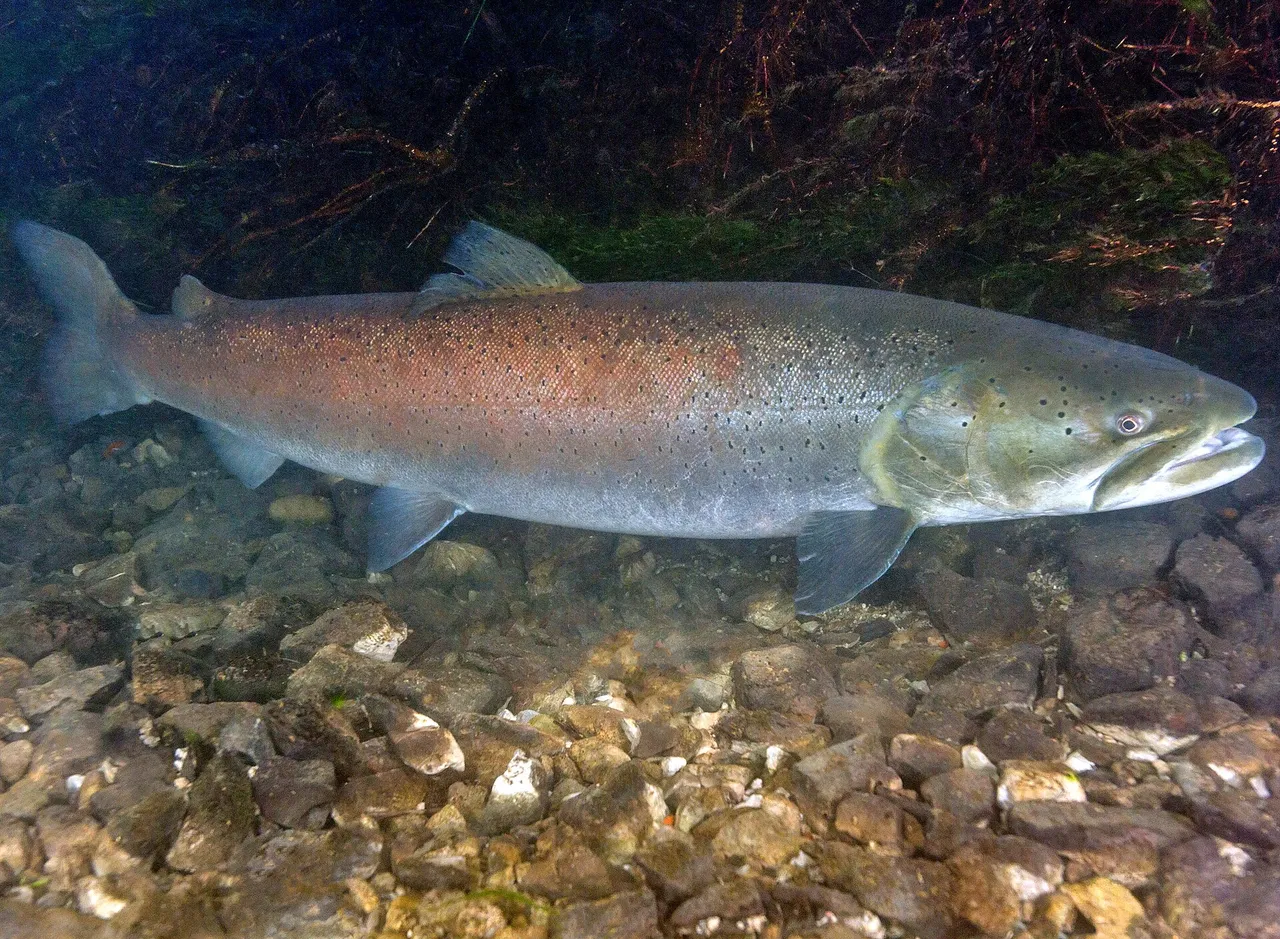
How this was identified, and who took it
Identified by: Identified on a combination: a small adipose fin, placing the fish among the salmonids; a long, almost cylindrical body unlike the deeper profile of a brown trout or salmon; a coppery-bronze flank covered in dense small dark spots rather than the sparse larger spots of Salmo salar; and a maxilla extending well back past the eye. Photographed alive in a gravel-bottomed river in the species' own basin. No other large Danube salmonid shares this body form and spotting.Liquid Art — CC BY-SA 4.0, via Wikimedia Commons — source, licenceLook at this first
Look at the shape before the spots. A huchen is long, round in section and almost pike-like in outline, with a small adipose fin behind the dorsal. Nothing else that shape in a Danube river is a salmonid, and nothing else salmonid in a Danube river is that shape.
Diagnostic — settles it on its own
Each of these settles the identification on its own. If one is clear, you have your answer.
A long, almost cylindrical body
Huchen are built like a pike rather than like a trout: long, round in cross-section, with the dorsal set well back. A brown trout of the same length is visibly deeper and more laterally compressed. This is the character that reads at a distance and through water.
An adipose fin
A small fleshy fin sits between the dorsal and the tail, with no rays in it. That places the fish among the salmonids and rules out the pike its outline suggests, which has no adipose fin and a very different head.
Supporting — use with other characters
Real characters that are not conclusive by themselves. Use two or three together.
Dense small dark spots on a coppery flank
The flank is coppery-bronze to reddish, covered in small dark spots that are often X- or crescent-shaped rather than round. An Atlantic salmon carries sparser, larger, rounder spots mostly above the lateral line; a brown trout carries red spots as well as black ones. Huchen have neither.
A large head with the jaw reaching past the eye
The head is large in proportion to the body and the maxilla extends well behind the rear margin of the eye in an adult — the mouth of a fish that eats other fish whole. It is a supporting character because large brown trout develop something similar.
What it gets confused with
- Large brown trout, which are deeper-bodied, carry red spots, and lack the cylindrical outline.
- Taimen, its Siberian relative, which does not overlap in range — so the separation here is geographic rather than morphological, and geography alone is not an identification.
- Pike at a distance and in poor light, from the body outline alone. The adipose fin settles it instantly.
Where this stops working
Huchen is assessed as Endangered, its populations are fragmented by damming across the Danube basin, and many remaining stocks depend on stocking. Fishing for it is closed, licensed separately or release-only in most of the range, and the rules differ by country and by river. The practical limit on this page is therefore not the identification — an adult huchen is not a difficult fish to name — but what an angler does next, which is a question for the local fisheries authority rather than for a reference page.
The full record
This page covers identification only. The Huchen record covers behaviour, lifecycle, distribution, handling and the sources behind all of it.
Reviewed 2026-08-15.
More about this fish
Telling it apart is one question. Here are the others.
How it is caught
Where it lives
Where you will find it
- Central and eastern European river fishingThe Danube salmon: a wholly freshwater salmonid, historically widespread through the basin, now critically reduced and protected through most of its range.
- Czechia and SlovakiaThe Danube salmon holds on in Slovak tributaries under very tight separate management, and it is the single fish most responsible for the region's specialist reputation.
- The Danube basinEndemic to the basin and confined to its cold, fast upper reaches, severely reduced by damming and channelisation.
- The Western BalkansThe Danube salmon persists in a small number of Balkan tributaries, and it is one of the two reasons specialist anglers travel to this region at all.
Why the 7 connections on this page are here, and the sources
How it is caught
What experienced anglers do — 1 connection
Widely and independently recommended by experienced anglers and specialist sources. This is real angling knowledge, not proof: controlled evidence for it is limited, and FishingHQ records it as convention rather than as a demonstrated effect.
Spinning
A practitioner claim about how Hucho hucho is commonly fished, following from where and how it feeds.
- General angling website restatements of established technique — Various (Credible secondary source)Relied on for: Widely restated practitioner accounts of fishing for huchen.Citation checked — the work exists and is described correctly
- Sea Angler — Bauer Media (Specialist angling publication)Relied on for: Practitioner treatment of the methods used for huchen and comparable species.Citation checked — the work exists and is described correctly
Where it lives
Backed by research — 2 connections
Supported by peer-reviewed research or fisheries science. The sources are listed and can be checked.
Lowland rivers
A habitat association for Hucho hucho taken from the environment and distribution data on its FishBase summary.
- FishBase: a global information system on fishes — Froese, R. and D. Pauly, eds. — FishBase Consortium (Scientific institute)Relied on for: The environment, depth range and habitat description recorded for Hucho hucho.States this directlyPassage read and verified
Spate rivers
A claim that the species uses rain-fed rivers on impermeable geology, resting on documented distribution and spawning habitat rather than on angling report.
- Freshwater Fishes of the British Isles — HarperCollins (New Naturalist 75), 1992 (Reference work)Relied on for: Distribution, habitat association, thermal requirements and life history of the freshwater fishes of the British Isles and north-west Europe.States this directlyCitation checked — the work exists and is described correctly
- FishBase: a global information system on fishes — Froese, R. and D. Pauly, eds. — FishBase Consortium (Scientific institute)Relied on for: Recorded depth range, temperature tolerance and habitat association for the species.States this directlyPassage read and verified
Where you will find it
Backed by research — 4 connections
Supported by peer-reviewed research or fisheries science. The sources are listed and can be checked.
Central and eastern European river fishing
A distributional claim taken from reference sources on the species rather than from angling report. It states presence and asserts nothing about a fishery.
- FishBase: a global information system on fishes — Froese, R. and D. Pauly, eds. — FishBase Consortium (Scientific institute)Relied on for: Distribution, habitat association, depth range and life history recorded for the species concerned.States this directlyPassage read and verified
- The IUCN Red List of Threatened Species — International Union for Conservation of Nature (Conservation authority)Relied on for: Global distribution, population trend and extinction-risk assessment for the species concerned.States this directlyCitation checked — the work exists and is described correctly
Czechia and Slovakia
That a species occurs in these waters, drawn from distribution science and stock assessment. It is a statement about where the animal lives and is not a statement that anybody will catch one, still less where.
- Freshwater Fishes of the British Isles — HarperCollins (New Naturalist 75), 1992 (Reference work)Relied on for: Distribution, habitat requirement and life history of European freshwater fishes, including their occurrence across the continental range named.States this directlyCitation checked — the work exists and is described correctly
- FishBase: a global information system on fishes — Froese, R. and D. Pauly, eds. — FishBase Consortium (Scientific institute)Relied on for: Recorded distribution and habitat association of the freshwater and migratory species named.States this directlyPassage read and verified
The Danube basin
A distribution association between an animal and a kind of water, rather than a claim about any named mark.
- Freshwater Fishes of the British Isles — HarperCollins (New Naturalist 75), 1992 (Reference work)Relied on for: Distribution and habitat association of European freshwater fishes, including occurrence in the river system concerned.States this directlyCitation checked — the work exists and is described correctly
- FishBase: a global information system on fishes — Froese, R. and D. Pauly, eds. — FishBase Consortium (Scientific institute)Relied on for: Distribution and habitat association recorded for the species.States this directlyPassage read and verified
The Western Balkans
That a species occurs in these waters, drawn from distribution science and stock assessment. It is a statement about where the animal lives and is not a statement that anybody will catch one, still less where.
- Freshwater Fishes of the British Isles — HarperCollins (New Naturalist 75), 1992 (Reference work)Relied on for: Distribution, habitat requirement and life history of European freshwater fishes, including their occurrence across the continental range named.States this directlyCitation checked — the work exists and is described correctly
- FishBase: a global information system on fishes — Froese, R. and D. Pauly, eds. — FishBase Consortium (Scientific institute)Relied on for: Recorded distribution and habitat association of the freshwater and migratory species named.States this directlyPassage read and verified