What does narrow-barred spanish mackerel eat?
What is established about how narrow-barred spanish mackerel feeds, kept separate from what anglers infer from it.
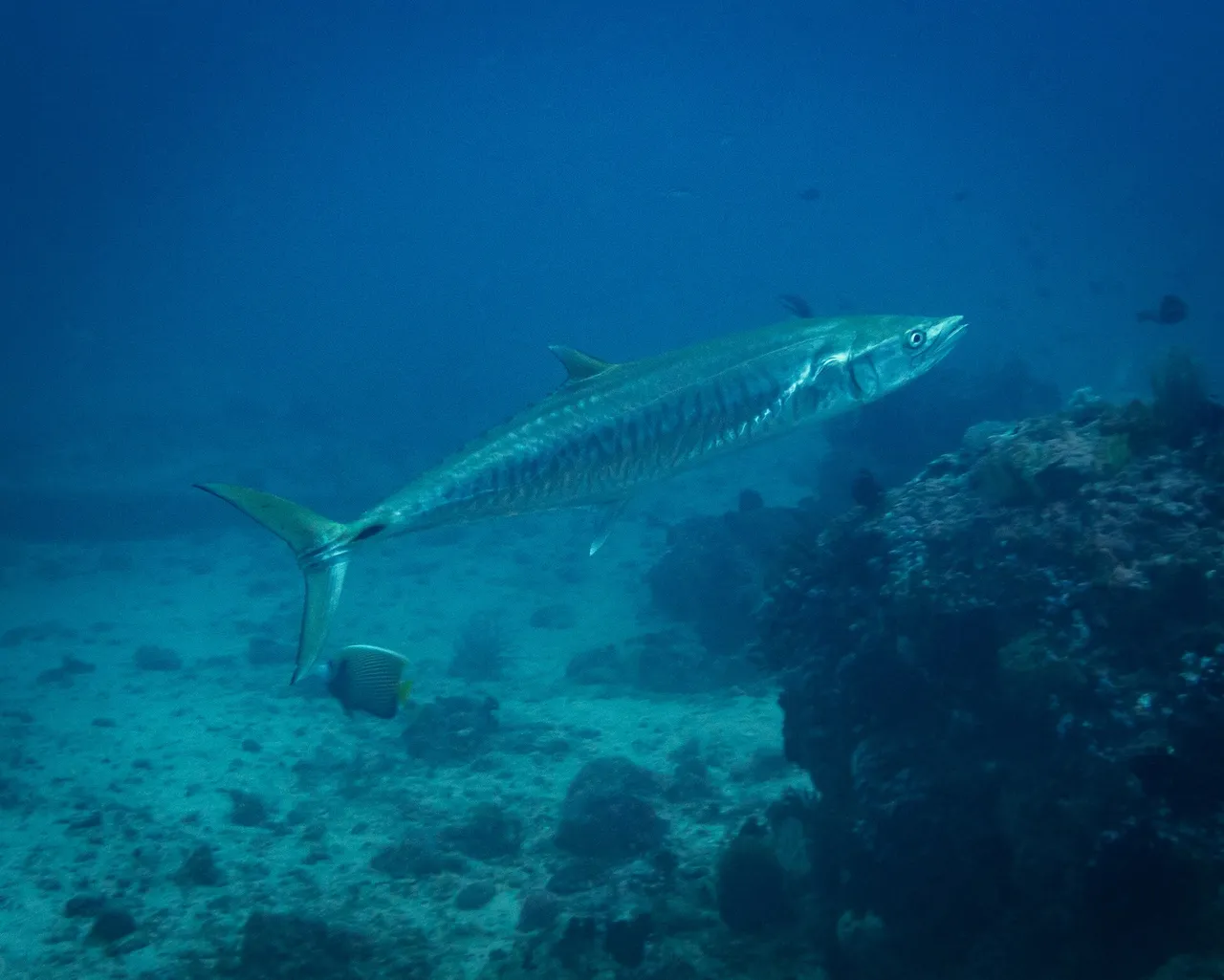
How this was identified, and who took it
Identified by: Full lateral view of a free-swimming fish with the diagnostic narrow wavy vertical barring clearly legible along the flank, together with the elongate body, pointed snout, small finlets and deeply forked tail. Natural-light underwater photography, so the colour is blue-shifted; the barring is unaffected.ppericard — CC BY 4.0, via Wikimedia Commons — source, licenceWhat is known about how it feeds
This is a fish built entirely for one short, fast attack, and the dentition tells you what happens at the end of it.
The teeth are blade-like and shear rather than hold, so prey is frequently cut rather than swallowed whole. The fish hunts at speed in open water and around reef edges and current lines, striking small schooling fish and squid from below and behind.
The two verified relationships are the two staples. Pilchards standing for the small shoaling clupeids that make up the bulk of the diet across the Indo-Pacific range, and cephalopods at group level, taken particularly in deeper water and at night.
Speed is the defining physiological characteristic and it costs energy, which is why the species feeds frequently and why its distribution tracks bait concentrations closely.
The fish is migratory along tropical and subtropical coasts, and its arrival on a stretch of coast is a bait event rather than a calendar one.
One consequence of the shearing dentition is not about fishing at all: a Spanish mackerel taking a hooked fish from another predator, or a bait from a shoal, removes a clean section rather than damaging it, which is how the species' presence is often detected before it is seen.
The food
Prey with a verified dietary link to this fish. Each entry carries its own evidence, and each is written at the precision the source actually used: a named species where the source named one, a group or food category where it said “polychaetes”, “crustaceans” or “detritus” and meant it. That is why this list is shorter than the animal’s real diet rather than longer.
- Cephalopods as prey — a group rather than a species: the evidence names the group
Squid are taken alongside small schooling fish, particularly in deeper water and at night.
- Pacific sardine — Sardinops sagax
Small clupeids including sardines are the principal prey across the range, and the mackerel's movements follow the bait shoals.
Food with no page of its own here yet
These are real components of the diet, listed as plain text because FishingHQ has no page for them yet. Inventing pages to make the list look fuller would be the fabrication this whole approach exists to prevent.
- anchovies
- garfish
- small tuna and scad
- squid
What anglers do with this
Everything below is interpretation, not finding. It is what experienced anglers conclude from the biology above, and the reasoning is usually sound and almost never tested. It is separated from the biology deliberately.
The shearing dentition is the basis of the universal use of wire terminal tackle for this species, and it is a requirement rather than a preference: an offering presented on nylon is removed cleanly, and the tackle left in the fish is a welfare problem.
The high-speed attack converts into fast presentations and into the observation that a slow one is frequently ignored, which is convention held across the Indo-Pacific.
Bait-following is the location method, as with every fast pelagic predator in this file.
Ciguatera is a consideration for large individuals in parts of the tropical range, and local advice governs it.
What this does not establish
The cephalopod relationship is group-level and the sardine relationship stands for a broader group of small clupeids. Composition varies enormously across an Indo-Pacific range spanning several ocean basins. Nothing here establishes proportions.
Where this connects
These are the baits, lures, methods and explainers FishingHQ already joins to this fish — which is why the list is sometimes short. They are not chosen for this page, and a link here means an evidenced relationship exists, not that it follows from the diet.
Lures recorded for this species
Methods used for it
The science behind the feeding
This page covers feeding. The Narrow-barred Spanish mackerel record covers identification, lifecycle, seasonal behaviour, handling and the sources behind all of it.
Reviewed 2026-08-12.