What does greater amberjack eat?
What is established about how greater amberjack feeds, kept separate from what anglers infer from it.
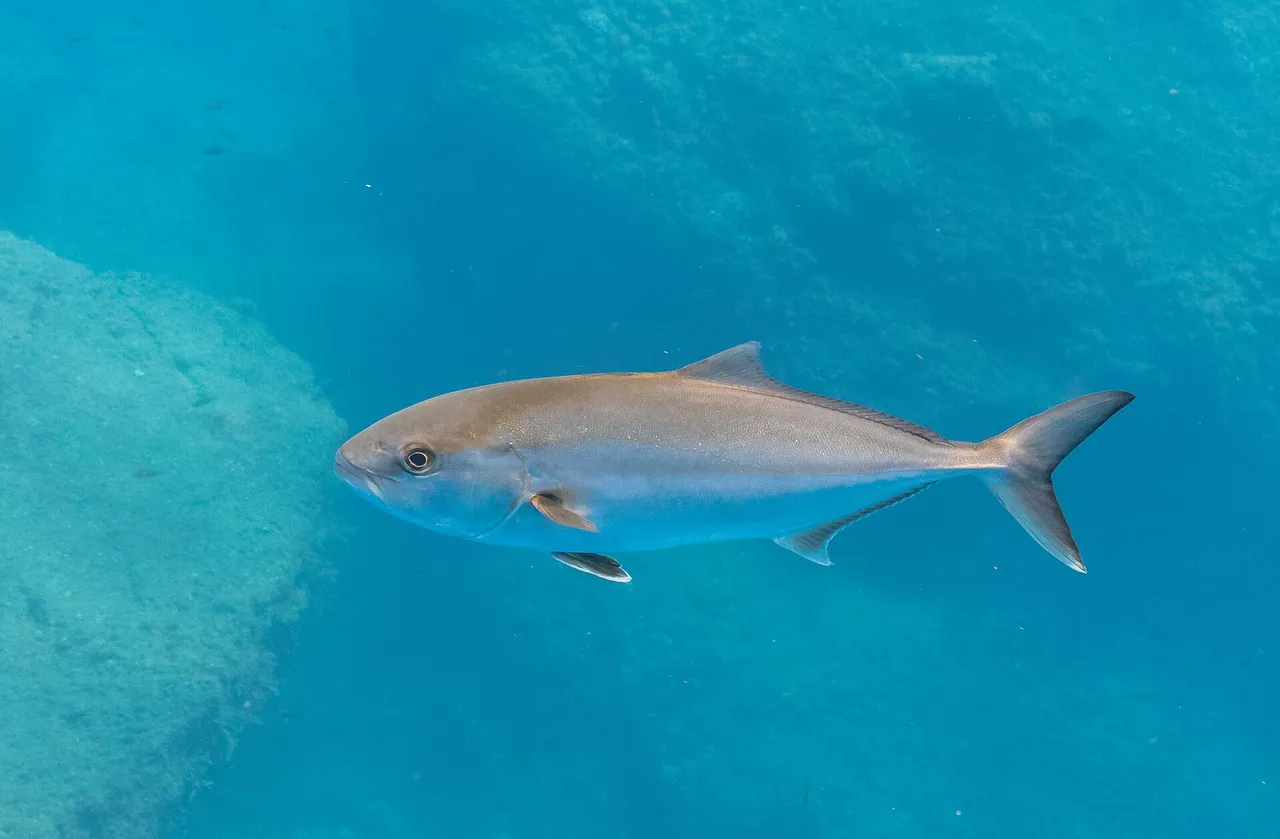
How this was identified, and who took it
Identified by: Full lateral view in blue water. The amber lateral band, the dark band running back through the eye and the low long-based second dorsal are all clear.Diego Delso — CC BY-SA 4.0, via Wikimedia Commons — source, licenceWhat is known about how it feeds
An amberjack hunts by driving prey against something it cannot swim through, and the two verified relationships are the two kinds of thing it drives.
Small shoaling clupeids — sprat and its relatives across the range — are pushed towards the surface or against structure until the shoal loses coherence. Cephalopods, recorded at group level, are taken over and around the deep structure the species holds to, particularly at depth.
The hunting is cooperative and fast. Amberjack work in groups, and their speed and stamina mean that a prey shoal has few options; the fish is at the opposite end of the strategic spectrum from an ambush predator like a conger, and the diet reflects a hunter that can simply catch things.
Structure is the constant. Wrecks, pinnacles, deep reefs and, in some regions, deliberately sunk artificial reefs concentrate both the amberjack and the prey, which is why the species is so tightly associated with marks rather than with areas.
Size changes the depth. Small amberjack are frequently shallow and inshore; large ones hold deeper over substantial structure. That vertical separation is a change in where the same diet is obtained rather than a change in the diet itself.
One food-safety point belongs to the species rather than to the fishing: in parts of the tropical range large amberjack are among the species associated with ciguatera, which is a consequence of what the food web below them has accumulated.
The food
Prey with a verified dietary link to this fish. Each entry carries its own evidence, and each is written at the precision the source actually used: a named species where the source named one, a group or food category where it said “polychaetes”, “crustaceans” or “detritus” and meant it. That is why this list is shorter than the animal’s real diet rather than longer.
- Cephalopods as prey — a group rather than a species: the evidence names the group
Amberjack take squid alongside fish, particularly over deep structure where squid concentrate.
- European sprat — Sprattus sprattus
Small shoaling clupeids are a principal prey where amberjack range overlaps them, and amberjack hunting behaviour is organised around driving such shoals against structure or the surface.
Food with no page of its own here yet
These are real components of the diet, listed as plain text because FishingHQ has no page for them yet. Inventing pages to make the list look fuller would be the fabrication this whole approach exists to prevent.
- sardine and anchovy
- mackerel and scad
- small bottom-associated fish
- crustaceans, in smaller fish
What anglers do with this
Everything below is interpretation, not finding. It is what experienced anglers conclude from the biology above, and the reasoning is usually sound and almost never tested. It is separated from the biology deliberately.
The association with structure is the fact the fishery is organised around, and it converts directly: amberjack are fished on marks, not on ground.
The cooperative driving behaviour is the reasoning behind fast-moving presentations worked over and around structure, and it is convention held consistently across the Mediterranean, the eastern Atlantic and the Gulf of Mexico.
The practical difficulty is not interpretation. A hooked amberjack runs for the structure it was taken over, and the fight is decided in the first seconds; that is a mechanical consequence of where the fish lives rather than a piece of tactical folklore.
Where retention is contemplated, the ciguatera association in tropical parts of the range is a matter for local advice rather than for a general page.
What this does not establish
The cephalopod relationship is group-level, and the sprat relationship represents a class of small shoaling clupeids of which sprat is the one FishingHQ holds. Diet varies substantially between the Mediterranean, the eastern Atlantic and the western Atlantic populations, and with depth and fish size. Nothing here establishes proportions.
Where this connects
These are the baits, lures, methods and explainers FishingHQ already joins to this fish — which is why the list is sometimes short. They are not chosen for this page, and a link here means an evidenced relationship exists, not that it follows from the diet.
Lures recorded for this species
Methods used for it
The science behind the feeding
This page covers feeding. The Greater amberjack record covers identification, lifecycle, seasonal behaviour, handling and the sources behind all of it.
Reviewed 2026-08-12.