How to identify giant snakehead
Channa micropeltes · Channidae
The characters that identify giant snakehead, ranked by how far each one can be trusted on its own.
Safety: biosecurity and disease transfer — can cause serious injury or death. One more point applies here.
How this was identified, and who took it
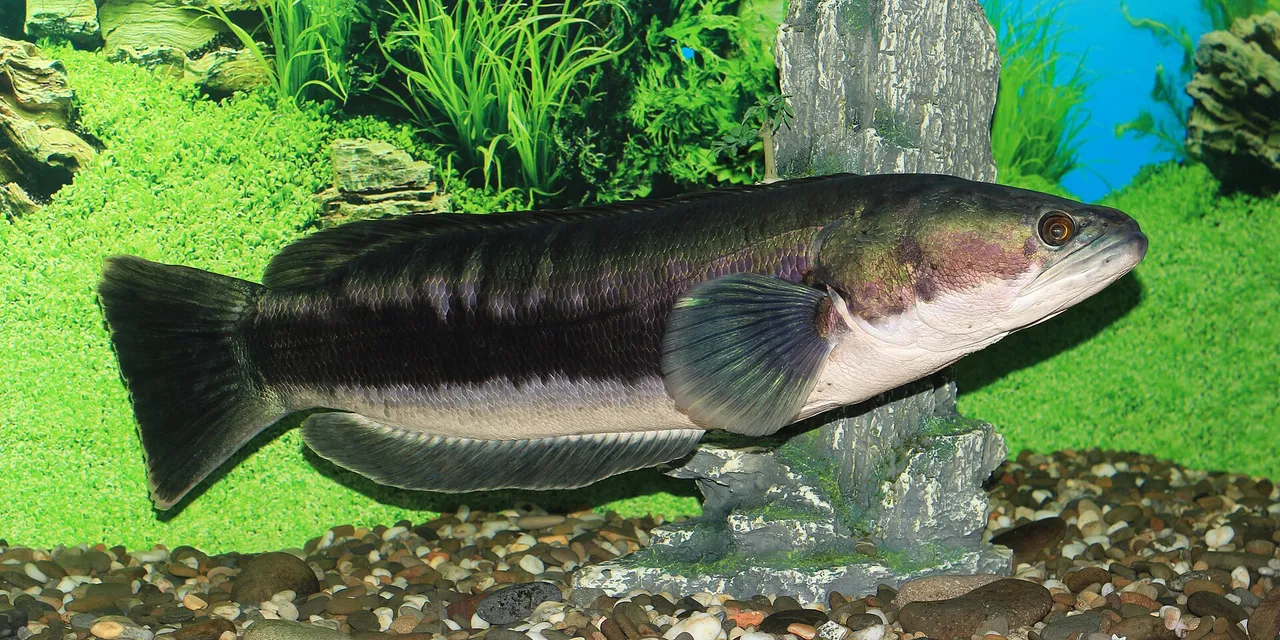
Identified by: Full lateral view. The cylindrical body, the very long-based dorsal and anal fins, the rounded tail and the snake-like head with forward-set dorsal eyes are all clear, as are the two dark lateral bands of an adult.George Chernilevsky — Public domain, via Wikimedia Commons — source, licenceLook at this first
Long cylindrical body, a flattened head plated with large scales, and dorsal and anal fins running most of the length without a spine in either. That combination is a snakehead; size and the adult's dark flanks make it this one.
No single character settles this one. Everything below is supporting or suggestive, and a confident identification needs several of them together — or, for the hardest cases, a count that cannot be made from a photograph.
Supporting — use with other characters
Real characters that are not conclusive by themselves. Use two or three together.
Long spineless dorsal and anal fins
Both run most of the body length and neither carries a spine. It places the fish among the Channa and rules out the various eel-shaped and elongate fish that might otherwise be considered.
A flattened head with large plate-like scales on it
The head is depressed and covered in enlarged scales, which is where the family name comes from. Combined with the cylindrical body it gives the animal its reptilian appearance.
Two dark bands along the flank of an adult
Adults carry a pair of longitudinal dark bands over a paler ground, which is the pattern that separates this species from most congeners in the same water. It is clearest on mid-sized fish.
Maximum size
This is the largest Channa in most of its range by a considerable margin, so a very large snakehead in the Mekong or on the Malay Peninsula is usually this one. A probability rather than a determination.
Suggestive only — varies with condition
Hints only. These vary with condition, season, water and how long the fish has been out of it, and a fish that contradicts them is still the same species.
Bright orange-and-black juveniles
Young fish are vivid orange with black stripes and travel in dense shoals guarded by the parents — a completely different animal to look at from the adult, and the life stage most people encounter in numbers.
What it gets confused with
- Great snakehead, which reaches a similar size and is patterned differently as an adult.
- Striped snakehead and other Channa across the range, which are smaller with bolder chevron markings.
- Juveniles of the above, which are the hardest case because the orange phase is not unique to this species.
Where this stops working
Channa is a large genus, taxonomically active, and several species are separated on scale counts and fin ray counts rather than on anything visible. Adults and juveniles of this species look nothing alike, so a page describing one describes the other badly. Where the fish is outside its native range the identification carries an obligation: introduced snakeheads establish readily, and air-breathing lets them survive transport in a way most fish cannot.
The full record
This page covers identification only. The Giant snakehead record covers behaviour, lifecycle, distribution, handling and the sources behind all of it.
Reviewed 2026-08-14.
More about this fish
Telling it apart is one question. Here are the others.
Similar and related fish
How it is caught
Where it lives
Where you will find it
- South-East Asian fishingThe region's signature freshwater sport fish, an air-breather that survives in water no other large predator tolerates, which is why it dominates the peat swamp and reservoir fisheries.
- ThailandA native freshwater predator of rivers, reservoirs and irrigation systems, and the fish that makes Thai freshwater lure fishing a wild fishery rather than a stocked one.
- The Mekong systemA large air-breathing floodplain predator of the basin, tolerant of the warm deoxygenated water that a draining flood leaves behind.
Why the 6 connections on this page are here, and the sources
Similar and related fish
Backed by research — 1 connection
Supported by peer-reviewed research or fisheries science. The sources are listed and can be checked.
Great snakehead
An identification comparison naming both binomials: Channa marulius and Channa micropeltes.
- FishBase: a global information system on fishes — Froese, R. and D. Pauly, eds. — FishBase Consortium (Scientific institute)Relied on for: Morphological and distributional data for Channa marulius and for Channa micropeltes.States this directlyPassage read and verified
- The IUCN Red List of Threatened Species — International Union for Conservation of Nature (Conservation authority)Relied on for: Separate assessments treating Channa marulius and Channa micropeltes as distinct species.States this directlyCitation checked — the work exists and is described correctly
How it is caught
What experienced anglers do — 1 connection
Widely and independently recommended by experienced anglers and specialist sources. This is real angling knowledge, not proof: controlled evidence for it is limited, and FishingHQ records it as convention rather than as a demonstrated effect.
Spinning
A practitioner claim consistent with the species' verified feeding behaviour.
- General angling website restatements of established technique — Various (Credible secondary source)Relied on for: Widely restated practitioner accounts of surface lure fishing for snakeheads in South-East Asia.Citation checked — the work exists and is described correctly
- Angling Times — Bauer Media (Specialist angling publication)Relied on for: Contemporary treatment of surface lure fishing technique.Citation checked — the work exists and is described correctly
Where it lives
Backed by research — 1 connection
Supported by peer-reviewed research or fisheries science. The sources are listed and can be checked.
Lowland rivers
A habitat and physiology claim held to a scientific standard.
- FishBase: a global information system on fishes — Froese, R. and D. Pauly, eds. — FishBase Consortium (Scientific institute)Relied on for: That Channa micropeltes occurs in lowland rivers and swamps with standing or slowly flowing water including large streams, canals and deep water bodies, and is an obligate air-breather.States this directlyPassage read and verified
Where you will find it
Backed by research — 3 connections
Supported by peer-reviewed research or fisheries science. The sources are listed and can be checked.
South-East Asian fishing
A distributional claim taken from reference sources on the species rather than from angling report. It states presence and asserts nothing about a fishery.
- FishBase: a global information system on fishes — Froese, R. and D. Pauly, eds. — FishBase Consortium (Scientific institute)Relied on for: Distribution, habitat association, depth range and life history recorded for the species concerned.States this directlyPassage read and verified
- The IUCN Red List of Threatened Species — International Union for Conservation of Nature (Conservation authority)Relied on for: Global distribution, population trend and extinction-risk assessment for the species concerned.States this directlyCitation checked — the work exists and is described correctly
Thailand
That a species occurs in these waters, drawn from distribution science. It is a statement about where the animal lives and is not a statement that anybody will catch one, still less where.
- FishBase: a global information system on fishes — Froese, R. and D. Pauly, eds. — FishBase Consortium (Scientific institute)Relied on for: Recorded distribution, habitat association and life history of the freshwater species named, including introduced populations where those are recorded.States this directlyPassage read and verified
- The Flood Pulse Concept in River-Floodplain Systems — Canadian Special Publication of Fisheries and Aquatic Sciences 106, Department of Fisheries and Oceans, Ottawa, 1989 (Scientific literature)Relied on for: That in tropical river-floodplain systems the seasonal flood pulse organises fish movement and production, which is the basis for stating where and when a species is available.Background and mechanism onlyCitation checked — the work exists and is described correctly
The Mekong system
A distribution association between an animal and a kind of water, rather than a claim about any named mark.
- The IUCN Red List of Threatened Species — International Union for Conservation of Nature (Conservation authority)Relied on for: Assessment and habitat account for the species, including the river or lake system it occupies and the pressures acting on it.States this directlyCitation checked — the work exists and is described correctly
- FishBase: a global information system on fishes — Froese, R. and D. Pauly, eds. — FishBase Consortium (Scientific institute)Relied on for: Distribution, habitat association, size and life history recorded for the species in the system concerned.States this directlyPassage read and verified
Safety
Biosecurity and disease transfer — Can cause serious injury or death
Giant snakeheads introduced outside their native range are effective predators that establish readily, and air-breathing lets them survive transport and short overland movement in a way most fish cannot.
What reduces it: Never move live fish or water between waters. Clean, drain, dry and check equipment. Where the species is non-native, establish the local requirement rather than assuming a fish should be returned.
Species that bite — Can cause injury needing treatment
Sharp teeth and strong jaws on a powerful fish that thrashes when handled. Guarding adults are also genuinely aggressive and have been recorded striking at people who approach a fry shoal in the water.
What reduces it: Never put a hand near the mouth. Use long pliers or a de-hooking tool with the fish controlled. Do not wade into a fry shoal.