Channel catfish
Fish · Last reviewed 2026-08-10
North America's most widely fished catfish — a scent-driven omnivore covered in taste buds, catchable on almost anything, and the reason smelly baits exist.
Safety: venomous and spined species — can cause serious injury or death. 5 more points apply here.
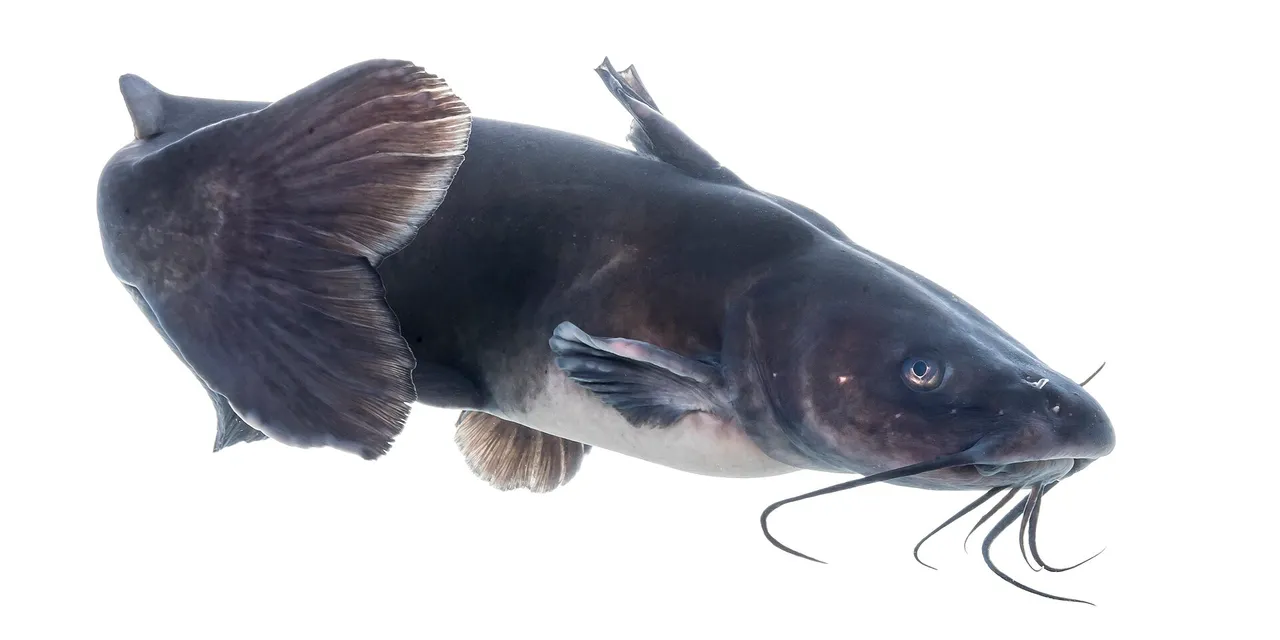
How this was identified, and who took it
Identified by: Whole fish on white. Deeply forked tail, barbels, adipose fin and the rounded free margin of the anal fin — the last being the character that separates it from blue catfish.USFWS Mountain Prairie — Public domain, via Wikimedia Commons — source, licence_Gavins_Point.jpg)
Catching Channel catfish
Everything here on fishing for it. Each entry opens the page behind it.
The channel catfish is the most widely distributed and most heavily fished catfish in North America, and it is the species that explains why catfishing has the reputation it does.
Its biology is essentially chemical. Catfish are covered in external taste receptors — not just on the barbels but over the entire body surface — which makes them extraordinarily sensitive to dissolved amino acids and lets them locate food in water where sight is useless. That is why they thrive in turbid rivers and impoundments where visual predators struggle, and it is why the traditional baits are what they are. Cut bait, liver, cheese and the various commercial stink baits are not a joke: they work because they present exactly the chemical signal the fish is built to detect.
It is separated from other North American catfish by the deeply forked tail and, in younger fish, by scattered dark spots on the flank — spots that fade in large individuals, which is a common source of misidentification. Blue catfish and flathead catfish share much of its range and are different fish with different habits.
It is also very widely introduced outside North America, including in Europe and Asia, where it is a significant aquaculture species and in places a naturalised one.
Identification
- Scientific name
- Ictalurus punctatus
- Family
- Ictaluridae
- Water
- Freshwater, Brackish
- Conservation status
- Least Concern
- Regions
- North America, Western Europe, East Asia
- Deeply forked tail — the separation from flathead catfish, whose tail is squared, and from bullheads.
- Scattered dark spots on the flanks in young and medium fish; these fade or disappear entirely in large adults, which regularly causes misidentification.
- Four pairs of barbels around a mouth with the upper jaw projecting slightly beyond the lower.
- Body scaleless with a smooth skin; a strong serrated spine at the front of the dorsal and each pectoral fin.
- Separated from blue catfish by the rounded anal fin with fewer rays; blue catfish have a straight-edged anal fin with more.
Size
- Typical
- 0.5–2 kg (1–4.4 lb)
- Large
- 4–8 kg (9–18 lb)
Exceptional: Over 12 kg (26 lb); maximum published weight 26 kg
A warm-season feeder with a long shoulder at both ends
Channel catfish are strongly temperature-driven and their season is longer than most warm-water species' because they tolerate a wider band.
FEEDING RISES WITH TEMPERATURE through spring, peaks through summer, and continues well into autumn. Channel catfish remain catchable in cooler water than flathead catfish do, so the practical season is broader.
SPRING IS PRE-SPAWN FEEDING, with fish moving shallower and feeding heavily as water warms.
EARLY SUMMER IS SPAWNING, when males occupy and guard cavities and the fishery changes character for a few weeks.
MIDSUMMER AND AUTUMN IS THE MAIN FEEDING PERIOD, with fish active day and night, though the nocturnal habit is more pronounced in clear water and in heavily pressured fisheries.
WINTER SLOWS THEM SUBSTANTIALLY. Fish move to deeper holes and channels, group tightly, and feed little — but they do feed, and winter channel catfish fishing is a genuine if slow pursuit rather than an impossibility.
FLOW EVENTS ARE THE SHORT-TERM DRIVER IN RIVERS. A rise brings fish onto flats and into current seams to intercept displaced food, and falling water concentrates them back into holes. That response to flow is more immediate and more useful than any seasonal generalisation.
AND SCENT-BASED FEEDING MEANS TURBIDITY AND WARMTH WORK TOGETHER: warm, coloured, rising water is close to ideal, which is why the species is associated with conditions other fish find difficult.
Backed by research — why, and the sources (2)
Supported by peer-reviewed research or fisheries science. The sources are listed and can be checked.
- FishBase: a global information system on fishes — Froese, R. and D. Pauly, eds. — FishBase Consortium (Scientific institute)Relied on for: Distribution, habitat association, depth range, size, reproduction and life-history parameters recorded for the species.States this directlyPassage read and verified
- The IUCN Red List of Threatened Species — International Union for Conservation of Nature (Conservation authority)Relied on for: Assessment and range account for the species, including the habitats it depends on, its life history and the pressures acting on it.States this directlyCitation checked — the work exists and is described correctly
The spines, the infection, and why small catfish are more dangerous than large ones
The dorsal and both pectoral spines lock. That is the fact everything else follows from: a catfish that has raised its spines can hold them rigid, so a hand closing around the fish drives them in rather than folding them down.
The puncture is not the main problem. Catfish spines carry a venom gland at the base in many ictalurids, and the wound is deep, narrow and difficult to clean — a combination that produces infection rates far above what a similar cut would. Serious hand infections from catfish spines are common enough to be a recognised presentation in emergency medicine.
The grip that avoids it comes from behind: the hand slides forward from the tail with the palm under the belly, so the pectoral spines sit between the fingers rather than in them, and the dorsal is behind the thumb web. It feels wrong the first time and it is the only grip that works on a fish that is moving.
SMALL FISH INJURE MORE PEOPLE THAN LARGE ONES. A twenty-pound catfish is handled with two hands and full attention; a one-pound one is grabbed. The spines on the small fish are proportionally sharper and the handling is proportionally more casual, and that is where the punctures happen.
Official guidance — why, and the sources (1)
Stated by a fisheries authority, scientific institute or recognised angling body. Authoritative, but summarising rather than demonstrating.
- Angling Trust guidance for anglers — Angling Trust (Angling or fisheries organisation)Relied on for: Angler guidance on handling spined fish and treating puncture wounds.Background and mechanism onlyCitation checked — the work exists and is described correctly
A cavity nest, a guarding male, and a fish that needs a hole rather than a bed
Channel catfish reproduction is a cavity-nesting strategy, and the requirement for an enclosed space is the constraint that governs where they recruit.
THE NEST IS A DARK ENCLOSED CAVITY RATHER THAN AN OPEN DEPRESSION. Channel catfish spawn in undercut banks, hollow logs, root masses, rock crevices, holes in bank structure and — very readily — in artificial cavities such as drainage pipes, drums and purpose-made spawning containers. The male selects and cleans the site, and the pair spawns inside it.
THE MALE THEN GUARDS AND TENDS THE EGG MASS. The eggs are laid as an adhesive gelatinous mass, and the male remains with them, fanning to keep them oxygenated and defending the cavity aggressively, continuing to guard the fry for a period after hatching. That is a substantial parental investment and it produces high survival per spawning.
WHICH MAKES CAVITY AVAILABILITY THE LIMITING FACTOR IN MANY WATERS. A river with excellent adult habitat and hardened, engineered, cavity-free banks recruits poorly, and the readiness with which the species adopts artificial cavities is why hatchery and pond production of channel catfish is so straightforward — supplying the missing habitat is easy.
TEMPERATURE TRIGGERS IT and spawning occurs in the warmer part of the year once water reaches the appropriate range, later in the north and earlier in the south.
TURBIDITY AND DARKNESS ARE NOT OBSTACLES, which follows from the record's sensory profile: this is a fish that locates everything by chemistry and touch, so a dark cavity in coloured water is a functional nursery rather than a compromise.
THE SPECIES IS WIDELY INTRODUCED, and the combination of tolerant adults, guarded nests and adaptability to artificial cavities is a substantial part of why it establishes so successfully outside its native range — with the consequences for native fauna that follow.
AND WHAT MAY BE DONE WITH A CAPTURED FISH, particularly outside the native range, differs between jurisdictions and is a matter for the competent authority.
Backed by research — why, and the sources (2)
Supported by peer-reviewed research or fisheries science. The sources are listed and can be checked.
- Freshwater Fishes of the British Isles — HarperCollins (New Naturalist 75), 1992 (Reference work)Relied on for: Habitat association, spawning behaviour, seasonal activity and ecology of freshwater fishes, including position within a water body.States this directlyCitation checked — the work exists and is described correctly
- FishBase: a global information system on fishes — Froese, R. and D. Pauly, eds. — FishBase Consortium (Scientific institute)Relied on for: Habitat association, spawning season, temperature tolerance and water-type tolerance recorded for the species.States this directlyPassage read and verified
Lifecycle and reproduction
Matures at two to five years and lives up to about twenty-five. Spawns in early summer in cavities — undercut banks, hollow logs, submerged debris and man-made structures — with the male preparing the site, guarding the eggs and fanning them until they hatch. That cavity-nesting requirement is a genuine habitat constraint, and providing artificial nesting structures is a recognised management technique.
Cavity nesting in early summer, with the male selecting and cleaning a dark enclosed site, spawning with a female, then guarding and aerating the egg mass alone until hatching. The dependence on cavities means that a river cleared of woody debris and undercut banks loses spawning habitat regardless of water quality, which is one reason the species responds so well to structure being restored.
Feeding and senses
An omnivore taking insects, crustaceans, molluscs, fish, and plant material, with the diet becoming more piscivorous with size. Feeding is driven by chemical detection rather than sight — the fish carries external taste receptors over its whole body — which is why it feeds effectively in turbid water and at night, and why scent-based baits are so effective.
Chemoreception dominates to an unusual degree: external taste buds distributed over the body, concentrated on the barbels, allow the fish to locate food by dissolved chemical trail alone. Hearing is also acute. Sight contributes little in the turbid water the species favours. This sensory profile is the single most useful thing to understand about fishing for it.
Through the year
Feeding increases sharply as water warms and is strongest through the warm months, with spawning in early summer. Fish move into shallower and faster water to feed at night in summer and hold in deeper holes in cold water, when feeding slows considerably. Rising and coloured water after rain is a classic feeding trigger, which is consistent with a chemically driven feeder.
Distribution
North America: native to the central United States, southern Canada and northern Mexico, in the Mississippi, Great Lakes, Hudson Bay and Gulf drainages. Very widely introduced elsewhere in North America and internationally, including in Europe and Asia for aquaculture and sport.
This is a biological range — where the species occurs, not a prediction that you will catch one. To browse the fishing geography FishingHQ holds, start at fishing places.
Why anglers care
The most widely fished catfish in North America, taken on cut bait, prepared scent baits, worms and lures, from banks, boats and through the ice. A major food fish and aquaculture species. Its accessibility from the bank, its willingness to feed at night and its size make it one of the most democratic fisheries on the continent.
Handling and returning
The dorsal and pectoral spines are serrated, strong and capable of a deep puncture that readily becomes infected; a struggling catfish drives them into a hand that is gripping it wrongly. Hold the fish from beneath with the hand behind the pectoral spines, or use a lip grip. Wet hands, and treat any puncture properly — catfish spine wounds are a common cause of serious infection.
Going further
- What does channel catfish eat? — feeding biology, kept separate from what anglers infer from it.
- Channel catfish vs Blue catfish — how to tell them apart.
Safety
Venomous and spined species — Can cause serious injury or death
Serrated, locking dorsal and pectoral spines on a strong fish, capable of deep punctures that frequently become badly infected. Small and medium fish are more dangerous than large ones because they are handled more casually.
What reduces it: Hold the fish from below with the hand behind the pectoral spines, or use a lip grip or glove. Never grip a catfish around the front of the body. Clean any puncture immediately and properly — these wounds infect readily and seriously.
Biosecurity and disease transfer — Can cause injury needing treatment
Channel catfish are very widely introduced outside their native range, and live movement for aquaculture and stocking is the route.
What reduces it: Never move live fish or water between waters. Clean, drain, dry and check equipment between waters.
Precautions that always apply here
- Handle spined and venomous species with the spines controlled. Know which local species have them before you fish, not afterwards.
- Wet your hands before touching a fish. Dry hands strip the protective mucus layer that keeps infection out.
- Check, clean and dry your kit between different waters — the published guidance is 48 hours’ drying, in sunlight where possible, because a number of invasive species survive over two weeks in damp conditions. Nets, boots and wet mats move invasive species and disease more effectively than anything else anglers do.
- Never move live fish, live bait or water from one water to another.
Check the rules before you fish
Fishing laws, bylaws, access rules, seasons, bait restrictions and permitted methods vary by location and can change. Check the current rules from the relevant authority and the water you intend to fish before fishing.
Check with:
- Current national or regional law for where you are fishing
- Current local bylaws
- The relevant fisheries authority
- The landowner, club or fishery whose water it is
- Any restrictions specific to the species or the method you intend to use
Where to go next
Understanding this fish
Told apart from
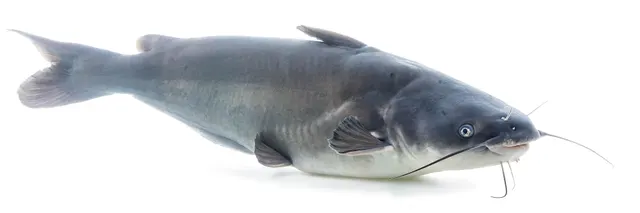 Blue catfishThe commonest catfish identification question in North America, and colour settles nothing — a large channel catfish loses its spots and turns slate grey. The reliable character is the ANAL FIN: a blue catfish's is long and straight-edged with around thirty or more rays, a channel catfish's is shorter and distinctly rounded with fewer. Both have a deeply forked tail, which is what separates the pair from a flathead.
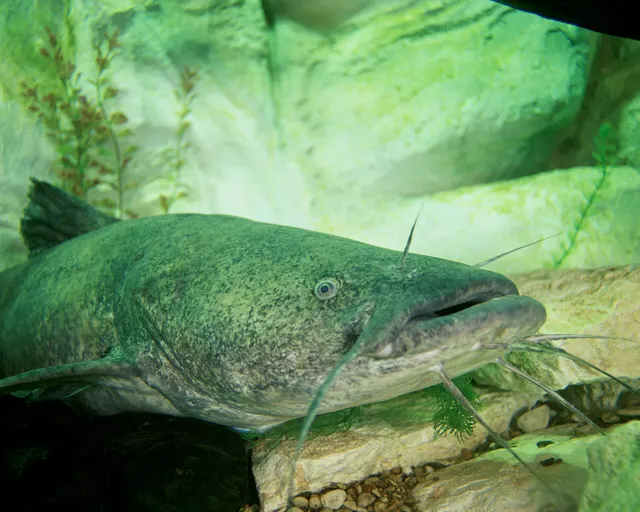 Flathead catfishThe exception that breaks the rule about catfish: flatheads eat live fish almost exclusively and ignore the scent baits that channel catfish are caught on.
More fish
Not related to this page — just the rest of the section. There is little else joined to this subject yet, and a short page should still lead somewhere.
Sources and evidence
- FishBase: a global information system on fishes — Froese, R. and D. Pauly, eds. — FishBase Consortium (Scientific institute)Relied on for: Scientific name, family placement in the Ictaluridae, a maximum length of 132 cm TL, a maximum published weight of 26.3 kg, a maximum reported age of 24 years.States this directlyPassage read and verified
- FishBase: a global information system on fishes — Froese, R. and D. Pauly, eds. — FishBase Consortium (Scientific institute)Relied on for: Environment, climate zone and depth range as recorded: Freshwater; demersal; pH range: 6.0 - 8.0; dH range: 4 - 30; potamodromous ; depth range 0 - 15 m . Subtropical; 10°C - 32°C ; 55°N - 25°N, 110°W - 70°WStates this directlyPassage read and verified
- FishBase: a global information system on fishes — Froese, R. and D. Pauly, eds. — FishBase Consortium (Scientific institute)Relied on for: The IUCN Red List category for Ictalurus punctatus — Least Concern, assessed 20 February 2012 — as republished by FishBase, the Red List itself being unreachable during review.States this directlyPassage read and verified
- Check Clean Dry — biosecurity guidance for water users — GB Non-native Species Secretariat (Conservation authority)Relied on for: The framework by which introduced fish are assessed and managed, and live movement as the transmission route.FishingHQ's interpretation of what it saysPassage read and verified
Why the 4 connections on this page are here, and the sources
How it is caught
What experienced anglers do — 1 connection
Widely and independently recommended by experienced anglers and specialist sources. This is real angling knowledge, not proof: controlled evidence for it is limited, and FishingHQ records it as convention rather than as a demonstrated effect.
Ledgering
Established angling practice for this species, recorded as convention. The note states the property of the animal or its water that makes the method the answer.
- IGFA International Angling Rules and World Record Requirements — International Game Fish Association (Angling or fisheries organisation)Relied on for: Recognition of the species as an established sport fish and the angling methods and tackle classes conventionally used for it.States this directlyPassage read and verified
- General angling website restatements of established technique — Various (Credible secondary source)Relied on for: Widely restated practice connecting this species and method.Background and mechanism onlyCitation checked — the work exists and is described correctly
Understanding this fish
Backed by research — 1 connection
Supported by peer-reviewed research or fisheries science. The sources are listed and can be checked.
Aquatic insect larvae as prey
Recorded diet evidence identifies aquatic insect larvae as a food item of this predator at group level rather than to species. The edge points at the taxon record for that reason, and encoding it as a species-level claim would assert something the source does not.
- FishBase: a global information system on fishes — Froese, R. and D. Pauly, eds. — FishBase Consortium (Scientific institute)Relied on for: Food items recorded for this predator, given as aquatic insect larvae.States this directlyPassage read and verified
- FAO Species Identification Guides for Fishery Purposes and the FAO Species Catalogues — Food and Agriculture Organization of the United Nations (Scientific institute)Relied on for: Species account describing this predator's diet, recorded at the level of aquatic insect larvae.Background and mechanism onlyCitation checked — the work exists and is described correctly
Told apart from
Backed by research — 2 connections
Supported by peer-reviewed research or fisheries science. The sources are listed and can be checked.
Blue catfish
An identification comparison naming both binomials, addressing the commonest misidentification in North American catfishing.
- FishBase: a global information system on fishes — Froese, R. and D. Pauly, eds. — FishBase Consortium (Scientific institute)Relied on for: That Ictalurus punctatus and Ictalurus furcatus are congeners in the genus Ictalurus occupying overlapping Mississippi and Gulf drainage ranges.States this directlyPassage read and verified
An identification link between two species readers genuinely mistake for one another, resting on published morphological characters rather than on angling lore, and naming the character that separates them.
- FishBase: a global information system on fishes — Froese, R. and D. Pauly, eds. — FishBase Consortium (Scientific institute)Relied on for: Morphological description, meristic counts, family placement, distribution and environment of the species named.States this directlyPassage read and verified
- FAO Species Identification Guides for Fishery Purposes and the FAO Species Catalogues — Food and Agriculture Organization of the United Nations (Scientific institute)Relied on for: Identification characters and distribution for inland and coastal fishes, from regional identification guides prepared for fishery purposes.States this directlyCitation checked — the work exists and is described correctly
Flathead catfish
A comparison resting on documented dietary difference, which is the practically decisive fact for anyone fishing for either.
- FishBase: a global information system on fishes — Froese, R. and D. Pauly, eds. — FishBase Consortium (Scientific institute)Relied on for: That Pylodictis olivaris is a Pylodictis of the Ictaluridae taking predominantly live fish as an adult, in contrast to the omnivorous diet recorded for Ictalurus punctatus.States this directlyPassage read and verified
How FishingHQ labels evidence is explained in the evidence policy.